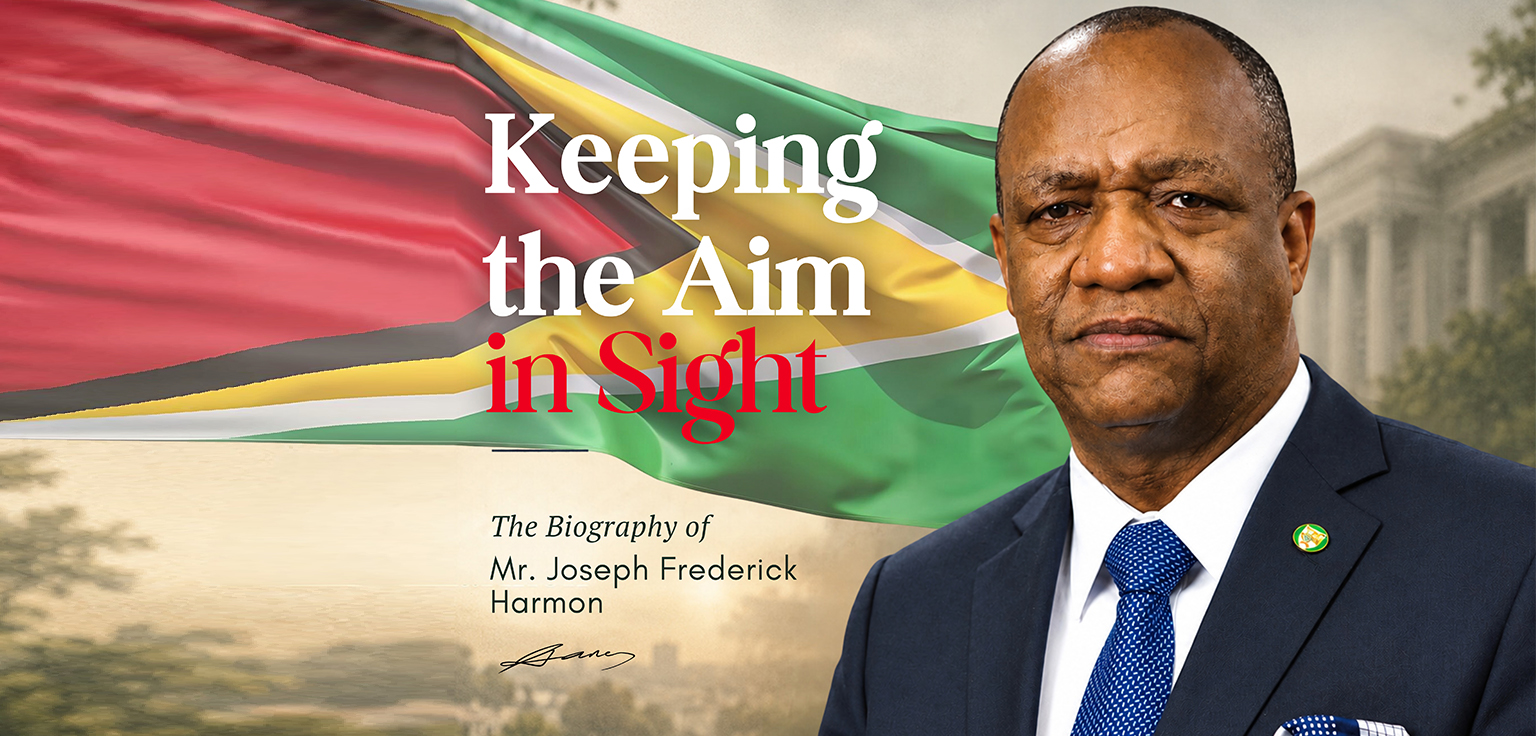

“Do not let the noise around you decide your direction. When people disagree, find the common ground that keeps the work moving.”
Introduction
When Mr. Joseph Frederick Harmon enters a room, there is often someone who knows him, someone who comes over to share a quiet word. Those encounters please him. Across the different settings of his life, he has continued to enjoy the feeling of being among people with whom he shares a connection. That part of him belongs alongside the responsibilities that made him a public figure.
Long before those responsibilities, he was a country boy growing up in Pouderoyen, in Guyana. His village stood on the outskirts of a sugar plantation, where much of community life depended on the estate. People of different backgrounds lived and worked within that environment. Indian music played in neighbouring homes, and he became familiar enough with it to sing some of the songs. That familiarity has stayed with him, occasionally surprising friends who discover how much of the music he knows.
His education began close to home, with his schools within walking distance. Later, military service took him into unfamiliar surroundings and brought him into contact with people whose lives were very different from his own. Training in China, the United Kingdom, Canada, and the United States extended his experience beyond Guyana. He encountered different approaches to military organisation and government, but the question that stayed with him concerned ordinary people: how could a country’s resources improve their quality of life?
Legal education opened another professional path and introduced him to a wider circle of relationships. He came to know fellow students from across the Caribbean, and those connections continued into professional life. A client with a problem in another territory could benefit from a telephone call to a colleague who knew him personally. The relationships formed while studying became useful to the people seeking his help.
His legal practice gave him another practical way to help people protect what they had built.
His involvement in national politics brought that concern for people’s circumstances into a wider setting. The government then placed him in a position where public expectations accompanied his daily work. As Minister of State, he became a familiar presence at press conferences, explaining government business and facing the reactions it attracted. He understood that public life brought criticism as well as support, and that both would be directed towards him.
He remained willing to communicate across political differences. The public arguments did not prevent a cordial exchange in private. He regarded the people on both sides of Parliament as representatives with work to do for their constituents. That understanding allowed him to speak across political divisions without treating every opponent as a personal enemy. He later served as Director General of the Ministry of the Presidency and as Guyana’s Leader of the Opposition.
Beyond these roles, friendship has remained a source of real pleasure and practical support. He values people who stay close when circumstances change. Friendship remained an important part of the personal life behind his public responsibilities. He has offered similar help in return. There is enjoyment, too, in spending time with an old military friend and going to cricket together, even when the team he supports does not win.
"I learned early that fairness does not always mean giving everyone the same thing. Equality is not always equal."
Phase 1: The Small House That Shaped His Beginnings
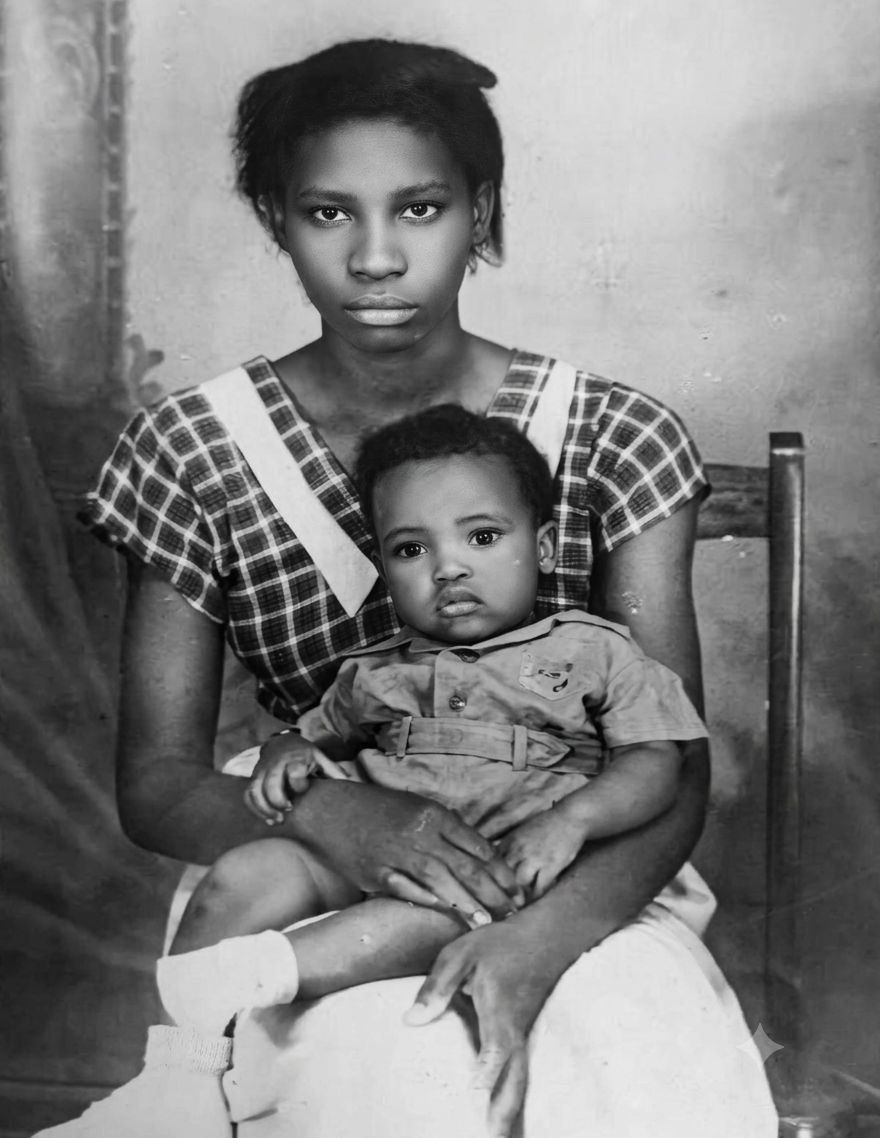
Mr. Joseph Frederick Harmon was born on 8 January 1954. His early years were spent in Pouderoyen, West Bank Demerara. His parents were not married, and his family extended across both sides of that relationship. On his mother’s side, he had one brother and three sisters; on his father’s side, four brothers and four sisters. He regarded them as one family, without drawing distinctions between them. The affection he felt for his brothers and sisters remained part of his life long after childhood.
The children who shared his grandmother’s home included his cousins. Their sleeping arrangements made use of the space available: the girls slept on the upper bunk, the boys below, and bedding was also spread on the floor. In later years, he compared the size of that entire house with the size of his own bedroom. Yet his memory of living there was a happy one. The closeness of the children belonged to that memory as much as the limited space.
Within the household, even the distribution of food had an order. When biscuits were shared, the older children received more and the younger ones less. One might get five, another four or three, and the youngest two. He understood that arrangement as fair. Everyone had a portion, and everyone understood their place within the family. It was an early lesson in what he came to call equity: sharing did not always mean receiving exactly the same amount.
His grandmother, Lillian Clara Cadogan, was known as Lily. Her presence extended well beyond the home. People in the village sometimes identified him simply as Lily’s grandson or Lily’s boy. Her name was enough for them to know where he belonged. She was a small woman with a forceful personality, someone he affectionately remembered as a “pocket rocket.” Growing up under her authority also meant growing up among people who knew her and shared her expectations of the children.
Those expectations followed a child into the village. If someone of an older generation found a youngster avoiding school, that person could intervene and administer a beating. A complaint at home might bring further punishment rather than sympathy. That was the discipline he knew while growing up, when an elder’s authority carried considerable weight. The village felt like an extension of his grandmother’s supervision. Home and community were closely connected, and the adults around him took an active part in how children behaved.
The sugar estate influenced life in other practical ways. The dispensary, the doctor, the cricket ground, and other social facilities were controlled by the estate. Its organisation reached into matters as ordinary as seeking medical attention or finding a place to play. He saw white, Indian, and African people living in different circumstances, yet depending on one another for the estate to produce. Keeping that work going required cooperation, despite the divisions within the society around him. He associated these early experiences with learning cultural tolerance. Alongside the authority of the estate, there was the everyday reality of people having to live and work together.
For the boys, there was cricket. A proper ball was not always necessary; a knot from a tree could serve the purpose. A bat could be made from a coconut tree, and a small piece of cleared ground became somewhere to play. They made use of what was available and got on with the game. Playing together also meant becoming familiar with one another’s language and ways. These were friendships formed through shared childhood experiences, and some of the boys remained among his closest friends many years later.
“Once I understood that my decisions would affect thirty men, I saw the training differently.”
Phase 2 : The Cadet Who Refused to Leave
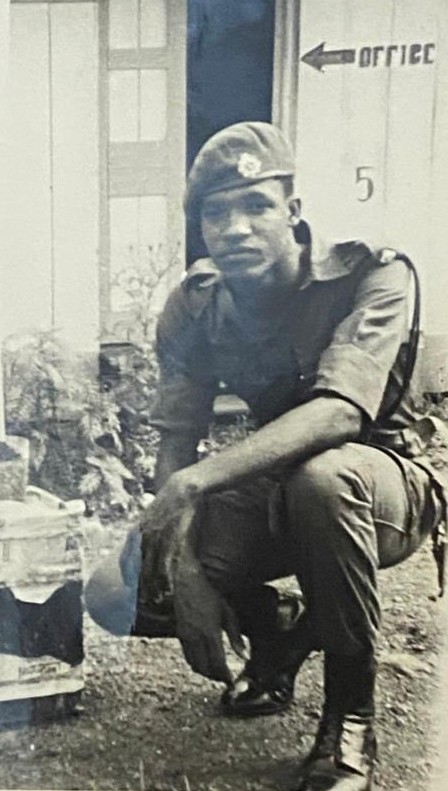
Three times during his early military training, Mr. Joseph Frederick Harmon packed his bags to go home. He had reached the point of feeling that this life was not for him. On the last occasion, he was heading through the door when an officer called him back. “Get back in there,” the officer told him. Before he could leave, he was made to consider the responsibility for which he was being prepared.
At the end of the course, he would be expected to command a platoon of thirty men. An order from him might send them into danger. Those men would have to respond without stopping to wonder whether their young officer could be trusted. The training, the officer explained, had to prepare him for that responsibility. It was a hard answer to his wish to leave, but it placed the demands of the course in a different light.
The group had begun with twenty-one young men drawn from some of the country’s strongest schools, including Queen’s College. They arrived educated and physically fit, ready to be trained as officers. The programme lasted about nine months. Its opening weeks were particularly difficult. Personal discipline was something a cadet brought with him; military discipline was imposed. The institution expected to reshape habits and responses until they met the requirements of service.
For him, the pressure also seemed unevenly distributed. He found himself receiving more assignments than the other cadets. At the time, he regarded some of this as unnecessary punishment. He did not yet understand that the instructors had recognised leadership qualities in him. The extra responsibilities were part of their preparation for what they believed he could become, although that purpose was not immediately apparent to the young man carrying them out.
One exercise brought those pressures into sharp focus. During a long walk across the savannah in intense heat, without water, he struggled to breathe. There was no breeze. He fell to the ground, unable to continue with the patrol. The officer in charge told the others to go on and leave him. They did. About an hour later, a Land Rover came looking for him and took him back to camp.
The response there was harsh. He was told that those who could not measure up might die and that the course allowed for a certain level of casualty. These were the words addressed to a cadet who had already reached his physical limit.
He remembered them as part of the severity of his training. The experience belonged to a period when keeping up could feel like an immediate necessity and when leaving had seemed, more than once, the only reasonable choice. The phrase remained with him to this day: “In the outer world it is live and let live. In Tacama, it is live and let die.”
The course itself had been developed within a military tradition influenced by Britain. Earlier officers had trained at Mons and Sandhurst in the United Kingdom before Guyana established its own officer cadet school. The local programme followed that pattern. Its demands extended beyond endurance, however. A future officer had to develop several kinds of competence, and performance was assessed across approximately six areas. Physical fitness, military skills, and military law were among them. Strength alone would not determine the result.
“Military training taught me to look beyond systems and ask how people were living.”
Phase 3 : When Command Became Understanding
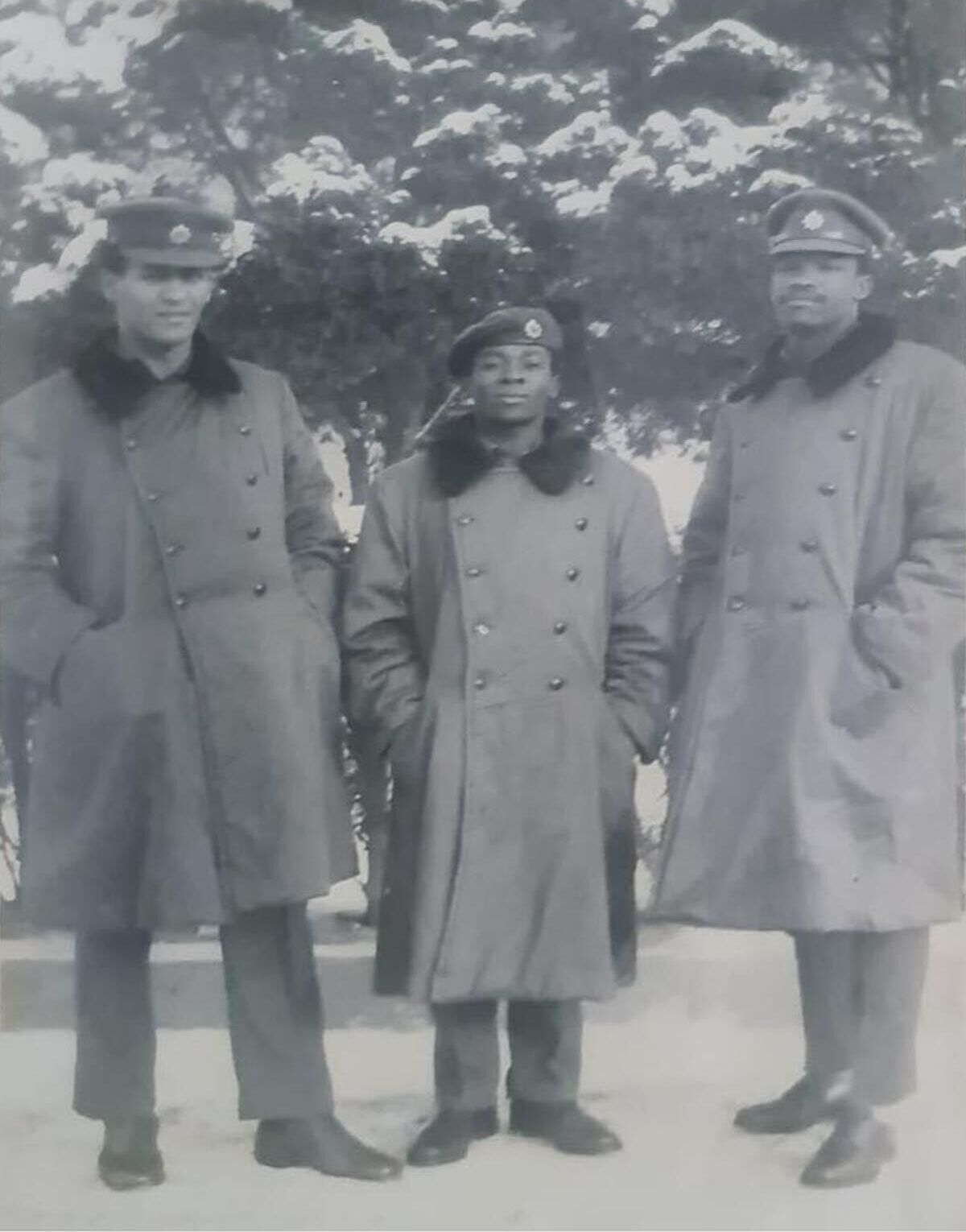
Snow was the first surprise. Looking through the aircraft window on his arrival in China, Mr. Joseph Frederick Harmon saw a landscape unlike anything he had known at home. He had travelled from the Caribbean with little preparation for the November cold. Outside, people were wrapped in winter clothing. When the aircraft door opened, he understood why. The men who had come to meet the delegation brought heavy jackets, which the visitors needed immediately.
He was leading a group of Guyanese officers on what became his first major experience of military training overseas. They spent six months in China, learning something of the language as well as the country’s military methods. Before the visit, his impression of the place had been limited, largely an image of enormous numbers of people travelling by bicycle. Now he was there, responsible for a delegation and surrounded by unfamiliar ways of doing things.
The numbers on the streets made an immediate impression. He had never seen so many people gathered in one place, walking and cycling through the city. The cold, damp conditions added to the strangeness of those first days. He spent about a month at the Peking Hotel, whose size also struck him. The visit gradually gave him a closer view of how such a large society was organised, and of the discipline through which its affairs were managed.
An important part of the assignment concerned the relationship between the military and political leadership. He had gone to learn how those responsibilities operated together. China gave him an opportunity to observe that relationship within a communist system. Formal hospitality offered another perspective. At senior levels, he encountered a standard of comfort and quality that surprised him beside the impressions he had brought from home and the crowded streets he was now seeing for himself.
The scale of military exercises presented a more immediate challenge. A company, in the system familiar to him, involved roughly a hundred and twenty men. In China, he encountered a formation of around three hundred. Giving a command and seeing wave after wave of men move forward was disorienting. The size of the response exceeded what he was accustomed to managing. An instruction that he understood in principle became a very different experience when so many people acted upon it.
One exercise involved opening a route through a minefield with explosives. The training took place with live ammunition and explosions around the advancing troops. There were moments when he struggled to judge the movement of the men around him as they advanced. He was shaken by the experience. He sustained injuries during training and believed that there might have been casualties in one exercise. Those memories remained part of what the assignment had demanded.
The months abroad left him with questions about the societies behind the uniforms. He began to recognise that people at the highest levels could enjoy considerable comfort under very different political systems. An ideological label did not, by itself, explain how the wider population lived. The experience helped him look beyond the language used to describe a government and towards the circumstances of the people within its reach. It was an understanding that continued to influence his outlook.
Note of Thanks
Mr. Joseph Frederick Harmon gives thanks first to his grandmother, Lillian Clara Cadogan, known in the village as Lily and also remembered by her married surname, Drakes. He also gives thanks to his loving mother, Susan Martha Clement, and acknowledges his brothers and sisters, whose shared family life continues to hold a special place in his heart.
His gratitude extends to his six children, Jermaine, Kimberly, Danielle, Jonelle, Joelle, and Mercedez, and to their mothers, whose place in the family remains important to him. He gives equal affection to his eight grandchildren, Naia, Mila, Gianna, Madison, Samantha, Tristan, Ellie, and Wyn. Their presence brings him happiness, and he is grateful for the joy, pride, and companionship they continue to give him.
He remembers the friends who have remained close through changing seasons of life. Eugene Gilbert and Roland Boodie have been his friends since his younger years. He is thankful to Frederick Mc Wilfred, known as Freddie, who later worked with him and managed much of his office. He also acknowledges Brigadier Edward Collins, Bonny Carlette, and Larry London, whose military friendship and support continued across the years. Brigadier Granger, who invited him into political work after their military association, also holds an important place in his journey.
He remains grateful to the mentors, instructors, teachers, professional colleagues, military associates, university and law school friends, and the unnamed friends who helped his daughters and cared for his family during travel. He continues to remember the kindness of those who supported him, whether or not their names are mentioned. For Mr. Joseph, gratitude belongs to every person who offered guidance, friendship, service, or love.
thanks,
– Mr. Joseph Frederick Harmon

AIMLAY is a leading global education platform empowering ACADEMIC and EXPERIENTIAL learners, uniquely focused on recognizing knowledge gained through experience and building a diversified community of doctorates and aspiring researchers.