“The highest education is that which does not merely give us information but makes our life in harmony with all existence.”
Dedication
This biography is dedicated to everyone who finds meaning in serving others and to those who think that quietly striving for excellence can change lives.
This biography is dedicated to Dr. Zobida’s
• Dear parents,
• Siblings and their families
• Daughter in law
• Spouse Kayam
• Children Safaaz and Sayyid
• Adorable grand daughter Siyana
“Education is the most powerful weapon which you can use to change the world.”
Phase 1: Roots of Grace — The Early Years
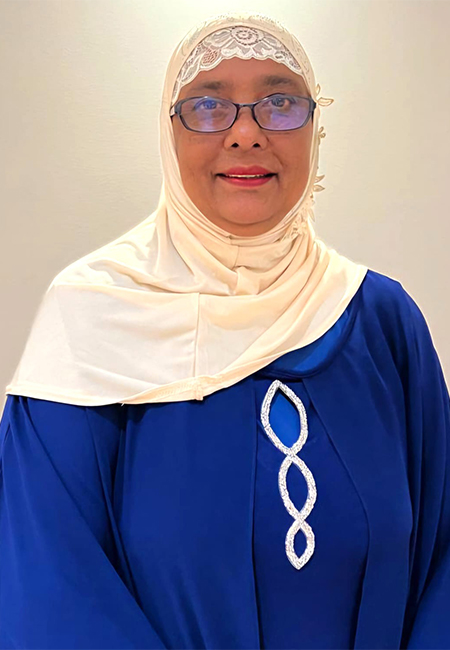
Dr. Zobida Khan-Mohammed’s story doesn’t start in a lab; it starts in a small home full of love, faith, and laughter. The family’s most valuable traits were their ability to keep going and their simplicity. Dr. Zobida was born on July 11, 1962, in the lively country of Trinidad and Tobago. She grew up in a place where hard work was not an option but a way of life, and education was seen as the best way to gain power. She was the third of six children, with two older sisters and three younger brothers. Her parents taught all of them the same moral values of faith and honesty with quiet strength.
Her father was a dedicated taxi driver who was a man of honour. He believed that dignity came from how one lived, not how much money one had. Even though her mother was kind, she had the kind of inner strength that became the invisible force that guided her children. The family’s days were simple. In the morning, they would smell the food prepared by mom. In the evening, they would tell stories and pray. At night, they would dream about better tomorrows. These times shaped Dr. Zobida’s personality, which was calm, observant, and deeply grateful.
She was very curious about the world around her from a young age. Dr. Zobida often thought about the hidden patterns of life while other kids played without a care in the world. She would ask a million questions about the rain, the soil, and the tiniest animals that moved without being seen. That innocent but strong curiosity would turn into a lifelong love of microbiology, where she could explore the unseen.
Dr. Zobida’s school life was full of discipline and quiet success. She went to Carapichaima RC School, Couva Government Secondary School and then Holy Faith Convent in Couva, where each school focused on both academic and spiritual growth. Her teachers quickly saw that she had a natural ability to concentrate and be precise, which is not something that most kids her age have. She thought a lot about herself, was humble, and was very observant. Her classmates may have thought she was quiet, but those who knew her knew that her mind was always busy thinking about things when she was quiet.
“The future belongs to those who believe in the beauty of their dreams.”
Phase 2 : The Birth of a Calling — A Life Devoted to Science and Service
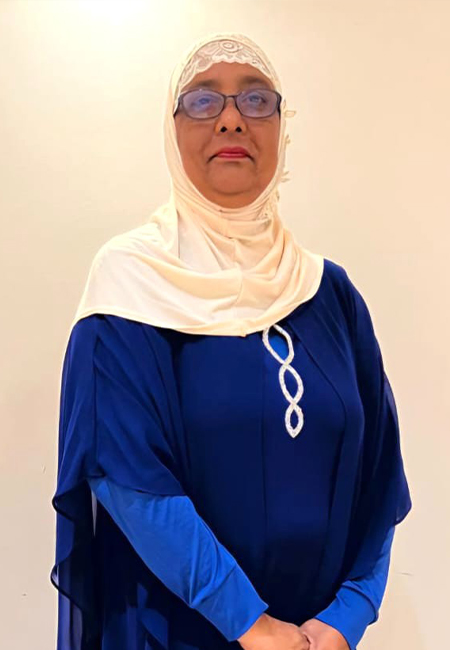
For many people, work is just a way to make money. For Dr. Zobida Khan-Mohammed it became a way of life. What started as a simple job in a lab quickly turned into a 40-year journey of discovery, leadership, and service to others. The walls of the Trinidad Public Health Laboratory (TPHL), where she started out as a young scientific assistant, would see her grow into a woman who turned scientific accuracy into an art form and public service into a way of life.
Trinidad and Tobago’s public health systems were changing by the early 1980s. Disease surveillance, testing protocols, and microbiological research were all changing, but there weren’t many resources available. Not only did labs need people who were smart, but they also needed people who were honest. When Dr. Zobida came into this world, she had a quiet determination that would soon set her apart from the rest. She had something that not many people had: the ability to see every sample not as data but as a story of how weak people are and how important it is to be accurate, careful, and quick.
She worked in all the main areas, such as bacteriology, parasitology, virology, food and water microbiology, and tuberculosis. Every day was a new test for her mind and her morals. Later, she would say, “The lab taught me to be humble. Every result I signed had an effect on someone’s life. That made me careful, but it also made me kind.” It was during these first few years of her career that she started to understand how important her job was. For her, science was more than just knowledge; it was a duty.
Her bosses noticed how accurate and quiet she was as a leader. When results were unclear or equipment broke down, her coworkers turned to her for help. Even though she was a junior technician, people trusted her because she was clear-headed and calm under pressure. She never let pride get in the way; instead, she took every chance to learn. She was the first to sign up for training sessions when new technologies came out. When things ran out, she came up with smart ways to get around them. Her discipline and ability to see ahead became essential to the TPHL’s daily operations.
“The best teachers are those who show you where to look, but don’t tell you what to see.”
Phase 3 : The Scholar and the Mentor — A Life Beyond the Microscope
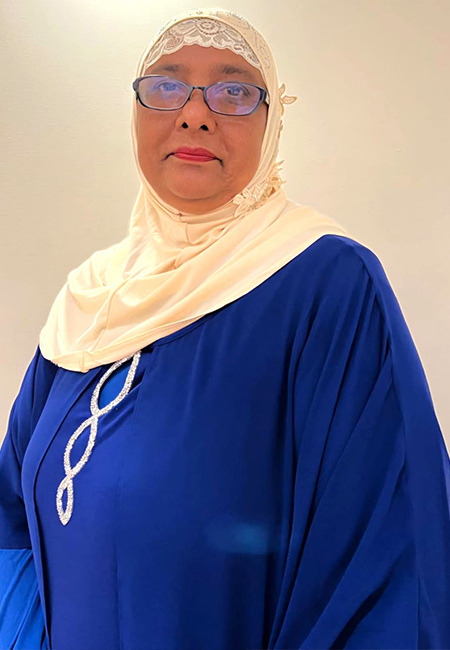
At some point in every important journey, success becomes purpose, knowledge becomes wisdom, and mastery becomes mentorship. Dr. Zobida Khan-Mohammed didn’t make this change all at once; it was a smooth process that followed the natural rhythm of a life dedicated to both science and service. She was no longer just a microbiologist by the time she reached the middle of her career. She was also a teacher, a researcher, and a protector of scientific integrity in the Caribbean.
Her time at the Trinidad Public Health Laboratory (TPHL) had already made her a respected person whose knowledge was in high demand and whose leadership style made people want to follow her. But as her work responsibilities grew, so did her desire to learn more. She understood that while accurate diagnosis was crucial, the future of public health relied equally on research, education, and ethical practice. She started to see the lab as more than just a place to work; it was also a place where she could teach the next generation of medical technologists.
Her interest in microbiology had never faded; if anything, it had grown stronger over time. She was still fascinated by the world of microorganisms that can’t be seen. She was amazed by how complex, adaptable, and important they are to human life. After decades of work in bacteriology and public health, she began to focus on research that linked microbiological knowledge to real-world effects.
Her most important academic work was a study she co-wrote with well-known scientists Abiodun Adesiyun and William H. Swanston on enteropathogens in childhood diarrhoea. It was published in the Pan American Journal of Public Health in 2005.
This research, based on careful data collection and analysis, showed how often and what kinds of bacterial infections happen in children in Trinidad. The findings had national importance, affecting public health plans and helping to keep an eye on diseases in the Caribbean region.
Note of Thanks
With heartfelt gratitude, Dr. Zobida Khan-Mohammed extends her sincere appreciation to all who walked beside her on this journey — her family, mentors, colleagues, and students. Each has been a blessing, shaping her life with love, wisdom, and inspiration.
She thanks her parents for their guidance, her siblings and their family, her husband and children for their unwavering support, and her colleagues for their faith and friendship.
To her students, she offers her deepest appreciation for keeping her purpose alive. Above all, she thanks the Almighty for granting her strength, grace, and the opportunity to serve humanity through science and compassion.
Thanks,
– Dr. Zobida Khan Mohammed