

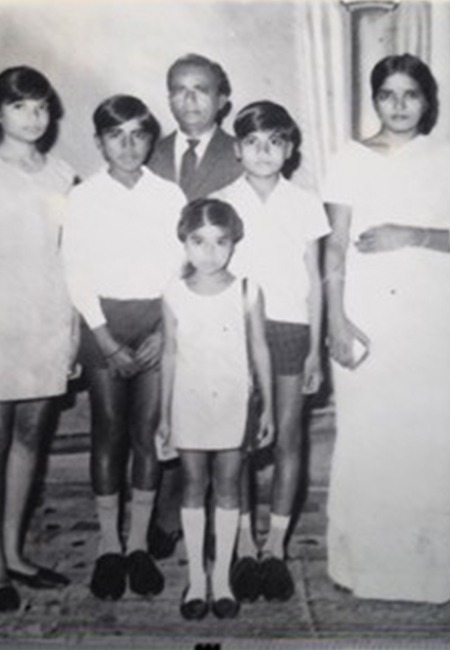
“He did not rise in a single leap; he rose one honest step at a time.”

Introduction

The story of Dr. Subhas Chandra Bauljeewon is not the story of a man who chased greatness—it is the story of a man who consistently chose what was right, even when life offered him no easy path. Born in Mauritius into a humble household and raised in an environment shaped by financial limitations and emotional challenges, he learned early that life’s journey would never be simple. Yet he also learned that dignity, education, and faith could become powerful guides, even when circumstances were difficult. His path is defined not by dramatic turning points but by the quiet courage of a man who simply refused to give up.

From the very beginning, Subhas’s life was grounded in the values passed on to him by his parents. His father, Shri Nundlall Bauljeewon, a tailor by profession, lived a simple but honorable life. His mother, Smt. Saraswati Jotborrowa, worked as a hospital theatre attendant, assisting in surgeries and medical procedures despite her limited formal education. She embodied strength, sacrifice, and discipline—qualities that would later form the foundation of Subhas’s character. When his father passed away while he was just 17, the weight of responsibility settled quietly on his young shoulders. His mother became the anchor of the family, raising four children alone with her government salary. For Subhas, her resilience was not just inspiring—it was transformative.

Growing up in Port Louis after the family moved from the south of Mauritius in search of better opportunities, he completed his primary and secondary education with determination, even though life outside the classroom was often filled with struggle. After secondary school, he worked for three years in various private companies. These early jobs were not glamorous, but they were necessary. They taught him responsibility, survival, and the importance of building a future that was not dependent on chance.

Education became his pathway out of the limitations of his childhood. With courage and hope, he left Mauritius to pursue higher studies in India. There, he completed his Bachelor’s degree in Botany, Zoology and Chemistry, followed by a Master’s degree with specialization in Aquatic Biology and Fisheries. For a young man from an island nation, surrounded by the sea and sustained by it, choosing a specialization connected to the marine world was both natural and deeply purposeful. He knew that the ocean held opportunities—not just for him but for his country.

But returning home was not easy. Despite his qualifications, Subhas remained unemployed for three years. These silent years tested his patience and faith. Yet he never complained. He waited, worked odd jobs, and continued believing in the strength of perseverance. Finally, his first opportunity arrived—a clerical position in the government service. It was short-lived, but it opened a door to something better: a position as Technical Officer in the Ministry of Fisheries.

“Some childhoods do not give comfort, but they give character.”

Phase 1: Roots in the South : A Childhood Shaped by Struggle and Silent Strength

The story of Dr. Subhas Chandra Bauljeewon begins in the quiet southern region of Mauritius, far from the polished offices and respected positions he would one day occupy. His early life was not painted with privilege or ease; instead, it was marked by simplicity, hardship, and the constant effort to rise above circumstances. He often describes his childhood as “difficult,” a word that holds layers of meaning—emotional, financial, social, and deeply personal. Yet, even in that difficulty, a foundation was being built, quietly and steadily, shaping a man who would one day become known for resilience, honesty, and unwavering dedication.

Born into a humble family, Subhas grew up in an environment where every small comfort had to be earned and every need had to be balanced against the limitations of the household. His parents lived in the south of the island, an area that, during his early years, lacked many of the conveniences and opportunities available in the capital. At that time, life in the rural parts of Mauritius demanded toughness, sacrifice, and an acceptance that survival itself required daily effort. For a young boy, these realities formed the backdrop of his earliest memories.

His father, Shri Nundlall Bauljeewon, worked as a tailor—a darzi, as he fondly recalls in Hindi. Tailoring was not an easy profession. It required long hours, sharp focus, and meticulous attention to detail. But income was uncertain, and earnings were modest. His father was not highly educated—he studied only until the 4th standard before life’s responsibilities pulled him away from school. Still, he carried within him values of honesty, simplicity, and discipline—values he passed on to his children in small, everyday ways.

His mother, Smt. Saraswati Jotborrawa, was the true backbone of the family. Educated until the 6th standard, she secured a job as a hospital theatre attendant, working in the operation theatre and assisting doctors during surgeries. In those days, such a job for a woman with limited formal education was both rare and demanding.


“Some people teach through words; some teach through the way they live. His parents taught by living.”

Phase 2 : The Pillars of His Becoming : A Tailor Father and a Hospital Theatre Attendant Mother

Behind every life of purpose, there are figures whose guidance is not loud but deeply shaping. For Dr. Subhas Chandra Bauljeewon, the strongest influences in his early life were his parents—two individuals of simple backgrounds but extraordinary moral strength. Their lives were not defined by education, wealth, or social standing. Instead, they were defined by resilience, hard work, dignity, and unconditional love.

His father, Shri Nundlall Bauljeewon, was a tailor by profession—known in everyday language as a darzi. His work required precision and patience, but income was often uncertain. Nundlall’s life was modest, built around the rhythm of needle and thread, yet he carried a sense of honesty and humility that deeply shaped Subhas. Although he had studied only until the 4th standard, he embodied the idea that one’s worth is not determined by academic certificates but by character and intention.

Subhas often recalled his father’s quiet demeanor. He was not a man of many words, but he was a man of consistent actions. He woke early, worked long hours, and made sure his family never slept hungry. He believed in living simply and honorably, and his daily routine taught young Subhas what discipline truly meant. Even though the home lacked luxuries, his father’s presence provided structure and stability—a steady force that helped the family navigate life’s many uncertainties.

Life, however, is unpredictable. When Subhas was just 17, he lost his father—a blow that came without warning and left a permanent mark on his heart. Losing a father during adolescence is more than just a loss—it is the moment when childhood abruptly ends. For Subhas, it meant stepping into maturity earlier than he should have, understanding responsibilities long before he was emotionally ready, and learning that life does not wait for a person to be prepared.

“When life gives little, effort must give more.”

Phase 3 : A Young Man Steps Forward: Schooling, Early Responsibilities, and the First Taste of Work

The journey of Dr. Subhas Chandra Bauljeewon from adolescence into early adulthood was not marked by sudden breakthroughs or dramatic opportunities. Instead, it was shaped slowly—through years of discipline, self-reliance, and the deep understanding that if he wanted to change his life, he would have to work for it, step by step. This phase of his life is defined by his educational journey within Mauritius, his early responsibilities to his family, and the quiet but meaningful transition from student to working young adult.

After his parents moved from the south of Mauritius to Port Louis, the capital city, Subhas found himself in a completely different environment. The city brought new rhythms—busier streets, larger schools, and more structured systems. Yet, even in this environment, he remained rooted in the values he had learned at home. He attended primary school and then secondary school in Port Louis, slowly building a foundation of academic discipline.

School was not simply a place of learning for him; it was also a space where he began to discover his own strengths. He was not surrounded by resources, tutors, or luxuries that ease the path of many children. Everything he achieved during these years came from personal effort, quiet focus, and the underlying belief that education was his doorway to a better future.

Life at home continued to be difficult. After the loss of his father, Shri Nundlall Bauljeewon, when Subhas was only 17, the family’s already fragile financial situation became even more strained. His mother, Smt. Saraswati Jotborrowa, had to shoulder the entire responsibility of raising four children—Subhas, his brother, and two sisters. She worked long hours as a theatre attendant in a hospital, assisting doctors during complex operations. She returned home late, often exhausted, but still guided her children with a steady hand. Her unwavering strength inspired Subhas to grow up faster, learn responsibility early, and understand that survival, progress, and dignity came through hard work, not luck.

Note of Thanks

In reflecting upon the journey that shaped the life and legacy of Dr. Subhas Chandra Bauljeewon, it becomes impossible not to acknowledge the people, memories, and values that guided him through every phase. This biography stands not only as a record of his achievements, but as a tribute to the strength, sacrifice, and quiet determination that carried him forward.

Above all, he extends his deepest gratitude to his late mother, Smt. Saraswati Jotborrowa, whose unwavering courage and tireless efforts laid the foundation for everything he became. Her commitment to raising four children alone, her belief in education, and her quiet resilience continue to live in his heart as a constant source of inspiration. He remains grateful to his late father, Shri Nundlall Bauljeewon, whose simplicity and sincerity shaped his early understanding of life.

Sincere thanks to his brother and two sisters who were very much supportive and stood beside him during moments of uncertainty. Their wisdom and support played a pivotal role in shaping his character and fueling his aspirations. He also expresses heartfelt thanks to his two sons, who gave him purpose in his most challenging years. Their presence, even in moments of difficulty, gave him the strength to continue working, building, and providing. Every stone he laid, every sacrifice he made, and every effort he undertook was driven by his desire to give them a secure and dignified future.

Dr. Subhas Chandra Bauljeewon acknowledges the Ministry of Fisheries, the colleagues who stood by him, and the countless fishermen and officers he worked with over the years. Their trust, collaboration, and shared commitment transformed his work from a profession into a meaningful mission. He extends his gratitude to the Indian Ocean Commission, whose confidence in his abilities reaffirmed his belief that sincerity always finds recognition.

Lastly, he thanks God, whose grace carried him through every struggle, every achievement, and every phase of his life. His journey—filled with trials, service, and quiet victories—remains a testament to faith, honesty, and perseverance.

Thank You
– Dr. Subhas Chandra Bauljeewon