
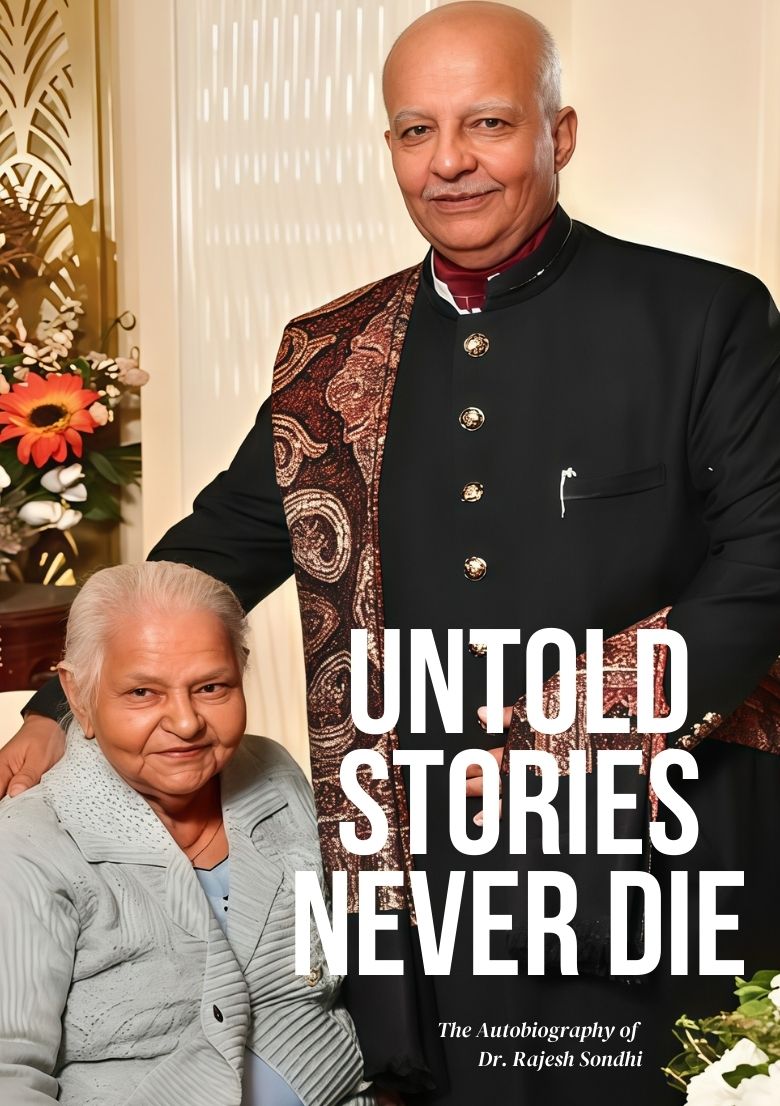
“I began with little but courage, and with faith and family, I found everything that mattered.”
Introduction
Rajesh was born into a family that knew the weight of both tradition and aspiration. His grandfather, Shri Ram Lal Sondhi, and grandmother, Smt. Saraswati, had already laid the foundations of humility and resilience that would echo through generations. His great grandfather, Mr. Niamat Rai, represented the strength of rooted ancestry, while his parents—Mr. Jagdish Sondhi, a determined tailor, and Mrs. Sushila Sondhi, a nurturing mother—embodied the ideals of hard work and devotion. Their modest rented home in Bikram Pura was more than a dwelling; it was a crucible of dreams where values were forged, even when resources were few. His father’s tailoring shop, known as Collegiate Tailor, stood as a symbol of honest labor, and though simple in its form, it carried the seeds of a future enterprise.
Childhood for Rajesh was simple, yet vibrant. He was an obedient son, a curious student, and a boy who discovered joy in the small rituals of life—walking to school, playing barefoot games of kancha and gilli danda, and forming friendships that would last a lifetime, such as the enduring bond with Rajan Khanna. These were the years of unhurried mornings and festive evenings, where Diwali lamps and Dussehra fairs colored the imagination of a child who did not yet know what destiny awaited him. But history has its interruptions. The war of 1965 was one such pause; the sound of radio bulletins filled the air, but to young Rajesh, it was only a fleeting memory that reminded him that even the innocence of childhood exists under the shadow of larger events.
As he grew, so too did the responsibilities of his family. The shift from tailoring to the iron industry in 1968 marked a turning point not just in his father’s career but in the trajectory of the Sondhi family. The establishment of Sondhi Industries was not an easy undertaking; it began without technical knowledge, and the years that followed were riddled with uncertainty. Yet, in the middle of doubt, his father’s spirit found light in a simple Punjabi slogan written on a wall: “Pakha khosle da, banda hosle da”—a fan runs on power, but a man runs on courage. These words, imprinted on Rajesh’s young mind, became a guiding truth that courage is the real engine of life. What was once a tailoring table became an iron workshop, and what seemed like a risky shift became the foundation for a family legacy in manufacturing.
“A man is not born from wealth or position; he is born from the values that breathe inside his home.”
PHASE 1: Roots in the Soil of Jalandhar
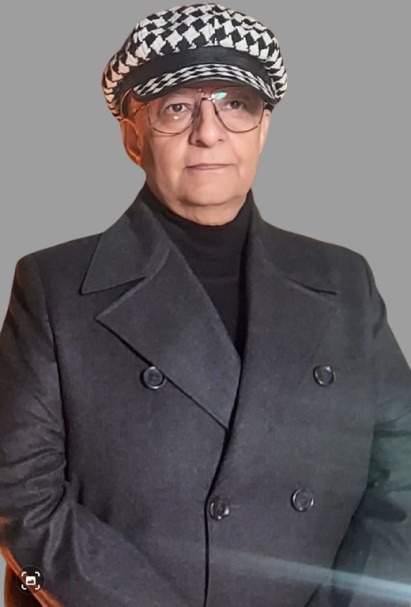
I was born on 20 May 1962, in the bustling city of Jalandhar, Punjab—a city alive with tradition, faith, and resilience. To many, Jalandhar was just another city on the map, but to me, it was the cradle of my beginnings, the soil where my roots were planted, and the canvas where my earliest memories were drawn. My story did not start with luxuries or privileges; it began with a modest rented house in Bikram Pura, where walls were narrow but hearts were wide, and where dreams sprouted even in limited space.
I was the son of Mr. Jagdish Sondhi and Mrs. Sushila Sondhi, two souls who knew the meaning of perseverance long before I could understand the word. My father was a man of discipline and silent determination. He ran a tailoring shop called Collegeate Tailor, where cloth was measured not only in inches but in dignity and precision. Each stitch he made was a prayer for his family’s survival and growth. My mother, gentle yet firm, was the anchor of our household. She stitched together not fabrics but the bonds of our family, ensuring that even in scarcity, love and values never ran short.
But my story begins even earlier, with the generations who stood before me. My grandfather, Shri Ram Lal Sondhi, was a man of simplicity, prayer, and upright living. He, along with my grandmother Smt. Saraswati, laid down the foundation stones of honesty and discipline that would guide me all my life. Their presence was a reminder that greatness is not built overnight—it is cultivated in silence, in habits, and in unwavering faith.Beyond them was my great-grandfather, Mr. Niamat Rai, whose name carried a dignity I could not yet comprehend as a child, but whose legacy still whispered through our family tales.
Our home in Bikram Pura was small—just two rooms in a rented space—but to me, it was a universe. Every corner carried a story, every crack in the wall held a memory. Childhood, as I look back now, was not about what we had, but how we lived. I walked to school on foot, not because we lacked transport, but because everything was close, and life was lived at a walking pace.
“Life tests us not by what we already know, but by what we are willing to learn with courage.”
PHASE 2: The Spark of Iron and Courage

The year 1968 was more than just a number in my calendar of life; it was
a threshold, a turning point for my family. I was barely six years old, too
young to understand the depth of change, but old enough to sense that
something significant was stirring within our home. Until then, my earliest
memories had been of father’s shop, Collegeate Tailor, where the rhythmic
sound of scissors cutting cloth and the hum of the sewing machine formed
the background music of my childhood. But life, like a restless tide, often
pushes us to shores we had never planned to reach.
My father, Mr. Jagdish Sondhi, decided to make a bold leap—he turned
away from tailoring, the craft that had sustained us, and stepped into the
uncertain world of iron industry. To outsiders, this shift must have seemed
reckless. After all, tailoring was a skill he had mastered; customers trusted him, and he had built a name in his community. But for my father, survival w as never about comfort—it
was about vision. He believed that iron, not fabric, held the future for his family.
On 4th February 1968, the foundation of Sondhi Industries was laid. A few weeks later, on 28th
February, we received our first sales tax registration. To most people, these were pieces of paper. To us,
they were symbols of courage. Our modest family from Bikram Pura was stepping into an arena we knew
almost nothing about. My father had no technical training, no inherited expertise in casting or machinery,
no mentor to guide him. What he did have, however, was willpower—a stubborn refusal to give up.
As a child, I watched him transform. The tailor who once measured suits now measured iron rods. The
hands that stitched coats were now blackened with dust and grease. Every day he worked late into the
night, experimenting, failing, trying again, and slowly teaching himself the mysteries of machines and
metals. My mother, though worried, never once let her anxiety dampen his fire. She stood by him, silent
yet unwavering, reminding us children that we were witnessing not just a struggle but the birth of a dream.
“Childhood is not measured by the marks we score, but by the lessons that remain etched in our hearts.”
PHASE 3: Classrooms, Scars, and Small Victories

The mid-1970s arrived like a season of new beginnings. By then, I was stepping out of the innocence of early childhood and walking into the corridors of adolescence. Life was changing in many ways—not only for me but for my family too. My father’s factory was slowly finding its rhythm, though challenges still lingered, and my mother continued to hold our home together with silent strength. I was beginning to discover myself as a student, a son, a brother, and a boy learning the meaning of responsibility in small but significant ways.
When I moved to Sain Dass AS Higher Secondary School, the transition felt both exciting and intimidating. Suddenly, I was no longer the little boy carrying a slate to school; I was part of a bigger world filled with louder voices, tougher lessons, and endless opportunities for both fun and fear. From 6th to 10th standard, these years became some of the most formative of my life. They shaped not only my education but also my character, my friendships, and my sense of identity.
Academically, I was what most people would call an “average student.” I never topped the class, and I never carried the shine of being a prodigy. But I had my strengths. Mathematics fascinated me. Numbers had a way of dancing in my mind, and solving problems gave me joy. It felt like solving puzzles where the world suddenly made sense. Chemistry and biology, on the other hand, left me uninterested and uninspired. No matter how many times I stared at chemical equations or tried to memorize biological terms, they never became friends of mine. Still, my parents encouraged me, insisting that studies were the foundation of the future, and I tried my best to live up to their hopes.
Yet, school life was not only about books. It was also about friendships, mischief, and lessons learned outside classrooms. I found myself surrounded by peers who were more like siblings than classmates. We shared our lunches, competed on the sports field, whispered during classes, and laughed over silly jokes in the playground.
Note of Thanks
As I reflect on my life’s journey, I am deeply grateful to those who have been its heartbeat.
To my parents, Mr. Jagdish Sondhi and Mrs. Sushila Sondhi, and my grandparents, Shri Ram Lal Sondhi and Smt. Saraswati, who gave me the strength of values and simplicity. To my great grandfather, Shri Niamat Rai, whose blessings echo through our lineage.
To my beloved wife Savita, the anchor of my life, whose unwavering support has made every struggle easier and every success sweeter. To my children—Parul, Raghu, Sunny, and Parth—who gave purpose to my responsibilities and joy to my heart. And to my grandchildren—Divija, Chirayu, Rayzel, Aarayna, Kridhay, and Ronav—whose laughter reminds me that legacy is not just carried forward, but lived every day.
I also thank my sisters Anju & Narinder Julka, Monika & Deshdeep Ralhan, and Mamta & Sanjay Grover who have always been part of my journey, and my extended family who stood by me in times of trial and celebration.
To my loyal colleagues Onkar Singh, Roop Lal, Aman Aggarwal, Sanjeev Khurana, Jatin Sondhi
and Vinay, who have been more than employees—they have been family, keeping our industries strong through decades of change. To my childhood friend Rajan Khanna and lifelong companions Ashwani Puri, Vijay Singla, Narinder Sharma, Murli Wadhwa, Narinder Pal Singh, Ashutosh Wadhwa and Ashwani Kapoor whose friendship has been a treasure no success can equal. I firmly believe you don’t fight for true friends, they come naturally
Finally, I bow in gratitude to the Almighty for guiding me through storms and triumphs alike, and to every
person who touched my life in ways big or small.
This story is not only mine—it belongs to all of you.
Thanks
Dr. Rajesh Sondhi