“True leadership is not about rising above others; it is about walking among them with purpose, humility, and service.”
Introduction
The story of Dr. Rai Singh Godara is one deeply rooted in the soil of Rajasthan — a land of resilience, simplicity, and courage. Born on 26 December 1962, in the quiet village of Ratna Desar Dudhli near Mahajan, Bikaner, his life began far away from the world of politics and public attention that he would one day enter. His journey is that of a man who transformed challenges into lessons and service into a lifelong mission. From his humble beginnings to his role as a respected leader and humanitarian, every phase of his life reflects unwavering integrity, compassion, and a deep sense of responsibility toward his people.
Raised in a family that valued ethics and hard work, Dr. Godara grew up watching his father, Shri Bhani Ram Godara, embody honesty and determination, while his mother, Smt. Surji Devi, taught him kindness, faith, and selflessness. His grandmother (Maternal), Smt. Pari Devi, played a special role in his life by giving him his name, Rai Singh, as a symbolic gesture of defiance against feudal inequality — a name that would one day be associated with courage, intellect, and public service. His early years were spent between the simplicity of Ratna Desar Dudhli and the spiritual aura of Dulmana and the family’s ancestral village Dheerera in Lunkaransar. These rural roots became the foundation of his empathy for the struggles of common people. His brothers, Mr. Rajpal Godara (Rtd. Add. SP of Rajasthan Police), Mr. Hansraj Godara (Ex- Sarpanch Dulmana) and Mrs. Gomti, Mrs. Kalavati, Mrs. Saraswati (Mr. Rai Singh’s Sisters) also played a significant role in shaping his values, discipline, and grounded nature.
Education was not merely an obligation for him; it was a path of transformation. He began his studies at Ratna Desar, continued at Middle School Dulmana, and later completed his higher secondary education at Arya Higher Sec. School, Sri Ganganagar. He also earned the “Vidya-Vinod” qualification in Sanskrit, reflecting his respect for India’s cultural and linguistic heritage. His interest in debates and social discussions made him a natural communicator — a skill that would later help him connect with people from all walks of life.
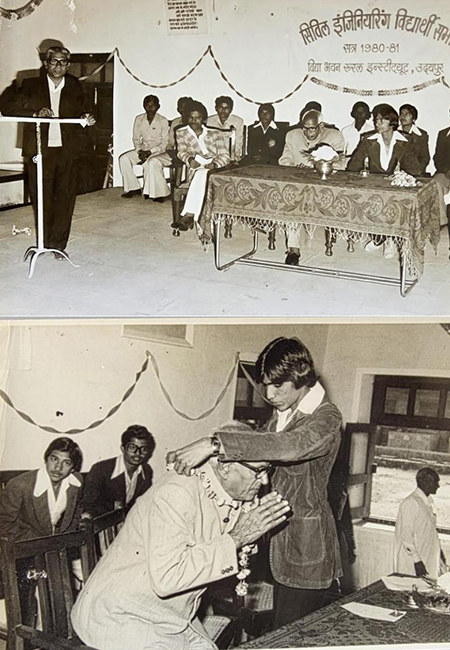
After completing his Diploma in Civil Engineering from Vidya Bhawan Rural Institute, Udaipur, he was elected as the NSUI-supported Students’ Union President, where his leadership was noticed for the first time. The oath ceremony, graced by Dr. K. L. Shrimali, former Union Minister of Education, became a defining moment. It revealed to him the strength of collective voice and democratic action — lessons that would stay with him throughout his career. During his academic years, mentors such as Prof. (Dr.) Sitaram Chaudhary, Mr. Bhagirath Poonia, and Mr. Jagdish Sahu greatly influenced his intellectual development and moral outlook.
“A man’s roots are not defined by the land he is born on, but by the values that shape his soul.”
Phase 1: Roots and Ideological Foundation (1962 – 1982)
The story of Dr. Rai Singh Godara begins on 26 December 1962, in the serene village of Ratna Desar Dudhli near Mahajan, Bikaner, Rajasthan. His life started in simplicity — surrounded by fields, honest work, and the timeless rhythm of rural life. His parents, Shri Bhani Ram Godara and Smt. Surji Devi, were ordinary people with extraordinary values. They believed that respect, education, and truth were the only legacies worth leaving for their children. Those ideals became the moral foundation of the life that would follow.
From his earliest years, Rai Singh Godara was exposed to the warmth of a close-knit family and the dignity of hard work. His father, Shri Bhani Ram, was a man of principle, known in his community for his fairness and sense of justice. He often said, “A person’s worth is measured not by his wealth, but by how he treats others.” That belief shaped young Rai Singh’s outlook on life. His mother, Smt. Surji Devi, was gentle yet strong — the emotional center of the family. Her compassion toward others taught him empathy, humility, and kindness, lessons that would later become the cornerstones of his leadership.
His grandmother (Maternal), Smt. Pari Devi, played a special role in his early life. It was she who gave him his name, Rai Singh. The story behind his name carried a deeper meaning. During those years, remnants of feudal influence still lingered in the villages of Rajasthan. Naming her grandson “Rai Singh” was not just a familial gesture — it was her subtle act of defiance against the oppressive social order that once denied equality to the common man. That symbolic moment would echo throughout his life, reminding him that dignity is not granted by status, but earned through one’s actions.
The Godara family traced its roots to Dheerera, a village in Lunkaransar, before settling in Dulmana. Though his birth took place at his maternal grandparents’ home in Ratna Desar Dudhli, his spiritual and emotional ties remained deeply connected to Dheerera — the ancestral soil that grounded his values.
“Some decisions in life are not taken by choice but by calling; when the heart recognizes its purpose, destiny begins to unfold.”
Phase 2 : Engineering Beginnings and Entry into Politics (1983 – 1986)
As Dr. Rai Singh Godara stepped into adulthood, his journey transitioned from the innocence of youth to the responsibilities of a man ready to shape his path. Having completed his Diploma in Civil Engineering from Vidya Bhawan Rural Institute (VBRI), Udaipur, he carried with him not just technical knowledge but a strong sense of purpose. The values of integrity and discipline instilled in him by his parents, Shri Bhani Ram Godara and Smt. Surji Devi Godara, became the guiding principles of his professional and personal life. During this period, he was deeply influenced by mentors such as Prof. Dr. Sitaram Chaudhary of Udaipur University, Mr. Bhagirath Poonia, and Mr. Jagdish Sahu, whose guidance strengthened his intellectual and moral foundation.
In the early 1980s, India was evolving — new industries were growing, and urban infrastructure was beginning to expand. For a young engineer like Rai Singh, it was an opportunity to build not only structures but also a career of stability and pride. He began his professional journey as a Jr. Engineer at the Urban Improvement Trust (UIT), Udaipur, one of the state’s most dynamic urban development organizations. It was a role that came with responsibility, precision, and the challenge of balancing technical expertise with public accountability.
In this position, Rai Singh quickly gained a reputation for his honesty, work ethic, and quiet leadership. He approached every project with discipline and humility. For him, engineering was not merely about constructing roads or buildings — it was about improving people’s lives. His colleagues often admired his ability to connect with both workers and officers alike, treating everyone with the same respect. Through this early experience, he learned that progress was not measured in structures alone, but in the trust and welfare of the people they served.
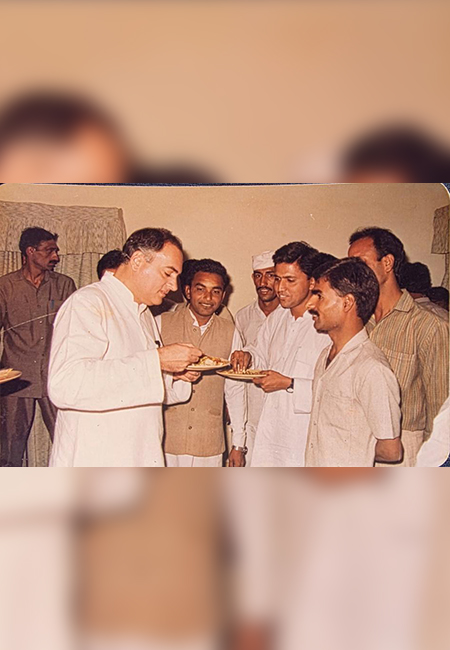
However, destiny had other plans for him — ones far beyond the boundaries of drafting tables and construction sites. It was during his tenure at UIT that a meeting would forever change the course of his life. On 27 November 1983, Shri Rajiv Gandhi Ji, then General Secretary of the Indian National Congress, visited for dinner at Hotel Anand Bhawan in Udaipur.
“When the purpose is service, time itself becomes a witness to one’s sincerity.”
Phase 3 : Rise of a Young Congress Leader (1986 – 1993)
After leaving his position as a Jr. Engineer in 1986, Dr. Rai Singh Godara stepped fully into public life with determination, humility, and faith. The decision that many had questioned soon began to reveal its wisdom. What others saw as risk, he saw as responsibility — a responsibility to live for something larger than himself. He had traded a life of comfort for one of commitment. From that moment, every day became a chapter in his mission to serve.
Settling in Jaipur, the state’s political and administrative hub, was the first step of this transformation. While most people sought success in the capital for personal gain, Rai Singh arrived with a selfless motive — to understand the pulse of governance and the needs of the people from the ground up. Jaipur in the late 1980s was a city of both aspiration and contradiction. Its beauty and culture existed alongside growing social issues, and its development reflected the larger challenges of India at the time.
As a new entrant in politics, Rai Singh faced the same struggles that every young leader encounters — to be heard, to be trusted, and to be taken seriously. But what set him apart was his patience. He knew that credibility could not be claimed; it had to be earned. He began at the grassroots, working with ordinary citizens, listening to farmers, workers, and youth, understanding their problems, and learning how policies affected them. His engineering background made him detail-oriented and solution-focused, while his compassionate nature ensured that every solution had a human touch.
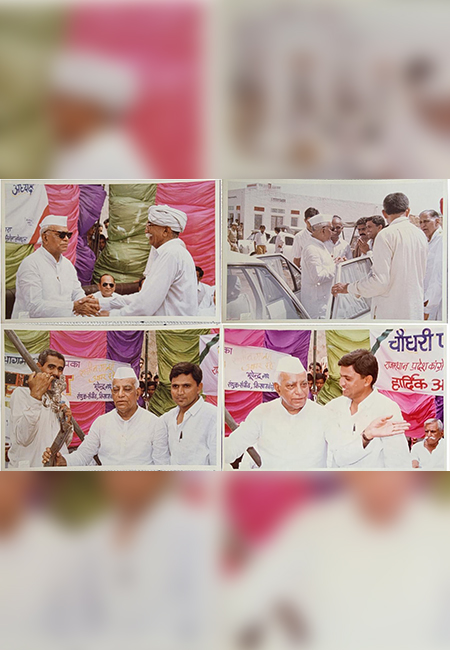
Recognizing his discipline, sincerity, and organizational capability, the Indian National Congress soon entrusted him with greater responsibilities. He was appointed State Convenor of Kisan Cell and then the State General Secretary of the Youth Congress, where his leadership style quickly gained respect. He was not one to seek attention or position; his focus was on results.
Note of Thanks
The life journey of Dr. Rai Singh Godara stands as a testament to devotion, humility, and service that transcends boundaries of politics and profession. As this biography reaches its conclusion, it extends heartfelt gratitude to all those who have been a part of his remarkable path — the family, mentors, colleagues, and people whose faith and affection shaped his purpose.
Dr. Godara expresses his deepest thanks to his beloved wife, Smt. Shanti Godara, whose strength and quiet support have been the foundation of his every success. Her patience, compassion, and unwavering belief stood beside him in every challenge and triumph. He also acknowledges his sons, Vijender Singh Godara and Himanshu Godara, whose understanding and encouragement have given him renewed energy to serve and guide.
He remains forever indebted to his late parents, Shri Bhani Ram Godara and Smt. Surji Devi, for instilling in him the values of honesty, discipline, and compassion — the cornerstones of his life. The spiritual blessings of Guruji Baba Bal Nath and Baba Basti Nath Ji continue to illuminate his path, reminding him that true strength comes from inner peace and faith.
He extends warm appreciation to the senior leader of Congress and former CM Shri Ashok Gehlot Ji, former Minister and present PCC President Shri Govind Singh Dotasara Ji, former PCC President and Speaker Late Paras Ram Maderna Ji, former Union Minister Late Daulat Ram Ji Saran and former Union Minister Kumari Selja ji, Shri Mukul Wasnik ji, Ch Birendra Singh Ji also former CM of Uttarakhand Shri Harish Rawat Ji, Dr. B. D. Kalla Ji and former LOP Late Rameshwar Dudi Ji for their trust, respect, and shared vision of service through the Indian National Congress. He also extended contributions in his career to Prof. (Dr.) Sita Ram Chaudhary, Sh Bhagirath Punia, Sh Jagdish Sahu, Sh Surja Ram Meel, Sh Ghanshyam Aggarwal, Sh PD Goel and Adv. Sandeep Arora Ji.
To the countless villagers, youth, and colleagues who have walked with him through decades of change — he offers gratitude not for their support, but for their shared belief that one honest heart can make a difference.
Dr. Rai Singh Godara says that his classmates and lifelong friends from his youthful days – Mr. Deepak Bordia, Mr. Mukesh Jani, Mr. Narendra Mehta and Mr. Rajkumar Pokharna has also held a very special and significant place in his life.
Dr. Godara says that there is no shortcut to success; hard work done with good intentions is the key to success, his guiding principle is success is born of action, i.e. “सिद्धिर्भवती कर्भजा:”
The story of Dr. Rai Singh Godara is, at its heart, a story of faith — in people, in goodness, and in the enduring power of service.
Thank You
– Dr. Rai Singh Godara