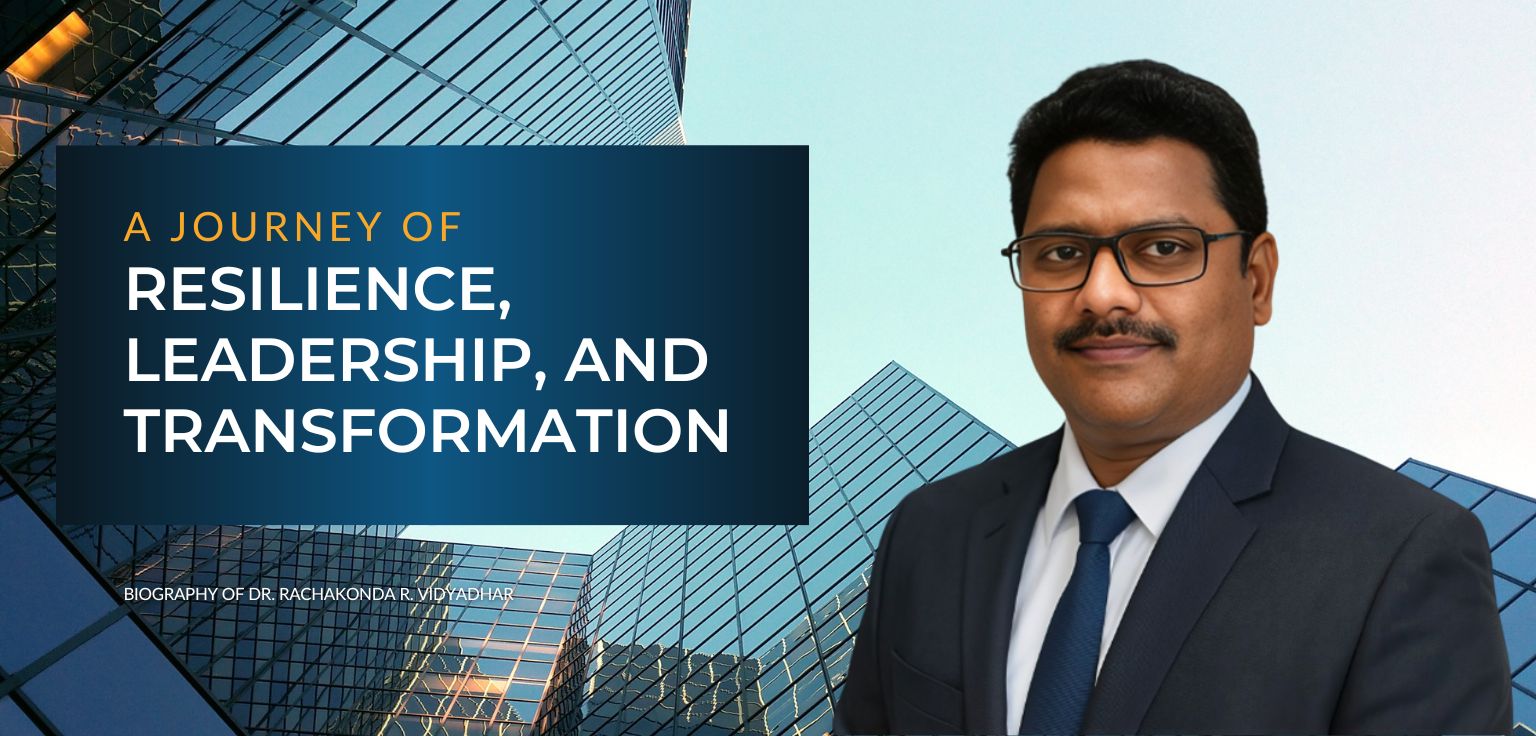
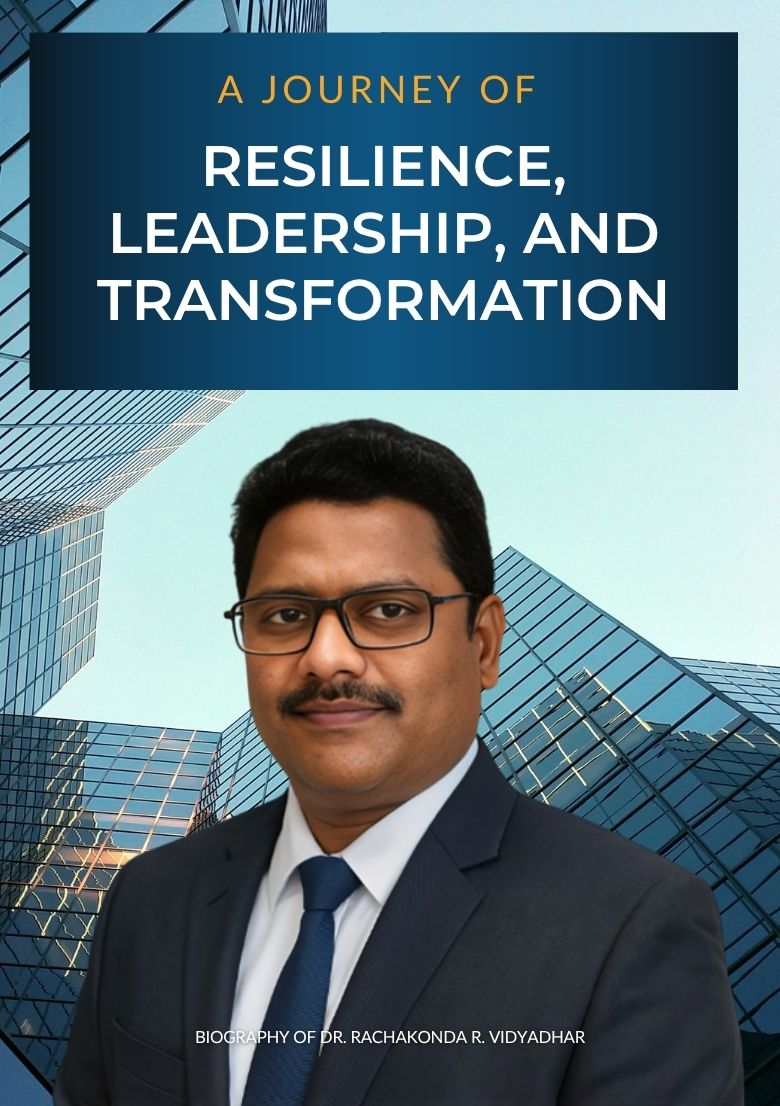
Dr. Rachakonda R. Vidyadhar

“A life is not important except in the impact it has on other lives.”

Introduction

Every once in a generation, there emerges a life story that transcends the ordinary, a story not confined to personal triumphs but one that becomes a source of light for countless others. Such is the life of Dr. Rachakonda R. Vidyadhar—a man whose journey resonates as a symphony of resilience, vision, and humility. His biography is not a record of achievements; it is a reflection of what is possible when unwavering determination meets purposeful leadership.

Born in the modest yet vibrant town of Yellamanchili, Visakhapatnam, Dr. Vidyadhar’s early life was woven with simplicity and scarcity. The walls of his childhood home carried whispers of struggle, yet they also nurtured a spirit of perseverance. Opportunities were few, resources were limited, but his aspirations knew no ceiling. From the very beginning, he embodied a truth that continues to inspire: our circumstances may set the stage, but it is our choices, courage, and vision that shape the script of our lives.

What makes Dr. Vidyadhar’s journey so remarkable is not just the path he carved in his professional field, but the way he persistently transformed obstacles into stepping stones. As a child, he dreamed beyond his immediate surroundings, and as a young man, he pursued knowledge not as a means to personal gain but as a tool to create impact. Where others saw barriers, he saw challenges to overcome; where others saw impossibilities, he saw opportunities to innovate.

As the pages of his life unfold, one sees the transformation of a determined boy from Visakhapatnam into a leader whose influence spans industries, geographies, and generations. His journey through engineering, strategic leadership, and global operations reflects not just technical brilliance, but also an innate ability to balance vision with execution. In every role, he has redefined what it means to lead—not merely through authority, but through inspiration, integrity, and compassion.

Yet, perhaps what distinguishes Dr. Vidyadhar most is not found in chambers, accolades, or organisational milestones, but in his human spirit. He is a mentor who takes time to guide young professionals, igniting in them the courage to dream. He is a leader who never loses sight of the fact that organisations thrive not because of machines, but because of people. He is a humanitarian who believes that education and sustainability are not luxuries, but necessities for building a stronger future.

This biography is not a catalogue of titles or accomplishments; it is a testament to character. It speaks of a man whose strength lies in perseverance, whose wisdom lies in humility, and whose success lies in service. To read about his life is to be reminded that greatness is not measured in how high one rises, but in how many others one lifts along the way.

“Strength does not come from physical capacity. It comes from an indomitable will.”

Phase 1: Roots of Resilience

The story of Dr. Rachakonda R. Vidyadhar begins in the vibrant coastal town of Yellamanchili, Visakhapatnam, India—a land of crashing waves, bustling markets, and resilient people. Though born here, his formative years took him far beyond the boundaries of this town. His childhood unfolded across the coal-mining towns of the erstwhile Madhya Pradesh (Shahdol and Bilaspur) and the industrious city of Sambalpur in Odisha, where his father was posted. Born into a modest family, his earliest memories were woven not with luxuries, but with the values of simplicity, honesty, and determination. What his family lacked in material abundance, they more than compensated for in spirit and love.

His father, Rachakonda Jagannadham, (M.A. Sociology, LL.B.), a man of relentless work ethic, often left home before dawn and returned only after dusk. Serving with Coal India Ltd. as Secretary (Administration), he carried with him the discipline of governance and the dignity of service. However, unforeseen family circumstances compelled him to step away from his government role and return to their hometown, Yellamanchili, during Vidyadhar’s high-school years. This decision, though necessary, marked a turning point in the family’s life. It brought with it financial constraints that tested the family’s resilience and shaped the young boy’s outlook on life. He taught young Dr. Vidyadhar that dignity comes not from the size of one’s earnings, but from the integrity with which one earns them. His mother, Rachakonda Kameswari, on the other hand, was the heartbeat of the home—her nurturing nature, deep empathy, and unwavering faith provided the foundation upon which his dreams were built.

Even in their small household, where every rupee had to be stretched and every meal carefully planned, the family thrived on togetherness. The warmth of his parents’ sacrifices instilled in him a belief that greatness was not reserved for the privileged, but for those who dared to endure, to rise, and to dream.

At each of the places, young Vidyadhar lived, he attended Kendriya Vidyalayas, institutions known for discipline and academic rigor. Here, he consistently topped his class, a testament to his sharp intellect and relentless focus. Teachers fondly remembered him as a boy with “eyes full of determination”—one who never accepted mediocrity and who approached every subject as if it were a stepping stone toward a greater purpose.

Financial hardships shadowed his school years. There were times when he borrowed textbooks from his college library, commuted long hours daily, and fees were paid after months of worry. Despite limited resources, Dr. Vidyadhar never let these constraints silence his curiosity or slow his pursuit of learning. With every exam passed, every lesson understood, he not only advanced his own journey but also carried forward his family’s hopes. He pursued his 10th grade as a private candidate, preparing through self-study without the structured support of a regular classroom, and emerged with an impressive 79%. This early success became a symbol of his self-discipline and clarity of vision.

“Education is the most powerful weapon which you can use to change the world.”

Phase 2: Engineering Foundations

For Dr. Rachakonda R. Vidyadhar, education was never a passive experience or a mere pathway to a career. It was a battlefield of perseverance—a series of hard-fought victories where every milestone represented more than personal advancement. Each achievement carried with it the pride of his family, the hope of his community, and the promise of a brighter future. His journey through the world of engineering was not simply about acquiring degrees or technical skills, but about building a foundation of resilience, clarity, and vision that would carry him into global leadership.

Every remarkable journey begins with a single step. For Dr. Vidyadhar, that first step was his Diploma in Mechanical Engineering at the Government Polytechnic, Visakhapatnam. To many, a diploma might seem like a starting credential, but for him, it was the ignition point of a lifelong quest.

ChatGPT said:

The classrooms and workshops of the polytechnic became his training ground—where theory met practice, and where his curiosity for machines and systems transformed into a structured discipline. Each machine he dismantled, each diagram he traced, each formula he memorized was more than an academic exercise; it was a brick in the foundation of his future.

But the journey was not easy. Each day, he rose at 4:30 a.m. to catch the early morning train, traveling nearly 2.5 hours each way, returning only by 9:00 p.m. after long hours of study. These daily commutes, though exhausting, became silent teachers—instilling perseverance, time management, and endurance. He would borrow textbooks from the college library, carefully plan every expense, and study under dim light, where fatigue often battled with determination. The lack of resources could have been an excuse to stop, but for Dr. Vidyadhar it became the fuel to push harder. Those years instilled in him tenacity, humility, and the ability to persevere against odds—qualities that would become central to his leadership style decades later. He graduated with an admirable 82%, a score that stood not just as an academic record but as proof of his grit and determination.

In those early years, a spark ignited: the realization that engineering was not just about machines, but about solving problems, shaping industries, and improving lives. That vision became the compass for everything that followed.

Where many would have paused after a diploma, Dr. Vidyadhar chose acceleration. With clarity of purpose, he pursued advanced degrees in Mechanical Engineering, seeking not only deeper technical knowledge but also a broader professional horizon.

He recognized that mechanical engineering was a powerful discipline, but to make a true impact, one needed to look beyond the boundaries of technical design. His curiosity led him into the domains of operations, logistics, and supply chain management, areas where engineering converges with business strategy and organisational efficiency.

“The future depends on what you do today.”

Phase 3: The First Step into Industry

In 2000, he stepped from academia into industry. On November 14, 2000, he was selected via campus interviews by ITC Ltd. – Paperboards and Specialty Papers Division, one of India’s most advanced manufacturing units. For a young engineer fresh out of academic corridors, this was not merely a job; it was the testing ground of his capabilities and the foundation upon which his career would be built.

At ITC, he was entrusted with mechanical maintenance of complex rotating equipment—giant machines that powered the production lines of high-quality paperboards. These were no ordinary machines; they represented the beating heart of the factory, and any downtime meant immense losses in productivity and revenue. While many young engineers viewed such responsibilities with apprehension, Dr. Vidyadhar embraced the challenge with quiet confidence and unshakable determination.

Where others saw repetitive routines of maintenance, he saw a canvas for innovation and improvement. He understood that engineering was not about simply following manuals—it was about applying knowledge, observation, and creativity to transform operations. His early exposure to predictive maintenance techniques helped him envision a system where problems could be detected before they became crises. By implementing vibration analysis, condition monitoring, and advanced maintenance scheduling, he dramatically reduced unexpected breakdowns.

Within a short span, Dr. Vidyadhar introduced Total Productive Maintenance (TPM) practices on the shop floor. This was more than a technical intervention—it was a cultural shift. Total Productive Maintenance empowered operators to take ownership of their machines, fostering a sense of pride and responsibility at every level of the workforce. Under his guidance, the plant witnessed approximately 30% increase in machine uptime, a remarkable achievement for a newcomer.

But beyond the numbers, what stood out was Dr. Vidyadhar’s mindset. He did not treat efficiency as a matter of cutting costs alone. For him, efficiency meant reliability, sustainability, and empowerment. A well-maintained machine was not just a piece of equipment running smoothly—it was a symbol of trust for the company, security for the workers, and stability for the future.

His supervisors quickly recognized that he possessed not only technical acumen but also an innate ability to blend leadership with empathy. He communicated with workers on the shop floor in their own language, listened to their concerns, and often worked side by side with them during long maintenance shutdowns. This humility and hands-on approach earned him respect and set him apart as a leader who inspired rather than commanded.

Looking back, Dr. Vidyadhar would later describe his time at ITC as the crucible of his professional journey. It was here that he learned the first critical lesson of industry: that every challenge, no matter how routine it seems, carries within it an opportunity for innovation and growth. His ability to see beyond the ordinary, to create systems of reliability, and to inspire confidence in others, became hallmarks of his career.

This first step into industry was not just the beginning of a job; it was the laying of a solid foundation of values—resilience, innovation, and service. These values would echo through every role he took on in the years to come, shaping not just his career but his enduring legacy as a visionary engineer and leader.

Note of Thanks

As I reflect upon my journey—from the modest beginnings of my childhood to the global platforms of leadership I have been privileged to serve—I am reminded that no success is ever achieved in isolation. Every step forward, every milestone reached, and every obstacle overcome has been made possible because of the love, support, and encouragement of people who have walked alongside me.

First and foremost, I express my deepest gratitude to my parents, whose sacrifices and values laid the foundation of everything I have become. My father’s relentless work ethic and my mother’s quiet strength instilled in me the discipline and humility that continue to guide me, no matter how far I have travelled. To my family, who stood by me through every challenge and celebrated every success, I owe an eternal debt of love. Their patience, faith, and encouragement have been my constant source of strength.

I am profoundly grateful to my family—my wife, Rachakonda Jyothi, and my daughter, Rachakonda Nitya Satya Shreshtha—whose unwavering support, endless patience, constant encouragement, and deep faith have been the steady source of strength guiding me through every phase, challenge, and triumph of this journey.

I am profoundly thankful to my teachers, professors, and mentors, who not only imparted knowledge but also nurtured the curiosity and resilience that fuelled my academic and professional pursuits. Their wisdom shaped my thinking, their encouragement gave me confidence, and their belief in my potential inspired me to dream bigger than my circumstances ever allowed.

My heartfelt thanks also go to the colleagues, teams, and leaders I have had the honour of working with across ITC, Schlumberger, and NESR. Together, we faced challenges, embraced transformation, and celebrated victories. Every project we delivered, every problem we solved, and every innovation we implemented was the result of teamwork and trust. I remain humbled by the dedication of the many professionals who stood shoulder-to-shoulder with me in high-stakes environments.

I am especially grateful to the students and professionals I have mentored along the way. While I may have shared my knowledge, it is I who has learned from them—their determination, their questions, and their growth have enriched my journey in immeasurable ways. To see them succeed has been one of the greatest rewards of my career.

To the communities that have welcomed me—across India, Saudi Arabia, and the GCC—I extend my appreciation. Every new culture I adapted to, every new challenge I embraced, was made easier because of the warmth and acceptance I received.

Finally, I offer thanks to the institutions and organisations that recognized my work and entrusted me with responsibilities that carried both risk and reward. Their confidence allowed me to test my abilities, push beyond limitations, and contribute meaningfully to operational excellence and transformation.

This biography is not just my story; it is the story of every individual who has influenced, supported, and shaped me along the way. If I have been able to leave a positive impact on organisations, people, or communities, it is because of the collective spirit of those who stood with me at every stage.

As I look to the future with hope and purpose, I carry this gratitude in my heart. It reminds me that while success may be measured in achievements, true fulfilment is found in the relationships we build and the lives we touch.

Thanks
Dr. Rachakonda R. Vidyadhar