Wealth belongs to the person who enjoys it and not to the one who keeps it.
Introduction
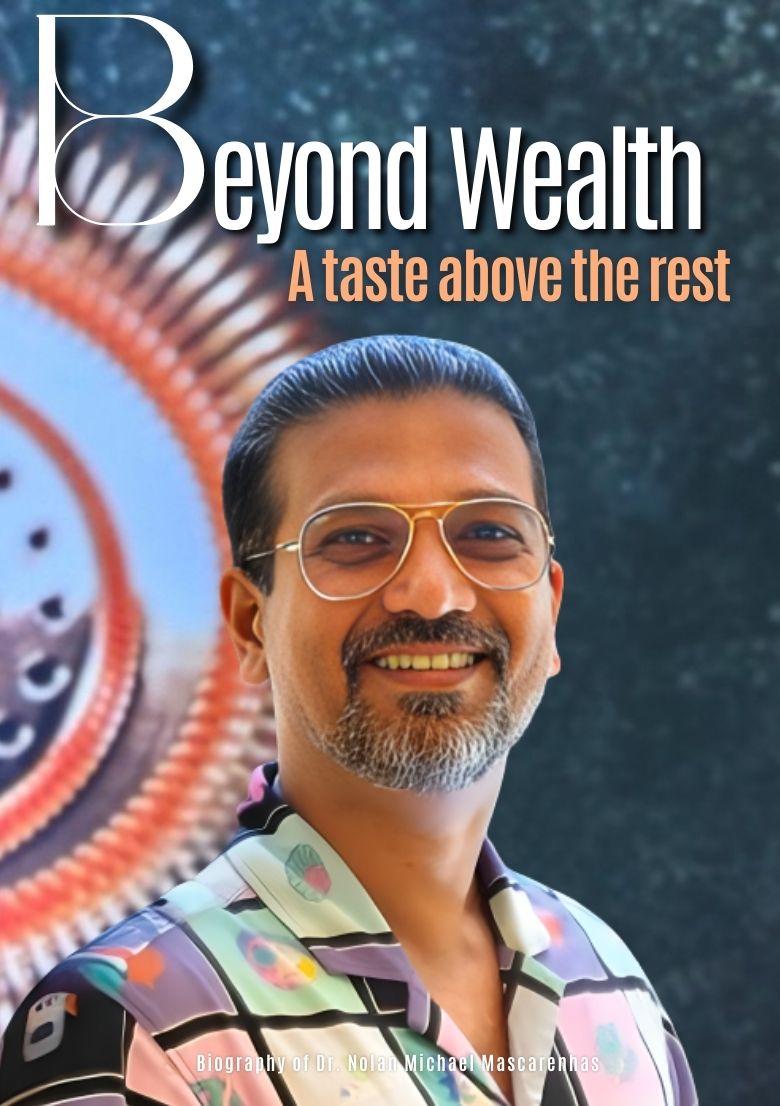
A dynamic leader, Dr. Nolan Michael Mascarenhas’s path demonstrates self-control, inventiveness, and a strong dedication to empowering others. Every stage of his life has influenced the leader he is today, from his early days as a sportsman, where basketball taught him strategy and teamwork, to his professional beginnings in advertising, where he perfected the art of effective and impactful communication.
When Dr. Nolan entered the financial and wealth management industry, he founded his practice on the values of openness, simplicity, and trust. He insists on clarity, frequently stating that a concept is not fully understood if it cannot be explained to a four-year-old, in contrast to many who use jargon to complicate financial strategies. Because of this philosophy, he has been able to establish a human connection with his clients, giving them the confidence to take charge of their financial journeys.
Dr. Nolan is unique not only because of his knowledge but also because of his moral principles. He sees money as a tool, fluid and ephemeral like a river, rather than as an end in itself. The necessities of life—health, housing, food, clothing, and the tranquillity that comes from leading an honest life—are what he considers to be true wealth. His clients have embraced a more comprehensive definition of success and looked beyond simple accumulation thanks to this viewpoint.
Dr. Nolan has fostered an empowering culture through his mentoring. Under his direction, every client and team member is prepared to act on their own initiative, guaranteeing that knowledge and fortitude take precedence over reliance. His practice, which has developed solely through recommendations and trust rather than advertising, is a testament to his sincerity and the enduring bonds he has built.
Not just that, Dr. Nolan Michael Mascarenhas is also a Goa-based food and travel writer, culinary anthropologist, and cultural curator whose work spans over a decade of gastronomy, sustainability, and heritage storytelling.
At the intersection of storytelling, sustainability, and gastronomy, Dr. Nolan Michael Mascarenhas is creating a legacy that is both globally recognised and firmly rooted in Goa. In his capacity as a culinary strategist, food and travel writer, and cultural steward, he has not only chronicled India’s changing culinary story but also actively fostered it through endeavours that honour tradition and creativity.
The Happy Hermit Estate, a 10-acre permaculture farm in Dodamarg that embodies Nolan’s living philosophy that “the happy life grows here,” is at the centre of this vision. The estate’s rainwater harvesting ponds, cacao intercropping, and immersive farm-to-table experiences reflect his dedication to soil health, biodiversity, and sustainable living. Dr. Nolan’s conviction that food is more than just nourishment but also a symbol of culture, memory, and community is reflected in its artisanal produce, which ranges from raw honey to rosella preserves.
“There is always one moment in childhood when the door opens and lets the future in.”
PHASE 1: Early Years of Dr. Nolan Michael Mascarenhas
Dr. Mubarika M. Kheda’s story begins in the small town of Salumbar, Rajasthan, India, where she was born on 28th October 1981. Her birth not only marked the beginning of her life but also took place on a highly significant night—Diwali, one of India’s most auspicious festivals. Adding to the uniqueness of this moment, it also coincided with the beginning of the Muslim New Year according to the Hijri Calendar. Born under such meaningful circumstances, her parents, Fakhruddin and Asma Bai, named her Mubarika, meaning “blessed” in Arabic. This name, given on such a sacred and celebrated occasion, became the first reflection of the divine grace that would accompany her throughout her life.
Her childhood was deeply rooted in the values of Dawoodi Bohra culture. “We are uniformed by our Mola’s preaching, and we follow Quranic teachings with modern standards. Our eating and dressing styles come from the Arabic Fatimi culture. For us, it is our pride and honour, and we make sure to pass it on to our children. Alhamdulillah Shukranillah,” she says.
The early years of her life were spent in Kuwait, where her family moved soon after her birth. Dr. Mubarika was the fourth child, with two elder brothers and one sister. As the youngest, she enjoyed the affection, attention, and warmth of her parents. Talkative and lively, she was an attention-seeker at times, yet always a cute and obedient child.
Her father, Fakhruddin, a businessman who ran his own restaurant, embodied dedication and hard work. His commitment to providing for the family created a strong foundation of values that Dr. Mubarika continues to uphold even today. Her mother, Asma Bai, though often unwell, remained a constant source of tenderness and care. Despite her health struggles, she ensured that her children were surrounded with love, comfort, and emotional strength — the true essence of a nurturing home.
“The secret of getting ahead is getting started.”
PHASE 2: Youthful Days: Defined by Sports, Struggles, and Society’s Expectations
Childhood and adolescence are rarely linear; rather, they are times of contrast, of happiness and hardship, of discovery and constraint, and of successes and failures. As Dr. Nolan Michael Mascarenhas returned to the comfortable but demanding environment of Goa from the regimented life of Nasik, this truth became evident to him in profound ways.
If his early years had been influenced by travel, hotel stays, hospitality, and discipline, his adolescence would have been a melting pot where academics, athletics, and social expectations clashed. Dr. Nolan’s character began to develop between the basketball court and the classroom, showcasing the fortitude, fervour, and mental independence that would serve him well into adulthood.
Dr. Nolan’s temperament never tolerated confinement within a classroom. His interest in books was divided; some topics captivated him, while others appeared dull and uninteresting. But in spite of this lopsided relationship with academics, he continuously shocked teachers and peers with the outcomes he generated. Even though many questioned whether he could receive good grades, Dr. Nolan frequently outperformed his peers. His method seemed almost contradictory: although he might not come across as studious in the conventional sense, his curiosity, memory, and resolve always made up for it.
This unpredictability characterised his school years. Because they saw his outdoor spirit as a diversion from “serious” studies, teachers and classmates alike frequently undervalued him. However, Dr. Nolan personified the idea that education is about more than just sitting at a desk; it’s also about perspective, balance, and the capacity to apply knowledge in a variety of contexts.
At the same time, he was naturally inclined to be active, move, and express himself physically. He was always on the football pitch or basketball court, or trying out a new sport if he wasn’t in class.
“Education is the key to unlocking the golden door of freedom.”
PHASE 3: Dr. Nolan: The Unwilling Critic of Education
In addition to being a personal narrative, Dr. Nolan’s journey serves as a mirror reflecting the numerous inconsistencies, fractures, and missed opportunities in our educational system. Confusion, poor judgement, and a recurring conflict between inflexible structures and an unyielding spirit characterised his formative years more than honours. At the age of thirteen, Dr. Nolan faced a decision common to many young students: the aptitude test. This ritual, which aimed to predict futures and suggest paths, produced conflicting results in his case. Teachers and administrators were unable to categorise him. The external evaluators dismissed this boy’s natural leadership and restless curiosity as mere distractions and declared, “This boy only wants to play sports.” He received discouraging half-marks (34.5 when 35 was needed) in lieu of encouragement, serving as a reminder that the system valued conformity over creativity.
The young Dr. Nolan first became aware of the covert politics of education during these years. By using transactional assurance rather than learning, tutors could ensure a passing grade. The unwritten motto was, “Pay us four thousand rupees, and we’ll give you 35 marks.” Though he was too young to fully understand the economics of education, he had a strong feeling that knowledge was not the currency at stake.
Resilience, however, saved him. He was the only person in his batch to fail a preliminary exam, but Dr. Nolan remained defiant. Early on, he understood that mental calm was more important than performance pressure. He found his way forward with the help of his parents, who favoured empathy over criticism, and one exceptional teacher, Mr. Sejwalkar, who had faith in him.
Because of Mr. Sejwalkar’s philosophical approach, which was rooted in Swami Vivekananda’s teachings, he excelled in Hindi rather than his mother tongue, English. His success was not just an academic surprise for a boy who grew up in an English-speaking family; it was a lesson in life that genius frequently appears out of the blue.
Note of Thanks
The telling of a life story is made possible by an unseen network of people who assist, inspire, and contribute to the writing of any biography. In order for the pages of this book to have such significance, Dr. Nolan Michael Mascarenhas would like to express his sincere gratitude to everyone who has shared in his journey.
This letter of gratitude is an expression of gratitude to all the many hands and hearts that have influenced, helped, and enhanced his life; it is not just a formality. Every individual—named or not—has made a lasting impression on the man he has become and the work he still does.
Dr. Nolan’s family is the cornerstone of his journey. He is eternally grateful to his parents for their vision, encouragement, and sacrifice. From the simplicity of his early years to the complexity of his professional life, they instilled in him the values of perseverance, hard work, and humility. Their conviction that he could accomplish his goals became the cornerstone of his ambitions.
He expresses sincere gratitude to his extended family, which includes his siblings, relatives, and those who supported him through both happy and difficult times. Every supportive gesture, every encouraging word, and every moment of presence turned into a silent guarantee that he was never alone in his endeavours.
For Dr. Nolan, family has served as a haven and a source of motivation. He dedicates a part of his gratitude to them with deep appreciation, understanding that his journey would not have had the same strength or purpose without their unwavering presence.
No meaningful journey is ever taken without teachers and no meaningful life is ever lived in isolation. Dr. Nolan is incredibly grateful to his mentors, including those he met during his early college years, his professional career in finance and advertising, and those he met later in his entrepreneurial pursuits.
His mentors helped him realise that genuine success is determined by one’s capacity for clear communication, responsible service, and stability in the face of change—not just by awards or material wealth. They supported him with foresight, challenged him with wisdom, and mentored him with patience.
The guidance he was given during his early years—to seek experience before credentials, to work before going to college—turned out to be life-changing. He has a great deal of respect for the reasonable voices that dared to offer alternative advice and helped him get ready for what came next.
Thanks
Dr. Nolan Michael Mascarenhas