“Some rise despite the storm. Others rise because of it.”
Introduction
Dr. Nadira Maharaj was not born into privilege. She was born into purpose. From the heart of South Trinidad, an area often described as under-resourced and economically modest, came a young girl with quiet determination and an unyielding spirit. She did not grow up surrounded by wealth or opportunity, but she grew up surrounded by discipline, values, and dreams seeded in sacrifice. Her journey from a low-income household to national healthcare transformation is not just remarkable—it is revolutionary.
Raised in a culture where responsibility was non-negotiable and humility was stitched into everyday life; Dr. Maharaj was no stranger to struggle. She grew up in a time where education was a privilege, not an entitlement. Thankfully, Trinidad’s public school system offered free access to primary and secondary education, which became her launchpad. Even then, she recognized that education wasn’t just her right—it was her escape.
While other children were dreaming of toys, Nadira dreamt of becoming a professional—inspired deeply by her mother’s cousin, a well-established accountant who married late, worked independently, and embodied everything Nadira aspired to be: respected, self-made, and financially secure. This woman became her early role model, and that early aspiration—to be more, to rise higher—never left her side.
At the age of 23, while already working as a civil servant, Dr. Maharaj married and started her own family. But ambition and duty walked beside her every step. She wasn’t content with routine. She applied for a scholarship, hoping for a chance to build a meaningful career. It took three years of perseverance before that dream materialized, and by then, she had already welcomed her first child into the world.
When most would have slowed down, she accelerated. Working seven days a week, studying at night, and raising her child during the day, Dr. Maharaj embodied the essence of perseverance. Even in a junior medical laboratory role, she conducted herself with the discipline of a director. Her mantra was simple: “Whatever I do, I do it right, and I do it with pride.
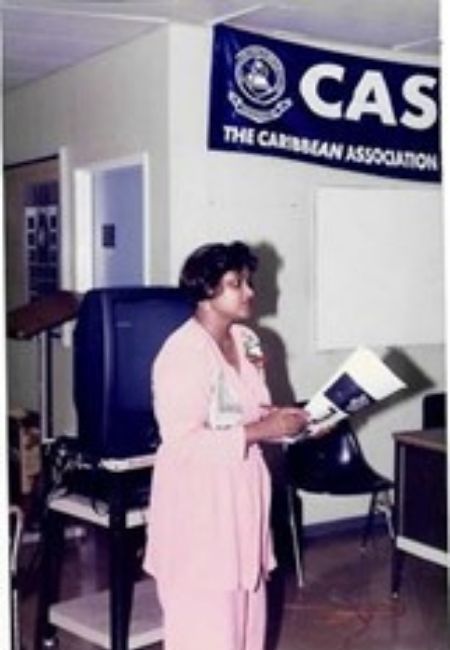
A turning point came when a magazine from the Caribbean Association of Medical Technologists (CASMET) mysteriously appeared in her lab. Until then, Trinidad had been isolated from that professional community. Her curiosity ignited a domino effect—one that led her to contact CASMET in Barbados, discover new training pathways, and ultimately form Trinidad’s first professional lab technologist branch.
She didn’t stop at becoming the first registered medical technologist in Trinidad—she formed the foundation of the entire movement. With just eight dedicated members, she led efforts to formalize the profession, hosted Trinidad’s first Caribbean technologist summit, and established ties with the American Medical Technologists, thus internationalizing the profession’s legitimacy. This move elevated phlebotomy from an informal practice to a recognized and certified discipline, training 150+ phlebotomists every year since 1996.
“We didn’t have much, but we had everything that mattered—discipline, duty, and dreams.”
Phase 1: Early Life & Education: Rooted in Values, Rising in Vision
The foundation of Dr. Nadira Maharaj’s extraordinary journey was built not with bricks of privilege but with the bedrock of purpose. Born in South Trinidad, a region often characterized by its limited resources and economic challenges, she was shaped by an environment that demanded resilience and rewarded self-reliance. There were no silver spoons—only silver intentions, passed down from a hardworking father and a deeply grounded mother.
Her childhood home was modest, nestled within a low-income community where aspirations often clashed with reality. But even amidst financial strain, there was no shortage of ambition. Her parents were firm believers in education as the only ladder out of hardship, and that belief became the core principle of Nadira’s upbringing. “We went to school, came home, did our chores, and learned responsibility,” she recalled. “That was life—simple but powerful.
Her earliest inspiration came not from a celebrity or textbook but from within her own family. It was her mother’s cousin, a self-made accountant, who stood out like a lighthouse in a sea of limitations. This woman had defied societal norms, remained unmarried well into adulthood, and carved her path as an independent, educated professional. To young Nadira, she represented the possible—the attainable future beyond the narrow lanes of poverty. “I didn’t know what I wanted to be yet,” Nadira confessed, “but I knew I wanted to be like her—respected, educated, and financially secure.
Despite the economic hardships surrounding her, Trinidad’s free public education system provided an open door, and Nadira charged through it with unwavering determination. She wrote the Common Entrance Examination, an essential gateway to secondary school, and succeeded. While many of her peers faltered under the weight of social limitations, Nadira surged forward, her mind already fixed on bigger goals
“It wasn’t just a job in a lab—it was the beginning of a movement.”
Phase 2: Entry into Healthcare & Laboratory Science: Turning Curiosity into a Calling

When Dr. Nadira Maharaj first stepped into the world of medical laboratories, she wasn’t stepping into a profession—she was stepping into purpose. Her entry into healthcare wasn’t orchestrated by design, but by a persistent inner voice that knew she was meant to do more than simply work. She was meant to lead.
After earning her Diploma in Medical Laboratory Technology, Nadira began her career in junior laboratory positions within the public healthcare system. At first glance, it may have appeared as an entry-level role—routine, repetitive, technical. But for her, it was a platform to observe, question, and transform
“I took pride in everything I did. Whether junior or senior, I believed in doing it to the best of my ability.”
Lab technicians were often disconnected from the broader healthcare system, rarely included in clinical decisions, and treated as mere background operators. But Nadira wasn’t one to stay quiet in the background. Even in the earliest days, she displayed a natural ability to build relationships, initiate conversations, and seek solutions.
Her inquisitive mind was ignited when she stumbled upon a stray magazine copy of the Caribbean Association of Medical Technologists (CASMET) News. No one knew where it came from, but Nadira knew it didn’t matter—what mattered was what it revealed. Within those pages was a world beyond Trinidad’s borders: a world of structured professional development, international standards, and collaborative knowledge-sharing. Trinidad, at the time, had no branch of CASMET. No network. No access. For most, that would’ve been the end of the discovery
“We were never just drawing blood—we were drawing the line between neglect and professionalism.”
Phase 3: Professional Breakthroughs & Phlebotomy Reforms: Structuring the Unstructured

In a country where formal healthcare policies were often delayed by bureaucracy and clinical practices passed down by observation rather than education, Dr. Nadira Maharaj’s vision was revolutionary. She didn’t just want to work within the system—she wanted to systematize what had long been informal, neglected, or unrecognized. The phase that followed her formal entry into laboratory science wasn’t just about personal achievement; it was about breaking barriers, elevating standards, and giving structure to professions that were long overdue for respect.
After completing her fellowship and management training, Nadira stepped into a new chapter with clarity: to rewrite how laboratory science, phlebotomy, and allied health practices were understood in Trinidad and Tobago. She was not interested in compliance for compliance’s sake. She wanted excellence measured, sustained, and shared.
One of her most groundbreaking contributions was in the field of phlebotomy. At the time, it was a loosely practiced skill, often acquired by mimicking others. A technician would watch, learn informally, and eventually begin “sticking” patients—without any standard certification, safety protocols, or ethical guidelines.
“We were letting people perform clinical procedures just by watching. That wasn’t just dangerous—it was irresponsible.”
Dr. Maharaj refused to accept such a reality. She believed that if lab testing was the bedrock of accurate diagnosis, then phlebotomy—the point of sample collection—deserved the same respect and rigor. She knew change wouldn’t come from within—it had to be brought in. So she looked outward.
Note of Thanks
As I reflect on a life carved from challenge, service, and enduring love, I am filled not only with gratitude—but with deep reverence. No story, no matter how individual, is ever truly written alone. This life I’ve lived, this legacy I continue to build, has been possible only because of the hands that held me when I was tired, the voices that lifted me when I was silent, and the souls that stayed when the world grew distant.
First and foremost, to my children, Nalini and Sean—you are the reason I rose every day with purpose. Nalini, your self-discipline, brilliance, and tender heart have made you not just my daughter, but my light and my pride. Sean, your resilience and growth have taught me that love is not measured by ease, but by effort, patience, and enduring faith. Watching you both evolve into responsible, intelligent, and beautiful souls has been my greatest joy. The world sees me as a professional, a leader—but to be called “Mom” by you two is the highest honor of my life.
To my four precious grandchildren, thank you for reminding me of all the beauty life still has to offer. Your laughter, questions, and bright eyes carry pieces of me—and I am so proud of who you are and who you will become.
To the woman who stood beside me as our family’s invisible strength—my housemaid, my second mother to my children, my guardian angel in disguise—thank you. You allowed me to leave home each day with confidence, knowing my children were cared for as if they were your own. You gave me space to build a nation because you built a home. You are part of this legacy, etched in every page of this story.
To my late partner, thank you for your unwavering support, your wisdom, and your shared hunger for growth. For over two decades, we lifted each other higher—academically, emotionally, spiritually. You pushed me to keep learning, to keep challenging myself, to become more. Even now, your memory continues to guide me, and our unspoken love remains one of my life’s most cherished blessings.
To my beloved parents, you gave me more than life—you gave me values. Daddy, you were a laborer in title, but a king in character. I often imagine how proud you would be to know that four of your grandchildren became doctors. Mommy, your presence grounded me during my toughest years. I thank you for the grace, patience, and lessons you left behind.
To every supervisor, manager, and leader who mentored me across my journey—from laboratories to ministries, from academic training to hospital administration—thank you. You gave me space to grow, courage to lead, and strength to stand my ground. You didn’t just give me responsibilities—you gave me belief. Because of you, I learned that leadership is not about power, but about presence, persistence, and people.
To the staff I’ve worked with over the years—technologists, administrators, cleaners, security personnel, nurses, electricians, and everyone in between—thank you for trusting my vision, for walking the hard roads with me, and for showing up with your full selves. Whether it was transforming a neglected building into a functioning hospital or reducing patient wait times from three hours to 20 minutes, you did it—with grit, dignity, and heart.
To the Caribbean Association of Medical Technologists, thank you for opening a door that I didn’t even know existed. That one magazine changed my life. Your community, standards, and spirit gave me the framework to elevate my profession—and to bring others with me.
To the Ministry of Health and international partners like CDC, AMT, and GMRTT, thank you for giving me a platform to shape national policy and represent Trinidad on the global stage. I pray that the structures we’ve built together continue to grow stronger for generations to come.
And finally, to the readers of this biography—thank you for walking through these chapters with me. I hope that somewhere in these pages, you find not just my story, but a reflection of your own courage. If my life proves anything, it is that no matter where you begin, you can build something beautiful—with integrity, intention, and a little audacity.
This is not the end. It’s just a moment of pause—a chance to say: Thank you. Truly. From all my heart.
Thanks
Dr. Nadira Maharaj