
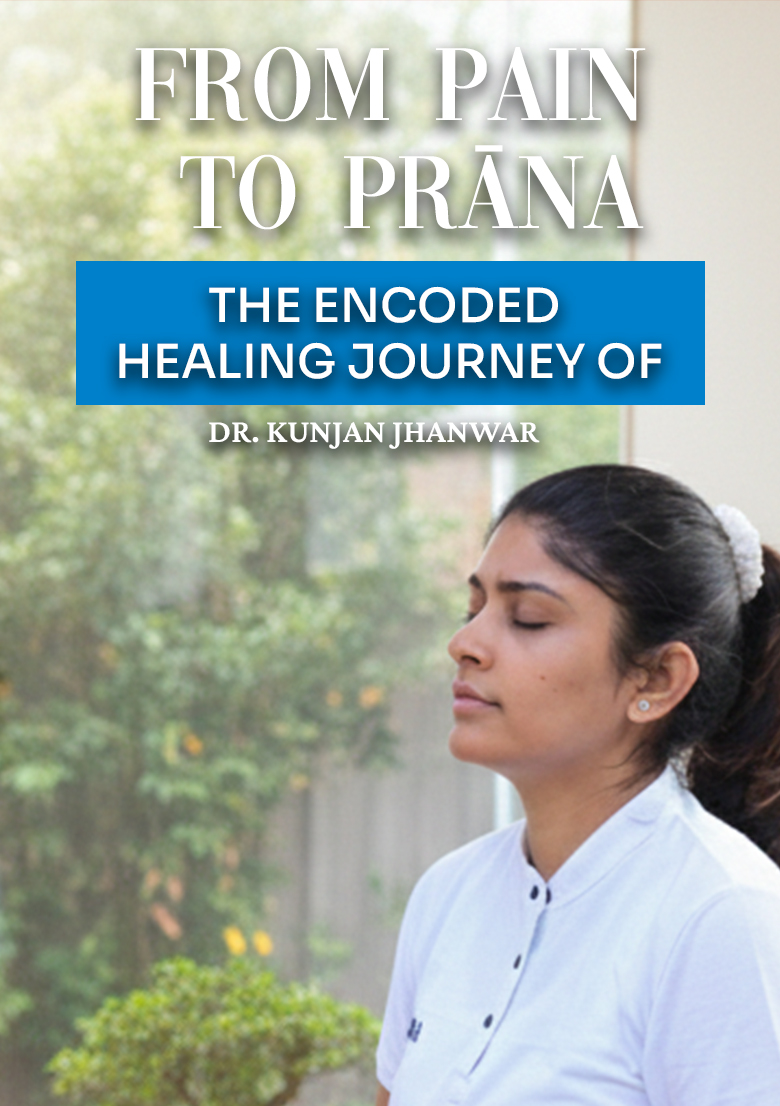
“Practice becomes firmly grounded when continued for a long time, without interruption, and with devotion.”
Dedication
Her beloved parents, whose silent strength and constant encouragement shaped the foundation of Dr. Kunjan Jhanwar’s life, are the primary focus of this biography. Their unwavering support carried her through every challenge, especially during the years when illness had taken over her body and hope seemed distant. They stood by her with patience, prayers, and belief, and even today, every achievement of hers brings tears of pride to their eyes. Their love has always been her earliest source of courage and continues to remain her greatest blessing.
To her husband, Mr. Sumit Jhanwar, this dedication holds a special place. His presence became the anchor that held her through the darkest storms. When she was sick, depressed, and life felt too heavy, his constant reassurance—his gentle promise, “tum theek ho jaogi”—kept her spirit alive. He carried her, comforted her, encouraged her, and refused to let her give up on herself. The strength of their partnership became the turning point in her journey from pain to healing.
To her affectionate Mother-in-law, Smt. Brijlata Jhanwar, whose kindness and support brought warmth and steadiness into her life, especially when she was struggling physically and emotionally. Her care made difficult days easier and reminded her that love can heal in its own quiet ways.
And to her revered Gurus — Shri Anand Dev Ji, who introduced her to the transformative path of Yoga, and Shri Brahmachari Abhishek Ji, whose guidance deepened her spiritual practice and inner clarity—this work stands as a tribute to their teachings. Their wisdom helped her rediscover herself, rise from suffering, and walk the path of healing with purpose and grace.
We offer this biography with heartfelt gratitude to all of them.
"The Self is never born, nor does it ever die. Having once been, it never ceases to be."
Phase 1: MŪLĀDHĀRA (ROOT): CHILDHOOD, SAṂSKĀRA, AND THE QUIET PREPARATION OF PURPOSE
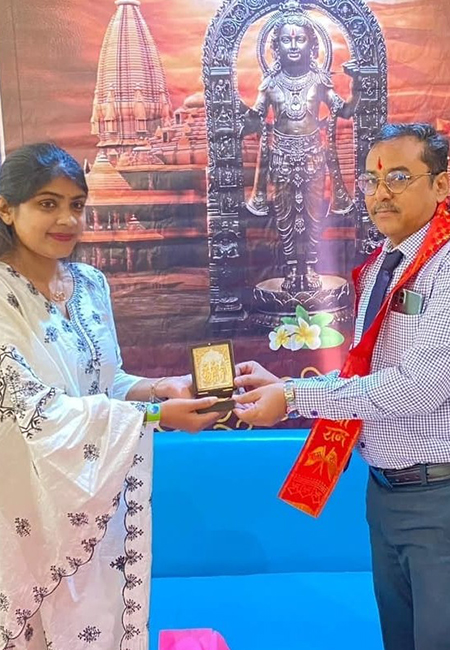
The early years of Dr. Kunjan Jhanwar should not be interpreted as only a beginning but rather as a continuation of his existence. According to the philosophical formulations of the Bhagavad Gītā and Advaita Vedānta, the act of birth itself is not a random occurrence; rather, it is the unfolding of karma that is carried forward for the sake of refinement, completion, and purpose. When viewed through this perspective, her upbringing was not a collection of unrelated events but rather a well-planned and organized environment in which self-control, discernment, and inner fortitude were silently fostered for a considerable amount of time before they were consciously acknowledged.
Dr. Kunjan was born and nurtured in Susner, a small village in Madhya Pradesh that is historically tied to the Ujjain region and is now part of the Agar district. He was born in 1982. Rather than being comprised of excess, her early world was characterized by simplicity and continuity. In her childhood, she was raised in a joint family, which consisted of her parents and three uncles. The home was expanded even further at celebrations and other occasions when the family got together. Her initial idea of collective life was created by this setting, which was characterized by the presence of individualism coexisting with shared responsibility. Daily routines, emotional intimacy, and mutual dependence were not choices but integral aspects of their lives. The establishment of psychological stability, which is the fundamental core of mūlādhāra (the root foundation), was quietly developed through this upbringing.
From the beginning, the families relied primarily on agriculture and a cloth business for their subsistence. These were not job descriptions; rather, they were experiences that people actually had. When working in fields, patience, timing, and an understanding of the natural cycles were essential. In the realm of business, one must rely on consistency, trust, and hard work without any assurances. At an early age, Dr. Kunjan observed that survival does not stem from impulses, but rather from actions sustained over time. She had been practicing the concept of niṣkāma karma, which is action without attachment to results, for a considerable amount of time preceding her encounter with the teachings of the Gītā. The work was completed, not because of applause.
“In this path, no effort is ever lost, and no step taken is ever wasted. ”
Phase 2 : SVĀDHIṢṬHĀNA (FLOW): EDUCATION, CREATIVITY, AND KARMIC REDIRECTION

The life of Dr. Kunjan Jhanwar entered a phase of mobility and expression, which is known as svādhiṣṭhāna in Yogic terms. This resembles the center of flow. This episode occurred after the roots were firmly set in Phase 1. The unfolding of this phase is a reflection of the Sāṃkhya insight that prakṛti, which is nature in motion, develops continuously, while puruṣa, which is pure awareness, remains the silent witness. This phase unfolds through education, creativity, bodily movement, and relational flexibility.
Following the completion of her education, Dr. Kunjan went on to earn a Bachelor of Commerce (B.Com) degree from the institution that is listed on her curriculum vitae. Her family made this decision after initially denying her desire to join the military. Her education in commerce helped her develop a disciplined brain in the areas of structure, accountability, and systems, which taught her to think in terms of processes, records, and overall results. What initially appeared to be secular eventually formed the foundation of her meticulous approach to preparing therapeutic interventions and her work in institutions.
Following that, she participated in the Master of Arts in Economics at Vikram University in Ujjain. This academic stage helped her develop a more complex perspective on the system, including how imbalance can lead to instability, how resources need to be regulated, and how conscious decision-making is essential to maintaining a sustainable equilibrium. With the benefit of hindsight, it is clear that Economics served as a macro-level study of equilibrium, which Yoga would later develop to teach at the micro-level of the human system.
She received a Master of Arts in Yoga from Himalayan Garhwal University, which details her further formal study in yoga. In spite of the fact that the experience draw toward Yoga developed over the course of several phases, the institutional foundation in Yoga is recognized here as a component of the educational continuum that allows this phase to transition into the subsequent phase.
“ One must uplift oneself by one’s own Self; one must not allow oneself to fall.”
Phase 3 : MAṆIPŪRA (FIRE): ILLNESS, INNER AGNI, AND THE TURN TOWARD CONSCIOUS HEALING
The third phase of Dr. Kunjan Jhanwar’s life is the most dramatic turning point in her inner life; it is a period in which the challenges she faced did not result in collapse but rather in conscious transformation. Maṭipūra, according to yogic philosophy, is the centre of agni, which is the fire that exercises control over digestion, vitality, courage, and willpower. The body and the mind both lose their resilience when this fire begins to wane. Recovery through the application of awareness and discipline transforms it into the axis of inner victory.
Dr. Kunjan’s health began to worsen in a dramatic and simultaneous manner across several different dimensions during this period, which occurred after she had married and given birth to her child. Following the delivery of her child, she endured significant physical weakness, numerous episodes of fainting, and chronic dyspnea, which eventually manifested as respiratory distress associated with asthma. The nights became particularly challenging for her; she frequently found that she was unable to lie down to sleep and instead had to remain seated while gasping for breath. This unexpected need was extremely destabilizing for someone who had previously been capable of engaging in athletic activities and demonstrating physical strength.
A deterioration in mental health occurred concurrently with the prolongation of physical suffering. Dr. Kunjan went through a period of really severe despair, which was not characterized by any external drama but rather by tiredness and solitude. She has admitted that she did, in fact, entertain ideas of terminating her life, but not out of a desire to do so; rather, she was experiencing exhaustion brought on by the agony, shortness of breath, and protracted uncertainty. A contributing factor was the prevailing social misunderstanding of the time, which often overlooked psychological distress as an illness. This misunderstanding made her internal conflict even more intense.
Note of Thanks
Dr. Kunjan Jhanwar extends her heartfelt gratitude to all those who have contributed to her life’s journey, regardless of their visibility or anonymity. She does it with a profound sense of humility and a silent thankfulness. The work that is being reflected here and the route that it mirrors are not individual accomplishments but rather collective unfoldings that have been formed by grace, support, patience, and struggle.
It is with deep appreciation that she conveys her gratitude to her family, whose presence served as a source of stability during times of uncertainty and a source of strength during times of weakness. She was able to develop, heal, and realign without fear because of their faith, perseverance, and acceptance of her throughout the process. She appreciates and expresses her tremendous gratitude for the continuous support, steadiness, and belief her husband provided during the stages when she was rebuilding her resilience breath by breath. His solitary company transformed into a pillar of stability, enabling her to engage in introspective labor.
Dr. Kunjan would also want to express her gratitude to her instructors, mentors, and guiding influences. These individuals were responsible for imparting knowledge to her in an honest manner and serving as a reminder that learning is just as much about self-control as it is about competence. Not only did their direction mold her comprehension of Yoga and healing sciences, but it also influenced the moral compass that she possessed.
She expresses her gratitude to each and every student, patient, and seeker who decided to confide in her about their experiences and challenges. Each contact helped her become more clear, increased the depth of her compassion, and strengthened her conviction that the process of healing is a collaborative endeavor that is founded on responsibility and awareness.
Last but not least, she expresses her appreciation to yoga itself, the living tradition that initially entered her life out of necessity and then developed into a purpose. Her practice of yoga instilled in her a sense of discipline, awareness, and direction, allowing her to transform difficulty into clarity and effort into comprehension.
When one holds appreciation with seriousness, it becomes a form of prayer. This expression of gratitude serves as a humble acknowledgment that no individual embarks on a journey alone.
Thank You
– Dr. Kunjan Jhanwar