“The best way to find yourself is to lose yourself in the service of others.”
Dedication
This book is dedicated to those few rare souls who quietly shaped the course of Professor Dr. Khairil Annas’s life without ever asking to be remembered. They are the mentors who opened doors of wisdom, the teachers who gave lessons beyond the classroom, and the companions whose quiet faith sustained him through life’s hardest turns.
From the corridors of Sekolah Alam Shah to the academic halls of Cambridge, from moments of celebration to seasons of solitude, there were always hands that lifted him, voices that encouraged him, and hearts that believed when the path grew uncertain. Their names may not appear in these pages, but their kindness fills every line written here.
He dedicates this work not to bloodlines or titles, but to faith, perseverance, and the divine guidance that transformed every struggle into a stepping stone. He honours the humble teachers who shaped his discipline, the elders who saw potential in his silence, and the mentors who offered truth even when it was hard to hear.
Above all, this book is a tribute to the unseen grace that directed his journey and to the quiet mercy that turned fear into fortitude, doubt into discovery, and ambition into service. For him, every success is not self-made but heaven-sent, every milestone a reminder that life’s blessings are entrusted, not owned.
May this dedication stand as an offering to all who walk unseen yet indispensable beside those who lead. May it remind every reader that greatness is never solitary , it is built by countless small acts of love, courage, and belief.
“When the world tests your worth, stand taller — for faith was never meant to kneel before fear.”
Phase 1: Foundations of Faith and Fortitude
Every great life begins with small victories that go unseen. For Professor Dr. Khairil Annas, the first triumph came long before the world knew his name. Born in a modest home where simplicity reigned and devotion was inherited, he learnt early that blessings were not counted as possessions but as perseverance. There were no luxuries, no shortcuts, only a mother’s prayer, a father’s quiet discipline, and a boy’s determination to rise through effort and grace
The First Light : A Child of Promise
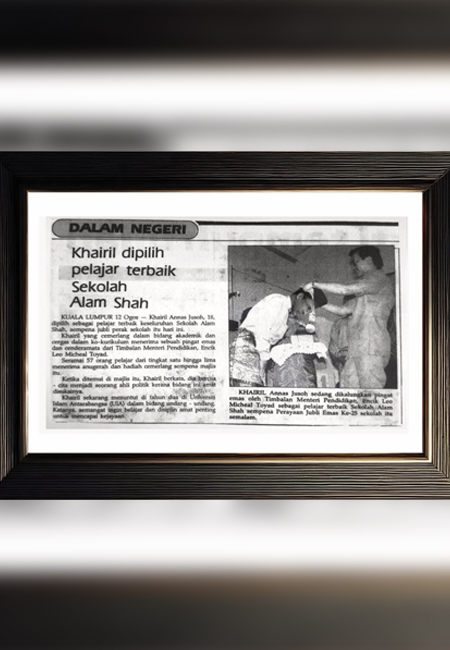
School for him was never routine; it was a revelation. While other children played, he found wonder in words and equations, treating every book as a doorway to possibility. noticed how quickly he absorbed lessons and how naturally he excelled. By the time he completed his primary school, he had achieved an extraordinary feat: 5 A1 distinctions, an accomplishment that placed him among the finest students in the nation.
That success changed the course of his life. It caught the attention of selectors for Sekolah Alam Shah Kuala Lumpur, one of Malaysia’s best boarding schools. Admission to the school was a dream reserved for the most exceptional. When the letter arrived, his parents wept, part pride, part prayer. For them, this was divine confirmation that their son was, as they had always believed, “a gift from God”.
The Call to Alam Shah
In 1984, a young Khairil Annas, only 13, stepped into the gates of Sekolah Alam Shah. The grandeur of its halls contrasted sharply with the simplicity he had known at home. The school was a crucible of excellence, designed to shape the nation’s next generation of thinkers, leaders, and innovators. Yet for him, it would become far more; it would be the place where endurance met purpose.
“Power does not reveal character — it refines it. Leadership begins the moment wisdom meets humility.”
Phase 2 : Into the Corridors of Power: The Scholar Who Served
The next chapter of Professor Dr. Khairil Annas’s life was not a leap of ambition but a quiet acceptance of destiny. The boy who once studied beneath an oil lamp and debated ideas in modest classrooms was now walking through the corridors where national visions were shaped. What had begun as an academic pursuit of justice was now unfolding into a lifetime of service to a nation he loved.
From Academia to Service
After returning from the University of Cambridge, he was immediately recognised as a rare kind of scholar, one who combined legal intellect, ethical conviction, and administrative foresight. His mentors saw in him the precision of a jurist and the empathy of a reformer. Soon after being admitted as an Advocate and Solicitor of the High Court of Malaya (16th January 1996), he began his career as a young lawyer running his legal firm ( From 1997 until 2003) while also operating as a Consultant Of Strategic Management / Practitioner Of Dr. Edward De Bono’s Creative & Lateral Thinking Method Coach / Trainer 10 at his consultancy company, he was approached to work together with the Ministry of Education, where he contributed to curriculum reforms and policy frameworks designed to strengthen Malaysia’s educational integrity. Also later at the Ministry Of Defence.
In those formative years, his approach stood out. He refused to treat bureaucracy as a machine; to him, it was an ecosystem of human aspirations. He often told his colleagues, “A document without conscience is a dead document.” His insistence on clarity, fairness, and ethics began to attract the attention of senior officers in Putrajaya.
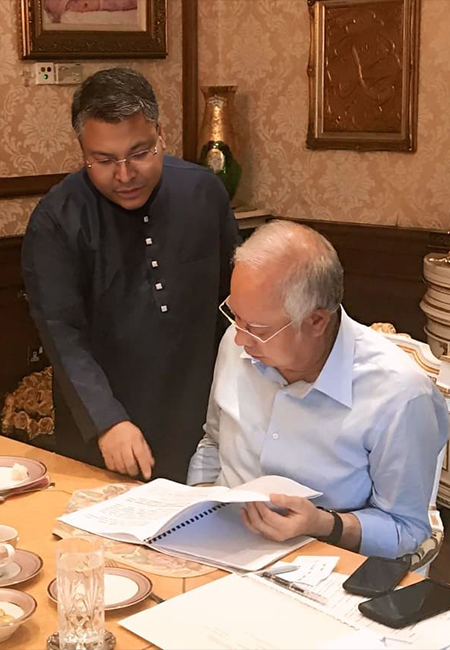
His professionalism soon led to a historic transfer , first to the Deputy Prime Minister’s Office and later to the Prime Minister’s Office ( PMO ), where he would spend over two decades shaping ideas, crafting policies, and guiding the nation’s intellectual compass.
“The true purpose of intellect is not to dominate, but to design — to build structures that serve humanity long after the thinker is gone.”
Phase 3 : The Architect of Thought and Service

Leadership is often imagined as a podium: loud, commanding, visible. But for Professor Dr. Khairil Annas, it was something quieter and far more enduring. He believed leadership was about architecture, not applause, about designing systems of thought and service that could outlast individuals. From the polished chambers of Putrajaya to the academic halls of Kuala Lumpur, he became the silent architect of Malaysia’s ethical governance model, bridging policy with principle and intellect with integrity.
The Visionary Advisor
When he assumed his role as Advisor to the Prime Minister of Malaysia, he entered one of the most demanding environments in public life. Policies, politics, and people all converged at complex intersections. However, instead Advocate and Solicitor of the High Court of Malaysia 18 of reacting to chaos, he introduced a language of clarity. He often reminded his team, “In governance, precision is kindness, because unclear ideas lead to unjust outcomes.”
Under his direction, the Policy and Research Division evolved into a nucleus of thought leadership. What had once been a bureaucratic wing began functioning like a think tank , producing data-driven reports enriched with ethical insight. Initiatives promoting educational reform, interfaith dialogue, youth empowerment, and moral leadership in governance bear his signature.
He worked tirelessly to introduce frameworks that infused national planning with social conscience. He would say, “Development is not progress if it forgets the people it was meant to serve.” In a world obsessed with economic metrics, he redefined success as the well-being of citizens and the dignity of labour.
Those who worked under him describe his style as intellectual serenity. He rarely raised his voice, but his words carried weight. When others argued policy, he discussed philosophy; when meetings became technical, he refocused them on morality.
Note of Thanks
When we think about the amazing life of Professor Dr. Khairil Annas, we can’t help but stop and be thankful. We are grateful for the paths he walked, the burdens he carried, and the legacy he left behind for his people. This thank-you note is not a formal gesture; it is an emotional acknowledgement of a life that gave more than it ever asked for.
As a Malaysian citizen, he should be thanked first for using his intelligence and energy to help the country. He was always there, from the classroom to the cabinet room, from writing laws to writing poems. His presence was steady, constant, and quietly life-changing. People owe him thanks not only as an institution but also as a person, because his policies, speeches, and cultural projects have affected the lives of thousands of Malaysians.
He also deserves thanks for being a teacher and a mentor. Many students remember how he made challenging topics come to life, how he encouraged questions that led to truths, and how he never let knowledge stay abstract. His guidance helped shape civil servants, lawyers, and leaders who still use what he taught them. Because of this, every classroom he went into is still brighter in my mind.
We should thank him for listening to the quiet voices of forgotten artists and ensuring the preservation of their songs and stories. His work with veteran seniman and seniwati, as well as his dedication to heritage projects like Gema Lebaran Lagenda, were acts of kindness that kept Malaysia’s soul alive. The country thanked him for protecting beauty at a time when usefulness often took over imagination.
His work as a scholar and author lives on in the pages of more than twenty-one books and thousands of national documents. He gave Malaysia not just rules and policies but also ideas and values. His writings on leadership, moderation, loyalty, and heritage are still vital in universities, ministries, and communities. The country owes him thanks for his contribution because his words helped them understand.
We should also thank him for being a strong person. The challenges he faced, the burden of responsibility, the scrutiny of being close to power, and the pain of being misunderstood could have made him feel hopeless. But he chose to stay strong instead of running away and to serve instead of being quiet. His quiet strength taught that dignity comes not from avoiding struggle but from turning it into something that helps others.
Lastly, we should thank him for being a kind person. He lived as proof that we can be a statesman and an artist, a lawyer and a poet, and an administrator and a teacher, all at the same time. His life was a mix of intelligence and kindness, vision and humility, and old and new ways of doing things.
This note of thanks is for every Malaysian who unknowingly carried his influence in their daily lives, not just schools or students. It is written with feeling for a man who did a lot of charitable work but kept it quiet because he was humble.
To Professor Dr. Khairil Annas, thanks are not enough, but they are the best gift: thanks for his mind, his music, his words, his loyalty, his bravery, and his love for Malaysia that will never die.
Thanks,
– Dr. Khairil Annas