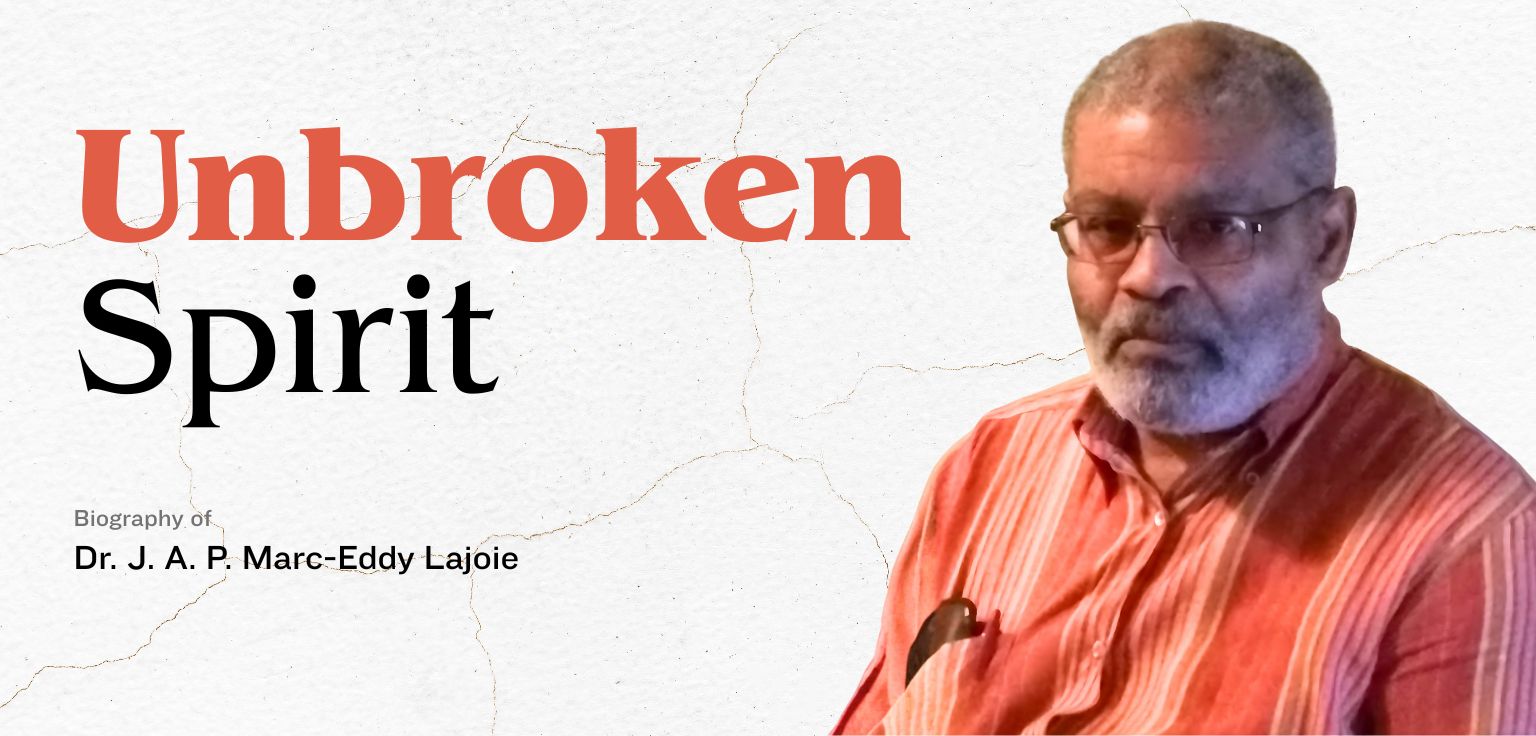
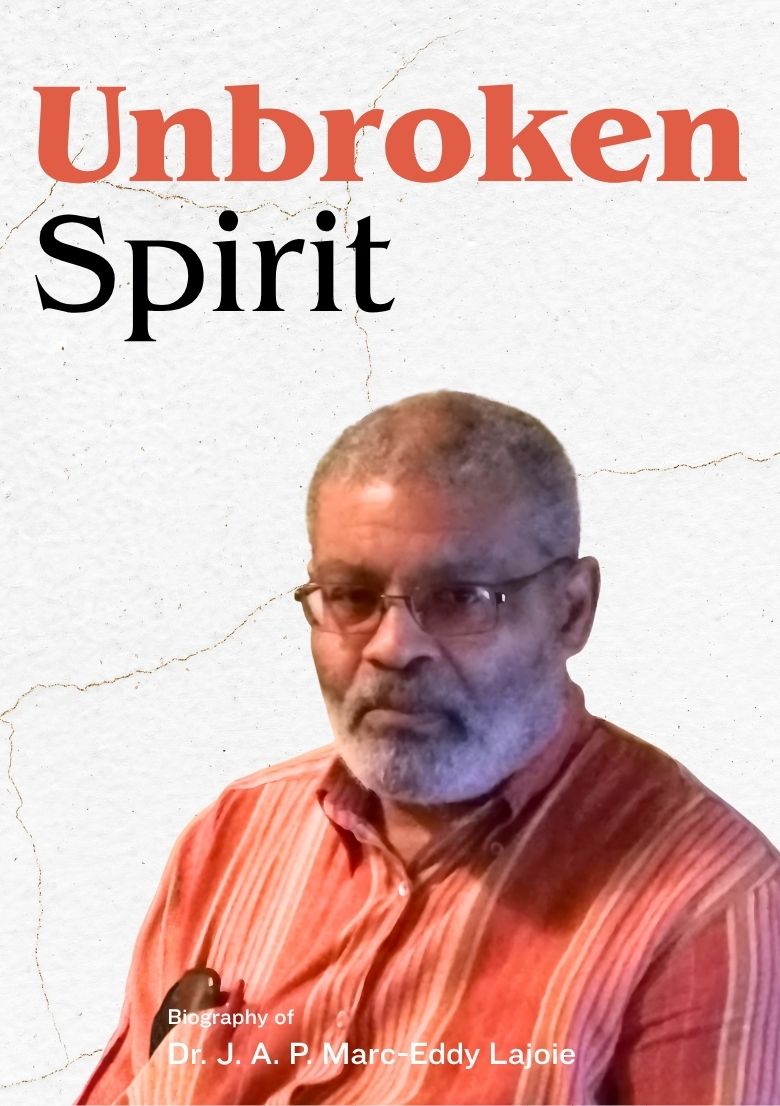
“A life is not measured by titles or trials, but by the faith that carries us forward, the respect we give to others, and the love we pour into every act of service.”
Introduction
Every life has its own rhythm, a melody shaped by family, faith, hardship, and triumph. The life of Dr. J. A. P. Marc-Eddy Lajoie is one such melody—one that rises from the soil of Haiti, flows across borders, and resonates with the universal themes of resilience, respect, and service. His story does not begin with prestige or privilege but with the deep roots of a family that prized knowledge, dignity, and compassion above all else.
Dr. Lajoie was born on August 24, 1954, in Port-au-Prince, Haiti, into a lineage that carried the essence of strength and vision. His paternal grandfather, Léon Lajoie, was a respected Black businessman, a man whose enterprise and courage made him a figure of hope in his community. Alongside him stood Anna Beauboeuf Lajoie, a teacher whose nurturing presence shaped young Marc-Eddy’s early worldview. On his maternal side, his grandfather, Roger Gousse, was a teacher of Latin—passing down discipline and intellectual rigor—while his grandmother, Mercedes Alexandre Gousse, stitched life together with her craft as a seamstress. Together, these figures formed a circle of inspiration that showed him that education, perseverance, and service were not optional but essential.
His parents carried this torch further. His father, Marc-Gérard Lajoie, born in 1926, was a statistician who stood as a pillar for his five children. Under his guidance, the family flourished, producing doctors, a nurse, a lawyer, and a military professional. His mother, Marie Emmanuelle Jeannick Gousse, born in December 1932 and later working at the World Trade Center in New York, worked at the World Trade Center in New York, embodying courage and sacrifice until her passing in 2011. These two anchors gave young Marc-Eddy the grounding values of respect, responsibility, and the unwavering pursuit of a better life.
He first attended Saint Louis of Gonzaga School, where his third-grade teacher, Mrs. Cameau, awakened in him a lifelong respect for education. From the 8th grade through his graduation, he continued at Petit Séminaire Collège Saint Martial on Rue des Miracles in Port-au-Prince. Her belief in his potential awakened in him the awareness that teachers could not only impart knowledge but also shape destiny. That awareness became a compass he would follow through his own roles as teacher, lawyer, and community servant. But life was not limited to classrooms. Haiti, with its vibrant culture and complex history, shaped him in equal measure. The nation’s struggles for freedom, its triumph of independence in 1804, and its ongoing quest for dignity resonated deeply with him. From childhood, he learned to equate freedom with responsibility—to recognize that fairness denied to one was a wound carried by all. This belief became the seed of his legal passion.
In 1982, he graduated in Haiti as an attorney, embracing law as both a career and a calling. That same year, he migrated to the United States, carrying not only his degree but also the heritage of discipline, faith, and determination instilled in him by his family. His path in America was not easy, but it was purposeful. He pursued studies at the Allen School for Physicians’ Aides in Jamaica, New York, where he trained as a Medical Laboratory Technician in 1986. The doctor who inspired him the most during this time was Dr. William B. White, a Montserrat native, whose mentorship encouraged him to become not only a Medical Laboratory Technician but also an international Phlebotomist. Under the mentorship of Dr. William B. White, a Montserrat native, he discovered that science, like law, was a tool of service—a way of protecting life, dignity, and health.
Later, his academic journey took him to the New York Institute of Technology and eventually to Widener University in Pennsylvania, where he earned his Bachelor of Arts between 2001 and 2002. He further advanced his studies by completing a Master in Education at Saint Joseph’s University in Philadelphia on September 15, 2012. During this period, Dr. Encarnation Rodriguez played a vital role as an influential teacher whose guidance deeply impacted his pursuit of educational leadership. This milestone deepened his commitment to the field of learning and leadership. His dedication to learning was unrelenting, driven by a vision of serving others not just in courtrooms or laboratories but also in classrooms. His years as a French teacher at Cardinal Dougherty High School in Philadelphia (2005–2006) stand as a testament to that vision. His students remembered his classes with joy, and his principal, Dr. Rooney, praised him for being more than a teacher—for being a guide who made knowledge come alive.
“The strength of a man is often born from the quiet sacrifices of those who came before him—family, faith, and legacy become the soil where destiny takes root.”
Phase 1: Roots of Wisdom, Seeds of Destiny
Every life begins not merely with birth, but with the inheritance of a legacy. For Dr. J. A. P. Marc-Eddy Lajoie, that beginning was marked on August 24, 1954, in Port-au-Prince, Haiti, where his life was etched in the resilience of his grandparents, the sacrifices of his parents, and the unyielding spirit of a family that believed deeply in education, respect, and service. To understand his later triumphs as a lawyer, educator, and servant of community, one must first walk the paths of those who laid the foundation of his character.
On his father’s side, Marc-Eddy inherited the spirit of enterprise and courage from his grandfather, Léon Lajoie. In a time and place where opportunity was scarce and challenges were plenty, Léon stood out as a respected Black businessman in Haiti. His name carried weight not just because of wealth, but because of dignity. He showed that a man could rise above circumstances if he carried himself with vision and integrity.
His work in Port-au-Prince was not just about business transactions; it was about opening doors for others. Léon became an emblem of possibility, a figure who proved that one’s color or background did not define one’s future.
Standing beside Léon was Anna Beauboeuf Lajoie, his wife and Marc-Eddy’s grandmother. She was not merely a grandmother but a teacher in the truest sense. Anna carried the dual responsibility of nurturing a family and shaping minds. In Port-au-Prince, she was known not only for her knowledge but for the gentleness with which she passed it on.
It was Anna who helped raise young Marc-Eddy, embedding in him the habit of respect, the love of learning, and the discipline of service.
Anna’s presence was profound. For every child she raised and every lesson she taught, she left an imprint that would later appear in the way her grandson respected teachers, revered mentors, and eventually became an educator himself.
On his mother’s side, another set of influences shaped his values. His maternal grandfather, Roger Gousse, was himself a teacher. Not just a teacher of ordinary lessons, but of Latin—a language known for its rigor and discipline. To sit under Roger’s guidance was to understand the beauty of structure, the weight of history, and the discipline required to master something challenging.
“In the heart of childhood, a single teacher’s faith and a family’s guidance can awaken the courage to dream and the strength to serve.”
Phase 2: The Classroom of Life: Lessons That Shaped a Calling
Childhood is the time when seeds of character are planted, often unknowingly, through simple gestures, everyday discipline, and the quiet encouragement of teachers and elders. For Dr. J. A. P. Marc-Eddy Lajoie, those formative years in Port-au-Prince, Haiti, were not just about going to school and learning lessons from books; they were about discovering who he was and what he was meant to become.
Even as a boy, he was raised in an environment where respect was lived out daily, teaching him that life was about honoring the past and preparing to serve the future.
Growing up in Port-au-Prince in the 1960s meant being surrounded by both the beauty and the struggles of Haiti. The narrow streets, the vibrant markets, the rhythm of Creole and French spoken all around, and the resilience of the people became the backdrop of his childhood.
In a country shaped by its proud history of independence but weighed down by economic struggles, children learned early that perseverance was not optional—it was necessary. For young Marc-Eddy, this atmosphere taught him to watch carefully, to listen deeply, and to respect the dignity of every person he encountered.
Dr. Lajoie first attended Saint Louis of Gonzaga, where he encountered Mrs. Cameau, his third-grade teacher. Her belief in his potential instilled in him an early conviction that teachers could not only impart knowledge but also shape destiny. This experience formed a cornerstone of his educational journey.
From the 8th grade through his graduation, he continued his education at Petit Séminaire Collège Saint Martial on Rue des Miracles in Port-au-Prince. Rooted in Catholic tradition, the institution instilled in him discipline, intellectual rigor, and moral grounding. It also gave him the confidence to grow as a student and nurtured the qualities of leadership and service that would later define his calling.
Education was the golden thread in his early life, and nowhere was that more evident than in his time at Saint Louis of Gonzaga, where he completed much of his primary and secondary education.
This institution was not just a building with classrooms; it was a sanctuary where boys were molded into men of character and discipline. The Jesuit tradition emphasized intellectual rigor, respect, and service, and it resonated strongly with the values already instilled in him at home.
“Law was never a pursuit of power for him—it was the language of fairness, the defense of dignity, and the promise that no one should stand alone.”
Phase 3: When Justice Found Its Voice
Every young person reaches a moment when the lessons of childhood begin to crystallize into a vision for the future. For Dr. J. A. P. Marc-Eddy Lajoie, that moment arrived as he transitioned from the formative embrace of family and teachers in Haiti into the larger world of adulthood. The seeds of justice, respect, and service that had been planted during his early years began to push through the soil, and by the early 1980s, they blossomed into a clear calling: the law.
This was not an accidental choice, nor was it one made lightly. It grew naturally from the boy who once bristled at unfairness, the student who had seen teachers transform lives, and the young man who had watched his parents and grandparents live with dignity even in difficult times. For him, law was never about power or prestige; it was about fairness, about protecting those who could not protect themselves, and about bringing dignity into places where it had been denied.
In Haiti during the 1970s and early 1980s, young professionals were growing up in a society marked by both resilience and struggle. The nation’s proud history as the first Black republic stood as a constant reminder of the strength of its people, but the economic and political climate often left citizens vulnerable. In this setting, the legal profession carried a particular weight: lawyers were not only advocates in the courtroom but also symbols of hope for ordinary people.
Marc-Eddy absorbed this atmosphere deeply. He saw how communities looked to men and women of law not simply for technical advice but for guidance, reassurance, and protection. To him, stepping into law was stepping into a lineage of guardianship—a way of extending the values of fairness and respect he had learned as a child into the wider world.
On July 11, 1982, in Haiti, Marc-Eddy achieved one of the first major milestones of his life: he graduated as an attorney. For his family, this was a moment of immense pride.
On July 11, 1982, in Haiti, Marc-Eddy achieved one of the first major milestones of his life: he graduated as an attorney. For his family, this was a moment of immense pride. For his father, who had worked tirelessly to raise five children into professionals, this was confirmation that discipline and sacrifice bore fruit. For his late mother, whose courage and labor had paved opportunities, this was a legacy fulfilled.
For Marc-Eddy himself, the day was more than a celebration of academic achievement. It was the beginning of his vow to live not just for himself but for others. He stood among his peers not as one who sought status, but as one who understood that every case he would touch and every client he would represent carried within it the hope of justice.
A Note of Thanks
As the writer of this biography, I extend my deepest gratitude to all who have been part of Dr. J. A. P. Marc-Eddy Lajoie’s remarkable journey. This story is not simply about one man’s resilience and faith, but about the many people who shaped him, supported him, and walked beside him along the way.
First and foremost, heartfelt thanks are owed to his devoted wife, whose steadfast love and loyalty over more than four decades have been a cornerstone of his life. To his children, who reflect his values of discipline, respect, and resilience, and to his grandchildren, who bring him immense joy and hope—this legacy truly lives on through them.
Acknowledgment must also be given to his parents and grandparents, whose guidance and sacrifices instilled in him the foundation of character that carried him through every trial. Gratitude is extended as well to the mentors and teachers who recognized his potential and helped him chart the path of service and knowledge.
Finally, thanks go to the Haitian community and all those who entrusted him with their struggles. Above all, this biography is a testimony of God’s grace, the anchor of his strength and purpose.
Thanks
Dr. J. A. P. Marc-Eddy Lajoie