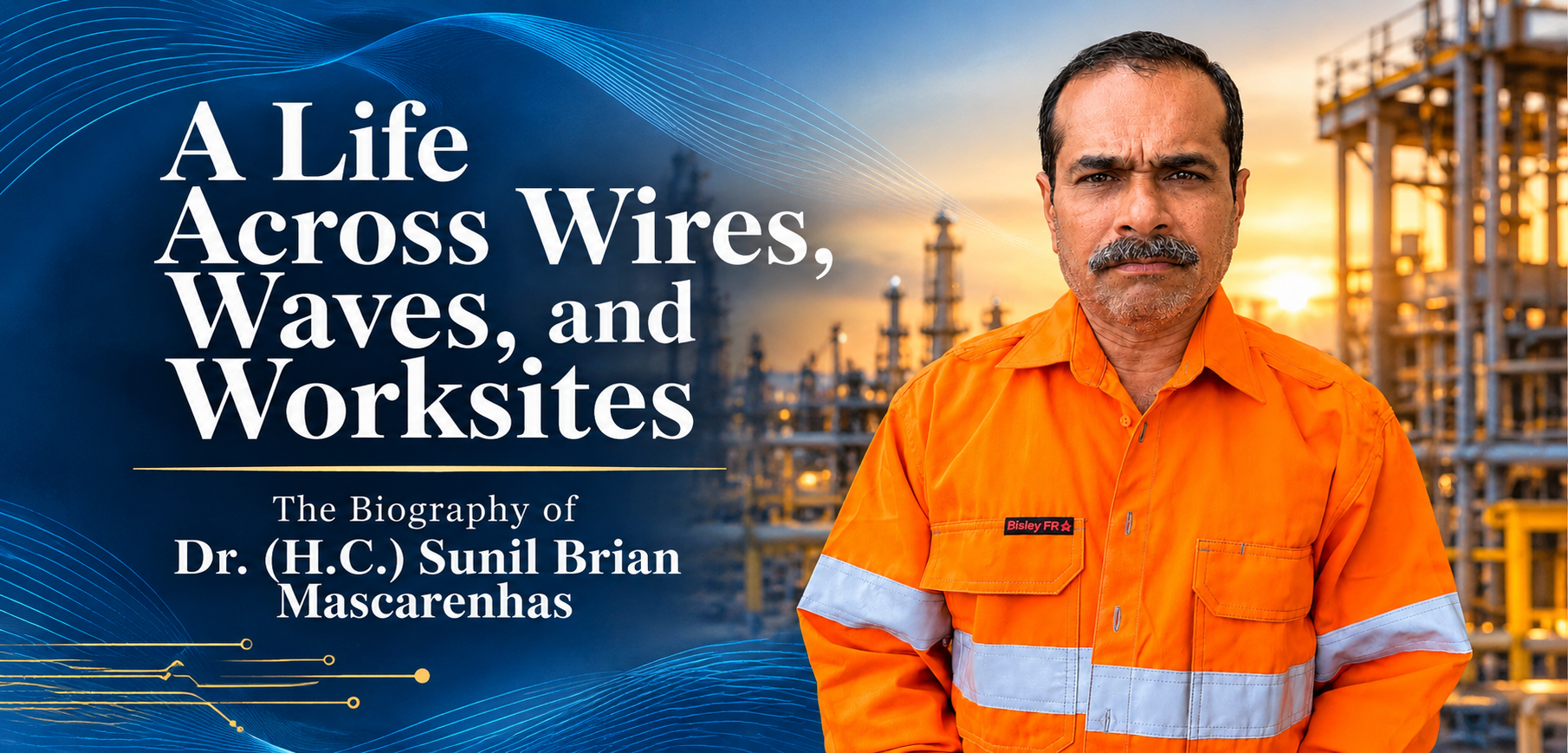
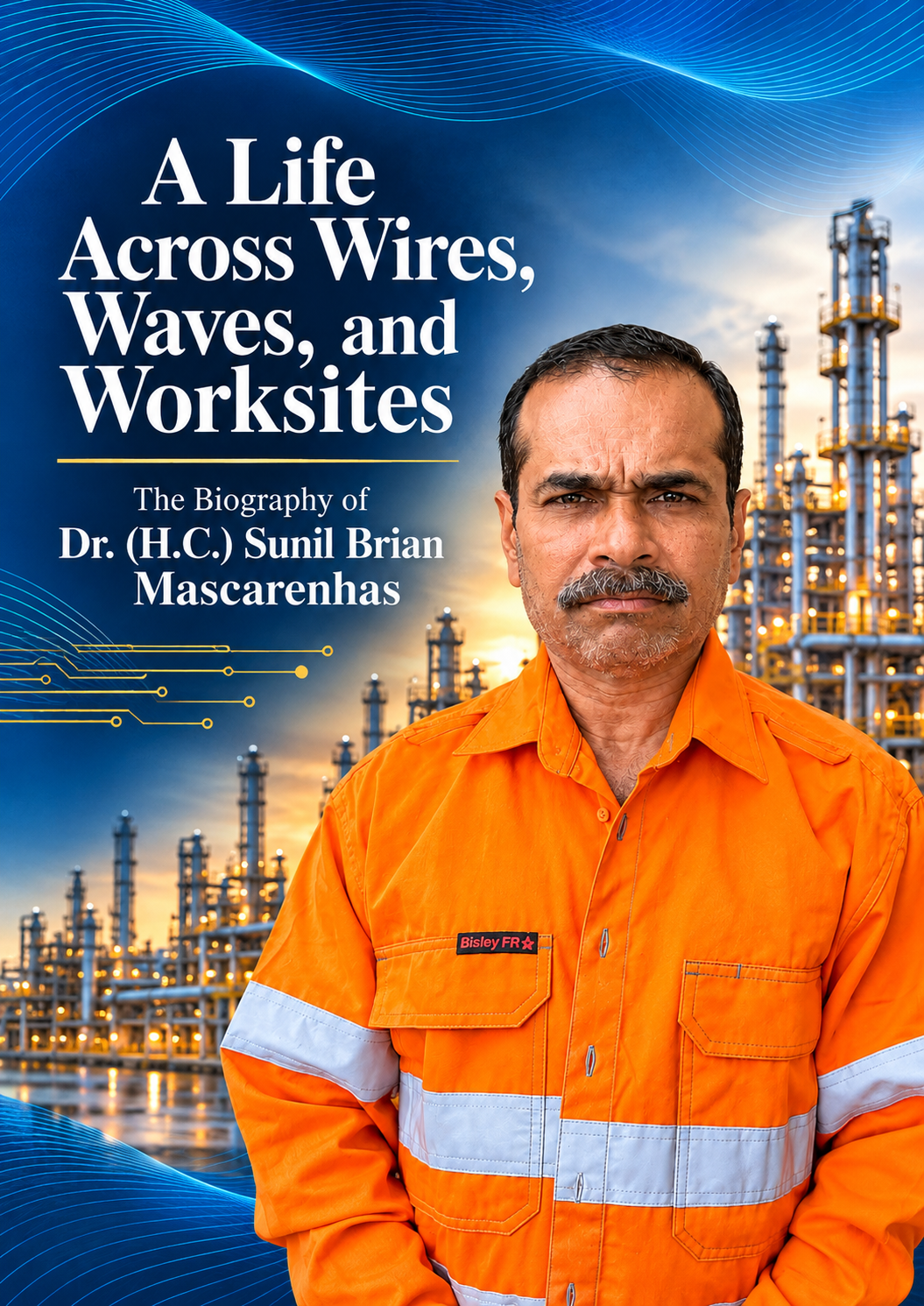
“I discovered that the smallest details often hold the answers, whether in a machine, a moment, or a person.”
Introduction
Behind the title, Dr. Sunil Brian Mascarenhas is just a curious soul who never stopped asking “why” and refusing to give up. From his beginnings in Bombay to establishing himself as an electrical contractor and registered builder in Perth, Australia, his path has been defined by continuous learning, adaptation, and the ability to find solutions in demanding circumstances.
Born in Bombay, he spent his formative years surrounded by family, learning the importance of perseverance, acceptance, and making the best use of available opportunities. The influence of his grandmother, parents, and extended family played an important role in shaping his outlook. His early exposure to practical work through his uncle from Mazagaon Dock Limited introduced him to the value of hands-on skills and encouraged his interest in creating and repairing things.
Although his childhood ambition was to become a ship officer, circumstances led him towards another path. With a background in Physics and a growing interest in electrical systems, he chose the electrical field as a profession where his scientific understanding could be applied in practical ways. His decision marked the beginning of a career that would take him from India to Oman, the United Arab Emirates, and eventually Australia.
Starting as a trainee electrician, Dr. Sunil gradually developed his technical abilities by working across different environments and taking on responsibilities beyond his initial training. His practice embraced oilfields, offshore ships, marine systems, electrical repair, building works, and industrial equipment. Through these roles, he developed a broad understanding of electrical and mechanical systems and became known for approaching problems with practical thinking and persistence.
His years working in offshore and oil and gas environments brought him into situations where every technical decision carried importance. Handling systems such as generators, compressors, navigation equipment, and other essential machinery required more than technical knowledge; it demanded careful judgement, adaptability, and the ability to find practical solutions when the usual options were not available.
He moved to Australia and began rebuilding his professional position in a new country. Adapting to Australian requirements, obtaining relevant qualifications, and establishing himself in a different professional environment became an important part of his development. That steady groundwork led to Velanka Electrics, his first venture as a licensed electrical contractor, and eventually to his registration as a builder, opening a new chapter in construction.
He has never kept his expertise to himself. Through his work as an electrical instructor, he supported apprentices at crucial stages of their careers, encouraging them, challenging them, and preparing them for the demands ahead. For him, maintaining high standards and helping others rise are not separate duties; they are two sides of the same professional conscience.
"Before a person learns to build things with their hands, they learn the values that shape the way they stand in the world."
Phase 1: The Foundations of Character in Bombay’s Close-Knit World
Long before technical systems, construction sites, offshore platforms, or professional responsibilities became part of Dr. Sunil Brian Mascarenhas’s world, there was Bombay. Born there in 1967, his earliest understanding of family, belonging, discipline, and practical living began to take shape. He would spend all his years before migration connected to the city, sometimes moving in and out of it because of work later in adulthood, but Bombay remained the place where his foundations were formed.
His early education began at St. Mary’s in Byculla, Bombay. He later continued his secondary schooling in St. Anthony’s Versova, Andheri West, where he completed high school. These years belonged to a period when his surroundings were not always easy. He remembered Bombay as having a challenging atmosphere, yet his childhood was not defined only by difficulty. Much of its warmth came from the people around him and the family environment in which he was raised.
His father, Lawrence Mascarenhas, was originally from Bombay and had completed his education through Madras University. His work eventually took him to Kuwait, where he was employed as a cargo loading supervisor. Because his father spent considerable time away, Dr. Sunil’s childhood did not follow the conventional pattern of growing up continuously under one roof with both parents. Years later, he would speak of his father with the knowledge that he was no longer alive, carrying the reality of that loss alongside memories of the family he came from.
His mother, Grace Mascarenhas, provided another important presence in his early life. She worked as a teacher before retirement and continued living in Bombay. Education was therefore not something distant from the household. It was part of the environment around him, even though his own route through learning would later take a less conventional form.
A large part of his childhood was spent with his grandmother. He later returned to live with his mother and his two brothers, but those earlier years remained significant because of the kind of family atmosphere surrounding him. His mother came from a family of three sisters and three brothers, which meant that he grew up within a large joint family rather than in isolation.
He remembered that period as enjoyable. There were many relatives around him, but what mattered most was not simply the size of the household. It was the way he was received within it.
His grandmother became his earliest role model. His aunts and uncles also occupied an important place in his upbringing. Although his surname was different from theirs, they never allowed that difference to make him feel separate. In his own recollection, they treated him as one of their family and never made him feel like an outsider. That sense of acceptance carried emotional weight. A child does not always remember every conversation or every ordinary day, but he remembers whether he belonged. Dr. Sunil knew that he did.
“Sometimes the path we imagine changes direction, but the purpose behind our dreams continues to guide us towards where we are meant to grow."
Phase 2 : When a Maritime Dream Found a Technical Path
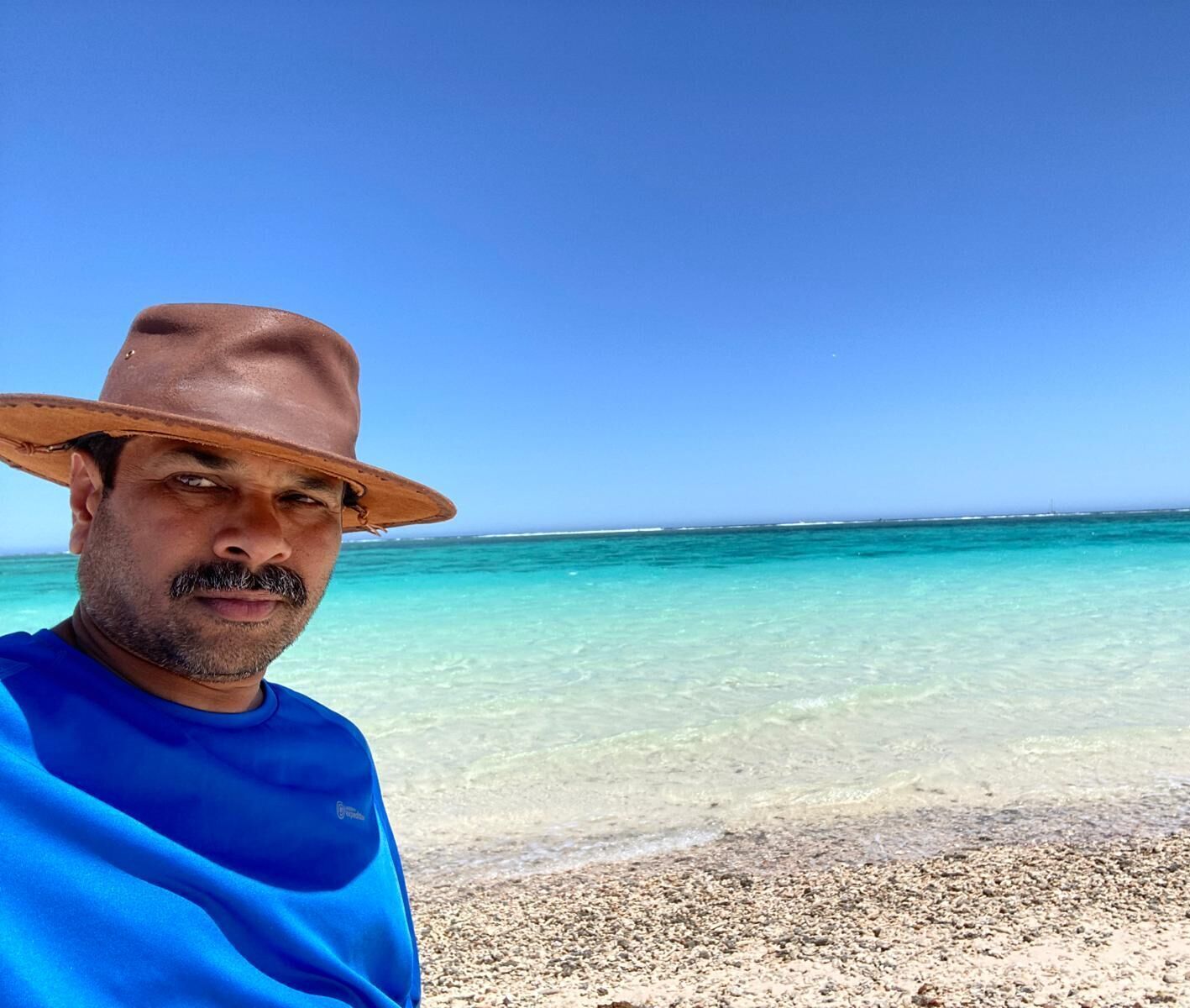
Long before electrical work became his profession, Dr. Sunil Brian Mascarenhas had imagined a very different future for himself. His ambition was to become an officer on a ship. The sea appealed to him strongly enough that his academic choices were shaped around that goal. In India, pursuing an officer’s position aboard a vessel required a foundation in science, particularly Physics, and he deliberately moved in that direction.
Physics suited the way his mind worked. It dealt with principles that could be understood, tested, and applied, and it also kept open the possibility of entering the maritime profession he wanted. He pursued a Bachelor of Science in Physics, completing his higher studies through correspondence in Bombay. His academic route demanded personal discipline because his studies were not separated neatly from the other responsibilities beginning to enter his life. He had to continue learning while also deciding how he would establish himself professionally.
The ambition to become a ship officer, however, came up against a practical reality. The required training demanded financial resources that his family could not provide. Dr. Sunil spoke plainly about that limitation. It was not a lack of interest or willingness that stood in the way. The expense attached to the route was beyond what was realistically available to him at the time.
That moment could easily have ended the dream altogether, but a good friend offered another way of thinking. Instead of remaining fixed on one route, he was encouraged to consider a Plan B and identify a technical field that could provide a future without demanding such heavy financial investment at the beginning.
Electrical work emerged as the most natural alternative.
The decision was not random. He already understood the close relationship between Physics and electrical principles. Rather than abandoning what he had studied, he found a profession in which that knowledge could still be useful. What changed was the route, not his interest in technical understanding.
Entering the electrical trade required another adjustment. At nineteen, he found that he was already considered too old for the conventional apprenticeship route available in India. Once again, the straightforward option was closed. He therefore chose the alternative available to him: two years of full-time technical training followed by one year of apprenticeship.
From 1987 to 1989, he completed his Trade Certificate as an electrician. At the same time, he continued working towards his Bachelor of Science rather than setting it aside. His degree studies extended from 1984 to 1990, combining academic learning in Physics with the increasingly practical demands of electrical training.
“True skill is not created in a single moment; it is built through every task accepted, every lesson learned, and every problem patiently understood.”
Phase 3 : Building Expertise Through the Discipline of Practical Learning
The first workplace placed Dr. Sunil Brian Mascarenhas in a position where knowledge had to become useful. In August 1989, he joined Earl Bihari Pvt. Ltd. in Bombay as a trainee electrician. His initial responsibility was straightforward: maintain the company’s electrical equipment. Yet the nature of the workplace soon widened what was expected of him. The company operated around the clock, and there was always something that needed attention. Restricting himself to a single trade was neither practical nor useful in such an environment.
That became one of the most valuable aspects of his early working years. When another task appeared, he learned to deal with it. Electrical work remained his foundation, but he gradually became familiar with welding, fitting, mechanical work, and hydraulics. Much of this knowledge came directly from working alongside equipment and people rather than remaining within the boundaries of one job description. He later summed up those years simply as learning on the job.
There was a practical intelligence developing within that routine. A machine rarely presented itself as an isolated electrical problem. One fault could involve a mechanical component, another could require fitting, and another might demand an understanding of how several systems worked together. The more Dr. Sunil encountered such situations, the more comfortable he became with looking beyond the obvious fault. The broad technical range he would carry into later work began here, in an environment where being useful meant being willing to learn.
By May 1990, his responsibilities changed considerably when he joined Hindustan Fabricators in Bombay. He entered the company as a foreman, remaining there until May 1991. The position moved him beyond the duties of a trainee and placed him closer to the wider demands of work taking place on-site. He was responsible for structural and fabrication activities as well as the electrical equipment used in those operations.
The range of machinery around him continued to grow. His work included installation and maintenance connected with structural fabrication, including sugar plants and storage sheds. Equipment such as welding machines, grinders, drilling machines, and window air conditioners also required maintenance.
These were not neat classroom exercises with predetermined answers. Industrial equipment had to function so that work could continue. Understanding the electrical side was valuable, but knowing how equipment behaved in actual use mattered just as much. Dr. Sunil became accustomed to examining what was happening in front of him, identifying where attention was required, and working through the problem rather than stopping at the boundary of his original training.
His technical exposure eventually extended to machinery such as lathes, surface grinders, milling machines, DME power presses, blast furnaces, and acid baths. The variety is significant because no single type of equipment defined his early working knowledge. Each system presented different operating demands, and each added another practical layer to what he understood about industrial environments.
Note of Thanks
With sincere appreciation, Dr. Sunil Brian Mascarenhas acknowledges the many people who have aided his development through their backing, direction, motivation, and company at different points in his life.
He expresses gratitude to his parents, Lawrence Mascarenhas and Grace Mascarenhas, whose influence remained an important part of his upbringing. Their values and the foundation they provided helped shape the principles he continues to carry with him.
He also remembers his grandmother, aunts, and uncles, whose care and acceptance gave him a strong sense of belonging during his early years. Their encouragement and the kindness they showed became meaningful parts of his personal development. Among those who touched his life, he remembers Albert Einstein, a teacher whose wisdom guided his learning and helped form the thoughtful approach he still carries today.
Dr. Sunil extends his appreciation to the friends, colleagues, and professionals who shared their knowledge, offered advice, and supported him throughout his professional path. He recognizes that many individuals contributed in different ways, whether through guidance, a helping hand, or a few important words at the right time.
He is thankful to the people he worked alongside in different countries and industries, including those who were part of his time in India, Oman, the United Arab Emirates, and Australia. The connections formed through these years provided valuable lessons and opportunities to continue learning and improving.
He also expresses gratitude to the apprentices and students he taught, as they became part of his own learning as an instructor. Teaching allowed him to share his knowledge while understanding the importance of patience, communication, and responsibility.
Above all, Dr. Sunil values the support of his family, including his children, Ashley and Shania, whose presence continues to bring meaning to his personal world.
He believes that no person moves forward entirely alone. Every contribution, whether large or small, deserves to be remembered. This note of thanks is his acknowledgement of all those who offered support, encouragement, and inspiration along the way.
thanks,
– Dr. (H.C.) Sunil Brian Mascarenhas

AIMLAY is a leading global education platform empowering ACADEMIC and EXPERIENTIAL learners, uniquely focused on recognizing knowledge gained through experience and building a diversified community of doctorates and aspiring researchers.