
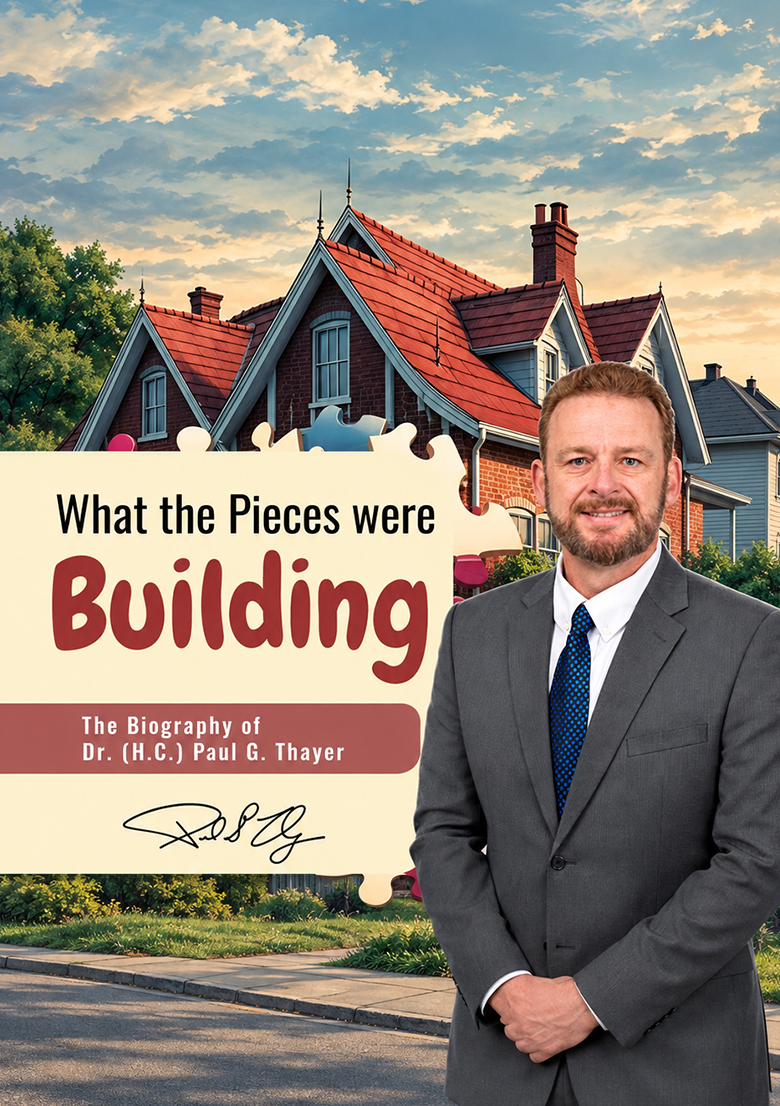
"Sometimes life gives you the pieces before it gives you the picture. The challenge is to keep working until you understand how they fit."
Introduction
There is an unmistakable pattern in the way Dr. Paul G. Thayer approaches life. He is drawn toward things that require attention, thought, adjustment, and eventually, resolution. A puzzle left unfinished bothers him. A problem sitting without an answer invites his attention. Even something as ordinary as putting sugar into coffee becomes a small reflection of how naturally his mind looks for balance. Two is acceptable. Four works just as well. Three, to him, simply feels wrong. The humour in that preference says almost as much about him as the preference itself. He is serious about solving problems, but he has never needed to become overly serious in order to do it.
That combination of concentration and humor appears repeatedly in his life. During deployments, Rubik’s Cubes would sometimes arrive in care packages. Those around him discovered very quickly that leaving one scrambled where he could see it was an effective way to get his attention. Dr. Paul would pick it up, solve it in roughly a minute, put it back down, and continue with whatever he had been doing. Naturally, the cube would soon be scrambled again. The cycle became its own running joke. Yet underneath the amusement was something characteristic of him: he preferred things understood, ordered, and completed. He was not content merely to notice that something was unresolved. He wanted to work through it.
His intelligence has never existed in isolation from people. Dr. Paul enjoys conversation, particularly when it opens a door into something unfamiliar. Travel has suited him because he does not approach a new country expecting it to behave like the last one. He is willing to try local food, hear how people explain their customs, and pay attention to the expressions, gestures, and context that often communicate as much as words do. That instinct became especially useful while working internationally. In Lithuania, he sometimes understood the direction of a question despite not speaking Lithuanian, responding from context before a full translation was necessary. The moments were useful, but they were also often funny, particularly when those around him wondered how he had managed to understand them.
Language itself has remained another puzzle worth exploring. He can speak German and Norwegian and has worked on Spanish, finding that written language often becomes accessible through familiar roots and patterns. He does not claim mastery where it does not exist. Instead, he works with what he recognizes, studies the structure, and gradually begins to decipher meaning. It is a revealing habit. Dr. Paul is comfortable admitting that he does not know everything, because not knowing something has rarely embarrassed him. More often, it gives him another reason to learn.
The classroom has brought out this side of him in a different way. He has experienced learning as both student and teacher, and he understands that ability does not always fit neatly inside conventional expectations. During a statistics course at Columbia College, his performance created an unusual problem for everyone else in the class. The professor graded on a curve, but Dr. Paul consistently scored so highly that there was little opportunity for anyone to benefit from it. By the final examination, he already had enough points to secure his grade. Realizing what his performance meant for his classmates, he wrote his name on the examination and submitted it without answering the questions. Even then, he somehow received points. The story carries his familiar mixture of academic confidence and humor, but it also reveals an ability to see beyond himself and understand the situation around him.
Sports appeal to him for reasons that are equally revealing. He enjoys football, basketball, and lacrosse, but much of the attraction lies in development itself. Watching a college athlete improve over several years, watching a team respond to adversity, or seeing individuals gradually understand their roles carries the same fascination he finds in mentoring and instruction. Progress interests him. So does the process behind it.
The life of Dr. Paul is therefore difficult to reduce to a profession, title, or single achievement. The more consistent thread is a way of thinking. He wants to understand how things work, but he is equally interested in how people work, how they learn, how they communicate, and how they improve. Curiosity gives him momentum, humor keeps that curiosity approachable, and experience has taught him that even complicated problems become manageable when someone is willing to keep looking at them from another angle.
"For me, it worked out beautifully. I like meeting people. I don’t like being in one place for too long."
Phase 1: Where Home Learned to Move

Dr. Paul’s earliest world was shaped by movement, family, and a household that carried both intellectual curiosity and military experience without becoming rigid because of either. He was born in Nacogdoches, Texas, where his parents, Albert Gardner Thayer and Margaret Anne Beare Thayer, had met while studying at Stephen F. Austin. Both pursued forestry, although their lives eventually moved in different professional directions. His mother became a middle school science teacher, while his father entered the Army and became a linguistic specialist. Those choices would have a lasting effect on the geography of the family’s life, taking them beyond Texas and placing much of Dr. Paul’s childhood in Germany.
Living with a father who worked with languages produced its own family humor. Albert could speak several of them, and when Dr. Paul had done something wrong, the seriousness of the situation was sometimes made considerably more confusing by the way his father expressed it. He might speak to his son using several languages in the same reprimand, only to finish by asking whether everything had been understood.
The answer, predictably, was no. Dr. Paul knew perfectly well that he was in trouble, even if the exact details had disappeared somewhere between the languages. The memory captures something important about the atmosphere in which he grew up. The military was present in the family, but so were humor, personality, and the ability to laugh at ordinary domestic moments.
That distinction mattered because his childhood was not governed by the kind of strict military household one might easily assume. His parents gave their children considerable freedom. They were not excessively stringent, and exploration was often permitted as long as it could be done without someone getting hurt. The children might wonder what would happen if two things were mixed together, and instead of shutting the idea down immediately, their parents were willing to let them find out in a controlled setting. It created a home where curiosity was not treated as an inconvenience. Questions were allowed to become experiments, and experiments sometimes became stories the family would carry for years.
Dr. Paul was the eldest of four children. His younger siblings were Peter, Nathaniel, and Tabitha, each born two years apart. Being the oldest carried a sense of responsibility for him, particularly in the atmosphere of the 1980s, when he felt that the eldest child naturally had a role in looking out for the others. That protective instinct existed beside a very different side of sibling life, because the four were also deeply sarcastic, mischievous, and comfortable teasing one another. Their closeness was not built on formality. It was built through growing up together, getting into trouble together, and developing the kind of humor that made perfect sense to them even when outsiders might have struggled to follow the conversation.
One childhood episode captures that sibling dynamic particularly well. Because the brothers resembled one another closely, Dr. Paul discovered that his younger sister could sometimes be persuaded that he was actually Peter. He found the situation amusing enough to keep the deception going, occasionally allowing Peter to receive the blame for something Dr. Paul himself had done. The arrangement worked until the day Peter was not even home. With only Dr. Paul and his sister in the house, their mother had little difficulty identifying the actual culprit. He got into considerable trouble, but the story endured because it reflected the playful disorder of a family that could laugh about its younger years long after the moment had passed.
"I earned my Eagle Scout rank in the Boy Scouts, was in the marching band and jazz band through high school, and then from there joined the Marine Corps."
Phase 2 : The Years Before One Path Took Shape
The years before adulthood did not find Dr. Paul standing on the edge of things. He became involved. His interests reached into scouting, music, learning, and activities that required him to stay mentally present rather than simply pass through them. During his youth, he earned the rank of Eagle Scout in the Boy Scouts of America, an achievement that also carried a quiet family connection. His father had earned the same rank, and so had his paternal grandfather. For Dr. Paul, scouting therefore existed within a family history that already stretched across generations, even though his own experience remained distinctly his.
There was something fitting about that continuity. Dr. Paul did not grow up confined to a single interest, however. High school also brought music into his life through participation in both marching band and jazz band. These were not details he later treated as the central achievements of his story, but they belonged to an important period when his interests were still broad and when there was no need to reduce himself to one future profession.
His involvement in music continued through high school, and years later he could look at the level reached by the students taught by his wife, Elizabeth, and laugh at his own earlier confidence. Looking back, the comparison became a source of humor, particularly because the students he hears now operate at a level that impresses him greatly. The observation says something about the ease with which Dr. Paul can revisit his own younger years without needing to make them larger than they were. He can value what he participated in while still recognizing excellence when he sees it elsewhere.
That ability to remain interested rather than defensive has stayed close to his personality. Dr. Paul is intellectually curious, but his curiosity does not require formality. He can listen carefully, engage with an idea, and still leave room for humor. His interests have never been presented as evidence that he was trying to prove himself exceptional at every turn. They show something simpler and more human: when something captured his attention, he wanted to participate in it fully.
What existed already was engagement. Dr. Paul liked having something to think about, something to participate in, and something worth giving his attention to. His youth did not need a single defining label because its value came from the range of experiences he was willing to enter. By the time high school was ending, that openness had given him a collection of interests rather than one fixed destination. The next decision in his life would begin for practical reasons, but it would eventually carry him far beyond anything those younger years had yet suggested.
"I really did not have a plan at the beginning. I simply saw that if I could work on aircraft, I could build opportunities almost anywhere."
Phase 3 : A Practical Choice That Became a Career
When high school came to an end, Dr. Paul was not standing before an unlimited field of choices. Life in Uvalde, Texas, came with practical realities that had to be faced before larger ambitions could take shape. His parents were lower middle class, and with four children in the family, paying for college was simply not something they could afford. For a young man who wanted the opportunity to continue his education, the question was therefore not only what he wished to study. He first had to determine how he could make higher education possible at all.
The answer came through the United States Marine Corps. His original reason for enlisting was straightforward. Military service could provide the financial means he needed for college. It was a practical decision rather than the fulfilment of a childhood plan to spend his life in uniform. Yet the choice was not entirely disconnected from an impression that had remained with him since childhood. Years earlier, while his family was stationed in Germany, he had seen the Marines assigned to guard the German Embassy where his father was stationed. Their appearance and bearing caught his attention. He noticed how sharply they presented themselves and how distinct they seemed from the other branches of service.
The memory carried its own humor. His father belonged to the Army, but the younger man still found the Marine dress blues more impressive. What stayed with him was not simply the uniform itself. It was the sense of discipline and presence carried by the Marines wearing it. Something about the way they distinguished themselves remained in his mind. When the time eventually came to choose between the Army, Navy, Air Force, and Marine Corps, that childhood impression helped incline him toward the last of them.
Even then, there was no carefully mapped professional future waiting behind the decision. His career field emerged through the military’s aptitude process. Testing showed that he was capable across a broad range of areas, including requirements that made certain positions particularly difficult to fill. The Marine Corps selected aviation for him, and his recruiter presented aircraft maintenance as a practical field with possibilities that could remain useful well beyond military service. If he knew how to work on aircraft, there would potentially be places for that skill in many settings.
At that stage, the logic made sense. Dr. Paul did not need to pretend that aircraft maintenance had always been his dream. It had not. What mattered was that he was willing to take seriously the opportunity placed before him. His original longer term thought was to earn an airframes and power plants certification so that he could work on aircraft wherever that knowledge was needed. Aviation therefore began less as a declaration of identity and more as a professional opening that offered tangible skills and possibilities.
He entered the work, learned it, and discovered what he could do within it. What began as a means of financing education became an environment in which his abilities would gradually be tested in increasingly demanding ways.
Note of Thanks
In reflecting on the journey of Dr. Paul, sincere appreciation belongs to Michael Malone and James Garrison, two individuals whose presence carried lasting importance during his years in the United States Marine Corps. Their contribution cannot be reduced to a single moment or one piece of advice. They were mentors who understood his abilities, encouraged his professional progress, and helped create opportunities for him to move toward positions where those abilities could be used more fully.
For Dr. Paul, their guidance became part of the foundation beneath many of the responsibilities he was later trusted to carry. Advancement in any demanding career is rarely the work of one person alone. There are moments when experience matters, moments when preparation matters, and moments when another person sees potential clearly enough to help open the next door. Michael Malone and James Garrison were part of that process for him. Their support helped him progress through the Marine Corps and reach assignments that became important chapters in his professional development.
His gratitude toward them carries particular weight because their mentorship became closely connected with his progress through the Marine Corps and the opportunities that followed. That enduring influence gives this note its purpose. It is not simply a formal acknowledgement placed at the end of a biography. It is an expression of respect for two people whose mentorship mattered when direction, advancement, and opportunity were taking shape.
To Michael Malone and James Garrison, these pages carry a quiet but enduring thank you. Their guidance became part of a journey that continued long after any single assignment or promotion had passed.
thanks,
– Dr. (H.C.) Paul G. Thayer

AIMLAY is a leading global education platform empowering ACADEMIC and EXPERIENTIAL learners, uniquely focused on recognizing knowledge gained through experience and building a diversified community of doctorates and aspiring researchers.