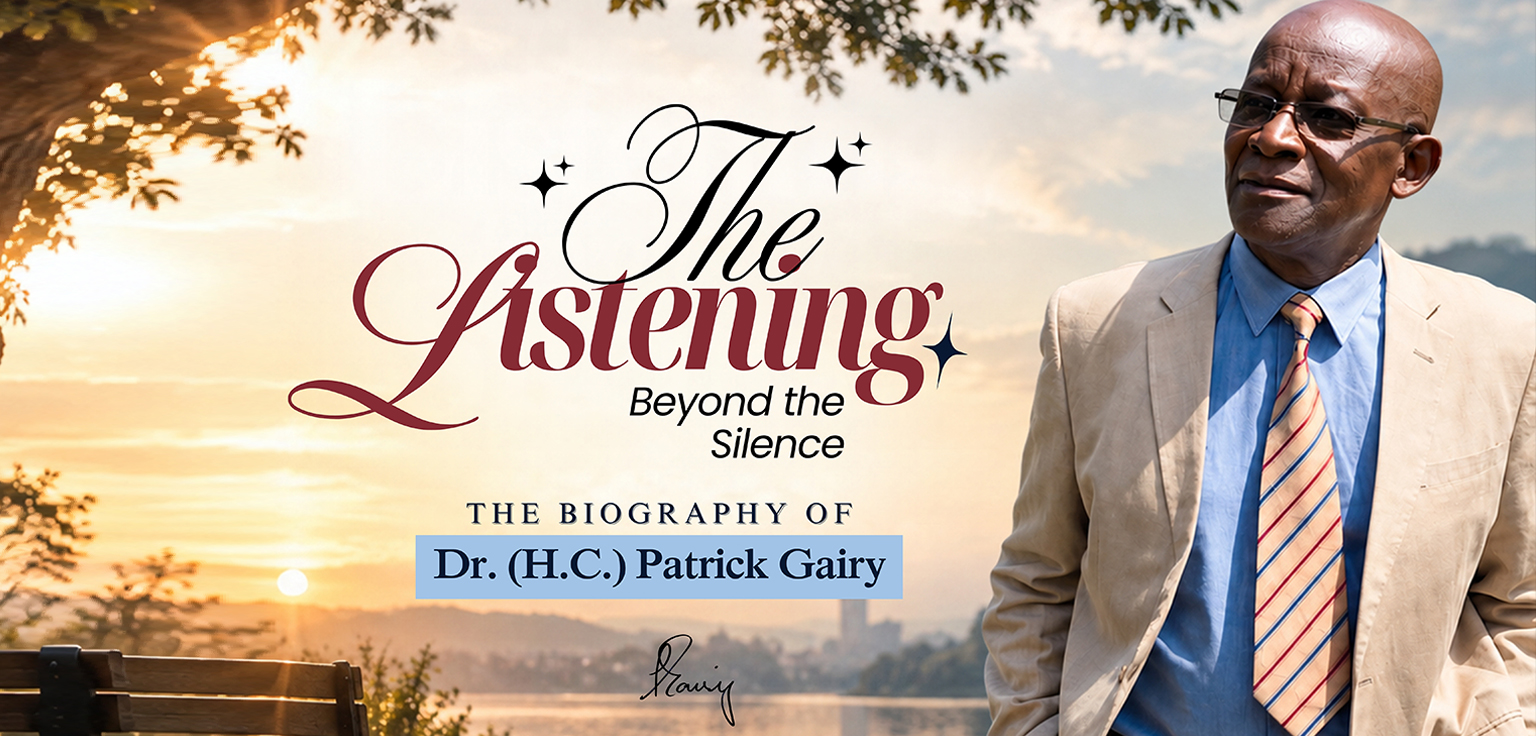
"Do not stand above people. Get among them and talk about it."
Introduction
Every life begins in a particular place, and for Dr. (H.C.) Patrick Gairy, that place was Trinidad. Born on 24 May 1946, he grew up as the second of seven children in a family where responsibility was part of everyday life. His father was a farmer who achieved recognition through agricultural competitions, while his mother was someone to whom he felt especially close. Their household gave him a clear understanding of discipline, family duty, and the importance of work.
The community around him also shaped his early years. He grew up among siblings, friends, and neighbours who travelled to school together, played cricket and football, and spent time outdoors. Childhood was shared across family boundaries. The children around him formed friendships through ordinary activities, and those relationships gave him a strong connection to the people among whom he was raised.
Responsibility came to him early. As one of the older children, he carried lunches to school, helped his younger siblings, and made sure that they were safe and accounted for. He was also a bright and popular pupil who often came first in his class. Although an early decision to move him forward meant that he missed important mathematics teaching, he continued to show ability and remained willing to help others with their studies.
His father expected the children to enter agriculture, but Dr. Patrick did not enjoy farming enough to make it his own career. His interest turned towards mental health after a childhood friend, Dean Williams, experienced a nervous breakdown and was taken to a local mental health hospital. The experience stayed with him. He wanted to understand what had happened, and his curiosity grew through other encounters with people experiencing mental health problems in Trinidad.
After leaving school, Dr. Patrick worked as a Junior Manager with the Department of Agriculture for seven years. Following this period, he decided to pursue a career in mental health nursing in the United Kingdom. When he saw an advertisement seeking nurses for training, he applied and was accepted. His departure from Trinidad introduced him to a new country, climate, and professional environment. England brought cold weather, leafless trees, unfamiliar surroundings, and a hospital community where most people were strangers to him. The hospital provided accommodation, which helped him settle while he trained.
His career developed through mental health nursing. After qualifying, he worked as a staff nurse and later moved into management. In 1975, he became responsible for a ward. His professional life eventually took him into community services, hospitals, prisons, and institutions for young offenders. He worked with people in their homes and with young people who were dealing with serious behavioural and mental health difficulties.
Dr. Patrick continued his education while working. He studied clinical subjects, community mental health, community practice teaching, community care, child protection, human rights, HIV and sexual health, suicide and self-harm, group therapy, anger management, solution-focused brief therapy, and adolescent forensic mental health. His education followed the needs of the people he encountered in his professional life.
"My family has always been in leadership roles."
Phase 1: Roots in Trinidad and a Family of Leaders
On 24 May 1946, Dr. Patrick Gairy was born in Trinidad, in the West Indies. He was the second of seven children and grew up with both parents. By the time of the biography meeting, his parents had passed away, but their influence remained visible in the way he described his childhood and the values of the family in which he was raised.
His father was a farmer and a manager in agriculture. He took part in competitions connected with the Department of Agriculture and received recognition for his work. Dr. Patrick remembered him as a leading farmer in Trinidad and Tobago, having been recognised as the top farmer in the country for three consecutive years. His father was also a strict man, reflecting the discipline expected within many families at that time. The older man’s achievements gave the family an example of commitment and public recognition. Farming was not merely a means of earning a living. It was an area in which his father had worked hard and achieved distinction. He also expected the children to consider agriculture as a possible path. For Dr. Patrick, that expectation became part of the background against which he later made his own professional decision.
His mother influenced him differently. He described himself as very close to her, and that relationship remained one of the important emotional memories of his early life. His father represented discipline and authority within the household, while his mother was someone with whom he shared closeness and affection.
The family also carried a tradition of leadership. Dr. Patrick explained that members of the family had often moved into management or leadership positions. He referred to a cousin, Sir Eric Gairy, who had been Prime Minister of Grenada. His father was a manager in agriculture, and the children also moved into management in different ways. The family therefore gave him examples of people accepting responsibility and moving beyond the role of simply following others.
His childhood was also shaped by the community around him. He remembered having many friends and spending much of his time among children from different families. They attended school together, returned home together, and played together. Cricket and football were part of their everyday lives. They also caught birds, gathered around fruit trees, and explored the natural surroundings.
Although the children came from different households, they remained closely connected. The community allowed them to grow up together, share their experiences, and develop friendships through ordinary activities. The children were not separated by formal social boundaries. Their relationships developed through the time they spent in the same places and through the things they did together. This environment helped Dr. Patrick become comfortable among people. He remembered a childhood in which friendship and community were part of daily life. He did not grow up isolated from others. Instead, he was surrounded by siblings, classmates, neighbours, and friends who became part of his earliest understanding of relationships.
His place within the family also mattered. As one of the older children, he was expected to accept responsibility. He later remembered carrying lunches to school and making sure that his younger siblings were properly looked after. These tasks were part of life in a large family, but they also required awareness and reliability. The family’s expectations were clear. His father wanted the children to enter agriculture, and the young Patrick understood why. Farming was the work his father knew, and it had brought him success. Yet Patrick also began to recognise that he was interested in a different direction. He respected what his father had achieved, but he did not feel that agriculture was the future he wanted for himself.
"I was a very bright kid, very bright in the primary school, and very popular."
Phase 2 : The Bright Boy Who Took Charge
During his school years in Trinidad, Dr. Patrick was known as a bright and popular pupil. He often came first in his class and took part in sports and other school activities. He was comfortable among his classmates and was remembered as someone who participated actively in school life. His education was not entirely straightforward. On one occasion, after coming first in his class, he was moved forward to another class. As a result, he missed lessons in mathematics and other subjects that would normally have been taught at that stage. He later felt that this affected him throughout his career.
The experience showed that academic ability did not always protect a student from gaps in education. Dr. Patrick was clearly capable, but the decision to move him forward left him without some of the teaching his classmates received. He continued with his education, but he remembered the effect of missing that particular part of his schooling.
Outside the classroom, he remained active. Sports were part of his school life, and he continued to enjoy the social side of being among other children. His popularity was not based only on coming first in class. He took part in activities and maintained friendships, which helped him remain connected to the people around him.
Responsibility at home also developed during these years. He was the second child, but his elder sister was nine years older and had already moved beyond the school routine shared by the younger children. Because the family lived far from school, Patrick carried the lunch for the children and helped make sure that everything was in order.
He became the person who took charge of his younger siblings. His role was practical. He had to ensure that they reached school, returned safely, and had what they needed during the day. He did not describe this responsibility as a formal position. It was simply part of what was expected within the family. His intelligence also became useful to others. He helped his siblings with their schoolwork and extended the same support to friends and classmates. He wanted them to understand what they were learning. His approach was patient, and he remembered that one of his own primary school teachers had shown patience towards him.
That memory influenced the way he helped others. He did not simply give answers. He tried to make sure that the person he was helping understood the lesson. Even at that age, he had begun to develop a quality that would later become important in nursing and management: the ability to support someone without making the person feel inadequate. His family expected the children to consider agriculture. His father was a farmer who had achieved recognition, and it was natural for him to hope that the children would enter the same field. Patrick, however, did not enjoy farming enough to choose it as his career. He had grown up around agriculture, but he felt that his interests lay elsewhere.
As he approached the end of his school years, he began to think about another direction. He did not yet know exactly where that direction would take him, but he knew that he did not want to remain in agriculture. The decision would later lead him to England and mental health nursing. The move away from farming was not based on a lack of respect for his father’s achievements. His father had worked hard and had become a leading farmer in the country. Patrick simply recognised that the same field did not attract him. He wanted to find a profession that connected more closely with his own interests. Those interests were already developing through his experiences with people. He had helped siblings and friends with schoolwork, remained active in his community, and become familiar with responsibility. Although he did not yet see these experiences as preparation for a professional life, they gave him qualities that would later support his work.
"I wanted to know more about what was happening."
Phase 3 : A Question Born from Compassion
Dr. Patrick’s interest in mental health began during childhood through his friendship with Dean Williams. Dean suffered a nervous breakdown and was taken to a local mental health hospital. The experience stayed in Patrick’s memory for many years. He wanted to understand what had happened to his friend and why a person could experience such a serious mental health problem.
The memory was not brief or easily forgotten. Even decades later, he could still recall Dean’s name. That continued recollection showed the effect the experience had on him. It created questions that remained with him as he grew older. Patrick was naturally inquisitive. He wanted to know more about mental health and about the experiences of people who suffered from mental health problems. During his years in Trinidad, he met other people who were affected by such difficulties. These encounters strengthened his interest and helped him see that mental illness was part of community life.
At that time, he did not have professional training or specialised language with which to explain what he was observing. He had concern and curiosity. He knew that people were suffering, but he wanted to understand the reasons and the possible forms of help available to them. The opportunity to pursue that interest appeared through an advertisement seeking nurses for training in the United Kingdom. Having completed seven years of service with the Department of Agriculture, Dr. Patrick applied and was accepted. It was an opportunity to pursue the field that had interested him since childhood and to begin a different professional chapter.
The decision also meant leaving the familiar environment of Trinidad. He had grown up among his family, friends, and neighbours. He knew the community, the climate, and the routines of life there. Training in England would place him in surroundings that were unfamiliar in almost every practical way.
He nevertheless chose to go. His father wanted the children to enter agriculture, but Patrick wanted to pursue another path. Mental health nursing offered him the chance to develop a profession based on understanding people and supporting them through difficult experiences.
The decision was closely linked to the memory of Dean Williams. Patrick had not simply chosen nursing as a general occupation. He had chosen mental health nursing because he wanted to know more about the area that had first captured his attention as a child.
His early experiences had also given him some preparation for the work. He had learnt to help his siblings and classmates. He had developed patience while assisting them with schoolwork. He had also grown up in a community where people knew one another and shared daily life. These experiences did not replace professional education, but they formed part of the personal background he carried into training.
Note of Thanks
Dr. Patrick’s gratitude extends first to his parents, whose influence shaped his earliest understanding of work, discipline, family, and responsibility. His father’s achievements in agriculture and his mother’s closeness remained important parts of his memories of childhood.
He is especially thankful to his children, Richard and Kerry, who supported him while he continued his education. Their help with typing during his bachelor’s studies and their encouragement made a meaningful contribution to that stage of his life. He also expresses deep appreciation to Donna, his present wife, for her companionship and support. Their shared life has included travel, church, visits to the beach, horticulture, and the ordinary activities through which they have built their relationship.
Dr. Patrick gives special thanks to his younger brothers, Cyril and Samuel, who supported him when circumstances were not going well. Their encouragement remained important to him. He also remembers the teachers, colleagues, managers, and former colleagues who influenced his professional development. The people he met in hospitals, communities, prisons, and young offender institutions became part of the experience through which he learned.
His gratitude includes the people who welcomed him into their homes, worked alongside him, trusted him, and allowed him to contribute to their lives. Each professional setting gave him lessons that continued to shape his understanding of care and responsibility. The knowledge he hopes to share in the future was built through many relationships and experiences. Dr. Patrick remains thankful to everyone who supported his learning, respected his work, and remained part of his journey.
thanks,
– Dr. (H.C.) Patrick Gairy

AIMLAY is a leading global education platform empowering ACADEMIC and EXPERIENTIAL learners, uniquely focused on recognizing knowledge gained through experience and building a diversified community of doctorates and aspiring researchers.