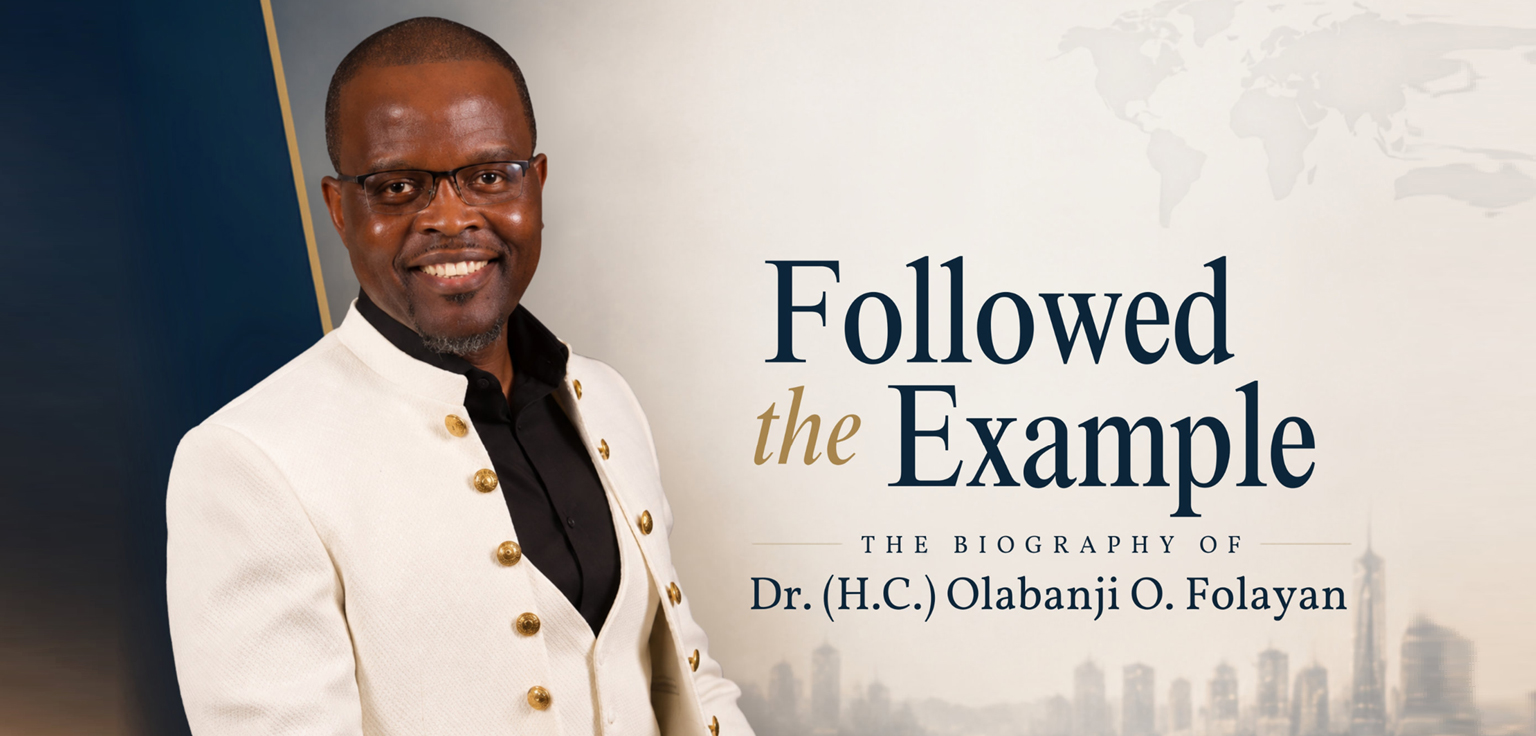
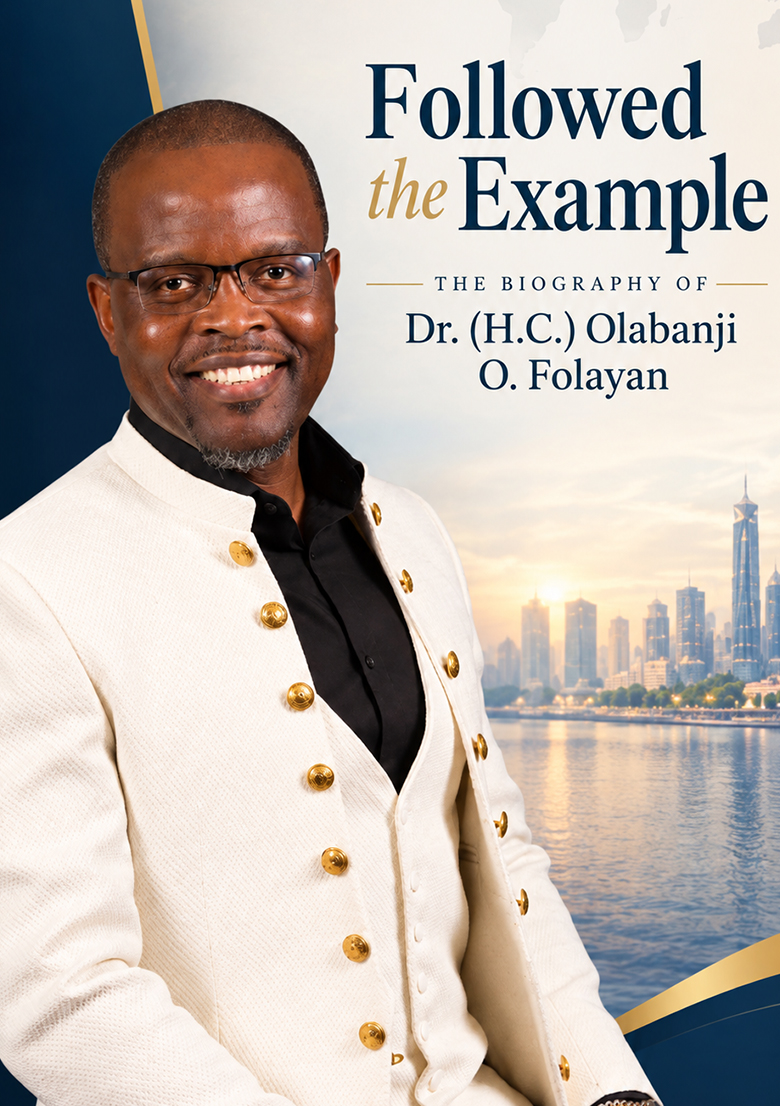
“If we do not embrace the people around us, we forget that they have the capacity to help us succeed just as much as they have the capacity to see us fail.”
Introduction
There is a revealing simplicity in the principle Dr. Olabanji O. Folayan chose to place at the heart of his professional philosophy. For a man whose career has involved large contracts, workforce management, demanding operational responsibilities, financial management, training, quality control, and executive decision-making, his understanding of leadership ultimately returns to people. Experience taught him that qualifications and knowledge can take a person only so far. Sustainable progress requires dependable individuals, mutual trust, and the ability to recognize that no leader, regardless of capability, can carry an organization alone.
Today, Dr. Folayan stands at the intersection of several identities that developed over different periods of his life. He is a security professional with more than three decades in the homeland security field, the Chairman and Chief Executive Officer of Securemedy Incorporated, a pastor, a philanthropist, and a man whose commitment to education has continued alongside his professional responsibilities. His journey has never belonged comfortably to only one category. Professional responsibility expanded into entrepreneurship. Academic development strengthened practical experience. Spiritual conviction eventually demanded room beside business. Service became personal rather than ceremonial. Each responsibility brought with it a different measure of growth.
Long before becoming responsible for his own company, he developed an unusually broad understanding of security management. His professional work exposed him to operations, logistics, human resources, quality assurance, training, employee relations, contract administration, budgeting, client management, business development, and the supervision of substantial workforces. At different points, he carried responsibility for multimillion dollar programs and worked within environments where performance, compliance, accountability, and human judgment could not be separated from one another. These experiences gave him something that formal titles alone could not provide: an understanding of how an organization functions when many moving parts must work together.
That understanding became increasingly important as Securemedy Incorporated developed. The organization has grown to employ more than 600 people at its largest point and has operated across more than nine states, serving federal, private, and public sectors. Over time, remaining in business became as meaningful to him as expansion itself. Years spent watching other organizations disappear made longevity deeply significant to him. The longevity of the company became one of the accomplishments he valued most, not because its journey had been without setbacks, but because it endured them.
There is another dimension to his life that cannot be measured by contracts, employees, or credentials. Dr. Folayan has come to see responsibility through the lens of faith. His decision to accept pastoral leadership altered the arrangement of his life and even interrupted an earned doctorate program in Strategic Management at Capella University when the combined demands of family, business, and ministry became too great to carry simultaneously. Rather than treating that decision simply as an academic sacrifice, he understood it as part of a larger obligation to follow what he believed God was asking of him.
The biography that follows is therefore not the story of a single profession. It is the account of a life in which business knowledge, education, leadership, faith, responsibility, setbacks, and service gradually came to occupy the same space. Dr. Folayan did not arrive at his present understanding through an uncomplicated ascent. He learned by working, losing, adjusting, studying, listening, building, and accepting responsibilities that sometimes changed the direction he had planned. What emerges is not an image of perfection but of continued development and of a man who came to recognize that what a person builds matters greatly, but so do the people who help him build it and the purpose for which that work is ultimately used.
“We had to learn how to use our hands, learn how to be hardworking, and learn how to fend for ourselves.”
Phase 1: Five Years That Changed Him
Before Dr. Olabanji O. Folayan understood anything about leadership, business, or professional responsibility, he had already learned what it meant to adjust to circumstances that did not wait for him to feel ready. His childhood unfolded between two countries, two very different environments, and two ways of life. What began in Washington, D.C., would eventually continue in Nigeria, where the familiar rhythms of his early years were replaced by a setting that demanded adaptation almost immediately.
He was born in Washington, D.C., to Nigerian parents, Dr. Ezekiel Adekunle Folayan and Mrs. Dorcas Olufunke Folayan. During his early childhood, the family lived in different places between Washington, D.C., and Maryland. His parents were working people building their lives while continuing their own education. His father drove a cab while pursuing his studies, eventually progressing through higher education and earning a doctorate in Economics from Howard University in 1983. His mother worked as a certified nursing assistant before later earning a bachelor’s degree in Marketing from Southeastern University. Their lives reflected the practical demands of earning a living while pursuing education at the same time.
In 1983, that household changed direction completely. His father had come to the United States for his education, and once the doctorate was completed, he decided it was time for the family to return to Nigeria. Dr. Folayan was ten years old and in the fourth grade when his parents uprooted the family and moved. Until then, he had never lived in Nigeria. The country was part of his family identity, but not yet part of his personal experience.
The move quickly became more complicated than simply becoming accustomed to a new home. School presented an immediate difficulty. Although English was familiar to him, adjusting to the local educational system presented an immediate challenge because instruction followed a different structure. Because he could not understand the language being used in the grades immediately ahead of him, the solution was unusual. He had to move directly beyond Grade Five and Grade Six and enter Form One (otherwise known as Junior High School in the United States).
Although advancing beyond two grades may have appeared impressive from the outside, the decision was primarily a practical response to the circumstances he faced. It happened because there was no practical alternative if he was going to continue learning in a language he understood. The consequence was that he entered a higher level of schooling without receiving two full years of foundational instruction.
He managed to continue, but the gaps did not disappear simply because he had advanced on paper. There were subjects and concepts his classmates already understood because they had been taught them during the years he had missed. At the time, he did not always recognize why certain things seemed easier for others. Only later did he understand that some of those struggles were connected directly to the educational years that had been bypassed. It took several years before he felt that he had academically leveled himself with his peers.
The classroom was only one part of the adjustment. His speech itself made him noticeable. Having grown up in the United States, he spoke English naturally in the manner he had always known. In Nigeria, however, the pronunciation and use of English around him were different. What sounded ordinary to him could be interpreted by others as pride or an attempt to show off. He found himself attracting negative attention simply by speaking as he always had.
“There were times when I could only afford to go to school part-time, and there were times when I could not afford to go to school at all.”
Phase 2 : Paying His Way Forward
When Dr. Olabanji O. Folayan returned to the United States in January 1989, the next chapter of his life began almost immediately. There was little time between completing secondary school and confronting the responsibilities that came with higher education. A month after his sixteenth birthday, he entered college, still at an age when many young people would have been completing high school. What stood before him, however, was not simply an academic journey. It was the challenge of finding a way to continue his education while carrying much of the financial responsibility for it himself.
His parents were in Nigeria, and the practical reality of college in the United States therefore became his own responsibility. He enrolled at the University of the District of Columbia, beginning there in the fall of 1989. It was the institution he could realistically afford at the time. His circumstances left little room for choosing a university according to preference alone. Tuition had to be considered alongside the simple need to earn enough money to continue attending.
There was another university that held particular meaning for him. He would have liked to attend Howard University, where his father had completed his doctorate. The connection made the institution personally significant, but wanting to attend and being able to afford it were two different things. Financial limitations decided the matter. Rather than allowing an unavailable option to stop his progress entirely, he entered the institution that was within his reach.
That decision says something important about this period of his life. The path was not ideal according to what he might have preferred, yet it remained a path forward. He did not have the financial resources to build his education around convenience. Instead, he had to build it around what he could sustain.
To meet those costs, Dr. Folayan worked in fast food and took other jobs while studying. College therefore unfolded around work rather than separately from it. Money determined how many classes he could take and, at times, whether he could attend at all. There were periods when he could only afford part-time study. At other times, he could not afford to enroll. His academic progress slowed accordingly.
The delay was not caused by a loss of interest in education. It came from the reality of having to finance it. Each interruption carried a practical explanation. If funds were available, he studied. When they were limited, he reduced his course load. When they were not available, he waited. The degree therefore took longer than a conventional college timetable might have suggested, but the extended route did not change the destination.
During those years, another part of his identity was becoming clearer. He recognized that business-related subjects interested him. It was not an interest he traced to a particular teacher, mentor, or defining incident. He described it more simply as something that seemed natural to him from a young age. Business caught his attention because he had an instinctive interest in it rather than because someone had directed him toward it.
He had also seen his father make attempts at different business ventures while he was growing up. Dr. Folayan, however, did not present those attempts as the source of his own business knowledge or passion. He was careful not to claim an influence he did not believe was there. His attraction to the subject felt personal. It was an area he wanted to understand and eventually the field he chose for his undergraduate education.
“Over the years, I started to like the field, and eventually I became passionate about it.”
Phase 3 : Security Was Supposed to Be Temporary

In 1992, security was not a profession Dr. Olabanji O. Folayan had carefully chosen for himself. At that point in his life, employment served a practical purpose. He was still pursuing his education and needed work that would allow him to continue paying his expenses without forcing him to abandon college. Several of his uncles were already working in security, and they recognized something useful about the industry that had little to do with long-term career planning. Security operated around the clock. That meant he could attend school during the day and work during hours that fitted around his classes. Their suggestion was straightforward: apply to Admiral Security Services and see whether the arrangement could work for him. At that time, the opportunity was viewed primarily as a way to support his education. His uncles introduced him to the opportunity, but his professional development in the field came through his own experience and dedication.
He entered Admiral Security Services with limited professional experience in the security field. During his initial training, he found himself surrounded by people who seemed far more familiar with the work. Some had already worked for other security companies and understood procedures and terminology that were completely new to him. Rather than pretending that he knew more than he did, he accepted that he was a beginner. His thinking at the time was practical. His uncles had told him this was something worth trying, so he would pay attention, complete the training, and learn enough to perform the job properly. The situation did not immediately inspire a sense of professional purpose. He was simply trying to earn an income while continuing toward the future he believed would begin after college.
Once the training was completed, he began receiving assignments at different work sites. With each assignment, the field became a little less unfamiliar. There was no dramatic moment when security suddenly became his passion. The change happened gradually through exposure. He observed how things were done, repeated procedures, encountered different situations, and learned from the everyday requirements of the work. What initially seemed complicated began making sense through experience. Time in the field gave him knowledge that no one had formally handed to him. He was learning simply because he was present, attentive, and willing to absorb what the job was teaching him.
The annual training requirements eventually gave him one of the clearest indications of how much he had grown. In the beginning, training had reminded him of how little he understood. After several years, the experience began to feel very different. He would sit through sessions, hear a question being asked or a topic being introduced, and realize that he already knew the answer. That recognition began occurring often enough for him to notice the change in himself. The profession that once seemed unfamiliar had become something he understood naturally. Over time, he recognized the depth of knowledge and confidence he had developed within the profession. That small realization carried considerable importance because it altered the way he viewed both the profession and his own ability within it.
Until then, Dr. Folayan had regarded security as temporary employment. His plan had always been to remain in the field long enough to complete his education and then move toward what he considered a “real job.” In his mind, the college degree was supposed to mark the beginning of something different. Security was merely helping him reach that point. Yet the longer he remained in the profession, the less convincing that original assumption became. He was no longer simply showing up for shifts and collecting a paycheck. He was accumulating knowledge. He was becoming familiar with the demands of the work. Most importantly, he was beginning to see that the field offered more possibility than he had first imagined.
Note of Thanks
For Dr. Olabanji O. Folayan, gratitude begins with his father, Dr. Ezekiel Adekunle Folayan, whose life gave him an enduring example of education, hard work, and honesty. His father’s academic journey also became an important reason he continued to value the significance of doctoral achievement in his own life.
He extends heartfelt appreciation to all of his siblings, Lasun, Lanre, Kunle, Soji, Febi, Dipo, Kebi, and Binto, for the love they have shared with him through the years. Their presence in his life remains deeply valued, and each sibling holds a special place in his journey.
His gratitude also reaches the mentors who gave generously of themselves along his professional journey. He thanks Mr. Wesley E. Sturdivant Jr. for being his mentor without demanding anything in return. He remembers the late Colonel Curtis E. Wren Jr. with special appreciation for never looking down on him during one of the lowest times of his career and for continuing to mentor him with a genuine concern for his progress. He thanks Mr. Leon Beresford for always wanting to see him succeed and for supporting his professional growth.
He also recognizes the membership and leadership of the church family that he pastors at Grace Chapel of Waldorf, MD. He is grateful for their continued love, prayers, and encouragement along life’s journey.
He is particularly grateful to his daughter, Kehinde Abubakar, whose love made him understand what it meant to be called Daddy. Her presence brought a personal joy to his life, and he is very grateful for their relationship.
Finally, Dr. Folayan expresses his deepest gratitude to his mother, Mrs. Dorcas Olufunke Folayan. He honors her for her constant prayers, for continuing to pray for her children, and for never allowing that commitment to fade. In his gratitude, hers is intentionally the final name, a quiet recognition of the prayers that have continued to accompany his journey.
Thanks,
– Dr. (H.C.) Olabanji O. Folayan