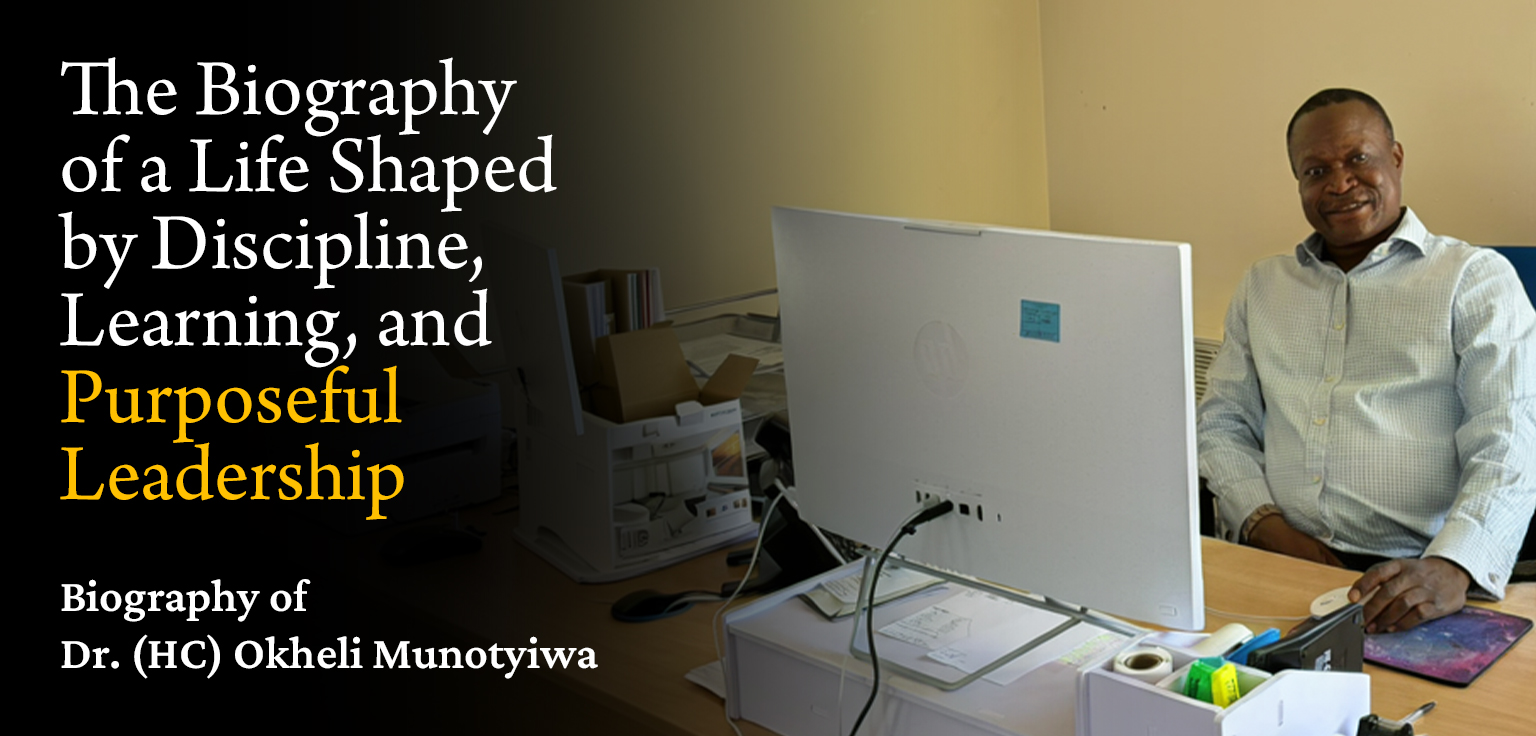
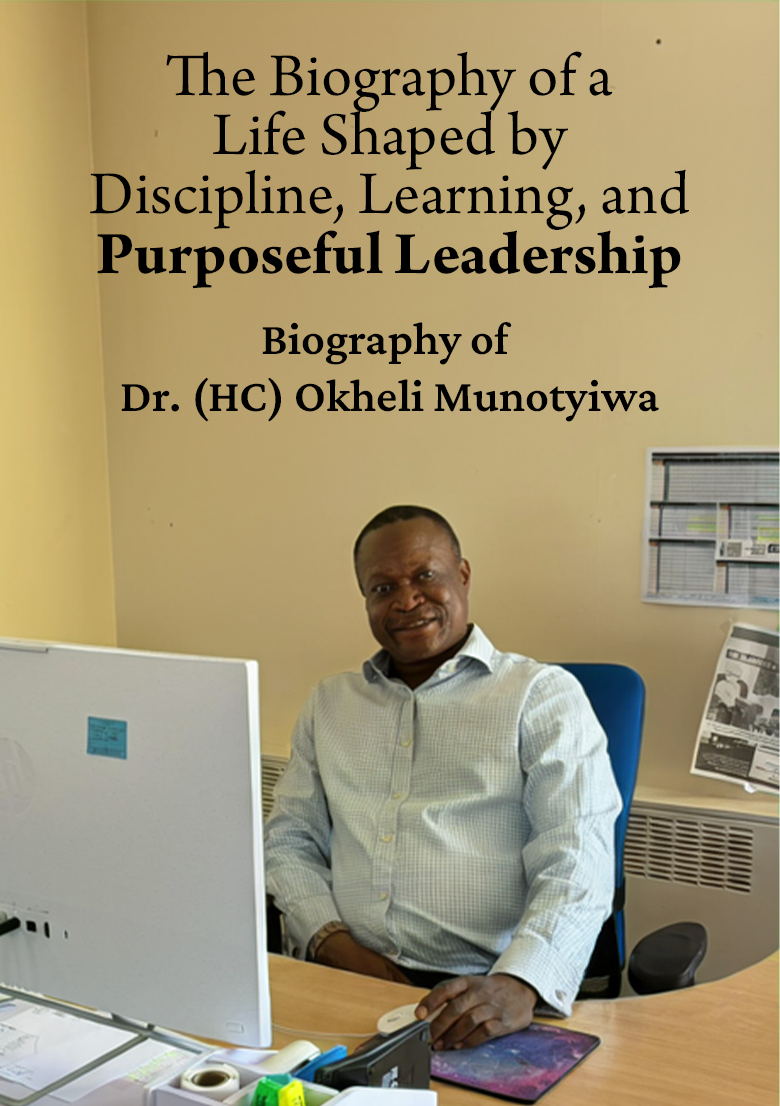
“Character is not built in comfort but revealed in responsibility.”
Dedication
This biography draws inspiration from the enduring foundations that shaped Dr. Okheli Munotyiwa’s life and values. Since he was a young child, his parents instilled in him the values of responsibility, humility, and perseverance by their silent strength, discipline, and sacrifices. He pays his first and foremost respects to them. Their direction served as the foundation for the moral compass that continues to guide his decisions, both in his personal life and in his professional life.
This dedication extends to his family as well, whose unflinching support served as a source of stability amid times of transition, uncertainty, and growth. Their presence was a consistent source of grounding and support throughout the process of adjusting to new circumstances, taking on challenging duties, and reaching an important turning point.
He also dedicates this work to the communities he served, which in turn shaped him. Educated in various settings, including formal institutions in his early years, he later worked in professional situations. Each of these locations played a role in shaping the person he became and the leader he continues to be.
First and foremost, this biography is devoted to the conviction that one may transform difficulties into a sense of purpose through disciplined effort, continuous learning, and service to others. It serves as a commemoration of the principles that guided his path as well as the others who walked alongside him, frequently in silence but yet making a significant contribution.
“The habits formed in youth make all the difference.”
Phase 1: Foundations of Character: Early Life, Environment, and the Making of Discipline

At an early stage in his life, Dr. Okheli Munotyiwa was imprinted with the determination of his family and a strong belief in the importance of education, although the conditions of his life made it difficult to maintain that belief. It was not through dramatic occurrences or exaggerated stories that his youth was depicted; rather, it was through realities that many families are familiar with on a personal level. These realities include striking a balance between hope and limitation and pursuing education as a serious commitment rather than a casual alternative.
Family was always the most important part of his identity, even from the beginning. He stated that his parents are still alive and that he was one of seven siblings who was a part of the household structure that influenced his early worldview. He grew up as one of many children living in the same house. Dealing with a large family invariably required adjustments, patience, and self-control. At a young age, he realized that nothing was solely about a single individual. There was a need to strike a balance between the various needs, there was a need to manage priorities, and the concept of responsibility emerged organically through the rhythm of family life.
He described his father, who worked in the city, as an important character during this period. This information is not merely of a biographical nature. It is a reflection of the kind of effort that children frequently do not see until they are in their later years: the daily discipline of leaving home, managing employment, and carrying the weight of responsibility for the future of the family. This situation became one of the first living instances of commitment and sacrifice for Dr. Okheli Munotyiwa. Although it was not delivered in the form of a lesson, it served its purpose nonetheless.
During his formative years, he did not overlook the importance of education. He divulged some profoundly illuminating information: in his nation, it was regarded as a sign of prestige to send children to school, particularly at the secondary level. This prestige was not about pride; it was about families valuing education and future opportunities. The explanation he stated was that his parents were enthusiastic and motivated to provide him with that opportunity.
“Do not go where the path may lead, go instead where there is no path and leave a trail.”
Phase 2 : Learning Without Maps: Education, Self-Direction, and the Discipline to Grow

As Dr. Okheli Munotyiwa progressed beyond his secondary schooling, education continued to define his life, though not yet in a way that provided clarity or certainty. This phase of his journey was marked by commitment to learning in the absence of guidance and by discipline exercised without guaranteed outcomes. It was during this period that he began to understand that direction is not always given but often constructed through perseverance and responsibility.
Although his family had sacrificed greatly to ensure access to education, the transition from school to higher learning revealed a significant gap. Career pathways were not explained, and students were expected to choose subjects and move forward without structured support. Dr. Okheli Munotyiwa has reflected openly on this reality, acknowledging that education existed, but career awareness did not. This lack of guidance, however, did not weaken his resolve. Instead, it required him to develop internal discipline and self-motivation.
Following the completion of his primary education in Zimbabwe, he went on to earn a Bachelor of Commerce degree in Accounting from Zimbabwe University, from which he graduated in the year 2010. Not only did this qualification offer him a formal background in financial principles, commercial reasoning, and organized analysis, but it also linked naturally with the topics that he had studied earlier, particularly accounting and mathematics. At this point in his life, schooling functioned as both a continuation and a consolidation, enabling him to transfer theoretical understanding into practical frameworks.
However, even after he had earned this degree, his path did not instantly start to settle into a permanent position. Life continued to require qualities such as adaptation, accountability, and resiliency. As a result of the lack of early career direction, the development of professional clarity occurred gradually rather than all at once. His discipline and his readiness to return to learning whenever it was necessary for his development remained constant throughout his life.
“In matters of conscience, the law of the majority has no place.”
Phase 3 : Entering Professional Life: Responsibility, Integrity, and Learning Under Pressure

When Dr. Okheli Munotyiwa entered the third phase of his life, it was the moment when learning moved firmly beyond the confines of classrooms and became a responsibility that was lived. When he started his professional life, it was not an effortless move. Early accountability, ongoing pressure, and ethical decisions that bore real repercussions all contributed to the formation of this entry. His education and preparation for the academic world had resulted in the formation of a discipline that was no longer theoretical. Every day, a critical setting tested the individual’s correctness, integrity, and judgment.
Beginning in 2004 and continuing until 2010, he was employed by the Zimbabwe Benefit Fund (ZDFBF), an organization that placed a high value on trust and precision in financial matters. The fact that he took on this position when he was still in the early stages of his professional career required him to make swift adjustments. There were enormous expectations, the systems were very formal, and mistakes were rarely forgiven. He did not assume a job that would allow for safeguarded learning. In other words, he took on responsibility.
The management of cash books, the performance of monthly bank reconciliations, and the supervision of daily banking activities were among his primary responsibilities. The completion of these duties required a high level of focus and self-control, particularly in an atmosphere where time constraints, compliance standards, and volume requirements were consistent. Each reconciliation carried a responsibility, and the daily work directly bolstered the institution’s legitimacy.
As he gained more expertise, the amount of trust that was placed in him also increased. The maintenance of the nominal ledger, the preparation of monthly management accounts, and the contribution to the year-end financial statements were all responsibilities that ultimately fell on his shoulders. These technical duties were not separate from one another.
Note of Thanks
This biography would lack something essential without honoring the individuals and events that significantly shaped Dr. Okheli Munotyiwa’s path. Every stage of his life is a reflection of the influence of individuals, institutions, and communities that have contributed to his development and comprehension. His life has never been a solitary quest.
He would like to express his deepest gratitude to his family, whose sacrifices, encouragement, and ideals served as the basis upon which he was able to develop his discipline and his ability to persevere. Throughout the entirety of his journey, their conviction in the importance of education, accountability, and integrity served as a guiding force.
Additionally, he extends his gratitude to the teachers, mentors, and professional colleagues who challenged him to think creatively, entrusted him with responsibilities, and fostered his growth by offering guidance and setting an example. Their influence reinforced the significance of accountability, ethical conduct, and lifelong learning.
In particular, he would also like to express gratitude to the communities and organizations that provided platforms for his growth and service. These circumstances tested his capabilities, enhanced his leadership skills, and provided him with the opportunity to make a meaningful contribution through structure and dedication.
First and foremost, Dr. Okheli Munotyiwa is thankful for the skills that he has acquired from the experience of overcoming obstacles. Every challenge turned out to be an opportunity for introspection, personal development, and a greater appreciation for one’s goals. It reflects a profound understanding that progress is never achieved in isolation but is shaped through shared effort, trust, and the unwavering support of others.
Thanks,
– Dr. Okheli Munotyiwa