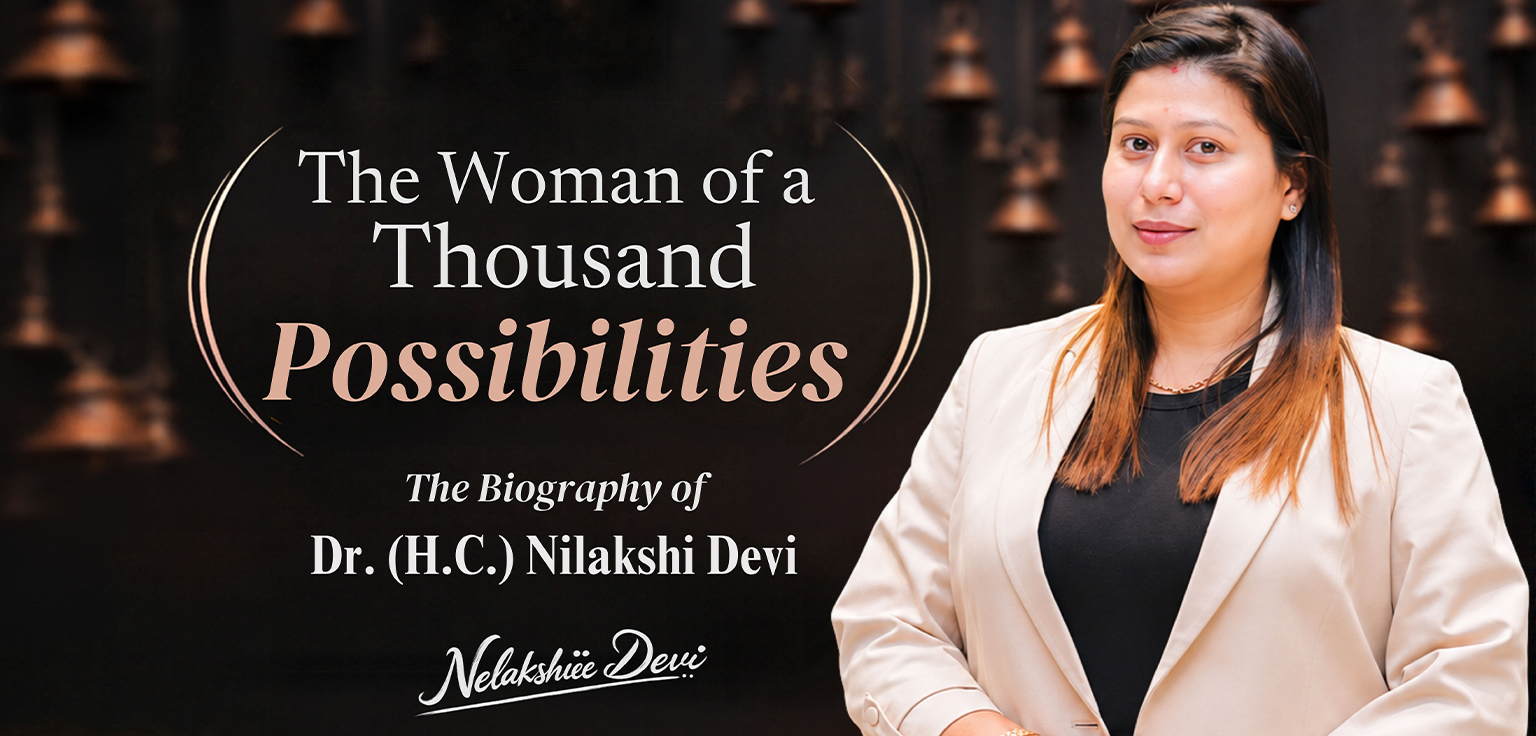
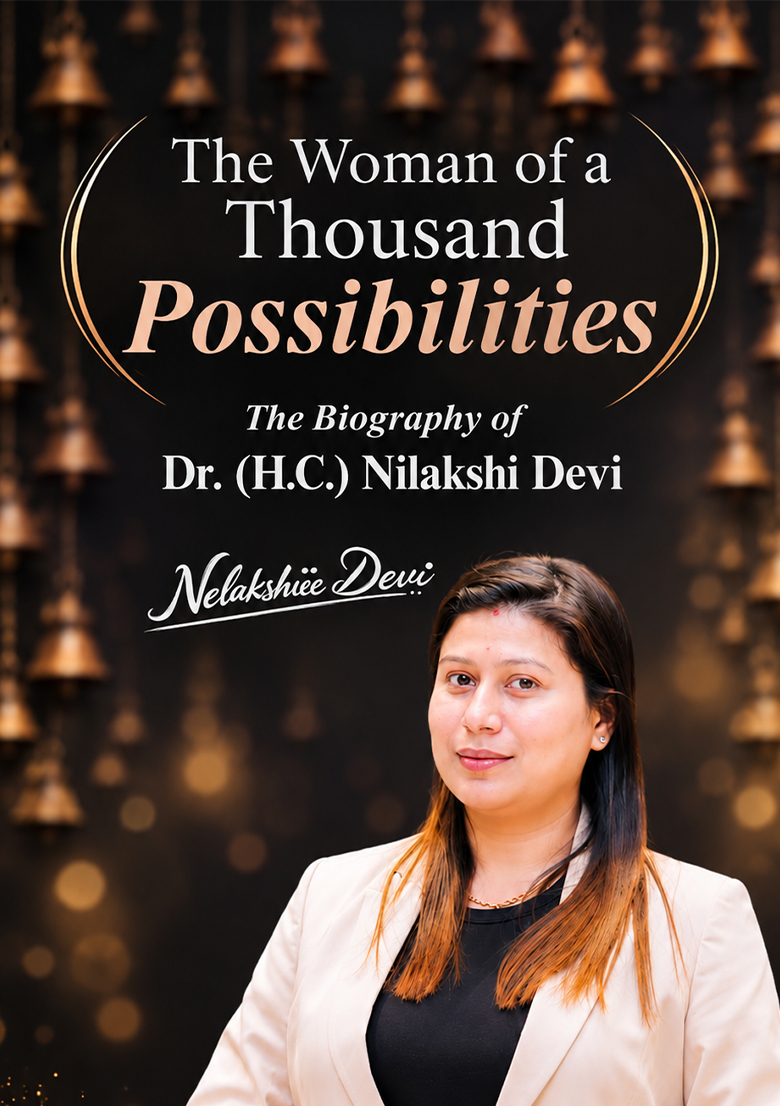
“Every skill I learned and every rupee I earned became a brick in a life I built myself. My story is proof that a woman can begin anywhere and still rise.”
Introduction
A life rarely announces its most important moments in advance. A decision that looks ordinary at the time can gather enormous weight years later: a course taken out of simple interest, a first salary carried home, a household purchase made with one’s own earnings, or a stretch of quiet months spent reconsidering one’s circumstances. Each can become a piece of a much larger understanding of independence. For Dr. Nilakshi Devi, these experiences have given shape and meaning to a life that has refused to stay confined to a single occupation, or to a fixed idea of what a woman ought to accomplish.
She was born on 31 March 1990 and grew up in Assam, where her schooling brought her into contact with people whose influence she still values. Among them was Prashant Barua, her English teacher in Class 7, whose place in her recollections says a great deal about how much she attaches to those who guided her learning. Her education would eventually include studies associated with Morigaon College and Gauhati University, alongside practical training in cutting, tailoring, and embroidery. These were different forms of learning, yet each asked her to build ability through attention and repetition.
Education held an important place in her development, though the direction of her adult life would eventually reach far beyond the subjects she studied. Her interests moved between practical creativity, financial work, and consultancy. Rather than reading as a carefully designed career plan, her experience reveals a woman willing to explore different kinds of work and to acquire whatever knowledge each one demanded. No single professional title could comfortably contain everything she wanted to pursue.
Her personal life took on a new dimension when she married Mridul Kumar Nath on 20 January 2010. That relationship remains deeply important to her, important enough that she has chosen to dedicate this biography to him. Their daughter, Namrata Nath, holds an equally meaningful place in the family. The girl’s ambition to become a Chartered Accountant is one of the aspirations her mother speaks about with obvious pride. So is Namrata’s gentle encouragement that Nilakshi should speak politely with others, a detail that offers a particularly personal glimpse into their relationship. Even within a family, it seems, learning can move in unexpected directions.
The beginning of her working life brought another significant date. On 3 May 2013, she secured her first job. Whatever the responsibilities of that initial position, entering employment marked an important step into the practical world of earning and managing professional obligations. In 2015, her career entered the field of Forex, where she remained involved until 2022. Her experience there included working with MetaTrader 4 (MT4), a trading platform that became part of her daily financial activities.
Some of her most meaningful accomplishments from those years were closely connected to home. Through her earnings, she purchased a washing machine and a television, and she undertook improvements to the house. These acquisitions carried a significance that cannot be measured by their price tags. They were the practical results of her work, things she could see and use in everyday life. For someone who values financial independence, the ability to contribute materially to a household carries a satisfaction all its own.
Her professional interests were never restricted to finance. On 22 January 2020, she began a makeup artistry course, entering a field that required a different kind of skill and creativity. During the same year, she also became involved with Oriflame. Such pursuits illustrate the breadth of her interests and her willingness to learn skills well outside her established professional experience.
Yet personal life was not without difficulty. She has spoken about challenging family circumstances and about a period in 2021 when she isolated herself and turned towards meditation. Her spiritual beliefs occupy a personal place in her understanding of life. She regards God as her ultimate role model and holds particular devotion to Maa Kamakhya and Lord Hanuman. These convictions belong to the private dimensions of her life, where questions of faith and personal understanding carry their own importance.
"I did not wait for permission to become someone. I learned, I earned, and I chose the work that lets me sit across from another person and be useful."
Phase 1: The Identity She Built for Herself
There is a particular kind of satisfaction in being able to introduce oneself through work that has personal meaning. For Dr. Nilakshi, that identity is closely connected to her present involvement in real estate and Vastu consultancy, two fields that bring her into contact with people seeking professional guidance. She takes pleasure in consultation itself: in the chance to sit with another person’s concerns and consider what knowledge she can offer. It is a practical interest, grounded in the work she has chosen, and it occupies an important place in how she understands herself today.
A professional identity can sometimes be reduced to a designation on a visiting card. Hers is less easily contained. Real estate involves decisions about property, ownership, and the practical requirements people bring to such matters. Vastu consultancy approaches spaces from another angle entirely, one concerned with traditional principles of arrangement and placement. Her involvement in both places puts her within two different forms of advisory work. Each has its own concerns and expectations, yet both require attention to the person seeking assistance. For her, the opportunity to offer consultation is itself a source of interest.
What stands out in her present outlook is the importance she gives to remaining professionally engaged. Work represents an opportunity to exercise judgement, maintain an independent identity, and make use of abilities that have value beyond the boundaries of her household. She does not describe consultation merely as an obligation attached to a profession. She regards it as a hobby, an activity she enjoys in its own right. That distinction matters. A person may undertake a responsibility because it is necessary, but genuine interest gives the responsibility a different character. It creates a reason to remain attentive even when there is no immediate personal advantage to be gained.
In real estate, the concerns that bring people to a consultant are practical and often significant to them. A property may represent a place of residence, a business requirement, or an important financial consideration. These matters call for care because the person seeking guidance arrives with a particular set of expectations. Dr. Nilakshi’s present association with the field places her in a professional environment where understanding those expectations is central to the work. Her interest in consultation gives her a personal connection to this responsibility, allowing her to regard the exchange of information and guidance as a meaningful part of her occupation.
Her involvement in Vastu brings another dimension to that professional identity. Within this practice, attention is directed towards the arrangement and use of spaces according to its established principles. For someone consulting in this field, the work involves discussing concerns that clients associate with their surroundings. She has chosen to include this discipline among her professional activities, giving it a place alongside real estate rather than treating the two as entirely separate identities. The combination speaks to the range of her present interests without requiring either field to define her completely.
There is also a personal quality to the way she understands professional interaction. Consultation necessarily involves communication, and communication asks something of both participants. One person must be willing to explain a concern; the other must be prepared to understand what is being asked. The value of such an exchange lies partly in the clarity with which knowledge can be shared. Her enjoyment of consultation suggests that she is drawn to this human element of professional life, where the ability to engage with others has a place alongside technical understanding.
“I still carry the names of the teachers who first showed me what learning could feel like. Some lessons stay long after the classroom has closed behind you."
Phase 2 : A Childhood Written in Small Lessons

Before there were professional responsibilities or decisions to be made independently, there was a young girl growing up in Assam, gradually becoming familiar with the people, places, and routines that made up her immediate world. Dr. Nilakshi was born on 17 April 1990, and the earliest part of her life belongs to the family and educational surroundings in which she was raised. Childhood is seldom understood in full while it is being lived. Its importance often rests in encounters that seem quite ordinary at the time, particularly the relationships through which a child begins to understand learning, behaviour, and the expectations of others.
The family forms an important part of those early surroundings. Long before children are able to explain what they believe or what kind of people they wish to become, they live among individuals whose habits and attitudes give everyday life its familiar character. The relationships within a household introduce ideas of responsibility, affection, and belonging, often without formal explanation. In Nilakshi’s case, her childhood in Assam provides the starting point for understanding the personal world into which she was born. The details of individual family relationships remain private within the account available, but their place in the setting of her early life cannot be separated from the years in which she grew up.
School brought a different kind of experience. Beyond the familiar surroundings of home, the classroom introduced a structured environment in which learning depended upon attention, instruction, and the willingness to understand unfamiliar subjects.
Each school day placed a student among teachers and classmates, with lessons to follow and expectations to meet. For a child, this was an opportunity to encounter people whose knowledge extended beyond the immediate family. The importance of those relationships becomes especially apparent when particular teachers remain significant enough to be remembered by name.
Among the educators associated with Nilakshi’s school years was Prashant Barua, who taught her English when she was in Class 7. His name occupies a distinct place in the information she has shared about her childhood. The fact that she identifies him specifically, rather than speaking only about her schooling in general terms, gives this part of her recollections a personal quality. He belonged to a particular period of her education, when the classroom was an important part of her daily surroundings, and English was among the subjects she was learning.
English occupies an interesting position in a student’s education because it involves more than remembering information. Language asks the learner to pay attention to words, their meanings, and the ways they can be arranged to communicate an idea. The teacher’s responsibility is to make these elements understandable while helping students become familiar with forms of expression that may initially seem difficult. For Nilakshi, Prashant Barua was the person associated with this subject during her seventh standard. His presence in her recollections places an identifiable human figure within the broader account of her school years.
There is something particularly meaningful about remembering a teacher from childhood. Formal education is organised around subjects, examinations, and the movement from one class to another, but the people who conduct those lessons can remain in a student’s memory as individuals. Their names become attached to a particular room, subject, or period of life. Nilakshi’s mention of her English teacher gives her school years precisely this kind of human detail. It allows an account of education to move beyond qualifications and dates, recognising that learning takes place through relationships between people.
“I have been a student in rooms full of books and at tables covered in fabric. Both taught me the same thing: patience is a skill you can practise.”
Phase 3 : The Education of Her Hands and Mind
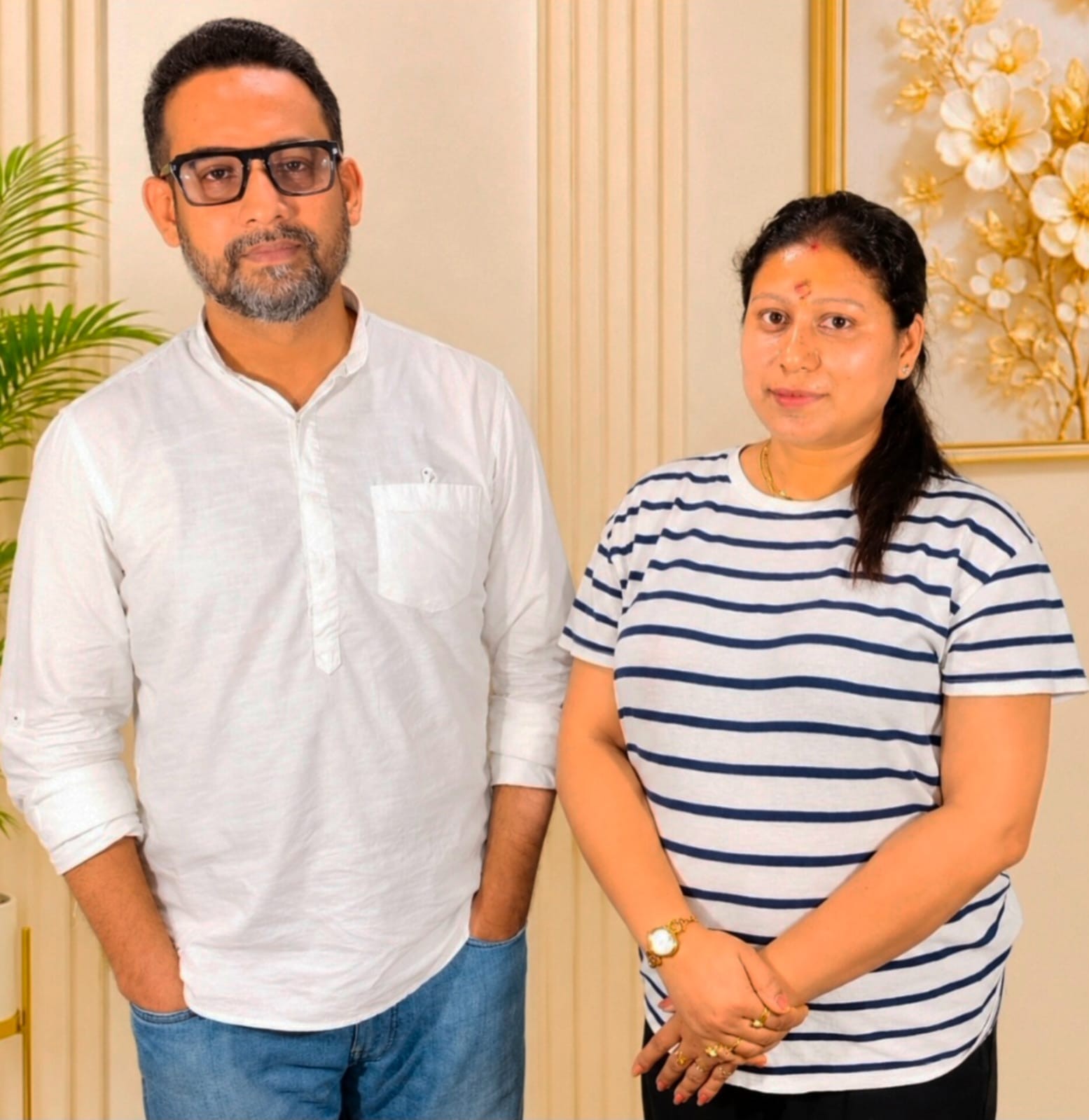
Education does not always arrive in a single form. Sometimes it comes through books, examinations, and the patient explanation of a teacher. At other times it asks for something entirely different: a steady hand, an attentive eye, and the willingness to repeat a difficult task until the result begins to improve. For Dr. Nilakshi, both forms of learning found a place in her development. Her academic studies introduced her to structured knowledge, while her training in cutting, tailoring, and embroidery gave her the chance to acquire practical abilities. Neither experience can be reduced to a qualification alone. Each involved time devoted to learning something she had not previously mastered.
Her association with Morigaon College, under Gauhati University, formed an important part of her higher education. Moving through college-level studies meant engaging with subjects in greater depth and accepting the responsibilities attached to formal academic work. The transition from school to higher studies carries different expectations. Students are required to work with more detailed material, become familiar with academic requirements, and take greater responsibility for their own understanding. Within this environment, Nilakshi pursued studies associated with the university’s academic programmes, including the subject of Education.
The study of Education concerns a field people encounter throughout their lives, often without stopping to consider the principles behind it. Teaching and learning are familiar activities, yet understanding them as an academic subject requires a different kind of attention.
It involves considering how knowledge is communicated, how educational activities are organised, and what learning means within a formal setting. Her academic record establishes her association with this subject. It is an important detail because it identifies a specific area of study within her broader educational background, giving a clearer picture of the knowledge she encountered during college.
Her educational information also includes references to BCA studies and an MA in Hindi. These details indicate the range of academic programmes associated with her background, although the precise status and completion details of every qualification require confirmation against the available certificates. The mention of Hindi adds a language-related dimension to her reported studies, while BCA introduces an area connected with computer applications. These are distinct disciplines, each demanding its own methods of learning. Their appearance in her educational account makes it important to recognise that her academic interests were not described through one subject alone.
Among the people she remembers from her BCA studies is Santosh Nath, whom she identifies as her best teacher during that period. Such recognition is particularly personal. Academic records may establish the name of an institution, a programme, or an examination, but they rarely explain which individuals a student considered especially important. Nilakshi’s recollection gives Santosh Nath a distinct place in her educational experience. She has chosen to remember him through the quality of his teaching, making his contribution meaningful in a way that extends beyond his formal designation.
The relationship between a student and a respected teacher can have a significance that is difficult to capture through academic results. A teacher is responsible for presenting a subject, answering questions, and helping students understand the material before them. Yet every student develops an individual impression of the people who undertake that responsibility. When Nilakshi identifies Santosh Nath as her best teacher, she offers a clear indication of the esteem in which she holds him. The specific lessons or conversations that formed this opinion have not been detailed, but her appreciation of his teaching remains an important part of the educational account she has provided.
Note of Thanks
Gratitude is a deeply personal feeling. It grows from remembering the people whose guidance, generosity, and influence have held meaning in one’s life. For Dr. Nilakshi Devi, this acknowledgement is an opportunity to recognise those who have contributed to her understanding of herself, her professional interests, and the values she continues to cherish.
Her heartfelt gratitude and deepest appreciation to her beloved parents, who blessed her with this precious life, whose love, sacrifices, and blessings continue to guide her at every step.
She expresses her sincere appreciation to Vikram Khaitan, whose guidance holds an important place in her professional learning. His contribution to her understanding of life remains meaningful, and she acknowledges him with respect for the knowledge he has shared.
A particularly heartfelt expression of gratitude belongs to Jayesh Bhai Gadhavi, whom she considers one of the most important people in her life after her husband. His willingness to help her financially during times of need has left a lasting impression. She remembers his assistance with genuine appreciation, recognising the importance of having someone willing to extend support when circumstances become difficult.
Her admiration also extends to Nita Mukesh Ambani, whom she regards with extraordinary reverence. She considers her a deeply inspiring figure, expressing an admiration that is neither dependent upon personal acquaintance nor accompanied by any expectation of receiving something in return. Her regard arises from the respect and inspiration she personally associates with her.
Above all, she offers her prayers and heartfelt gratitude to Maa Kamakhya and Lord Hanuman, whose divine presence holds a sacred place in her spiritual beliefs. Her faith remains an intimate part of her life, offering a source of personal devotion and guidance.
Through these acknowledgements, Dr. Nilakshi honours the different forms of influence that matter to her: a teacher’s knowledge, a well-wisher’s generosity, an admired personality’s inspiration, and the divine blessings she holds close to her heart. Each occupies a distinct and cherished place in her gratitude.
thanks,
– Dr. (H.C.) Nilakshi Devi

AIMLAY is a leading global education platform empowering ACADEMIC and EXPERIENTIAL learners, uniquely focused on recognizing knowledge gained through experience and building a diversified community of doctorates and aspiring researchers.