
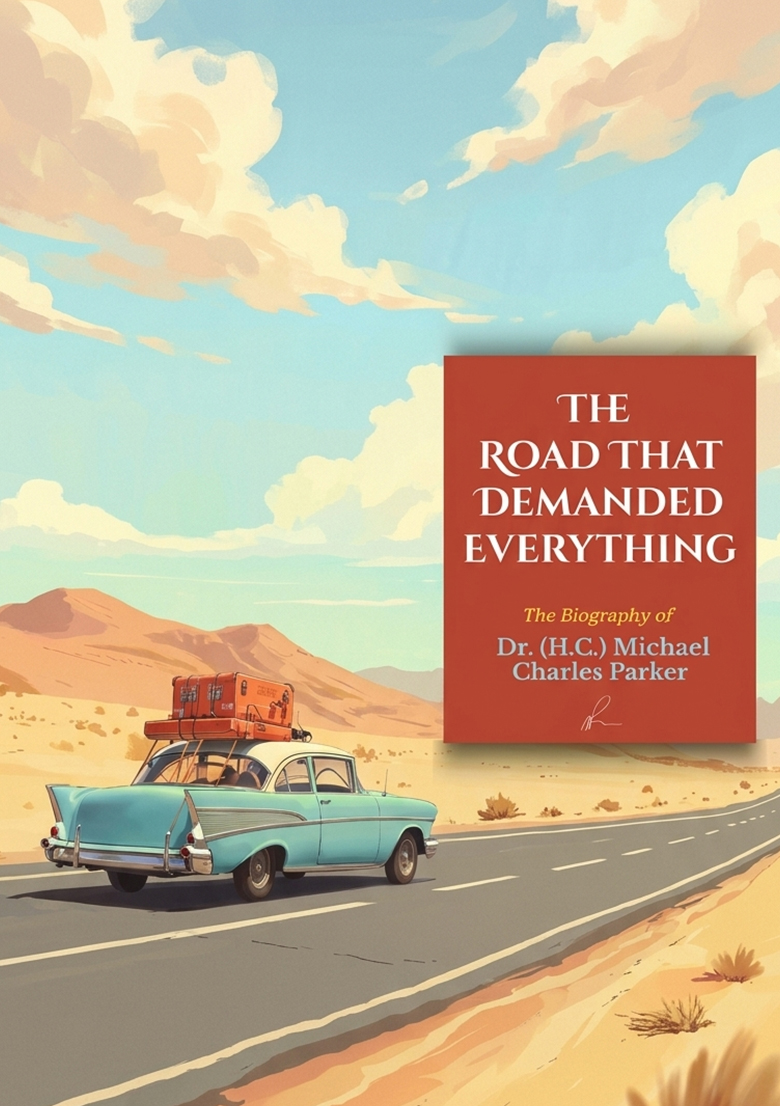
“I chose the harder road, the uncertain path, the life that demanded everything. I gave my strength to strangers, my time to lost causes, my heart to the forgotten. And I would walk it again without hesitation, because purpose is worth every scar, every loss, and every tear it costs."
Introduction
A workshop in Fiji brought Dr. Michael Charles Parker into contact with staff of the Ministry of Youth and Sports. The training was well received. He also heard that youth workers needed further support as they responded to difficulties facing young people. When an invitation came for him to return to a longer advisory role, he recognised an opportunity to use what he had learned through decades of community work. He accepted the role in 2026.
The account behind that decision begins in Port Lincoln, South Australia, where he was born on 1 October 1959. He remembers the seaside town warmly. He was a shy, studious boy who enjoyed sport, time on his grandfather’s farm and the influence of an uncle he admired. His teenage years were less settled. Family violence affected him, several moves disrupted his schooling, and he left home at eighteen without completing secondary school. He later connected those experiences with his concern for young people facing hardship of their Own.
In 1978, he became a Christian after finding a welcoming congregation at Bethel. Judy, whom he would marry, had introduced him to the church. His faith grew through conversations with a local minister about marriage, fatherhood, and the life he wanted to lead. He considered studying for ministry, then chose to work at the Commonwealth Bank and support his young family first.
When he felt ready to study, Judy supported a decision that would change their household. He enrolled at Luther Seminary in 1985, began in 1986, and studied full-time while she worked. He earned a Bachelor of Theology in 1989 and a Graduate Diploma in Ministry in 1991. Ordained that year, he began pastoral work in Wangaratta, Victoria. After a short posting, the family returned to South Australia, where he served churches in Laura, Appila and Jamestown.
Community needs soon became a larger part of his work. He helped establish chaplaincy, a youth centre and opportunities for families affected by drought. He also brought music and conversation into hotels through pub church. Invitations to share and develop such programs led him to establish Creative Community Outcomes in 1992. At Victor Harbor, he later worked with businesses, government, community members and volunteers on a response to Schoolies Week.
After moving to Perth, a basketball activity he began for his children grew into a gathering place for other young people. Relationships formed there brought him closer to Aboriginal families whose children were struggling at school and elsewhere. In 2007, he founded Catalyst Schools, an alternative education program built around literacy, numeracy, life skills and family involvement. He saw students make progress, but the program later lost funding. His injury during those years and financial hardship around the program’s end made that period especially difficult for his family.
His work continued through community services in Meekatharra, teaching roles, and training in the APY Lands. He learned to bring courses into communities rather than always expecting people to travel to them. He also developed Timothy Training so local leaders could learn as they worked and teach others in turn.
That history gives context to his present work with Pacific Australia Skills in Fiji. He now helps develop youth work and counselling training and delivers Youth Essentials workshops. The setting has changed from the places where he began, but his method has grown steadily through them: listen to people, work with those who know their community, and give them skills they can carry forward.
"Port Lincoln gave me the sea, my grandfather's farm, and a childhood I still carry. It also gave me wounds I spent years learning to understand."
Phase 1: The Shy Boy Who Learned to Endure
When Dr. Michael Charles Parker looks back on Port Lincoln, he does not begin with dates or documents. He begins with the feeling of the place. Born there on 1 October 1959, he grew up in a South Australian seaside town that gave him room to run, to play sport, and to be part of a family. He was a studious boy, mostly shy, with a hunger for learning that showed itself early. At Port Lincoln South Primary School, he was named dux. He could shine in a classroom, even if he preferred not to be the centre of attention outside it.
His father, Eric, started out as a mechanic and became a successful hotel entrepreneur. Cars stayed close to his heart, especially vintage Chevrolets. He collected Ariel motorbikes too. For a young son, those vehicles were more than machinery. They were lessons in how things were built, how they were cared for, and what made one different from another. Michael’s own interest in cars grew as he entered his teenage years. By sixteen, he had his first: an AP5 Valiant.
His mother, Trisha, worked mainly in retail. He remembered the effort both parents poured into their work, though family life was more complicated than the occupations beside their names might suggest. His parents later divorced, and after remarriage, his mother ran post offices for many years. Those changes formed part of the household story he grew up within. He has described both parents’ work ethic with respect, while speaking just as openly about the difficulties the family experienced. He also spoke fondly of a beautiful and caring mother whose love and sacrifice, even as she suffered, have always been inspirational and comforting.
Among his siblings, he was especially close to his younger sister Karen. He also shared a good brotherly bond with Derek, who arrived later. His younger sister Belinda was born around the time he left home at eighteen. The age gaps meant his memories of growing up beside Karen were different from those of the younger two. He spoke warmly of each relationship, and took care to correct the number of sisters when it was misunderstood: two younger sisters and one younger brother.
Time with his grandfather offered another kind of closeness. Michael would go to stay with him on his farm. Those visits stayed with him clearly enough that he names his grandfather among the people who influenced him most in his early years. An uncle mattered too. A gifted sportsman, he encouraged the boy’s interest in sport without, as Michael recalled it, ever needing to give a formal lesson. Michael simply admired what he could do.
Port Lincoln remained a good place in his memory, but the years that followed brought repeated moves. In 1973, the family moved to Glenelg, where sport continued to interest him, and he became a surf lifesaver. Another move, to Walleroo in 1976, meant another change of school. At Kadina High School, he was a prefect. That responsibility sits alongside his earlier description of himself as shy. He did not have to be outspoken to take his place among other students or to accept a role entrusted to him.
Moving towns several times unsettled his secondary education. Each move asked him to adapt to a new place and a new set of people while he was still a teenager. In 1977, he moved again, this time to Nuriootpa. His life outline records his first job there as a barman. Work brought responsibilities of a different kind, but he had not been able to follow a continuous course through school. He has said plainly that he did not complete his secondary education.
“I walked into that small country church a stranger. They welcomed me anyway. That welcome became the foundation of everything I believed."
Phase 2 : Where Faith Found Its Feet
Leaving home had given Dr. Michael Charles Parker distance from the difficulties of his teenage years, but distance alone does not tell a young man what kind of life he wants to build. He was working, finding his footing as an adult, when he met Judy. She was a Christian. Through her came an invitation that sounded ordinary enough: on a Sunday, he would go to church with her, then meet her parents over lunch.
He went with her to a small country church at Bethel. What he found there stayed with him. He had come through a difficult couple of years, and the congregation received him without asking him to pretend his life was already settled. He could walk in, take his place, and come back the following Sunday. As the weeks passed, faith began to mean something personal to him.
The relationship with Judy was deepening too. While they prepared for marriage, Michael talked with a local minister in Kapunda. They walked through the town discussing what it meant to be a man, a husband, and a father. The questions held his attention because he was about to live with their answers. He listened to the minister and weighed the responsibilities that would soon be his, along with the kind of care he hoped to give the family he and Judy would make together.
In 1978, he became a Christian and was baptised. He has described that change as a conversion that opened his eyes to other people in the community. What he had found at Bethel gave him a way to think about love and purpose. He believed God loved him and wanted him to tell others they were loved too. He had first encountered that welcome among people willing to make room for him; now he wanted to understand how to live it.
Judy and Michael married, and family life began quickly. Their eldest son, Mathew, arrived in 1978. Their second son, Jarrad, was born in 1979. The life outline places the young family in Glenelg and then in Tanunda, where they had their first house. In 1982, they moved to Modbury Heights. Home, children, and work gave shape to the years. Michael was earning a living at the Commonwealth Bank, and the family depended on the steadiness of that income.
He had an early desire to study for ministry. In his first enthusiasm as a Christian, he even applied to seminary. Then he read Scripture that warned against placing someone new to the faith in a pastoral role, and he drew back. He felt he needed time. His young family needed support as well, and bank work allowed him to provide it.
Waiting did not mean his interest in theology had passed. It meant he chose to take his responsibilities at home seriously while he learned more about his faith. He had entered church life only recently. There was much to understand, and much to practise in his relationships with Judy and the children. The conversations in Kapunda had made fatherhood and marriage feel worthy of thought; daily family life made them immediate.
“Judy never asked me to play it safe. She asked me to be faithful. That answer cost us both, and it changed everything.”
Phase 3 : The Cost of Answering the Call
By the middle of the 1980s, Dr. Michael Charles Parker and Judy had built a life that looked secure from the outside. He had steady work at the Commonwealth Bank. They had a new house, a new car, money in the bank, and children depending on them. For a young family, these were no small achievements. They represented years of work, careful choices, and the quiet comfort of knowing the household could meet its needs.
Then one day, the desire to study returned with unusual force. He felt the time had come.
The thought unsettled him because he understood its practical cost. Leaving the security Of bank work for full-time study would affect the entire family. There would be no financial support to carry them through those years. The house, the car, the money they had saved: these made the decision harder, not easier. They had something real to protect.
He was nervous about speaking to Judy. The calling may have felt personal, but the consequences belonged to both of them. When he finally explained what had been weighing on him, she did not dismiss it or ask him to ignore it for the sake Of comfort. Her answer was direct. If God was calling him, she believed he needed to respond.
That support made the decision possible. It did not remove the sacrifice. Judy would have to work while he studied full time, and the demands of family life would continue regardless of his academic responsibilities. They were choosing a different kind of future without knowing exactly what it would require of them.
Michael enrolled at Luther in 1985 and began his studies in 1986. The complete period of preparation lasted about six and a half years, including a year of field experience. He entered the seminary carrying an unusual educational history. He had once been named dux at primary school, yet repeated moves and difficulties at home had prevented him from completing secondary education. Now, as a husband and father, he was returning to formal study with responsibilities far beyond the
The work demanded concentration. Theology required him to read closely, examine ideas, and consider what pastoral service would ask of his character. He studied Hebrew, Greek, biblical interpretation, church history, philosophy, counselling, worship, education, and pastoral care. Each subject approached ministry from a different direction. Together, they asked him to think about faith as something that had to be understood, communicated, and lived among people.
Academic learning formed only part of those years. He later described the period as one of character formation. He came to understand his strengths more clearly and to recognise his challenges without turning away from them. His own life could be reconsidered. Experiences that had once seemed like disconnected hardships could be examined with greater honesty, giving him a deeper capacity to recognise struggle in others.
Note of Thanks
Dr. Michael Charles Parker offers his sincere thanks to everyone who has shared a part in his life and work. He remains grateful for the Opportunities that allowed him to serve through ministry, education, youth development, community programs, and professional training. Each role introduced him to people whose experiences broadened his understanding and strengthened his commitment to practical service.
He is especially thankful to the young people, families, colleagues, volunteers, educators, community leaders, and organisations who trusted him to work beside them. Their knowledge, honesty, and willingness to participate helped shape many of the programs recorded in these pages. He also acknowledges those who challenged his ideas, because those moments encouraged reflection and growth.
Gratitude is extended even to the difficult seasons. Interrupted plans, criticism, injury, financial loss, and the closure of valued work brought pain, but they also revealed the importance of perseverance, humility, and beginning again. Those experiences remain part of what formed him.
Above all, he thanks God for guidance, strength, and presence through both favourable and uncertain times. He offers his deepest gratitude to his wife, Judy, whose trust, patience, and constant support made many of his decisions possible. He also thanks their children for the understanding and encouragement they gave throughout the years.
To everyone who offered an opportunity, shared a lesson, or remained close during hardship, Dr. Michael gives his heartfelt thanks.
thanks,
– Dr. (H.C.) Michael Charles Parker

AIMLAY is a leading global education platform empowering ACADEMIC and EXPERIENTIAL learners, uniquely focused on recognizing knowledge gained through experience and building a diversified community of doctorates and aspiring researchers.