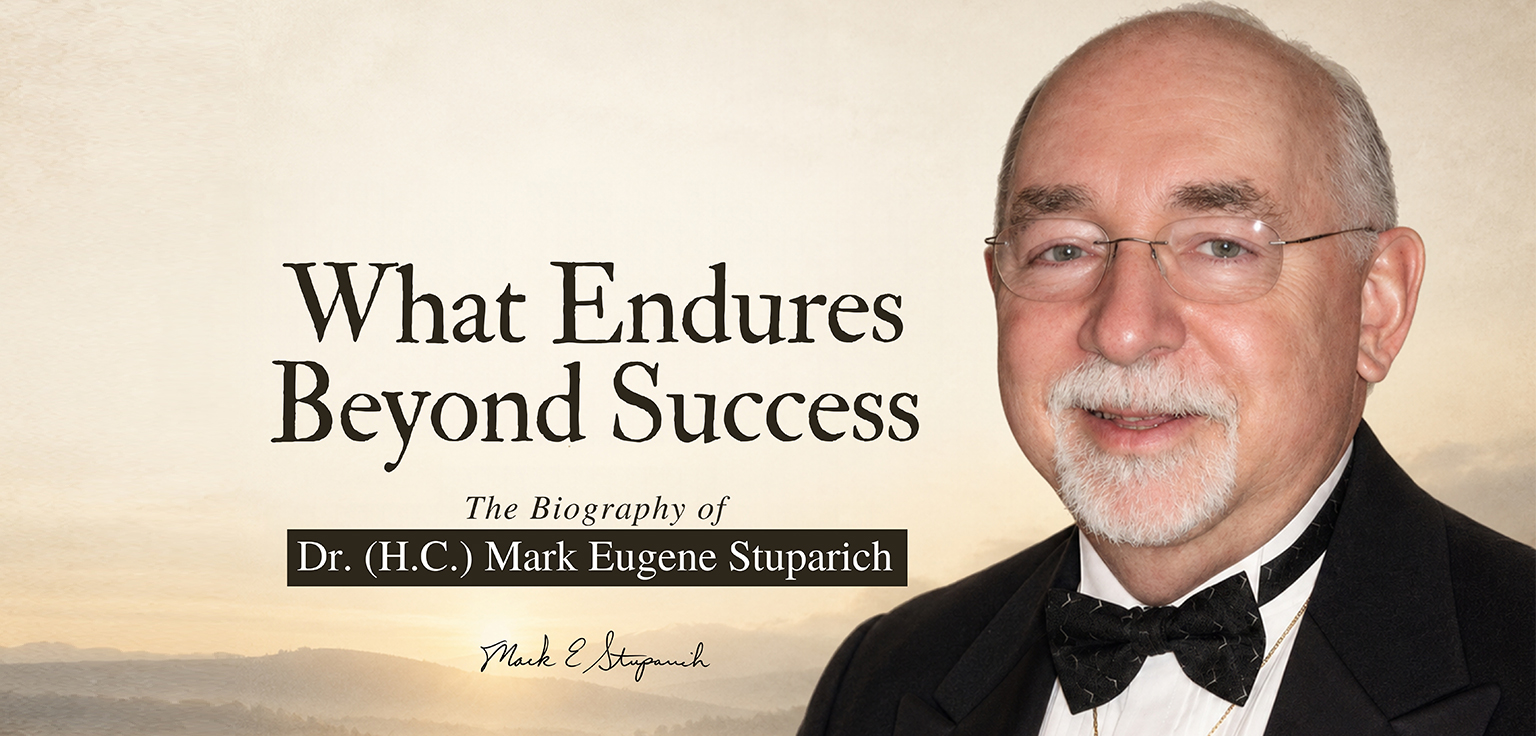
"No matter how much the world changes, there is always value in learning enough to move forward with it."
Introduction
Dr. Mark Eugene Stuparich’s life has been rooted in Baldwin, New York, a Long Island community he knew first as a boy and later as the place he continued to call home. The setting was residential and close to the water, marked by open spaces that gradually gave way to more houses. It was not a large city, and its character suited a childhood lived among family, school, a few close friends, and the practical expectations of home. From that beginning came a life that would extend far beyond the familiar streets of Baldwin while never losing its connection to them.
He was the only child of Natalio and Tillie Stuparich. His father had arrived in the United States from Italy at seventeen, having worked his way across on a steamship. He learned boat building in a fishing and boating community, and during the Second World War the place where he worked built boats for the Navy and Coast Guard. When demand changed after the war, he transferred his skills to house building and became a highly skilled carpenter, especially valued for detailed work such as moldings and cabinetry. The work was physical, exacting, and honest. Yet he wanted a different professional future for his son, one shaped by formal education and white collar work.
That conviction became an early influence. His father was strict about school and expected him to do well. He attended Catholic school for eight years, then a private high school with a demanding curriculum. Mathematics and science became his strongest interests. He was not drawn to athletics, but music gave his younger years another texture. Accordion lessons began when he was five and continued until he was about thirteen. He later played clarinet in high school and bugle in a drum and bugle corps. Although practice once felt like a chore, music stayed with him and would later return in a more personal way through singing.
The path from mathematics to computing was not obvious at first. Computer science programs were available only at some of the leading colleges when he entered higher education, and his own college did not offer one. He studied mathematics at St. John’s University, graduating in 1969, and took a small number of computer courses while there. Those courses opened an interest that made sense to him. Programming required logic, discipline, and an orderly mind, qualities he already recognized in mathematics. His first experiences with technology were far removed from the compact devices of today. The mainframes he worked with filled entire rooms, yet they marked the beginning of a field that would become the center of his professional life.
After college, he joined Chase Manhattan Bank and remained with the organization for forty two years. His roles changed as banking changed. He began in systems work, developed into a manager, and moved into product and customer-facing responsibilities when his ability to work with clients was recognized. Later, as electronic commerce and corporate internet banking grew, he worked at the point where technology, banking operations, client needs, and industry standards met. His career did not depend on standing still in a familiar specialty. It depended on meeting new technology with study, industry engagement, and a readiness to take on responsibilities that required both technical precision and human judgement.
Alongside that career, he built a family with Elaine. Their five children arrived across eleven years, and the demands of work, study, and parenting often competed for the same hours. He pursued a certificate in computer programming and systems analysis through New York University and later an MBA in Operations Research from St. John’s University. The years were difficult, especially when his children were young, but they also made clear the support that family life required and the long view that sustained it.
"I am an only child."
Phase 1: From Italian Roots to Long Island Shores
Before the long career in banking and electronic commerce, there was a small household in Baldwin. Dr. Mark Eugene Stuparich grew up as an only child, with his father Natalio and his mother Tillie. His father’s arrival in the United States carried the memory of an earlier world. At seventeen, Natalio had come from Italy and worked his passage as a deckhand on a steamship. Once in America, he lived with friends from Italy and learned a trade. In a community shaped by fishing and boating, he learned to build smaller boats. The place where he worked later built vessels for the Navy and Coast Guard during the Second World War.
The end of the war changed the demand for boats, but it did not diminish Natalio’s skill. As returning service members needed homes, a housing boom followed. He transferred what he knew from boat building to house building and worked as a carpenter. While he could frame a house when necessary, his particular skill lay in the detailed work of moldings and cabinets. His hands built the kind of work that required patience and precision. Though he had not had the chance for extensive formal education himself, he placed a high value on it for his son and wanted him to enter a professional life unlike the manual labor he had known.
Baldwin provided a quiet setting for those early years. It was a South Shore community on Long Island, flat because of its seashore location and largely middle class in character. Many homes had been built in the 1940s and 1950s. Empty lots and open spaces were still visible at first, though they were gradually purchased and developed. There were small businesses and local stores, but it was above all a residential place. Its proximity to the water was part of daily life, not an occasional destination.
He did not have a large group of friends and found socializing difficult at times. Yet he had a few close friends, including one whose boat gave summer days a distinct purpose. Together, they spent time on the water, collected clams, and sold them for spending money. His mother’s large family added another kind of companionship. Many of his cousins were older, but because they lived close by and the families visited regularly, they became almost like adopted brothers and sisters. Those relationships softened the solitude that can accompany being an only child and connected him to a wider family circle.
This first world gave him several enduring reference points: a father’s example of skilled work and educational ambition, a mother’s close presence, the comfort of extended family, and the shoreline community that remained his home. It was not a childhood defined by spectacle. It was defined by familiar people, a developing sense of responsibility, and a place whose rhythms stayed recognizable even as the rest of his life widened in scope.
Natalio’s hopes for his son were grounded in his own life rather than in an abstract idea of success. He had crossed the Atlantic as a teenager, found support among people from his country, and learned work by doing it. Boat building, then house building, demanded close attention to material, proportion, and finish. His son grew up seeing that work could be skilled and dignified, while also hearing that education could offer a different kind of opportunity. The message was not that one form of work was without value. It was that a formal education could make it possible to choose a path with wider professional possibilities. That belief entered the household early and remained one of the most important gifts Natalio gave his only child.
"My parents, and especially my father, valued education very highly."
Phase 2 : The Classroom and the Music Room
Education was never treated casually in the Stuparich home. Natalio’s own limited opportunity for formal schooling made him especially determined that his son should do well. That expectation was strict, but it created a path. Dr. Mark Eugene Stuparich attended Catholic school for eight years and then entered a private high school, where the curriculum was more difficult. He managed the demands of that environment well enough to continue on to college, carrying forward the lesson that serious effort in the classroom could create options beyond the world he had known as a child.
Mathematics and science were his preferred subjects. They appealed to the part of him that valued order, reasoning, and clear answers. History did not hold the same attraction in those early years, though he later came to enjoy reading historical books as an adult. His school experience was therefore not merely about grades or advancement. It also revealed the habits of thought that would later serve him in programming and systems work: logical sequence, patient analysis, and respect for accuracy.
Music developed alongside that education. When he was five, his parents enrolled him in accordion lessons. He studied the instrument until he was about thirteen. At the time, the routine of practice and lessons often felt burdensome, as childhood disciplines can. In later life, however, he came to appreciate the ability to play and found more enjoyment in music than he had as a boy. His father took particular pride in his musical ability and had been more interested than his mother in making the lessons part of his upbringing.
The accordion was not his only instrument. In high school, he played clarinet, and he also played bugle in a drum and bugle corps. His listening was broad. Classical music sat alongside the rock and roll that was beginning to come into its own during his youth. He especially remembered enjoying the Mamas and the Papas and the Association. These interests did not point him towards a musical profession, but they gave him a way to participate, perform, and listen attentively. Much later, music would again have a place in his life through singing.
His school years were also marked by a loss that altered the structure of home. Natalio became ill for about nine months and died of cancer when his son was fifteen. Because his decline had been visible, the death did not come without warning, but it was devastating nonetheless. Looking back, Dr. Mark Eugene Stuparich recognized that it affected him more deeply than he understood at the time. He had just finished, or was about to finish, his second year of high school. Suddenly, the household consisted of his mother and himself.
The practical work that his father had once handled began to fall to him: gardening, painting, repairs, and the ordinary tasks of keeping a home in order. He described it as becoming the man of the house. The adjustment was difficult, yet it became a learning experience that later helped him when he had a family of his own. School, music, and loss thus came together in these years, shaping both the disciplined student and the responsible young man who would leave Baldwin for college without truly leaving the values learned there.
"It was a logical progression from being a mathematician to being a computer scientist."
Phase 3 : Mathematics Opens the Door to Computing
College began with a daily commute rather than a departure from home. Dr. Mark Eugene Stuparich attended St. John’s University in New York and graduated in 1969 with a Bachelor of Science in Mathematics. At the time, he had not mapped out a precise professional destination. Mathematics felt like the natural choice because it was a subject in which he was proficient and comfortable. It gave him a rigorous way of thinking and a language of logical relationships, even before he knew how central those habits would become to his career.
Computers were only beginning to enter his horizon. In high school, he had known very little about them because the field itself was still young. Even in college, computer science programs were available only at some of the best institutions, and St. John’s did not yet have one. A few computer courses, however, made a lasting impression. They revealed a new kind of work in which mathematical reasoning could be applied to practical problems. The attraction was not simply novelty. Programming required discipline, clarity, and the ability to move step by step through a problem, all qualities that aligned with his mathematical training.
The computers of that period bore little resemblance to the personal devices that later became common. The machines he encountered in the workplace were large mainframes that occupied entire rooms of equipment. From today’s perspective, even a personal computer would likely exceed the power of those early systems. Yet the scale of the equipment did not lessen its significance. He had entered the field at a moment when computer technology was becoming increasingly important to large organizations, while its wider social and commercial uses were still taking shape.
After graduation, he accepted his first position with Chase Manhattan Bank. It was the beginning of a relationship with one organization that would continue for forty two years and through several mergers. He joined as a young employee among colleagues of varying ages and found that he was accepted as part of the team. Nobody held his youth against him. The work was shared, and the experience was encouraging. For someone who had had difficulty socializing in childhood, the collaborative nature of the workplace offered another setting in which confidence could develop through contribution rather than through outward display.
The early years did not end his formal learning. A supervisor recommended a certificate programme offered by the New York University School of Continuing Education. He took six courses in computer science, attending school one night each week while working. The programme led to his 1972 Certificate in Computer Programming and Systems Analysis. It added formal knowledge to the learning already taking place on the job and showed an early willingness to strengthen experience with further study rather than rely on the degree he had already earned.
By the time he moved fully into systems work, the essential direction of his professional life had been set. Mathematics had given him the mental discipline. Computer courses had introduced the possibility. The bank had given him the place to apply both. What began as curiosity about a new technology had become the foundation of a career that would grow as technology itself changed.
Note of Thanks
Dr. Mark Eugene Stuparich’s gratitude begins with his parents, whose influence has remained present throughout his life. His father, Natalio Stuparich, came to the United States from Italy as a young man and built a life through trade, skill, and hard work. He learned boat building, later became a carpenter, and took pride in work that demanded care and precision. More than anything, he believed that his son should receive the education he had not been able to pursue in the same way. His insistence on doing well in school was demanding, but it established an expectation that learning could widen a life.
He holds particular gratitude for his mother, Tillie Stuparich, whose support and values continued after the loss of his father. When he was fifteen, the household became theirs alone, and the responsibilities of home changed. Her presence, the closeness of the extended family, and the values she carried gave him a steady foundation. Later, when he married, the family home was adapted so that she could continue to live nearby. The closeness of that arrangement reflected the bond that had always existed between mother and son.
He is also grateful for the people who worked alongside him during his long career. Supervisors who encouraged further study, colleagues who accepted him as a young employee, clients who trusted him with complex needs, and peers from other banks who collaborated through industry standards all played a part in the work he was able to do. Their contributions made professional growth a shared experience rather than an individual achievement.
Finally, gratitude extends to the family that has continued to surround him: his children, grandchildren, and the memory of Elaine, whose support was present during the years when work, study, and family responsibilities had to be carried together. Their closeness has given enduring meaning to the values he first learned at home.
thanks,
– Dr. (H.C.) Mark Eugene Stuparich

AIMLAY is a leading global education platform empowering ACADEMIC and EXPERIENTIAL learners, uniquely focused on recognizing knowledge gained through experience and building a diversified community of doctorates and aspiring researchers.