“Do not judge me by my success; judge me by how many times I fell down and got back up again.”
Introduction
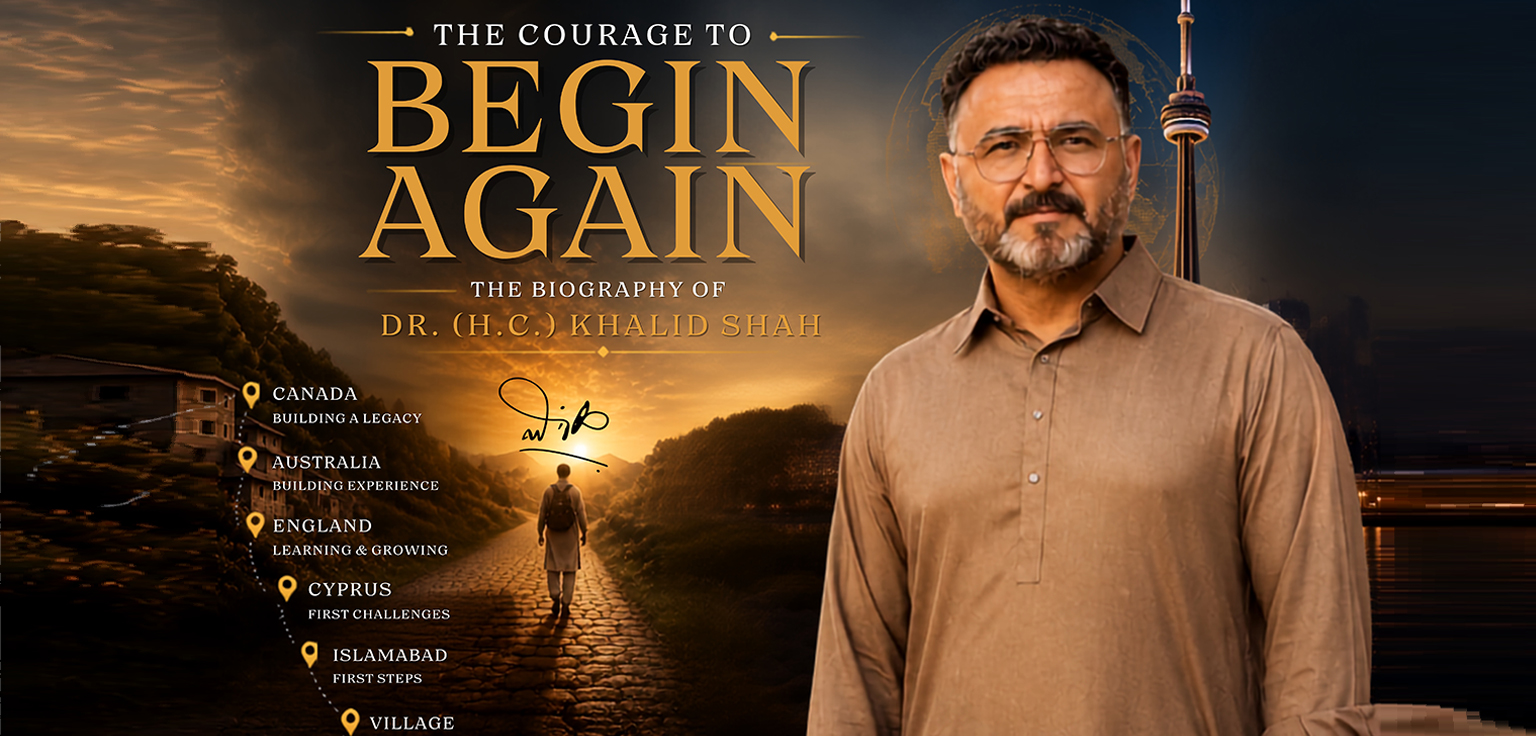
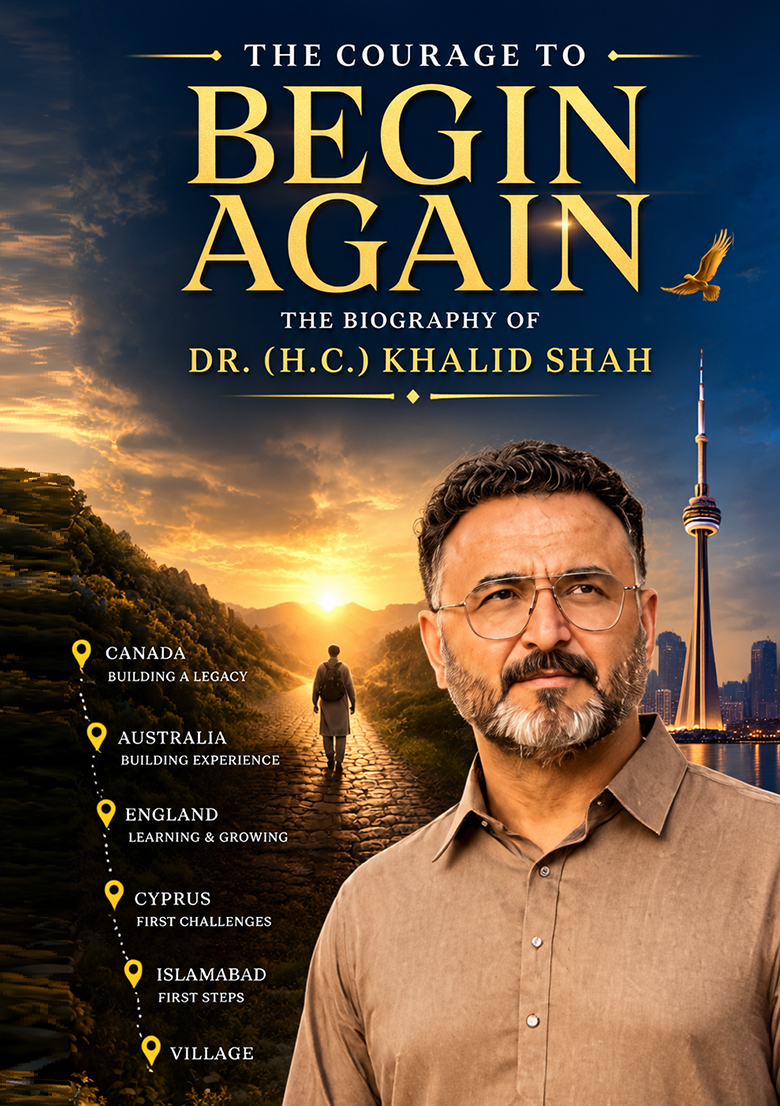
The life of Dr. Khalid Shah is a journey shaped by courage, struggle, discipline, and the quiet strength to begin again whenever life demanded it. Born on 16 November 1982 in a remote village in the former North Frontier Province, he came from surroundings where opportunities were limited and even basic educational facilities were not easily available. His early life was simple, grounded, and very different from the comfort of modern resources. Yet those limitations did not weaken his spirit. Instead, they gave him the patience, focus, and resilience that later became the foundation of his growth.
From a young age, Dr. Khalid learned that life does not always offer a prepared path. Education proved difficult; we shared books, and we achieved proper schooling through struggle. In that environment, he developed the habit of making use of whatever was available. His father, Sardaraz khan, also had an enduring impact on his thinking. The values he received from him, including dignity, clarity, loyalty to one’s roots, and the principle of never harming others without reason, stayed with him through every stage of life.
His journey expanded when he moved from village life to Islamabad, where exposure to computers, multimedia work, and graphic design revealed new opportunities. What began as a humble office assistant role gradually became a path of learning and confidence. Through practice, dedication, and persistence, he developed skills in graphic designing, studied at Nicon College, worked as a lab assistant, taught for more than one and a half years, and gained respect through his own effort. This phase taught him that skill can change a person’s place in life.
The road ahead then took him beyond his homeland. His time in Cyprus was among the hardest periods of his life, marked by very little money, language barriers, and limited options. From there, he moved to England, where he continued to work, study, and build himself. His international business journey later expanded through Australia, where he gained experience in restaurants, security services, and the automotive industry. With double Master’s degrees from the United Kingdom and Australia, he combined education with practical exposure and strengthened his identity as a global business professional.
In Canada, Dr. Khalid once again started anew. He cleared the required exam to become a licensed 310S Master Mechanic, opened his own automotive shop, faced the painful setback of losing the shop to fire, and rebuilt with determination. Over time, he expanded into automotive repair, used car sales, body repair, storage, cleaning and glass replacement, restaurants, and business development services. His journey in Toronto became a reflection of his ability to transform difficulty into growth.
Today, as the Founder and Chief Executive Officer of Triple Z & Associates, Dr. Khalid stands as a dynamic entrepreneur and global business leader with over two decades of experience across England, Australia, and Canada. His mission is to build, develop, and manage profitable businesses that create value, empower communities, and open doors to global opportunities. His leadership philosophy is built on focus, innovation, integrity, and results.
Yet beyond business success, his story remains deeply human. He defines success not only by financial growth but also by peace of mind, character, family stability, and the ability to stand with dignity. The Canadian citizenship of his family in 2023, his recognition as a Pushtun entrepreneur, and his desire to guide newcomers and community members all reflect a life that has moved from personal struggle toward purposeful contribution.
This biography presents the journey of Dr. Khalid as a story of humble beginnings, repeated rebuilding, global experience, family dreams, business vision, and values that remained strong across every country and challenge.
“Start where you are. Use what you have. Do what you can.”
Phase 1: From a Remote Village to the First Lessons of Life
The life journey of Dr. Khalid Shah began on 16 November 1982, in a small and remote village in the region that was then known as the North Frontier Province. It was not a place surrounded by comfort, visibility, or opportunity. It was not a childhood shaped by modern convenience or readily access to facilities. It was a beginning marked by simplicity, limitation, and quiet endurance. He was born into a world where life moved at its own pace, where people lived close to the soil, close to their families, and close to the realities of difficulty. In his understanding, he was simply a village boy from a small city, raised in an area so remote that even basic facilities were not easily available.
His early surroundings were far from the polished image of childhood that many people imagine today. There were no fancy memories attached to luxury, no childhood photographs carefully preserved from every stage of growing up, and no comfortable environment where every need was already arranged. In fact, when he reflected on those years, he remembered how difficult it was even to find photographs from that time. The village did not have a telephone. There was no internet, no easy communication, and no modern system through which memories could be captured and stored. Life existed in its raw form. People lived through moments more than they recorded them.
For Dr. Khalid, childhood was not about having everything. It was about learning to live with very little and still moving forward. His village was so small and underdeveloped during those early years that even a primary school did not properly exist there. Education, which is often considered the first step toward opportunity, was itself a struggle. The idea of a structured school building, with classrooms, resources, and trained systems, came much later in his life. In the earliest years, learning took place wherever space could be found. Occasionally a house became a temporary school. Sometimes children gathered in a place used for prayers, which they called the mosque or masjid. Even there, the arrangement was not permanent or easy. Children would move around, elders would come for prayers, and the space would no longer belong to learning.
These details may seem simple, but they reveal the foundation of his journey. He first learned how to exist in uncertainty before entering the world of international business, building ventures across countries, and becoming associated with leadership, development, and global operations. He grew up in a place where nothing was guaranteed. Even the first steps of education required adjustment, patience, and acceptance. His childhood did not provide comfort, but it quietly taught him how to create his own path through patience and determination.
When he looked back at the late 1980s, he remembered that people did not commonly understand education the way they do today. He did not receive the same facilities that children now receive through private and government systems. There was little awareness, little competition, and very limited access. The village did not yet have the educational environment that later generations would experience. What was missing from his childhood, however, became one of the silent forces that strengthened him. The absence of ease made him observe life more deeply. The lack of comfort made him value every small opening. The scarcity around him taught him that progress is not always born in places of abundance. Occasionally, it begins in places where a 3 person has no choice except to become strong.
As a child, Dr. Khalid was also honest about his own nature. He remembered children being naughty, moving around, running around, and behaving like children do. He did not describe his early years with artificial seriousness. He remembered them as they were, filled with roughness, movement, interruption, and the ordinary mischief of village life. This honesty gives his story a human quality. He was not born as a finished personality. He was shaped gradually, through place, difficulty, people, and circumstance. The village gave him a beginning that was humble, imperfect, and deeply real.
“Education is the most powerful weapon which you can use to change the world.”
Phase 2 : Education Amid Scarcity and the Values That Stayed
For Dr. Khalid Shah, education was never a ready-made privilege placed gently into his hands. It was something he had to reach for, protect, and carry with patience. His early years had already introduced him to a world where facilities were limited, but as he began to grow, he understood even more clearly that learning in his surroundings required effort beyond the ordinary. It was not only about attending classes or reading lessons. It was about finding a way to continue despite an environment where resources were few, systems were weak, and encouragement often came more from personal hunger than from external support.
In the world where Dr. Khalid grew up, people did not commonly understand education as they do today. The quality of schooling remained limited, and the structure around it continued to develop. There were teachers, some good, but the overall system lacked the strength, exposure, or competition to shape young minds easily. In his memory, those years carried the truth of an area where education had not yet become a fully accessible path for every child. The private sector was almost unknown to them during the early stages, and the idea of modern schooling had not reached the village in any strong way. For families like his, life depended on what was available through ordinary means.
His family was not in a financial position to arrange expensive or private education. That reality did not come to him as a complaint but as a fact of life. They did not have the kind of comfort that allowed every child to have a separate set of books, additional facilities, or an easy learning environment. Dr. Khalid was the youngest among four brothers, and the rhythm of education in the family carried its own practical pattern. Books were not treated as personal possessions for one child alone. They moved from one brother to another. One brother would study from a book for one year, then that book would pass to the next, and eventually it would reach him. In that simple practice, there was both scarcity and discipline. Nothing was wasted. Everything had to be used carefully.
Even in the classroom, all children did not always have every book they needed. One student might have a mathematics book, another might have an English book, and someone else might carry a different subject. They shared what they had. They learned not because everything was perfectly arranged, but because they had to create a learning atmosphere among themselves. This early experience quietly taught Dr. Khalid something that later became useful in business and life. Resources may be limited, but cooperation, observation, and persistence can still create progress. When there is not enough in hand, a person either stops or learns to manage better. Those early experiences taught him discipline, patience, and the ability to move forward even with very little.
The lack of educational resources did not only affect books. It shaped the whole experience of learning. There was little competition, and this limited the quality of education around them. The system was not deeply polished. The teachers did what they could, but many were not properly qualified according to the standards that later generations would expect. For a young child, such an environment could have created discouragement. Yet Dr. 9 Khalid did not let the condition of the system define the limits of his possibility. He continued through those years with the quiet understanding that education, even in a difficult form, was still a door.
As he moved toward higher levels of schooling, things became a little better. The difficulties of primary education had been sharper, but the high school stage brought some improvement. Still, the memory of those early struggles remained. He had seen what it meant to begin with almost nothing. He had seen how children studied without enough books, how they adjusted to whatever was available, and how families made small arrangements to keep learning alive. These realities became part of his inner strength. They did not make him bitter. They made him aware.
“The journey of a thousand miles begins with a single step.”
Phase 3 : Leaving the Village and Discovering a Wider World
The journey of Dr. Khalid Shah from the boundaries of his village to the wider world did not begin as a carefully planned dream. It began with circumstance, movement, and necessity. Life sometimes pushes a person forward before he fully understands where the road may lead. For Dr. Khalid, leaving his village was not simply a matter of ambition. It was connected with the realities of the environment around him, the tensions of his region, and the need to find a safer and more practical path for the future. What seemed at first like a difficult shift eventually became one of the most important moments of his life.
In the area where he came from, family conflicts and local tensions were part of the social reality. One incident involving a cousin created a situation in which remaining in the village was no longer the best option for him. At that stage, he did not choose to leave entirely on his own. His brother took him along to Islamabad, and this move opened a new chapter. It was not an easy emotional departure. A village, however small, still carries the familiarity of home. It carries faces, habits, language, surroundings, and the rhythm of life a person has known since childhood. Leaving it means leaving behind more than a location. It means stepping away from a known world into a place where almost everything must be learned again.
For a young man coming from a small and remote background, Islamabad was not just another city. It was the capital, a place filled with opportunities, movement, businesses, offices, and possibilities that were far beyond the everyday experiences of his early surroundings. The transition from the village to a normal city, and then toward the capital, changed the way he saw life. It widened his thinking. It gave him exposure to a different pace of living. It made him aware that the world was bigger than the limits he had known. This was one of the first moments when his inner view began to expand.
At that time, he did not arrive in Islamabad with great resources or a clear professional position. He came from a background where he had to observe, adjust, and learn as he moved. He started by helping his brother in business, looking around, finding small opportunities, and trying to understand how things worked in a larger environment. This stage was not glamorous, but it was important. It taught him to stay alert. It taught him to watch people, systems, offices, and business activity with curiosity. He was not merely passing time. He was absorbing a new world.
One of the most significant early opportunities came when he came across a person working on a multimedia related project. At that point, Dr. Khalid had very little exposure to computers. In fact, before that time, he may not have even seen a computer properly. Yet an opening came in the form of a small job, something like an office assistant or office boy role. Many people might have looked at such a position as ordinary. For him, it became an entry point into an entirely new direction. Occasionally, the first door does not look impressive from the outside, but it leads to a room where the future begins to change.
His work in that environment introduced him to computers, office systems, and a different kind of professional atmosphere. It was the first time he became familiar with a world that was connected to technology, design, and multimedia. He did not enter as an expert. He entered as someone willing to learn from whatever was around him. This willingness became one of his defining qualities. He did not wait for perfect status before beginning. He accepted the position available to him and used it as a place to observe and grow.
Note of Thanks
With deep humility, Dr. Khalid Shah extends his heartfelt gratitude to every person, experience, and turning point that shaped his journey from a simple beginning to a life built through patience, courage, and hard work. His story carries the silent strength of those who stood beside him, guided him, and believed in his ability even when the road ahead was unclear.
This biography is dedicated with profound love and respect to his beloved mother, whose principles, strictness, passion, and faith in him became a lifelong source of strength. She saw possibility in him at a young age and believed that one day the world would recognize his efforts. Though she could not witness every achievement, her words and values continue to live through his journey.
He also expresses heartfelt gratitude to his father, Sardaraz Khan, whose wisdom, guidance, and timely advice helped shape his character and decisions. His father’s words taught him the importance of honesty, dignity, self-control, and staying connected to one’s roots. These values remained with him throughout his journey and continued to guide him through every new beginning.
He also expresses sincere gratitude to Sardaraz Khan, his father whose timely advice became an important turning point in his life. That guidance helped him make a wiser decision at a critical stage and remains deeply remembered with respect.
Above all, Dr. Khalid is thankful to his family, his community, and everyone who became part of his path. Every struggle, every lesson, and every blessing has contributed to the person he is today.
thanks,
– Dr. (H.C.) Khalid Shah