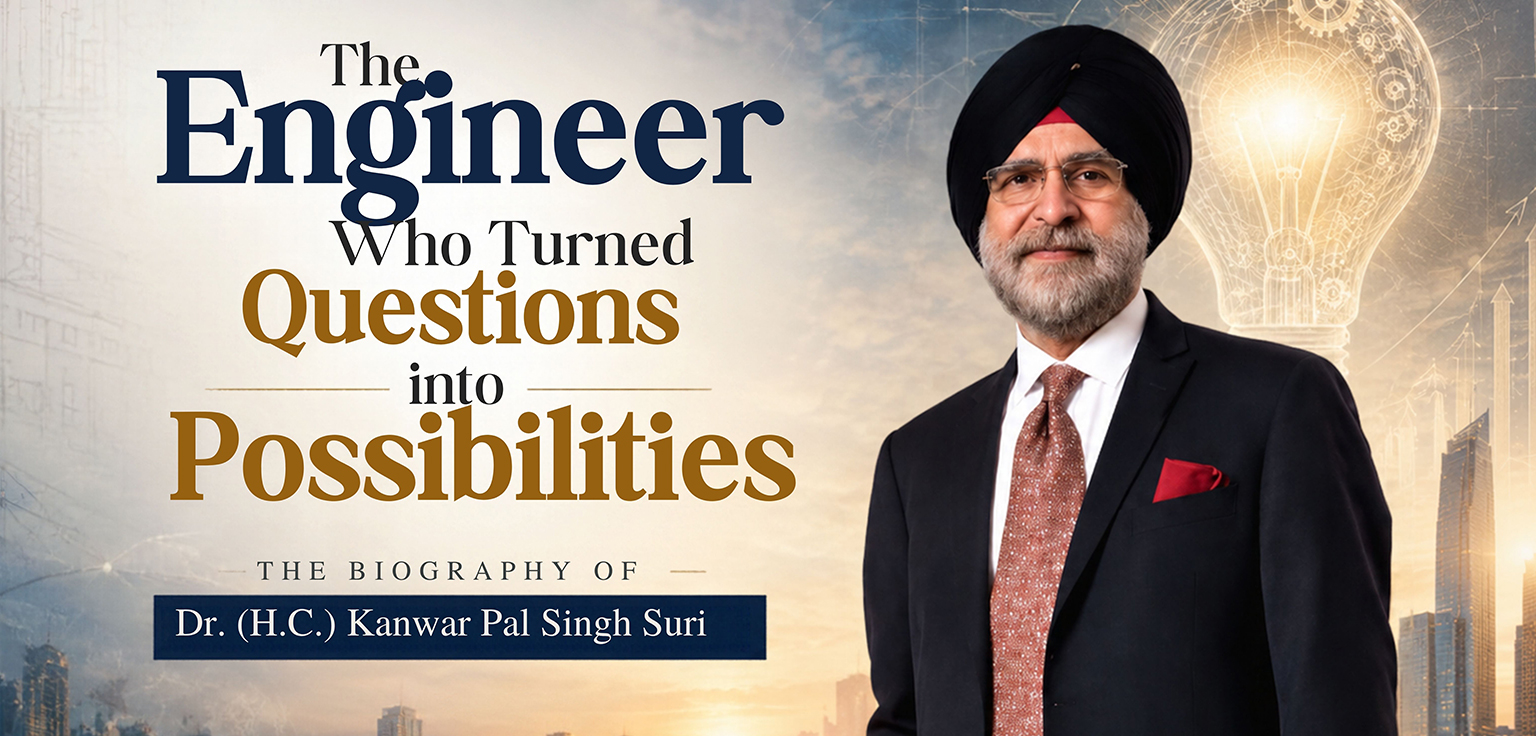
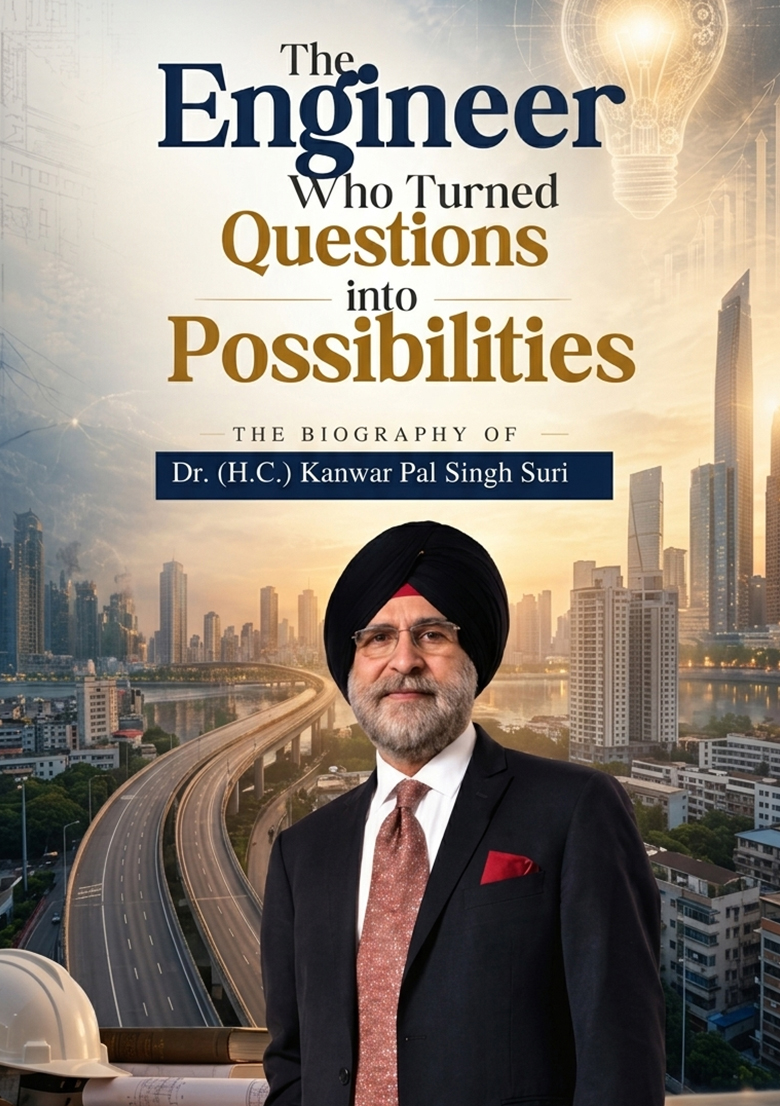
“The bridge between a bold vision and enduring achievement is formed by knowledge, discipline, and the courage to act.”
Introduction
The life of Dr. Kanwar Pal Singh Suri stretches across countries, disciplines, responsibilities, and generations. It began in Rawalpindi in 1946, when the map of the region was about to change. After the Partition of India and Pakistan, his family moved to Delhi, where he grew up in a disciplined household shaped by effort, responsibility, and respect for education. Those early years were not surrounded by ease. Travel was crowded, resources were limited, and school life belonged to a generation that wrote on a wooden board rather than on the devices that define classrooms today. Yet he did not remember those circumstances with bitterness. He saw them as part of the foundation that taught him endurance.
After high school, his path led him to study at Khalsa College (Delhi University) for his B.Sc. (Physics, Chemistry & Mathematics) and then Harcourt Butler Technological Institute (Kanpur University), where he completed his B.Sc. (Mechanical Engineering) with a scholarship. He continued his education for Masters in Engineering and system administration certifications by Gould Inc. Computer Systems for Fortran and MPX-32 (USA) and later certifications by IBM Corporation for CATIA 3D design/CAEDS/FEA and Unix operating system software (USA).
A change in family circumstances altered the future once planned for him to manage the manufacturing business. He might have remained in India and managed the family manufacturing business, but change of family circumstances made him move to England and USA for higher studies and new employment opportunities.
His career in USA progressed in filtration through Pall Corporation, Western Filter, and eventually PTI Technologies Inc., where he finally retired.
That purpose became especially visible in aerospace. Under his leadership, he worked on filtration systems for commercial aircraft, military platforms, helicopters, and space applications. He contributed to the filtration programs for NASA’s Space Launch System (SLS) Orion, Airbus, Boeing, Embraer, Dassault, Northrop Grumman, military helicopters, and several other specialized filtration systems. The design included control of harmful gases, contaminants, odors, and aerosol particles. He also embraced Additive Manufacturing (AM/3D print) technology and printed parts using titanium powder, proving that new technology did not stop him from learning and adapting to new challenges.
His record of 27 United States patent filings, including 13 granted patents and 14 published applications, reflects sustained invention rather than one fortunate idea. Yet numbers alone do not explain him; he found equal satisfaction in mentoring young students who were taught mathematics and physics, introduced them to emerging technologies, and encouraged young engineers to plan their goals with clarity.
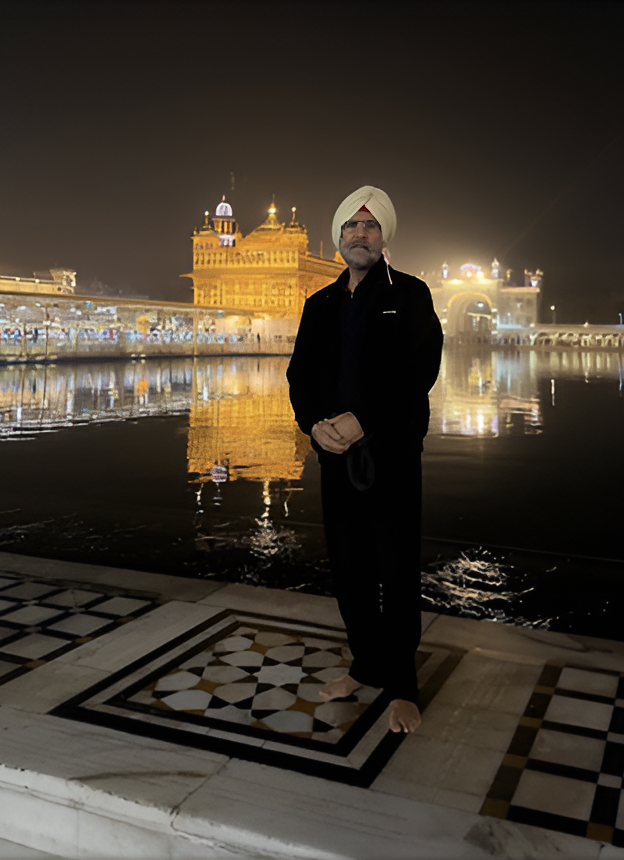
Retirement did not bring withdrawal. Dr. Kanwar continued writing a technical paper on “Advanced Cabin Air Filtration Technology for Crew and Passenger Safety”, studying new research, exploring artificial intelligence, and spending time with his children and grandchildren. He also carried a personal wish to visit the Golden Temple in gratitude for the life he had been given.
His story is therefore more than a record of engineering achievement. It is a life guided by purpose. From Rawalpindi to Delhi, England to the United States, and from classroom science to the frontiers of aerospace innovation, his journey was propelled by a relentless pursuit of practical truths. At every milestone, he asked the defining questions: What needs to be done? How can it be done better? What will it take to reach the goal? The answers forged a remarkable legacy, one built on a foundation of absolute discipline, insatiable curiosity, and an unwavering resolve to move forward.
"When you grow up seeing your parents work hard, you learn that progress is not given. It is created through effort."
Phase 1: From Rawalpindi to a New Beginning in Delhi
The earliest chapter in the life of Dr. Kanwar Pal Singh Suri began in Rawalpindi in 1946, at a time when the land around him still belonged to undivided India. He entered the world just before history altered the boundaries of the region and changed the course of millions of lives. His birthplace would soon become part of Pakistan, while his own family would begin again elsewhere.
Following Partition, the family moved to Delhi. For a child, such a shift could not have been understood through maps, political decisions, or historical explanations. It was experienced more simply through the disappearance of one familiar setting and the arrival of another. Home had to be rebuilt, routines had to be formed again, and the family had to move forward within circumstances they had not created.
Life in Delhi was built around family, discipline, and education. He grew up with his two brothers in a household where the word of a parent carried weight. It belonged to a different time, one in which children were not encouraged to question every decision placed before them. When his father gave an instruction, it was expected to be followed. The boundaries were clear, and responsibility began early.
Watching this left an impression. A machine was not something mysterious or untouchable. It was made of parts that could be understood. A problem could be opened, studied, and solved. Long before Dr. Kanwar entered formal engineering education, he had already begun absorbing the belief that curiosity should lead to practical action.
His mother shaped the household through her own hard work. He remembered both parents as central sources of motivation. Their influence did not come from speeches about ambition. *Ihis work ethic grew out of the daily demands of family life and an enduring ability to persevere through adversity. It instilled in him the belief that self-improvement is not a mere ambition but a solemn lifelong responsibility.
Daily life itself reinforced that lesson. The family did not move through Delhi with abundant comfort. Travelling with three boys could be difficult, especially when public transport was already full. There were occasions when the available vehicle had no proper space left, yet the children still had to fit themselves into the journey. They would sit tightly in the middle or hold on wherever possible.
These experiences remained clear in his memory because they represented the realities from which his ambitions grew. He had seen what it meant to manage with limited resources and choices. Rather than allowing those conditions to narrow his outlook, he developed a desire to improve the family’s standard of living. Progress became a personal goal. It was not about displaying Success. It was about creating a life in which the next generation would have greater Opportunity.
“A good teacher does not only teach a subject. A good teacher leaves a part of himself in the way a student thinks."
Phase 2 : The Result Board He Carried Away on His Scooter
Education gave Dr. Kanwar Pal Singh Suri the first clear language for the curiosity that had been growing within him. His early surroundings had already taught him to observe carefully, respect discipline, and take responsibility seriously. School and college now gave those instincts a direction. He began to understand that progress did not depend only on ambition. It required concentration, preparation, and the patience to stay with a difficult subject until it became clear.
He completed his school education in Delhi, where academic performance was treated seriously. His family never thought marks to be the only concern of the child. A bad mark felt like a failure shared by the parents, as they had poured their effort, expectation, and hope into the education of their children. This created pressure, but it also gave good motivation to work harder for Dr. Kanwar. He knew his work was more than just his own success.
Science appealed to him because it explained things. Chemistry explained how substances reacted and changed. Physics explained motion, force, pressure, and the behavior of matter. Mathematics demanded precision and trained the mind to think logically. These subjects were challenging, yet difficulty did not discourage him. He believed in saying that “where there is a will, there is a way”. That belief was not used as an easy slogan. It appeared in the time he gave to study and, in his determination, to understand subjects that many students found demanding.
After school, he entered Delhi University and pursued a B.Sc. in chemistry, physics, and higher mathematics. The combination required a mind that could move between formulas, scientific principles, calculations, and practical interpretation. He did not treat the subjects as separate worlds. Each one strengthened a different part of his thinking. Chemistry taught him about materials and reactions. Physics taught him to think about the way systems behaved. Higher mathematics taught him the discipline of looking at problems in terms of structure and calculation.
Organic chemistry was especially difficult, though Dr. Kanwar approached it with the same determination that guided the rest of his studies. He did not assume that a demanding subject was beyond him. He worked through it because he understood that knowledge becomes useful only after a student has struggled enough to make it his own. Years later, formulas and principles learned during this period would unexpectedly return to him during complex technical work.
One of the most memorable days of his student life came when the university results were announced. He had earned a first division. The excitement of the moment briefly overcame his usual discipline. In his excitement, he took the result board, put it on his scooter, and rode off with it. His friend quickly reminded him that the board displayed the results of other students as well. Realizing what he had done, Dr. Kanwar turned the scooter back and went to Delhi University and kept it in its place.
It was still funny in a way because it showed the purity of his happiness; it wasn’t just a dot on a piece of paper but the result of years of focus, of his parents’ hopes, of the joy of knowing that his work had been worth something. He was so lost in his own pleasure that for a second he forgot the board was for everybody.
“I did not discover engineering only in a classroom. I first saw it in my father's hands, when knowledge became something practical.”
Phase 3 : From His Father's Balcony Workshop to the Engineering Classroom
After completing his studies in chemistry, physics, and higher mathematics, Dr. Kanwar Pal Singh Suri stood at a point where more than one future seemed possible. He had the academic foundation to continue in science and had considered pursuing a master’s degree. A life in chemistry, research, teaching, or scientific study could easily have followed. Yet another direction had been forming around him for years, shaped by family expectations, practical exposure, and the influence of his father.
His father served in the Indian Army as an electrical and mechanical engineer. He did not treat engineering as a distant profession limited to technical offices. It was visible in the way he approached machines and solved practical problems. He would dismantle the engine of a motorcycle, scooter, or car, carry the parts to the balcony, study them carefully, and work until he understood what needed attention. For a young man already drawn to science, watching this created a natural connection between knowledge and application.
His father’s engineering background also influenced his sense of responsibility. His time in the Indian Army had taught him the real value of accuracy, discipline, and dependability. This was evident in the way he tackled even the most mundane mechanical problems at home. For Dr. Kanwar, seeing this down-to-earth ability in action sparked an early admiration for engineering as a discipline that was not only based on knowledge but also on responsibility.
The influence did not come through pressure alone. Dr. Kanwar saw in his father a person who could understand how something worked and then use that understanding to restore or improve it. Science explained principles, while engineering placed those principles into motion. The distinction became increasingly meaningful as he began thinking about the kind of work he might pursue.
His father’s brothers operated a large manufacturing business in Delhi, India. None of them held an engineering degree, and the family believed that the eldest grandson could eventually bring formal technical knowledge into the company. The expectation was that Dr. Kanwar would study mechanical engineering and later assume responsibility for the business. That was a serious plan, and the siæ of the thing and the confidence the family had in him showed it.
His father knew about the factory well and had taken leave from the Indian Army for almost two years to help his brothers. During that period, he helped in managing various aspects like supply chain, machining, design, and production. The company had got an order amounting to around one and a half crore rupees (appx.), which was a huge amount in those days. The opportunity before the family appeared considerable, and the need for qualified technical leadership was clear.
For Dr. Kanwar, the factory was not merely something discussed by adults at home. During summer vacations, he spent two or three months there and gained direct exposure to its work. He did not remain at a distance as a visitor expected to inherit responsibility one day. He entered the working environment and began learning how manufacturing actually functioned.
Note of Thanks
Dr. Kanwar Pal Singh Suri is grateful to his parents for the values they taught him: discipline to work with integrity, the courage to persevere, and the faith to believe that sincere effort will eventually be rewarded. Their influence was a constant through every change of country, profession, and responsibility.
He also recalls the teachers who broadened his horizons and nurtured his curiosity. One of these teachers is Dr. Raj Gera. His mentorship started in the classroom and continued into subsequent professional years, exemplifying how the impact of a good teacher can be a lifelong gift.
He thanks the colleagues, engineers, technicians, managers, and teams who worked with him throughout his career. Every program demanded shared effort. Every successful result depended upon people willing to analyze, test, question, improve, and carry responsibility together. He remains grateful to the organizations and leaders who trusted him with opportunities to serve, develop ideas, and guide others.
Dr. Kanwar also credits the researchers, technical writers, and specialists whose studies continue to inform his work on advanced cabin air filtration; their studies of airflow, particles, contamination, and safety have helped broaden his understanding and have bolstered his continuing technical writing.
He is grateful to the students and young professionals he met at Guru Nanak Dev University, Delhi University and elsewhere. Their questions, their ambition and their eagerness to learn reminded him that knowledge is best when shared.
But above all, he thanks his family for the patience, understanding and strength that accompanied a demanding professional life. His children and grandchildren continue to give meaning to the years that followed his retirement.
Dr. Kanwar humbly accepts these thanks with the knowledge that all that he has achieved in life was achieved with guidance, teamwork, family support, opportunity, and God’s grace.
thanks,
– Dr. (H.C.) Kanwar Pal Singh Suri

AIMLAY is a leading global education platform empowering ACADEMIC and EXPERIENTIAL learners, uniquely focused on recognizing knowledge gained through experience and building a diversified community of doctorates and aspiring researchers.