
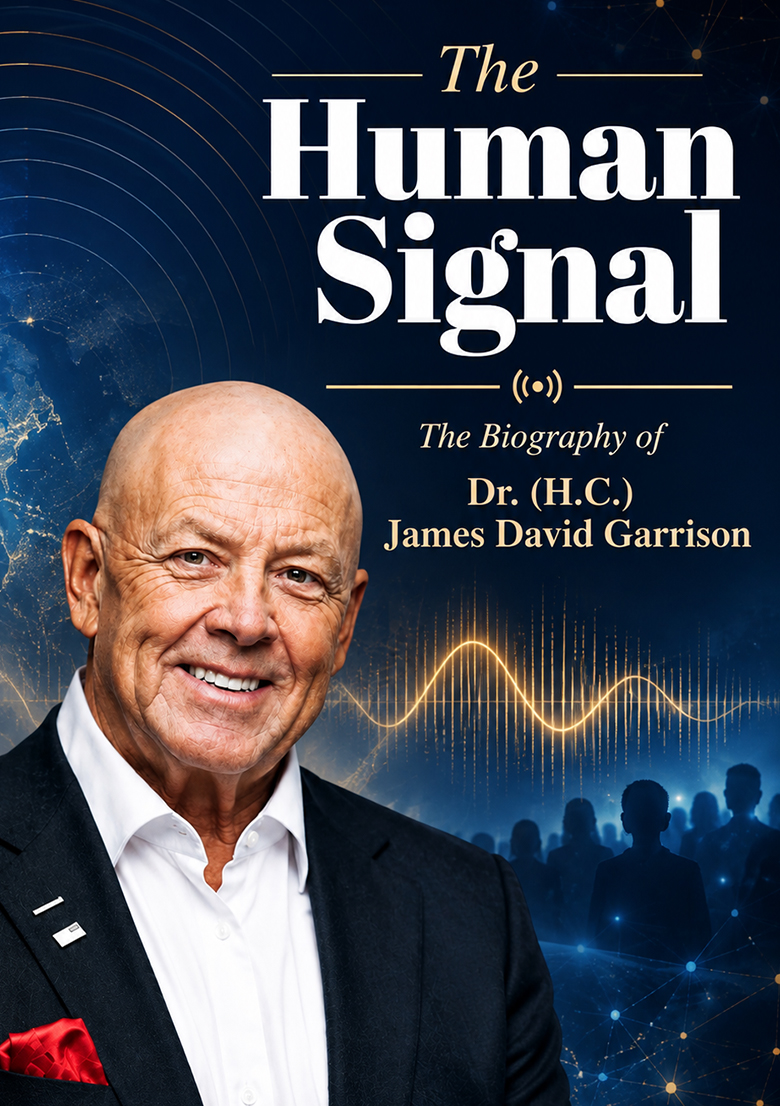
“I love the challenge. I love being ahead of everybody. I love winning.”
Introduction
There is a revealing difference between being interested in a result and being fascinated by how that result is made. Many people can enjoy music, admire a film, or feel the energy of a live gathering. Fewer become absorbed in the hidden arrangement of sound, image, timing, equipment, and human effort that makes the experience possible. Dr. Garrison belonged to the second group from an early age. Curiosity did not stop at enjoyment. It moved naturally towards structure.
That instinct eventually placed him in a profession that suited both sides of his nature. He was technical without becoming detached, creative without losing discipline, and sociable without treating communication as performance alone. The work required him to understand systems, but it also rewarded his ability to read people. It invited his interest in sound while making room for visual storytelling. Most importantly, it gave him a field in which learning could never truly end.
His career unfolded through remarkable changes in production. Tools that once seemed essential gave way to entirely different ways of presenting information. Processes that had depended on physical media became digital. Gatherings once defined by a shared room could later connect participants across continents. Every transition created a choice. A professional could protect what was familiar, or remain open to what was arriving. Dr. Garrison repeatedly chose the second path.
Adaptability, however, tells only part of the story. The deeper continuity in his life was an appetite for participation. He did not want to stand at a distance from an idea and comment upon it. He wanted to make it work. When a piece of equipment was unfamiliar, he learned it. When formal instruction became available, he pursued it. When employment provided security but no longer offered fulfilment, he changed direction. When one company taught him what ownership demanded, he applied those lessons to the next. Movement in his life was rarely movement for its own sake. It was a response to a clearer understanding of what the work required from him.
Entrepreneurship gave that understanding a practical form. It allowed him to combine technical judgement, creative imagination, and personal responsibility under one roof. Ownership made every decision more immediate because an idea could no longer remain theoretical. It had to become a workable structure, support the assignment in front of him, and leave the organization capable of answering the next demand. The discipline of building therefore became as important as the excitement of beginning.
This conviction helped shape a professional identity that could travel beyond one city and function across a wide range of settings. Yet scale did not turn his work into something impersonal. The larger the assignment became, the more important careful attention seemed to be. A speaker stepping towards a stage could still need encouragement. A client planning an important gathering could still need the comfort of a prompt answer. A technical professional could still distinguish himself or herself by courtesy, confidence, and composure. The human details did not become smaller when the screen became larger.
The same balance appears in Dr. Garrison’s attitude towards change. He appreciates what technology can accomplish and understands the cost of ignoring it. At the same time, novelty has never been valuable to him merely because it is new. A development must strengthen the work, widen what can be offered, or answer a real need. This practical openness allowed him to advance without treating every earlier skill as disposable.
For this reason, his biography is not merely the account of a career in audio, video, and corporate production. It is the record of a relationship between curiosity and courage. One helped him see possibility; the other allowed him to act upon it. Along the way, practical obligations, incomplete certainty, competition, changing tools, and an unprecedented interruption to live events tested that relationship. It endured because the work continued to feel alive to him.
“I had the best childhood. My parents taught me everything I know about developing good people skills. Their influence continues to guide me to this day!”
Phase 1: A Traditional Texas Home and a Secure Beginning

Dr. (H.C.) James David Garrison grew up in Texas within what he remembers as a traditional family. His father worked, his mother remained at home, and the rhythm of daily life was built around the ordinary responsibilities of raising three children. He was the eldest. His brother, Samuel Luke Garrison, came next, followed by their younger sister, Angie Garrison. Their mother, Betty Garrison, gave the home its steady presence, while their father carried the responsibility of work.
The family was not wealthy, yet Dr. Garrison never experienced his childhood as deprived. That distinction matters to the way he remembers those years. There were school supplies when they were needed. Dinner appeared on the table. There were clothes to wear and a safe place to sleep. Nothing in his recollection depends upon luxury. The abundance he remembers came from sufficiency, routine, and the confidence that the essentials of life would be there.
For a child, that kind of security can become almost invisible. It does not announce itself with spectacle. It is felt through repetition: another morning prepared for school, another evening gathered around the needs of the household, another week shaped by familiar expectations. Looking back, Dr. Garrison does not measure the quality of those years through possessions. He measures them through the absence of unmet need. He had what allowed a child to grow without carrying adult worries too early.
He walked to elementary school, a simple detail that captures the grounded quality of his upbringing. School was part of the neighbourhood routine rather than a distant institution. The path there belonged to the texture of ordinary life, as did the friendships formed during those years. He had many friends, and a few of those early connections survived across the decades. Their endurance suggests how social he was even before communication became one of his professional strengths.
Sunday brought another form of continuity. The family attended church every week. Faith was therefore not introduced as an occasional response to difficulty but as a regular part of family life. The habit of gathering, listening, and participating became woven into his understanding of community. Much later, gratitude would occupy an important place in the way he viewed his life, but its earliest setting was this dependable household in which church formed part of the weekly rhythm.
The Boy Scouts added a different kind of experience. It gave him a place outside home and school where he could take part in organised activity, spend time with others, and encounter interests that helped widen his world. He remembers it with uncomplicated affection. It was fun, but it also belonged to the broader pattern of participation that marked his childhood. He was rarely drawn towards withdrawal. Groups, conversation, shared activity, and the chance to learn through doing suited him.
“I was very outgoing. I loved debate, speech, and drama. I was definitely not shy.”
Phase 2 : Finding His Voice Beyond the Classroom
School gave Dr. Garrison a place to discover the difference between ability and engagement. His grades were good, and he eventually completed high school early, yet conventional academic work rarely held his attention for long. He became bored easily because the routine did not feel sufficiently challenging. He could do what was expected, but completion alone did not awaken him. The parts of school that mattered most were those that asked him to speak, interpret, create, and respond in real time.
He found those outlets in debate, speech, and drama. Each activity drew upon a different part of the same natural confidence. Debate required him to think and answer. Speech gave him a reason to stand before others and shape an idea through language. Drama opened a wider creative space in which expression mattered as much as correctness. He did not approach these activities as remedies for shyness. Shyness was never the problem. He was distinctly outgoing and comfortable being seen and heard.
That ease was reinforced outside school through an unusual preference. Even as a boy of eight or ten, Dr. Garrison often found adult conversation more interesting than the activities of children his own age. He was not drawn to sports, and many of the interests that occupied other boys did not hold the same appeal for him. He would rather listen to adults tell stories about their work, their decisions, and the businesses they were trying to build.
The meetings he attended with his father became a kind of informal classroom. He understood that he was there to sit quietly and absorb what was happening. No one needed to turn the occasion into a lesson plan. The value lay in proximity. He could hear how adults discussed practical matters, how they described difficulties, and how an idea could become an enterprise. He listened before he had the experience to judge everything he heard, and that gave him a wide field of impressions to carry forward.
Business fascinated him precisely because it seemed to represent authorship. The thought that someone could own a company and shape its direction was compelling. It was not yet a plan with dates, capital, or a market. It was an idea about agency. A person could decide to build something, accept the uncertainty attached to it, and make a living through an organization of his or her own. For a child whose family had not followed that road, the possibility felt especially interesting.
His social life remained active despite his preference for older company. He had many friends and took part in musical groups. He was not isolated from his classmates, nor did he dislike his school years. He simply recognised that the classroom, by itself, did not contain all the learning he wanted. Conversation, performance, and practical stories supplied what standard lessons sometimes lacked. They gave him movement.
The distinction between creative and academic effort became important. Dr. Garrison did not reject learning. In fact, his later life would demonstrate a persistent willingness to learn difficult systems and keep pace with changing technology. What he resisted was passive learning that left no room for curiosity. When something engaged him, he could pursue it deeply. When it felt repetitive or remote from application, his attention moved elsewhere.
“My dad would often say “There are two kinds of people in this world. There are people that make things happen. And there are people that wonder, what just happened? ”
Phase 3 : Six Strings and an Engineer’s Ear
Music entered Dr. Garrison’s life as enjoyment, but it did not remain only something to hear. He wanted to participate in it, then understand it, and eventually learn how its smallest technical decisions could change what an audience experienced. That progression began early and became one of the clearest lines connecting childhood interest to adult profession.
He listened widely, with much of his early taste shaped by the Top 40 music of the period. The Eagles and Bob Seger belonged to the sound around him. By 1971, when he was thirteen, his interest had become strong enough for him to buy his first guitar. He taught himself to play it. There was no formal instructor guiding each step, so progress depended upon patience, attention, repetition, and the willingness to correct himself.
That self-directed beginning suited the way he learned. The guitar offered immediate evidence. A chord either sounded right or it did not. Improvement could be heard. Over time, he became a capable guitarist, but the deeper significance of that first instrument lay in the habit it strengthened. Dr. Garrison discovered that he did not need to wait for perfect conditions before beginning to learn something that mattered to him.
His curiosity soon moved beyond playing. He became interested in mixing music and in the way sound itself behaved. Bass, middle ranges, and lower frequencies were not just labels. They were parts of a field he wanted to explore. Mixers, audio systems, and public-address equipment attracted him because they turned sound into something that could be shaped. The listener heard a finished result; he became increasingly interested in the decisions that produced it.
As a teenager, he continued learning how audio systems and public-address systems worked. The attraction was both technical and creative. Equipment demanded accuracy, but the desired result still depended upon judgement. A system could be connected correctly and yet fail to produce the balance, clarity, or effect required. Dr. Garrison liked that combination. It offered rules without eliminating the ear.
His earliest professional entry into production came through audio work. He began as an audio technician and developed into an audio engineer in his early twenties. The role demanded more than enthusiasm for music. It required him to translate listening into technical action, understand how the system affected the room, and remain attentive to the quality of the result. Audio gave his curiosity a professional discipline.
The limitations of the period gave him a direct education. Much of the equipment was analog, and new digital systems were only beginning to appear. Formal institutions had not yet built courses around every technological development. In many cases, the manufacturers themselves became the teachers. Companies introduced professionals to their equipment because few other places could explain it.
Note of Thanks
Gratitude occupies a central place in the way Dr. Garrison understands his life. He considers himself exceptionally blessed and does not regard what he has received as something he was automatically entitled to possess. Each morning begins with thanks to God for the life that has been given to him, the opportunities that have opened, and the measure of happiness he has experienced.
That gratitude is not reserved for moments of public success. It is part of his ordinary awareness. He speaks openly with family and friends about how fortunate he feels and remains conscious that accomplishment alone cannot explain the fullness of his life. Faith gives him a way to receive success without treating it as proof of personal superiority.
Dr. Garrison also offers heartfelt thanks to the people across the production industry who have supported him through the years. The field may contain competing companies, but he does not reduce those relationships to rivalry. Many competitors are also friends, and professional respect has often made honest conversation possible.
When a difficult project raises an unfamiliar question, he knows he can call someone in the same industry and ask for a perspective. Even a competitor may respond generously, explaining how he or she might approach the situation. That willingness to share judgement reflects a community of people who understand the work and want one another to succeed in serving clients and supporting their families.
To those friends, colleagues, technicians, contractors, and fellow production professionals, Dr. Garrison extends sincere appreciation. Their knowledge, readiness, and friendship helped turn demanding assignments into shared achievements. His thanks belong to everyone who offered support, answered a call, assembled a crew, exchanged an idea, or stood beside him in the continuing work of bringing people together.
thanks,
– Dr. (H.C.) James David Garrison