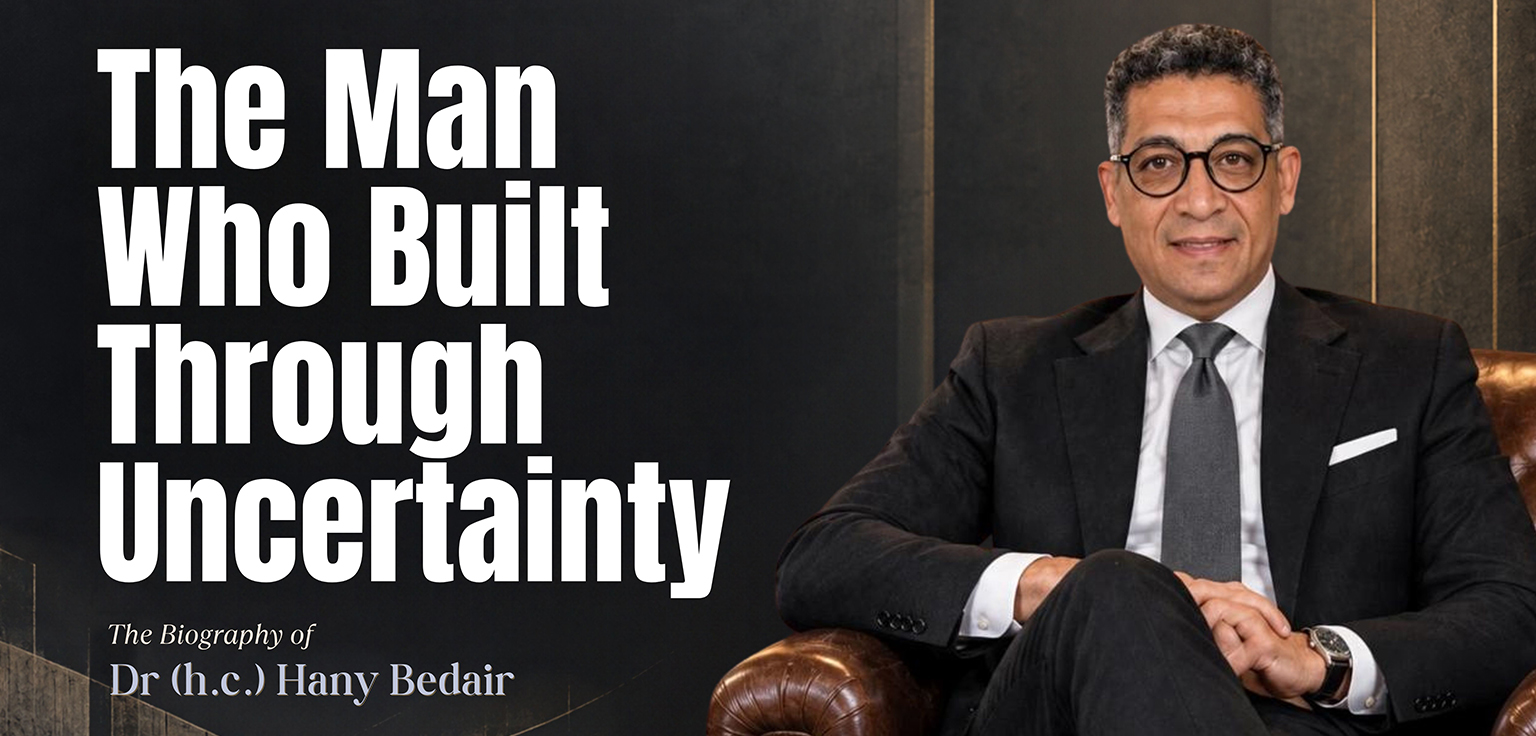
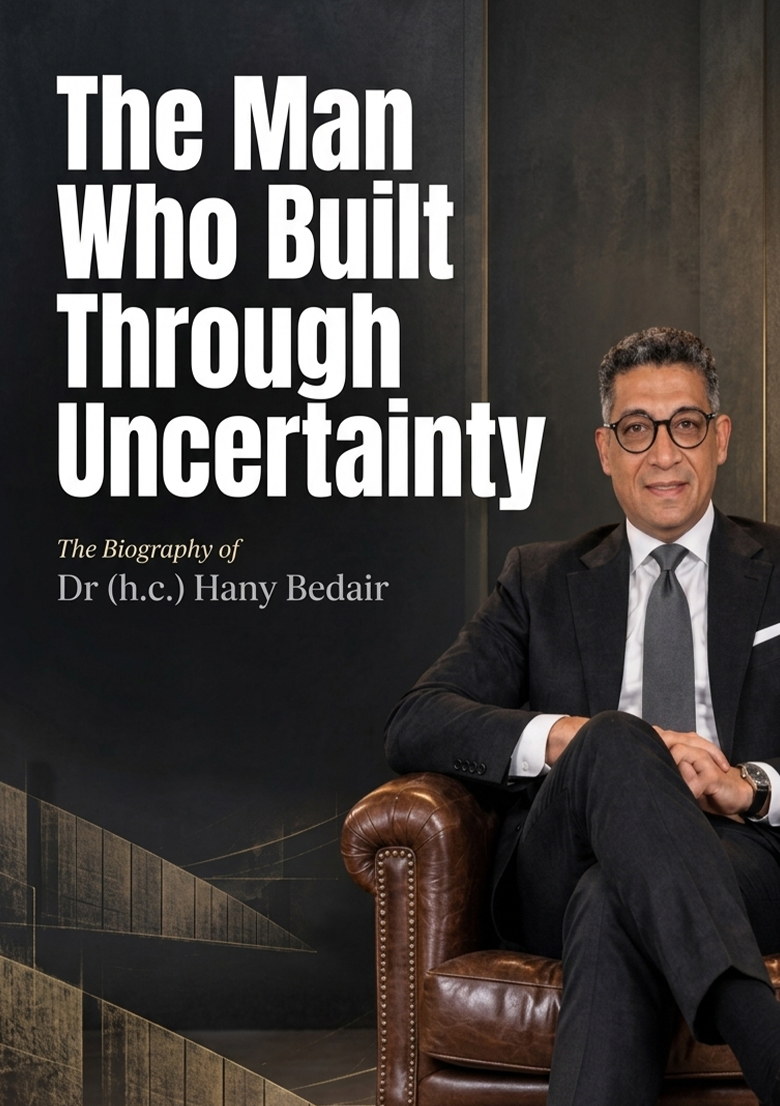
"I never run away from a challenge. I actually search for it."
Introduction
There is a kind of professional life that is easy to summarise and hard to understand. The summary of Hany Bedair’s would run like this: an Egyptian telecommunications engineer who rose from a night shift in an Alexandria exchange building to the executive leadership team of one of the largest mobile groups in the emerging world; who built or helped build mobile networks in Algeria, Tunisia, Iraq and North Korea; who became Group Chief Technology Officer for a business serving more than a hundred million customers; who then founded his own company, sat on the boards of submarine cable ventures and a mobile money business, turned around a national data centre programme in Egypt and, twice, went to Afghanistan to keep a country’s telephones working while its State collapsed around them. In his late forties, he went back to university to study quantum physics. He holds a national long-jump title. He owns several telescopes.
The summary is accurate, and it explains almost nothing. It does not say why a 29-year-old with a six-month-old son flew into Baghdad six months after the fall of the city, or why, nearly twenty years later, a man with nothing left to prove flew into Kabul two months after the fall of that one. It does not say what it cost, or whom it cost, or what he thinks he learned. It does not say why the long jump matters, or why a solar tracker built in a university workshop in 1996 is, in his own account, the first appearance of the pattern that would define everything after it.
This book tries to say those things. It was written from long conversations with Hany Bedair and from the notes, certificates and documents he provided, and wherever possible it lets him speak for himself. Passages in quotation marks are his own words. The register he uses is plain. He describes a three-hour gunfight the way an engineer describes a fault report: what happened, in what order, and what they did next. The book has tried to keep that register, because it is the truest thing about him.
Three themes run through the chapters that follow, and it is worth naming them at the start, since Hany named them himself when asked what the book should be about: listen first, build together, speak up when it matters.
Listen first is the lesson of a boy whose chemistry teacher would not let him answer until the rest of the class had tried, and of an engineer who arrived in Algeria fluent in Arabic and French and could not understand a word anyone said. It is the lesson of Pyongyang, where every sentence passed through an interpreter and a political filter, and of executive committees in which Russians, Norwegians and Egyptians were each certain the others had misunderstood. “The person who talks least in the room usually understands the most,” he says, and he says it as a man who spent a long time learning to be that person.
Build together is the lesson of Baghdad. It is the discovery, made under fire, that a good team, trusted and given room, could deliver under conditions that should have made delivery impossible, and that his real job was to make that possible and then get out of the way. It is the method he carried to the group executive floor, to his own firm, and to Kabul: “Surround myself with people stronger than me in their field, and give them room.”
Speak up when it matters is the lesson of the due-diligence rooms, where a technical lead was expected to come back with reasons to proceed and instead came back with reasons not to. It is the lesson of BENYA, where he delivered everything he had been hired to deliver and left anyway, because the culture would not let him stay. And it is the lesson of the mountain in Kenya where he turned back short of the summit and decided that this, too, was a decision rather than a defeat.
The chapters are arranged in the order the life was lived, with one exception. The book opens in Baghdad in October because that is where Hany says his life changed for good, and because everything that follows runs back to it. From there it returns to a garden in Heliopolis, with three brothers and a football, and goes forward.
Beyond the professional story, there is a family that lived with every one of these decisions, a wife who is herself an engineer and who held the household together while he was elsewhere, and three children who at home are called Som3a, Loulou and Yoyo. Hany is clear that a biography which left them out would be a CV in prose. They are here, and the book is dedicated to them.
"I learned discipline and decision-making from him."
Phase 1: Heliopolis
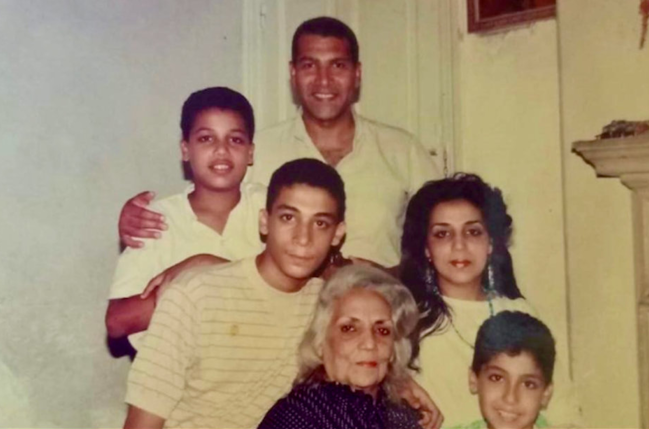
Hany Bedair was born on 2 October 1973 in Cairo, the eldest of three sons, and grew up in Heliopolis. The district deserves a word. It was laid out at the start of the twentieth century by a Belgian industrialist as a garden city on the desert edge of Cairo, with wide avenues, arcaded buildings in a style its architects called Heliopolis style, a tram line to the city, and the sporting club that would later matter so much.
His father, Omar Bedair, was an army officer who would retire a decorated General. His mother, Aicha Mamdouh, taught French. It was, as Hany puts it, a home of discipline and languages, and the two came from different parents.
The father was often away because of his work. When he was home, he was a presence rather than a talker: Hany’s clearest early picture of him is a man shaving in the morning with the BBC World Service on the radio, breakfast eaten on the move.
“I learned discipline and decision-making from him.” He also learned, very young, what his father’s world looked like, because Omar took his eldest son with him to the army camps. Hany had sat inside tanks and fighter jets before he was old enough to understand what they were for. The knowledge stayed with him, and so did the habit of calm around things that would frighten most children.
The mother did the harder, daily work. “Raising three young boys was definitely not an easy job.” She taught him French at home, helped with his schoolwork until the fourth grade, and then let go. “After that I was on my own, at my own discretion.” He regards that early independence as one of the best things she gave him. From her he also took a love of learning for its own sake, which would one day send a man in his late forties back to university for a doctorate in physics.
There was a third adult in his childhood, and she lived a hundred metres away. His maternal grandmother, Safia Akef, had a house on the same street in Heliopolis, close enough for a boy to walk to without asking, and he walked to it constantly. She was, in his words, very kind and very loving, and her home was a second home from the beginning; from the ninth grade onwards it was simply his home, and he lived with her full time through the last years of school and into university. The arrangement suited a studious boy and a grandmother who liked his company, and it gave him something the General’s household, for all its virtues, was not built to give: unhurried time with someone who had nothing to teach him and asked nothing of him. She died in 2002. Her health failed quickly, over two months, while he was working in Algeria, and he was not at her bedside when she went. He flew in the next morning, too late for the burial, and made it only to the condolence service. He has made his peace with most of the costs of the career, but not that one. “One of the things I still regret to this day,” he says, and it is one of the few regrets in this book that he names without qualification.
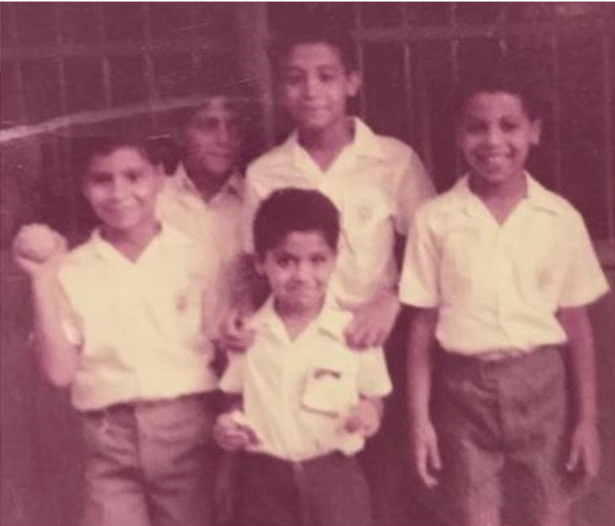
The three brothers “loved each other like hell, and also fought no less.” Hany was the reader; he saved his pocket money to buy books. His brother Hisham, now a real-estate businessman in the United States, spent his money as soon as he had it and then stole Hany’s books. The great unsettled question of their childhood was which of them was the better footballer. “I never conceded to his claims. But in reality he is definitely the better one.” The youngest, Mohamed, six years behind, was the baby of the house, and the older two treated him accordingly. When they wanted to be rid of him, they would freeze like statues, not a word, not an inch of movement, until he got bored and wandered off, with their mother shouting from the next room that they should be kinder to their little brother and go and play with him. “That was definitely evil,” Hany says now, without much remorse. Mohamed is a lawyer in Egypt today, and the three remain close.
When Hany was ten, the family spent a year in England. Omar had been sent to the Staff College at Camberley, in Surrey, where the British Army trained its own and selected foreign officers in tactics and Strategy, and the family went with him. For a boy from Heliopolis, it was a year of grey skies, a different school, a different language in the shops, and a country that he discovered he liked very much. The year lodged somewhere deep. Thirty years later, when the family finally settled in Surrey in 2014, a few miles from Camberley, it did not feel like emigration. It felt like returning.
“I always stood up again. Never gave up. Never will.”
Phase 2 : The Long Jump
Everyone at the club knew Hany Bedair was fast. It made him a dangerous right winger, the kind who gets the ball on the touchline and is gone. What nobody had thought to do was time him. Then one afternoon, still a schoolboy, he stopped to watch the Heliopolis athletics squad training, decided he would give it a try, walked over to the coach and asked to be tested. The coach, sensibly, put him in a 100-metre race against the squad. He beat them. “Athletics started then.”
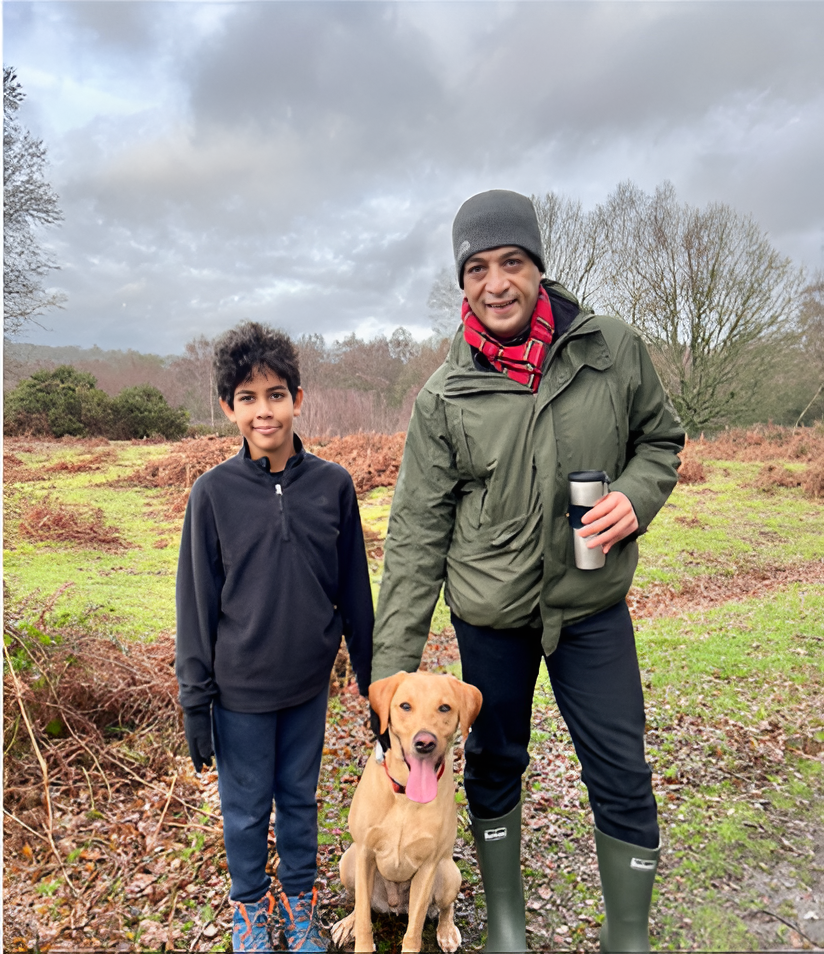
It was the era of Carl Lewis, who ran the 100 metres and the sprint relay and jumped long, and did all three better than anyone alive. At the Los Angeles Olympics of 1984, the year the Bedairs were in England, Lewis had won four gold medals, and for the rest of the decade he was the athlete every fast boy in the world wanted to be. Hany decided to do the same. The long jump became his main event, A moment outdoors with family. But he kept the 100 metres and the 4 x 100 relay, running third leg, the bend, because he was better at running the curve than almost anyone on the team. His personal bests, as he records them, were 7.82 metres in the long jump and 10.4 seconds for the 100 metres. For a reader unfamiliar with the sport, 7.82 metres would have placed a junior in contention at continental level; it is a serious distance.
In 1990, aged seventeen, he won the Egyptian national under-20 long-jump title in Alexandria. His coach was there, and the head coach and his teammates from the Heliopolis squad. He does not remember celebrating that day, because there were more events the following morning and the squad was still competing. The celebration came later, back in Cairo, and it was a modest one: a meal together at the club, as far as he can recall. “Things were much simpler at the time.” He says it without nostalgia. It was simply how a national title was marked in 1990, by a group of young athletes who had other things to run the next day.
It did not come free. Athletics training was six days a week, and football had to go. “The part I hated most was the three-kilometre warm-up laps. I hated running for long periods.” A sprinter’s body and a sprinter’s temperament, in other words, made to do a distance chores. He did them.
He also lost a great deal of time to injury, and the worst of it was serious. He tore the anterior cruciate ligament in his left knee, the ligament that holds the joint stable under exactly the kind of load a long jumper puts through it on take-off. The injury required reconstructive surgery, and the recovery, for an athlete who needed not just a working knee but one he could trust at full speed on a board, took at least two years. Two years is a long time at seventeen or eighteen. It is most of a junior career. He spent it rebuilding strength from nothing, returning to training at a level far below what he had already achieved, and working back towards a standard he knew he was capable of and could not yet reach. “I always stood up again. Never give up.” It is the sentence he reaches for when asked about setbacks, and it was earned on a surgical table and a rehabilitation track, not in a boardroom.
Asked what sport taught him, he does not reach for the usual phrases about teamwork, though he values it. He talks about training: the discipline of turning up on the days you do not want to, and the understanding that the result on competition day is decided weeks earlier on the track when nobody is watching. He talks about losing, and about the particular humiliation of a long jumper’s bad day, three fouls and nothing on the board, and about coming back from it. In the long jump there is no partial credit. An athlete who has trained for a season and steps a centimetre over the board three times has, for the purposes of the record, not competed. He learned early that preparation improves the odds and guarantees nothing, and that the only useful response to a bad day is to go back to the track.
The long jump itself deserves a word, because it shaped the way he thinks about performance. It is an event of extraordinary compression. A jumper spends months on the approach run, on hitting the board at full speed within a few centimetres, on the take-off angle, on what the arms and legs do in the air, on the landing. All of that is expressed in a little over a second, six times, on one afternoon. There is no pacing, no second half, no recovery from a slow start. Either the run-up is right, and the board is hit, and the jump is good, or it is not, and the next attempt is a few minutes later with the same body and the same wind. He learned to prepare obsessively and then to let the preparation do the work, because thinking on the runway is fatal. Years later, briefing a board on a decision he had spent weeks preparing, he would recognise the Same feeling: the work was done, and the only thing left was to run.
“This is what I'd love to do. Maths and physics.”
Phase 3 : Choosing Engineering
For most of his childhood Hany Bedair intended to be a brain surgeon. It was the natural ambition of a boy who was top of the class in mathematics and science and had the hands for a laboratory. The first year of secondary school ended it. Biology, taught for the first time as a subject in its Own right, turned out to be a mountain of material to be memorised, and memorising was the one thing he had never been good at. “Too much to know by heart. I was always bad at remembering.” In the same year, and in the same building, physics opened a different door. “This is what I’d love to do. Maths and physics. That shaped my decision to be an engineer.”
He finished school with top grades, in the top hundred in the country, and announced that he wanted to study nuclear engineering. His father said no. The discussion was long and hard, and Omar Bedair’s case was a practical one. Egypt had talked about a nuclear power programme since the 1960s and had not built a reactor; a nuclear engineer in Egypt would spend his career waiting for a programme that might never come. The son moved the pointer, as he puts it, to telecommunications engineering. He has never pretended it was his first choice. “I always had the passion for physics at the back of my head.” It stayed there for thirty years before he did anything about it.
Engineering in Egypt is a five-year degree, one preparatory year followed by four of specialisation. In September 1991, Hany entered the Faculty of Engineering at Ain Shams University, one of Cairo’s great public universities, to read Communications and Electronics Engineering. He stopped competing in athletics after the first year. “A hard choice I had to take. I could not cope with the load of both.” Given what athletics had meant to him, and what it had cost him in a knee, it is a measure of how seriously he took the degree.
The early years covered the foundations every engineer shares: mathematics, physics, mechanics, electrical circuits, materials. From the third year, the work narrowed towards his discipline: electronic circuits, control systems, communication systems, telephony, electromagnetic waves and antennas, information theory, microwave electronics, computing. His transcript records Distinctions in electronic engineering, electrical measuring instruments, electronic computers and automatic control, spread across the programme. He was not a student who peaked in one year.
The professors he remembers are a particular set. Dr. Omar Abdelhalim taught physics and played squash, and the two of them played together at the club, sometimes with Hany’s father, who had taught his son the game as a small boy. Dr. Mohamed Marzouk taught circuit electronics. Dr. Mohamed Ibrahim Hassan taught mathematics, and Dr. Refaat Bassily physics. And Dr. Mahmoud Hanafi taught microwave engineering: “a brilliant scientist, but I never understood a word at the time.” He says it with affection. It is the kind of admission that only a man who later went back and understood can afford to make.
Two things happened at Ain Shams that mattered more than any course. The first was that he met Hanan, who was reading the same degree. The second was the graduation project. He, Hanan, and three friends built a solar tracking system, not a paper design but a working prototype that turned a panel to follow the brightest light in the room, as a real tracker follows the sun across the sky. One of the three friends was Hossam Ashraf, who has been his best friend ever since. “More of a brother, actually.”
The day the project was presented is a story Hany tells with evident pleasure, thirty years on. The five of them had planned the demonstration carefully. They would dim the lights in the hall so that the tracker started from a neutral position, then switch on a lamp to one side and let the panel find it. The lights went down. And the tracker, instead of settling in its neutral position, drove hard to one extreme of its travel and stayed there. One of the examining professors began, with some enjoyment, to argue that the thing did not work. Hany’s teammates shut it down and restarted it. It did exactly the same thing again.
Note of Thanks
For Hany Bedair, gratitude begins with the people whose presence has remained constant throughout his life. His wife, Hanan, and their children, Ismail, Mariam, and Youssef, hold the first place in these acknowledgements. Their understanding and support have accompanied years of demanding responsibilities and long absences, and he remains deeply grateful to each of them.
He extends his thanks to his parents, Omar Bedair and Aicha Mamdouh, whose discipline, learning and languages shaped his character and outlook; to his maternal grandmother, Safia Akef, whose house a hundred metres down the Street was his second home and, from the ninth grade, his only one; and to his brothers, Hisham and Mohamed, for the closeness the three have kept across continents and professions.
Among the professionals who shaped his development, he acknowledges Naguib Sawiris; the late Khaled Bichara; Mohamed El Basha, his first manager at Alcatel; the late Eng. Abdelfattah Salem, his first boss at Esso; Perihane El Hamy, who sat up all night in a Tunisian switch room with him; and the many professionals he was blessed to learn from.
His appreciation extends to his teachers at St George’s School, Nasser Yassa, George Seraphim and Naim George, and to his professors at Ain Shams University, among them Dr. Omar Abdelhalim, Dr. Mohamed Marmuk, Dr. Mahmoud Hanafi, Dr. Mohamed Ibrahim Hassan and Dr. Refaat Bassily.
A personal acknowledgement belongs to Hossam Ashraf, his friend since university and more of a brother.
Finally, he offers sincere thanks to the teams in Egypt, Algeria, Tunisia, Iraq, the DPRK, Afghanistan and beyond, and especially to the Iraqi colleagues of 2003 to 2005 and the executive team at Etisalat Afghanistan, who worked day and night for the company.
His gratitude rests on a simple recognition: no accomplishment belongs entirely to one person. Behind every result in this book are people whose effort, ability, and willingness to contribute deserve to be remembered.
thanks,
– Dr. (H.C.) Hany Bedair

AIMLAY is a leading global education platform empowering ACADEMIC and EXPERIENTIAL learners, uniquely focused on recognizing knowledge gained through experience and building a diversified community of doctorates and aspiring researchers.