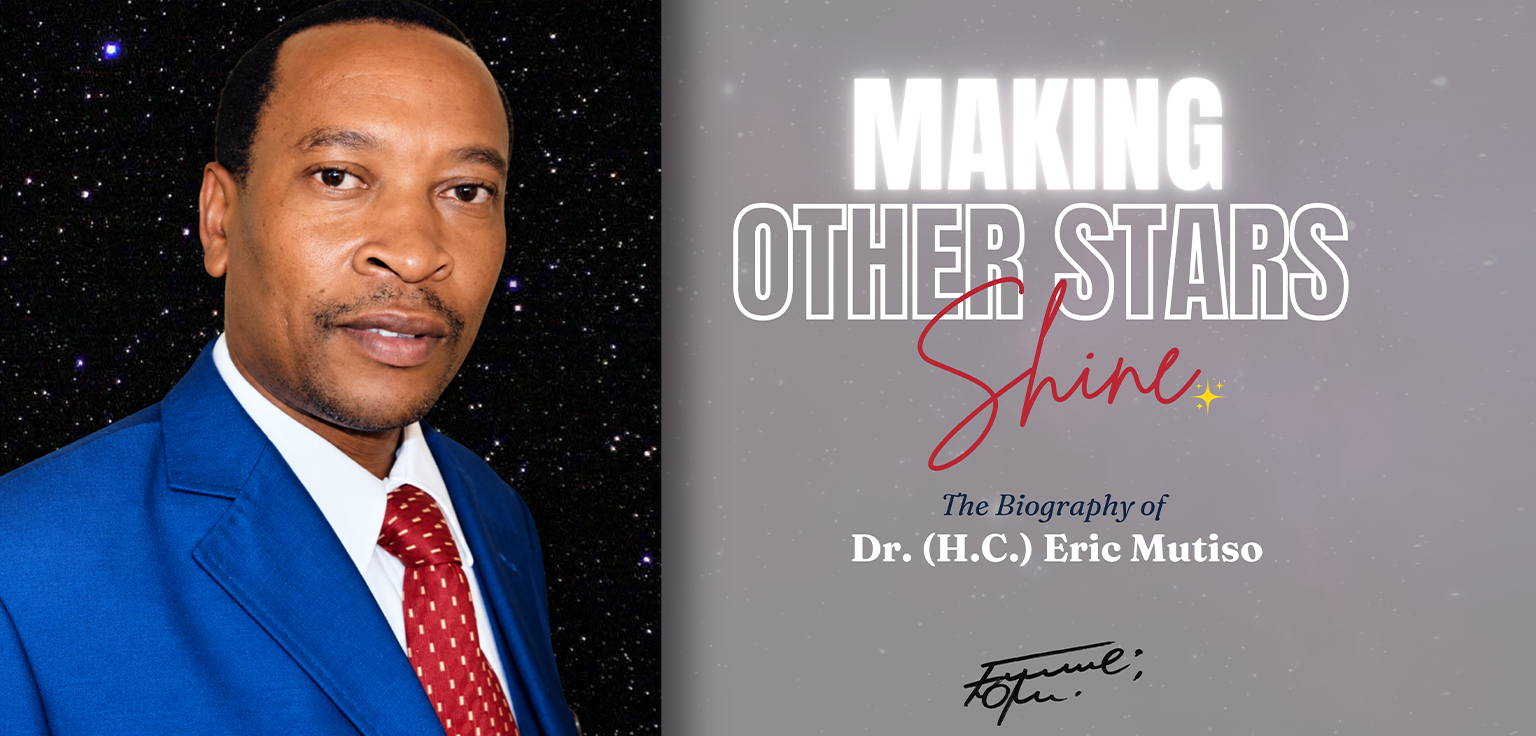
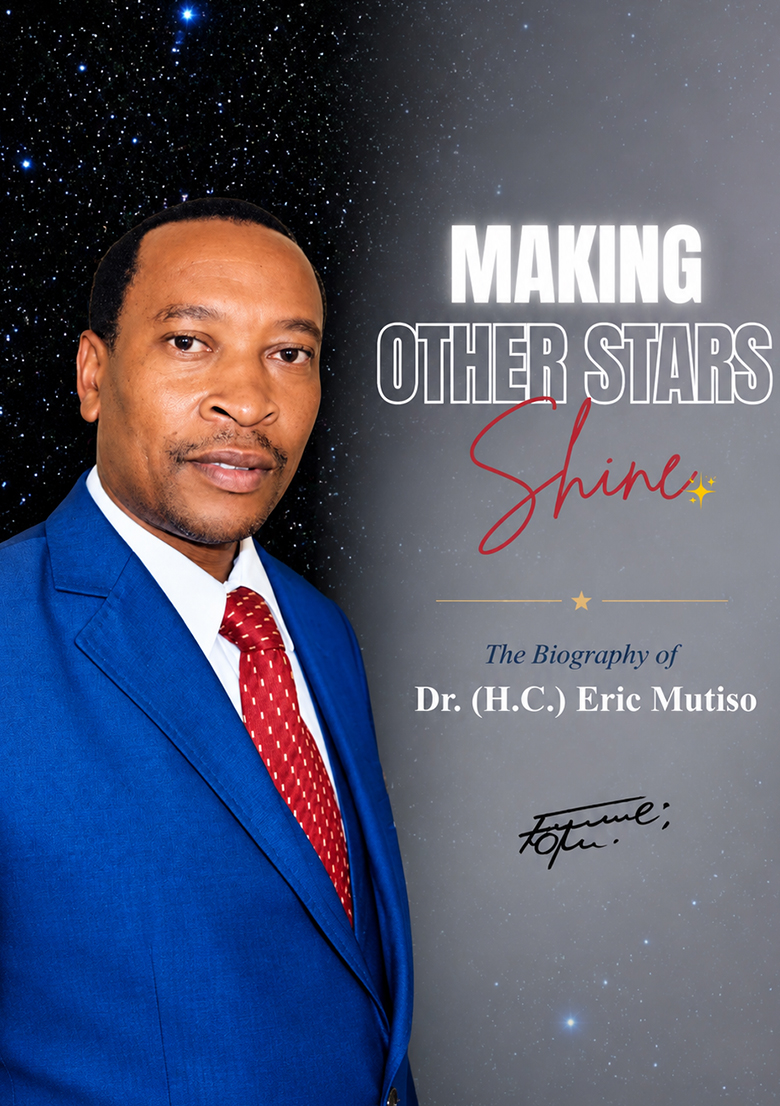
“Leadership becomes meaningful when people are not merely guided but strengthened enough to carry their own future forward.”
Introduction
The life of Dr. Eric Mutiso does not unfold as a straight progression from hardship to success. It is better understood as a journey in which each experience widened his understanding of responsibility. His earliest years gave him no reason to take opportunities for granted. He grew up in a Christian family where faith formed part of everyday life and where limited resources required every member of the household to understand responsibility early. Education mattered deeply, but pursuing it was not always simple. Those beginnings gave him an intimate understanding of what it means to want something worthwhile while having to overcome circumstances that make it difficult to reach.
Faith became another defining influence. His childhood participation in church eventually developed into a deeper personal commitment and later into active ministry. What began in a family and religious setting gradually expanded into years of pastoral responsibility, theological education, institutional leadership, mentoring, and service through the Free Pentecostal Fellowship in Kenya. Leadership increased the number of people who depended upon him, but it also exposed the limits of what one person could address through spiritual guidance alone. Communities brought him problems involving poverty, displacement, domestic difficulties, conflict, justice, education, and insecurity. Some required prayer and counsel. Others required food, clothing, shelter, administration, professional knowledge, or cooperation with government and community representatives.
During the 2007 and 2008 post-election crisis in Kenya, humanitarian need became immediate. Families were displaced, communities were unsettled, and peace could no longer be discussed only as an ideal. It required organised assistance and cooperation. His involvement in humanitarian support and reconciliation during that period reinforced an understanding that leadership becomes clearest when people are vulnerable.
Education remained part of his response to what he witnessed. Theological study had already strengthened his ministry, but further responsibility made him aware of additional gaps. Situations involving domestic mistreatment, sexual assault, legal concerns, and unresolved disputes convinced him that compassion needed to be supported by knowledge. He therefore continued studying while carrying significant leadership and family responsibilities.
The journey later crossed geographical boundaries. A scholarship opportunity took him from Kenya to the United States in 2018, opening another chapter of academic and personal transition. Plans changed. Financial and institutional circumstances changed. The COVID period interrupted expectations. Personal health difficulties later demanded another pause. Yet education remained unfinished business rather than an abandoned ambition.
His interests increasingly moved towards Criminal Justice and Forensic Psychology, where questions that had troubled him during community and pastoral leadership could be explored from another perspective. Justice, human behaviour, community safety, accountability, and the treatment of vulnerable people became connected with experiences he had already encountered in practice.
Professional growth also extended into financial services. For Dr. Eric, financial knowledge became another form of empowerment. Families could not pursue lasting stability through encouragement alone. They needed to understand how to use, protect, and build upon what they possessed. His professional development in that field widened his concept of service once again.
“Before leadership had a title, it looked like carrying firewood home, sharing the little there was, and learning that responsibility begins close to the heart.”
Phase 1: Where Faith and Responsibility First Took Root
Dr. Eric was born on 1 April 1975 into a humble Christian family. His parents were Catholics, and church life became familiar to him from childhood. Sunday school, music, Bible memory verses, and participation in church activities were not occasional events in his upbringing. They formed part of the environment in which he first learned about faith. At home, however, life was equally instructive.
His father, Philip, worked as a tailor and businessman and spent considerable periods away from the family because of his work, including business activity in Mombasa. His mother, Teresia Muloko, became a powerful presence in the daily life of the household. Dr. Eric remembers her as hard-working, disciplined, generous, and unwilling to tolerate disrespect or misconduct. He was raised in a family of seven children, six boys and one girl. The family also experienced the loss of the firstborn while he was still young. Within a household already facing financial limitations, responsibilities could not be postponed until adulthood.
Dr. Eric and his siblings helped their mother with ordinary but demanding work. They cooked. They searched for firewood. At times he climbed trees and moved through the surrounding areas to collect it. Some of the firewood could be sold to bring in a little money for the household. His mother accepted whatever work was available to support the family, including casual work, employment connected with nursing facilities, and other responsibilities that allowed her to provide what she could. Her example taught him something beyond hard work.
He watched her respond when neighbours needed help. Even when the family itself possessed little, she could still find something to share. She also contributed actively to community occasions, helping organise choirs, teaching children songs, participating in weddings and cultural gatherings, and assisting with the organisation of ceremonies. The children sometimes joined her and witnessed how naturally she became useful wherever there was work to be done. This generosity left a deep impression on him.
One childhood memory captures the lesson particularly clearly. Children from a family even poorer than his own came to their home when food was available. Dr. Eric could not bring himself to eat while they remained hungry. He shared what was in the pot until nothing remained. His mother questioned what he would eat after giving away everything, but the decision had come from an instinct he already recognised in himself. If somebody was hungry beside him, eating alone did not feel right. His father influenced him differently. He remembers him as an encouraging counsellor, a man of faith who repeatedly urged his children to work hard and refuse to give up. Even when the father himself faced difficulties, he spoke positively to his family.
He reminded Dr. Eric to put genuine effort into education and whatever responsibilities he accepted. Education began in 1980 when Dr. Eric was five. He later identified Mungala Primary School as the place where his educational journey began. Despite the financial circumstances surrounding him, he performed strongly. By the time he completed primary education in 1991, he remembered ranking among the leading pupils and finishing third.
“Sometimes determination is simply walking towards a classroom before sunrise, even when the road, the fees, and the future are uncertain.”
Phase 2 : Walking to School with More Determination Than Resources
Finishing primary school with strong results should have opened the next stage of Dr. Eric’s education with confidence. Instead, the transition revealed just how strongly financial circumstances could decide what happened to a capable student. His elder brother was only slightly ahead of him academically. When the time came for his brother to enter secondary school, the family struggled to raise the necessary fees. Relatives who were in stronger financial positions did not provide the support the family had hoped for. Money had to be gathered through other means, including fundraising, and Dr. Eric remembered that a parcel of land was sold to help his brother continue. The pressure did not end there.
If both brothers progressed at the expected pace, their parents would soon face the cost of supporting two children in secondary education at the same time. The burden was more than the household could reasonably carry. Dr. Eric therefore repeated a class, creating additional space between their school years. For a young student who had performed well, delaying progress was difficult to accept. Yet that experience also gave him an early understanding of sacrifice within a family. Education was not simply an individual achievement. Every child’s opportunity affected the resources available to everyone else.
When his own turn for secondary school arrived, the financial position had not become easier. He had hoped that good academic performance would lead him towards a stronger school. Instead, the family could afford only what was available within their means. He entered Kwanthanze High School, where the difficulties were not limited to fees.
The school had no electricity. Some classrooms lacked doors. The distance from home was approximately three to four miles, which meant that getting to school required planning before lessons even began. Dr. Eric remembers waking around four in the morning preparing himself and starting the journey while it was still dark. Arriving too early created another problem. Without electricity, there was little he could do in a dark classroom. He therefore learned to judge his departure so that by the time he reached school, morning light would allow him to begin studying.
It was an education shaped by the clock, the road, and the sunrise. School fees remained an even greater challenge. He was repeatedly sent home when payments could not be made. Sometimes the absence lasted long enough for him to lose substantial classroom time. When he returned, lessons had progressed without him. He had to rejoin subjects from points he had not been present to study. His mother continued working to keep the family going. At different times she worked at a golf club and later in a nursing home as a matron. The income helped, but several children still needed support, and his elder brother would soon be entering university.
Dr. Eric later acknowledged that these interruptions affected his performance. His secondary school results did not reflect the academic strength he had demonstrated earlier. He had spent too much time moving between school and home, trying to return after financial interruptions and recover lessons already missed. Yet he stayed with the journey.
From 1992 to 1995, he continued at Kwanthanze High School until completing secondary education. What remained with him was not only the qualification but the character required to reach it. He had learnt that determination did not always look impressive from the outside. Sometimes it looked like walking miles before dawn. Sometimes it meant returning to a classroom after being absent because fees had not been paid. Sometimes it meant watching other students study under better conditions without allowing comparison to end one’s own effort. The experience also altered his relationship with disappointment. There had been moments when he questioned why relatives who appeared capable of helping had not supported the family. But as he grew older, he chose not to build his identity around resentment. Instead, he used that memory to reinforce another belief: people should help one another when they have the ability to do so because circumstances can change, and the person who appears to have little potential today may eventually become an example of what persistence can produce.
“A calling becomes real when it moves beyond belief and begins asking what one can do for the people standing nearby.”
Phase 3 : Turning a Calling into Preparation
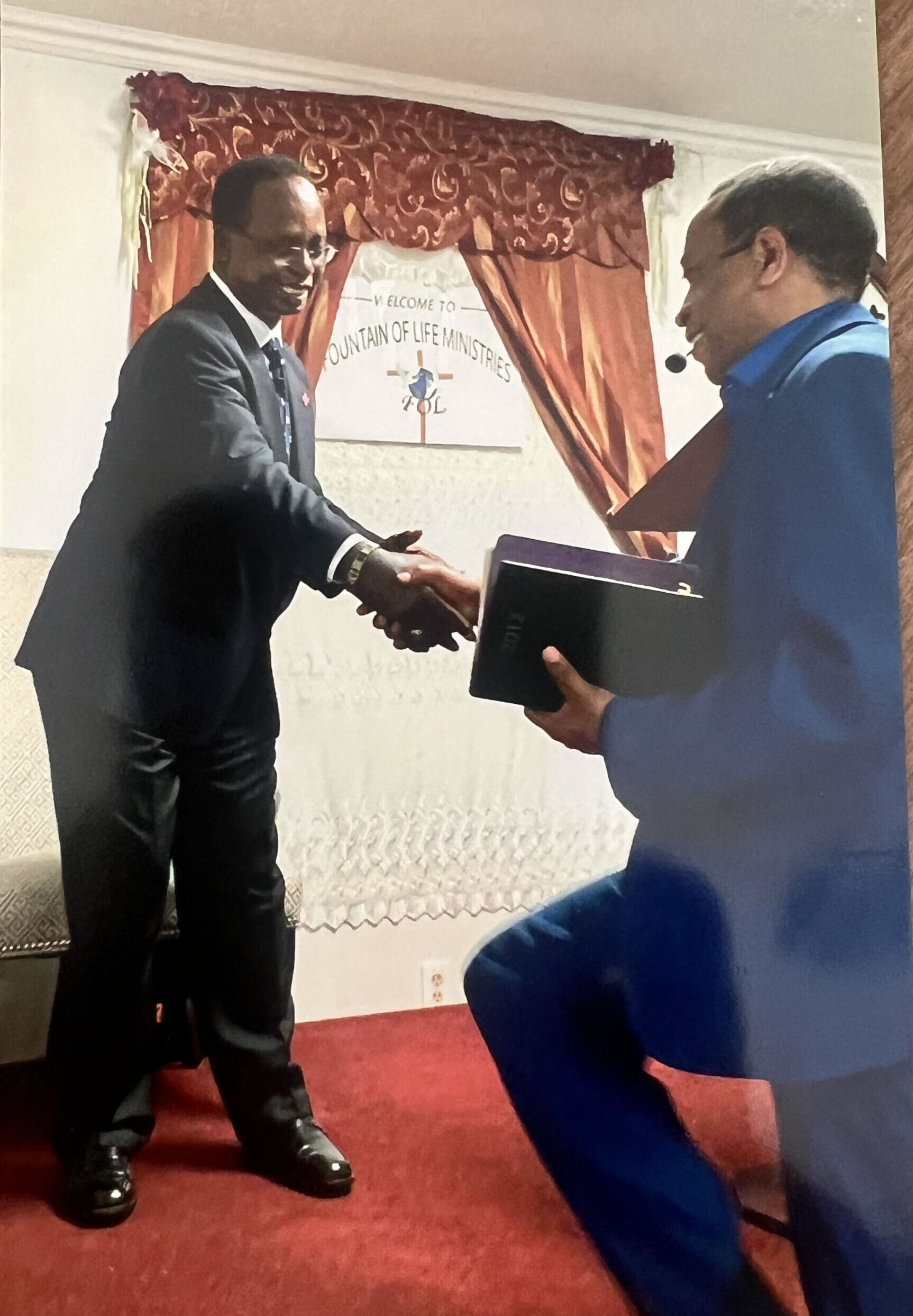
After secondary school, Dr. Eric found himself returning more deliberately to the spiritual commitment that had been growing since childhood. In 1997, he described committing himself more fully to the work of God and joining the Free Pentecostal Fellowship in Kenya. At first, service did not begin with a major office. It began among people. He brought young people together, helped organise meetings, encouraged them in education, and became involved in mentoring and leadership. The work attracted the attention of missionaries who observed what he was doing in the community.
Their interest opened an unexpected conversation about his future. When asked what he wanted to do next, Dr. Eric answered that he wanted to attend college. The educational support available through them was connected with theological study. He accepted the opportunity because theology was consistent with the faith that had already become central to his direction.
This eventually brought him to Karen Christian College, an institution of the Free Pentecostal Fellowship in Kenya. His formal diploma course ran from 6 May 2004 until 24 March 2007. The three-year programme led to a Diploma in Bible and Theology. His studies strengthened areas that practical ministry had already begun exposing him to, giving structure and academic depth to the religious commitment that had previously developed largely through experience. Dr. Eric approached the opportunity seriously.
He recalled completing the programme with First Class Honours and a GPA of 3.68, finishing among the strongest students in his graduating group. Academic recognition mattered to him, but the greater change occurred beyond the classroom. Studying in Nairobi exposed him more directly to vulnerable people living within and around the city. Bible college students visited churches and communities where street-connected children and disadvantaged families were visible. Dr. Eric found it difficult to observe those conditions and return to academic life as though nothing had happened.
Together with fellow students and friends, he helped collect clothes and food. They visited families and children who needed support, speaking with them and trying to offer both practical assistance and encouragement. The experience widened his understanding of ministry.
Theological education was teaching him how to interpret Scripture, but life outside the institution was forcing another question: what should faith look like when people are hungry, discouraged, or living without support? Dr. Eric increasingly understood that the answer had to involve presence. After completing his theological studies, another opportunity emerged within the church. He was assigned to work in a city congregation alongside a senior pastor who was himself planning to pursue further education. The arrangement placed Dr. Eric in an environment where he could learn while gradually assuming greater responsibility.
He had already been involved with the congregation during his studies. As time passed, his responsibilities increased. When the senior leader eventually left to pursue higher education, Dr. Eric took over the church as senior pastor. On 24 February 2008, the Free Pentecostal Fellowship in Kenya formally ordained Pastor Eric Mukeku Mutiso into Gospel ministry at FPFK Waithaka Church in Nairobi. The certificate represented more than a ceremonial moment. Years earlier, he had been a child participating in Sunday school and church music because faith was part of his family environment. By 2008, that inherited foundation had become a chosen vocation carrying responsibility for other people.
Note of Thanks
Dr. Eric extends his deepest gratitude to his parents, whose influence began long before any professional achievement entered his life. His father’s encouragement taught him persistence and faith in difficult circumstances, while his mother’s discipline, hard work, compassion, and generosity gave him a living example of service. He remains grateful to the teachers, lecturers, professors, clergy members, and mentors who contributed to his education and development. He acknowledges the Catholic foundation of his childhood and the profound role of the Free Pentecostal Fellowship in Kenya, which nurtured his faith, ministry, theological education, and leadership.
His appreciation extends to Mungala Primary School, Kwanthanze High School, Karen Christian College, Global University, Liberty University, and Deeper Bible College, each representing a different stage of his continuing educational journey.
He also remembers mentors and church leaders who gave him guidance at important points, including Dr. Stephen Muoki, Professor Ngetich, Bishop Paul Lemurua, and the other clergy and leaders who invested their time in his growth. Within his family, Dr. Eric offers special gratitude to his wife for sharing the responsibilities and demands that accompanied years of ministry, study, professional development, and service. He also acknowledges his children, Alex, Deborah, and Joseph, whose place within his life gives personal meaning to his concern for future generations. Above all, his gratitude recognises that every stage was strengthened by people who taught, encouraged, challenged, supported, or simply remained present. Their contribution forms part of the journey recorded in these pages.
thanks,
– Dr. (H.C.) Eric Mutiso

AIMLAY is a leading global education platform empowering ACADEMIC and EXPERIENTIAL learners, uniquely focused on recognizing knowledge gained through experience and building a diversified community of doctorates and aspiring researchers.