
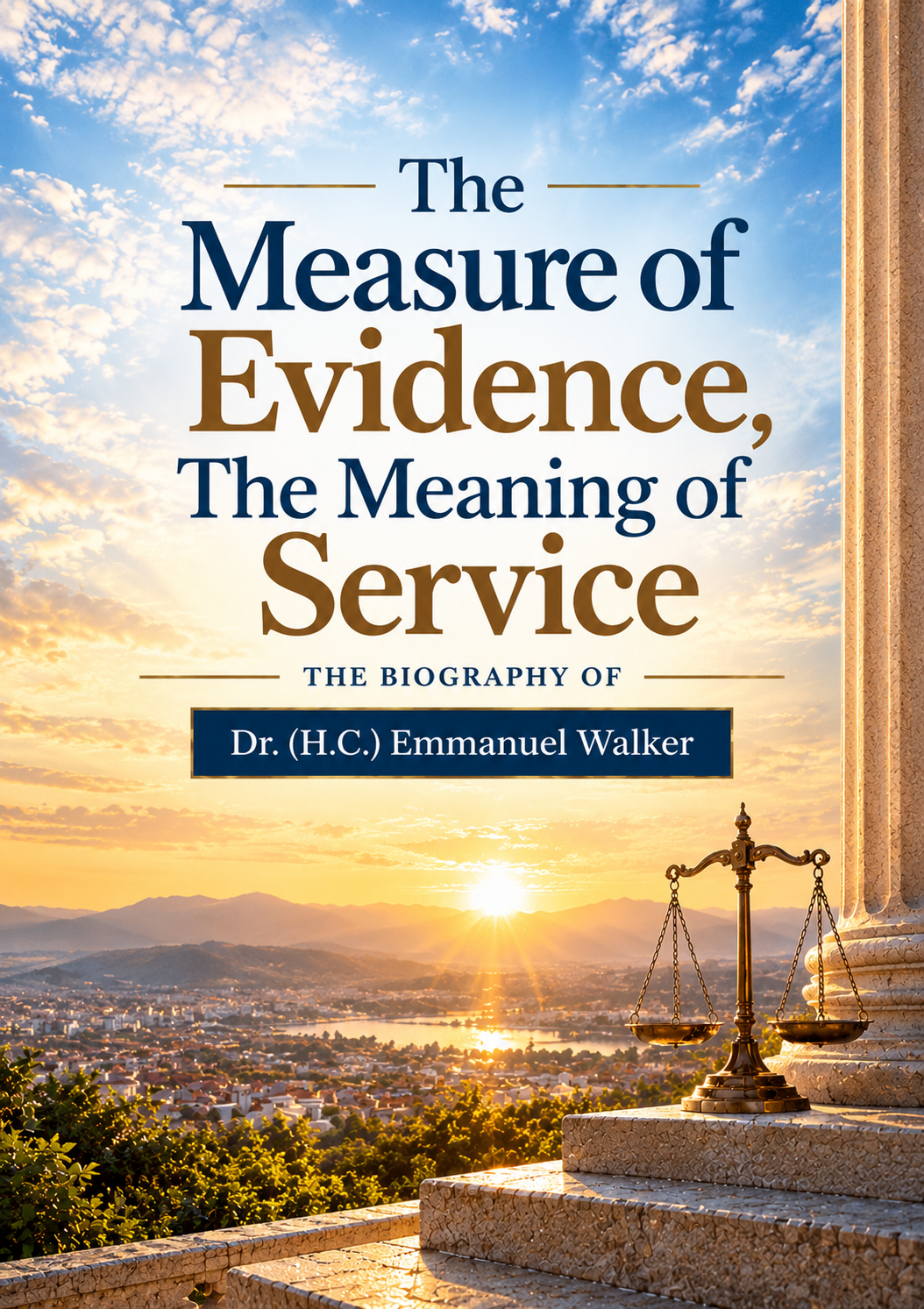
"Sometimes the outcome remains unknown. What matters is knowing that the responsibility was fulfilled."
Introduction
There is a particular kind of responsibility in being asked to speak through evidence. The work begins far from public attention, often with material that appears silent to everyone else. It requires method, concentration, and an acceptance that personal preference has no place in the result. Later, the same work may have to withstand questions in a courtroom, where every conclusion must be explained and every boundary respected. Dr. Walker spent much of his professional life within that demanding space, where science met law and where careful analysis became part of society’s effort to reach the truth.
The seriousness of that calling never made him view knowledge as something cold. His understanding of learning was deeply human. Knowledge could help a court examine a case, yet it could also help a young person recognise a direction. It could strengthen a laboratory, organise an institution, guide a family or improve a community. He saw education as one of the strongest ways by which people could build themselves, then carry that strength into the lives around them. That belief explains why teaching remained close to his heart even after his career moved into forensic science.
His outlook was shaped by an instinct for order without rigidity. He believed that people should follow the law, work seriously, and pursue a profession with commitment. At the same time, he understood that growth is rarely a perfectly straight journey. His own path did not unfold exactly as first imagined. One ambition led towards another field; one educational decision created an unexpected opportunity; one period of employment revealed an enduring passion that later returned through mentorship and community work. He did not treat these changes as evidence that the earlier effort had been wasted. Each experience gave him something that the next responsibility required.
This capacity to carry lessons forward became essential in a profession transformed by technology. The scientific work with which he began depended heavily upon careful manual processes. Over the years, machines, computerised systems, DNA methods and automated procedures altered what laboratories could do and how results could be produced. Dr. Walker did not stand apart from that change. He continued learning, sought training and helped prepare younger professionals to work with methods that had not existed at the beginning of his career. Adaptation, in his view, was not a rejection of earlier knowledge. It was the disciplined extension of it.
There was also an emotional reality behind the technical one. Crime was never an abstract subject when its evidence arrived through cases involving loss, violence or vulnerable people. Some matters were difficult to carry, particularly those involving children. His response was not to become indifferent. He turned distress into urgency, working to ensure that the scientific contribution was completed in time and that avoidable delay did not weaken the movement of a case. Professional calm, for him, did not mean the absence of feeling. It meant preventing feeling from displacing the duty owed to accuracy.
That same discipline shaped his understanding of credibility. An expert could be respected only by remaining faithful to the area of genuine expertise. A confident answer unsupported by knowledge was more dangerous than a clear admission that a question lay outside one’s field. He learned to listen fully, answer precisely, and rely on the work carried out in the laboratory. These habits protected both the evidence and the person presenting it. They also reflected a larger quality in his character: he did not need to claim more than he knew in order to stand securely in what he did know.
"What do we live for, if it is not to make life less difficult to each other?"
Phase 1: From San Fernando to El Socorro, Foundations of Belonging
Dr. Walker entered the world at San Fernando General Hospital in southern Trinidad. The city of his birth was not, however, the place that would hold most of his childhood memories. For the first two years of his life, he lived with his parents in Siparia, also in southern Trinidad. When he was two, the family moved to El Socorro, San Juan, in the eastern part of the country. That community became home in the fullest sense. He grew up there, travelled from there to school, later attended university while living there, and continued to regard it as the place around which his life had taken shape.
The environment he remembered was marked by hospitality and a willingness among people to live peaceably with one another. Neighbours were not imagined as distant figures occupying nearby houses. The community carried an expectation that people would notice one another’s needs and respond when possible. Harmony did not mean that every life was identical or free from difficulty. It meant that difference did not have to become hostility. For a child growing within such surroundings, consideration for others was not introduced as an abstract moral lesson. It was visible in the way ordinary relationships were maintained.
Home strengthened that understanding. Wilberforce Walker, his father, was a public servant. Before retirement, he served with the Ministry of Works and Transport and attained the position of Accounting Executive. His working life offered the children an example of steady public responsibility. Their mother, Angelina, devoted herself principally to the household and to caring for the needs of the children until they reached adulthood. The family did not treat that contribution as secondary. Her attention formed the daily structure within which the children were guided, encouraged, and corrected.
There were six children in all, and Dr. Walker was the second. An older sister came before him, followed by another sister and then three brothers. Their grandparents also lived with the family and shared in their upbringing. The presence of more than one generation gave the household a strong sense of continuity. Lessons did not come from one voice alone. Parents and grandparents reinforced the belief that the brothers and sisters were expected to remain a unit, even when childhood ended, and adult lives carried them in different directions.
That expectation had a practical meaning. Those who had the means to help were to support those who did not. A family member’s progress was not supposed to become a reason for distance. It created a greater capacity to assist. The children were taught to look after one another, to make life more peaceful and manageable through cooperation, and to resist the idea that individual success cancelled responsibility towards the rest of the family. The lesson remained simple enough for a child to understand and strong enough for an adult to return to repeatedly.
His mother held the greatest influence over the direction he imagined for himself. She asked what he hoped to become and then reminded him that any answer required work. Desire alone was not a plan. She encouraged achievement with incentives and kept his attention on the path he had named. His father was also instrumental in the children’s upbringing, while his grandmother brought the firmness of a strict disciplinarian. She made clear that there were standards to follow and lines that should not be crossed. Together, their influences created a balance of aspiration, accountability and care.
Faith occupied an equally natural place in family life. Achievements were celebrated, whether they belonged to Dr. Walker, one of his sisters or one of his brothers, and gratitude to God formed part of those occasions. Birthdays and Christmas brought the family together. Carnival created another cherished gathering. Relatives would assemble at a chosen point in Port of Spain, the capital, to watch the masquerade bands pass. These moments made celebration communal. Progress was noticed, joy was shared, and thankfulness was spoken rather than merely assumed.
"Education is the most powerful weapon which you can use to change the world."
Phase 2 : Moved to Grow, Discipline, Competition and Scientific Curiosity
School first became a familiar world for Dr. Walker at El Socorro Central Government School. He spent most of his primary years there, beginning at about seven and remaining until roughly the age of ten or eleven. He knew the classroom, the teachers and the children around him. Familiarity made the school comfortable, and his academic performance gave his parents little cause for concern. In fact, their concern arose from the opposite direction. He was doing well so consistently, and apparently without enough effort, that they began to wonder whether the environment was demanding enough of him.
They decided that he needed stronger competition. The purpose was not to punish success or withdraw him from friends without reason. They believed his ability would develop more fully if he entered a classroom where other students could challenge him. A transfer was therefore arranged to Mount Lambert R.C. School shortly before the examination that would determine entry into secondary education. The timing made the change especially significant. Much of his preparation had begun at El Socorro Central, while the final months would now be completed in a different school.
He was not angry, as he later clarified, though he was disturbed by the decision. A child who has found his place among peers cannot immediately regard removal as an academic strategy. He knew the people in his former class and had already learned how to belong there. The new classroom contained unfamiliar personalities, established friendships and a different rhythm. Two of his brothers transferred with him, which offered some continuity, yet they were not beside him through every lesson. He still had to enter his own class and work out how to relate to people who did not know him.
The experience became an early lesson in adjustment. He had to observe, understand and find his place within a new group. In later professional language, he would recognise something of group dynamics in that process. At the time, it simply felt strange. The discomfort gradually eased as the months passed. What had first appeared only as a loss of familiarity began to reveal the reason behind his parents’ choice.
His first examination at Mount Lambert R.C. School delivered a result he had not been accustomed to receiving. Instead of finishing first, he placed eighth in a class of more than thirty students. His parents regarded that outcome with satisfaction. A position within the first ten was still strong, while the presence of students ahead of him meant that he could no longer rely upon easy distinction. The result required him to work harder. Competition had become real, and with it came a more honest measure of how effort affected performance.
The teacher responsible for his class added another level of discipline. He was strict, strongly oriented towards order and aware that Dr. Walker travelled some distance to attend the school. He also knew that the younger brothers would look to their older sibling. That placed an expectation on Dr. Walker to set the example, not only through marks, but through conduct. Academic responsibility and family responsibility met within the same classroom. What he did could influence more than his own result.
After completing the common entrance examination, his secondary education took him briefly to Belmont Secondary School, now renamed St. Francis College. The greater part of those years was spent at St. Mary’s College, where he completed the examinations then known as O Levels and A Levels. The move into secondary school widened the academic world before him. Subjects such as biology and physics became serious areas of study rather than distant names. Earlier exposure to agricultural science and hygiene or health science had offered an initial connection with scientific thinking, though it was at college that science truly captured his attention.
"And so rock bottom became the solid foundation on which I rebuilt my life."
Phase 3 : When Medicine Gave Way to a Wider Scientific Path
The ambition to study medicine faced its decisive test when Dr. Walker completed his A Level examinations. His results did not secure the entry he had hoped for at the Mona campus in Jamaica. The application was unsuccessful, and he was advised that his second choice, agriculture, was available in Trinidad. He did not immediately abandon the hope of medicine. Instead, he chose Natural Sciences at the University of the West Indies, St. Augustine, believing that a strong first year might allow him to compete again for entry into the medical programme.
The plan was reasonable, though the competition remained intense. Many students were attempting a similar route, and some carried stronger grades. Dr. Walker performed well, yet he was not admitted to medicine. The outcome required him to reassess the direction of his degree rather than remain fixed upon a door that had not opened. Natural Sciences provided more than a temporary waiting place. It offered a broad encounter with chemistry, zoology, physics and botany, allowing him to judge each subject through actual study.
The university did not operate through semesters in the way later programmes would. At the end of each year, students examined their grades and considered which subjects offered the strongest route towards the degree they hoped to earn. Dr. Walker made those choices carefully. Zoology and physics contributed to his scientific foundation, while chemistry and botany emerged as the areas in which he would concentrate. He ultimately majored in those two subjects.
He aimed for a first-class degree. That ambition was not fulfilled, nor did he receive an upper second. He graduated in 1978 with a lower second-class Bachelor of Science in Natural Sciences. His response was grounded in gratitude. He thanked God for the result and accepted what it represented: a completed university education earned through demanding subjects and independent decisions. There had been no personal mentor mapping out every academic choice. Teachers ensured that students understood the work and prepared for examinations, while decisions about direction were largely his own.
The degree soon led him towards the classroom. Trinidad and Tobago was experiencing a shortage of science teachers, and graduates in the relevant fields were encouraged to apply. Natural Sciences prepared him to explain chemistry, biology and related subjects, even though it did not by itself make him an industrial analyst. He attended the interview, was selected alongside several counterparts, and entered the Ministry of Education as a Teacher II.
Between 1978 and 1982, he taught at Five Rivers Junior Secondary School and St. George’s College. He also conducted continuation classes for students at Arima Senior Comprehensive School. Teaching was a practical first profession for someone whose training was principally theoretical. Industry would have required additional preparation in methods used to analyse or manufacture particular materials. In a classroom, he could immediately pass on the scientific knowledge he had acquired and give students a foundation from which they could advance.
He loved the work. Education already had a familiar place within the wider family, where several relatives were teachers, and his older sister had also entered the profession. Their encouragement supported him, though his affection for teaching did not persuade him to remain permanently. A tension had begun to form between what he enjoyed and what he still wanted to become. Teaching allowed him to improve others, while he felt that his own scientific development would remain limited if he stopped with a bachelor’s degree and continued along the same path.
Note of Thanks
With a grateful heart, Dr. Walker acknowledges the teachers and professors who contributed to his education from the first years of school through advanced scientific study. Their work gave him more than the information needed to complete examinations. They helped him recognise the discipline required to understand difficult subjects, the patience necessary for genuine learning and the confidence to carry knowledge into professional responsibility.
His gratitude also belongs to the members of his family who assisted him throughout the journey. Their presence gave encouragement, a familiar voice, and made achievement something that could be shared rather than privately claimed. Among them, Donna deserves special appreciation for the companionship that continued through demanding professional years and into retirement. Her place in his life cannot be reduced to a single event; it rests in the constancy of a shared journey.
He remembers with respect everyone who helped him move from one level of learning and responsibility to another. No qualification or appointment existed in isolation. Each depended upon instruction received, confidence offered, and the willingness of others to make room for his growth. The support of family stood beside the labour of educators, forming a network of influence that remained present even when decisions had to be made independently.
This note carries his sincere thanks to all of them. Their contributions became part of the knowledge he later shared, the standards he upheld and the encouragement he extended to younger people. In honouring their assistance, Dr. Walker recognises a truth that has accompanied him throughout life: progress may be personal, yet it is never created entirely alone.
thanks,
– Dr. (H.C.) Emmanuel Walker

AIMLAY is a leading global education platform empowering ACADEMIC and EXPERIENTIAL learners, uniquely focused on recognizing knowledge gained through experience and building a diversified community of doctorates and aspiring researchers.