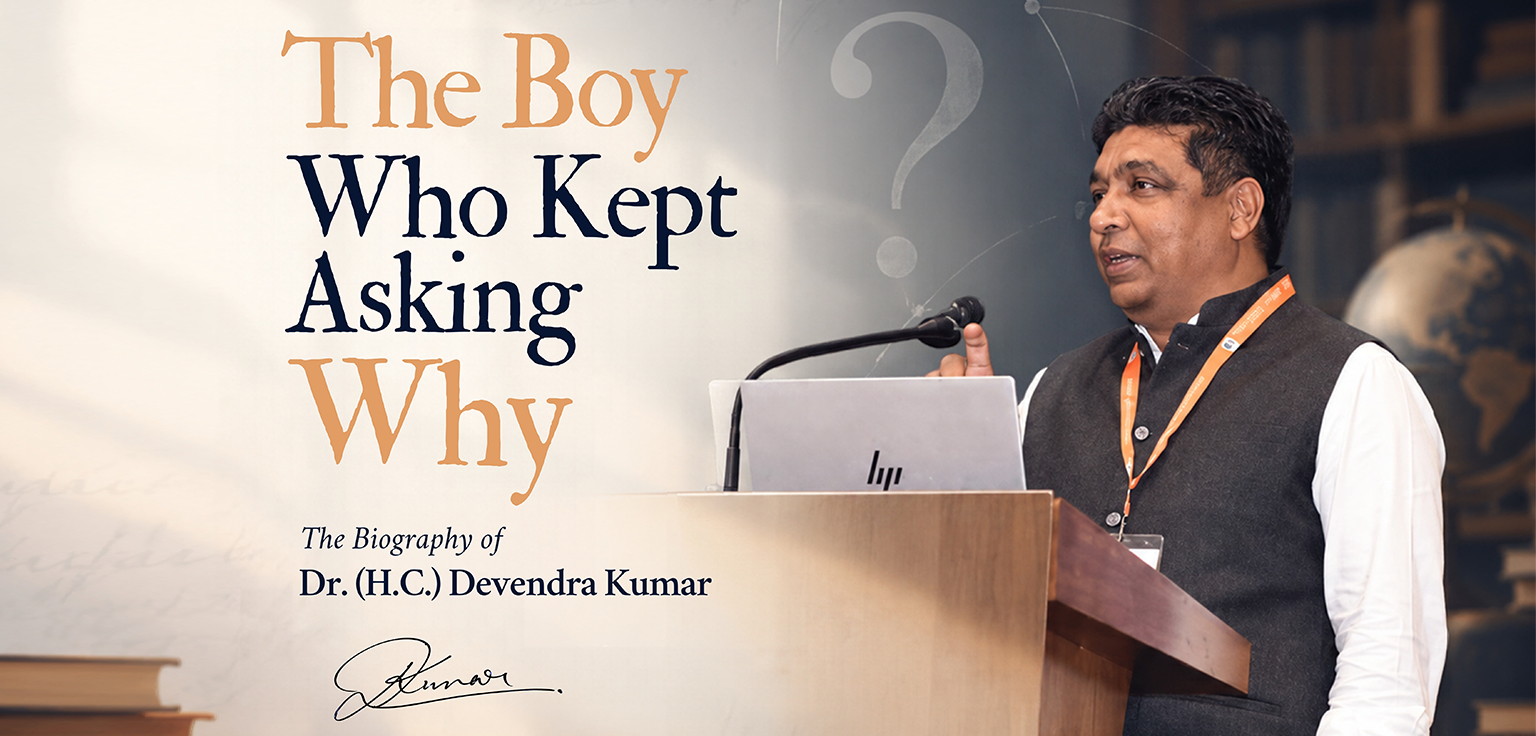
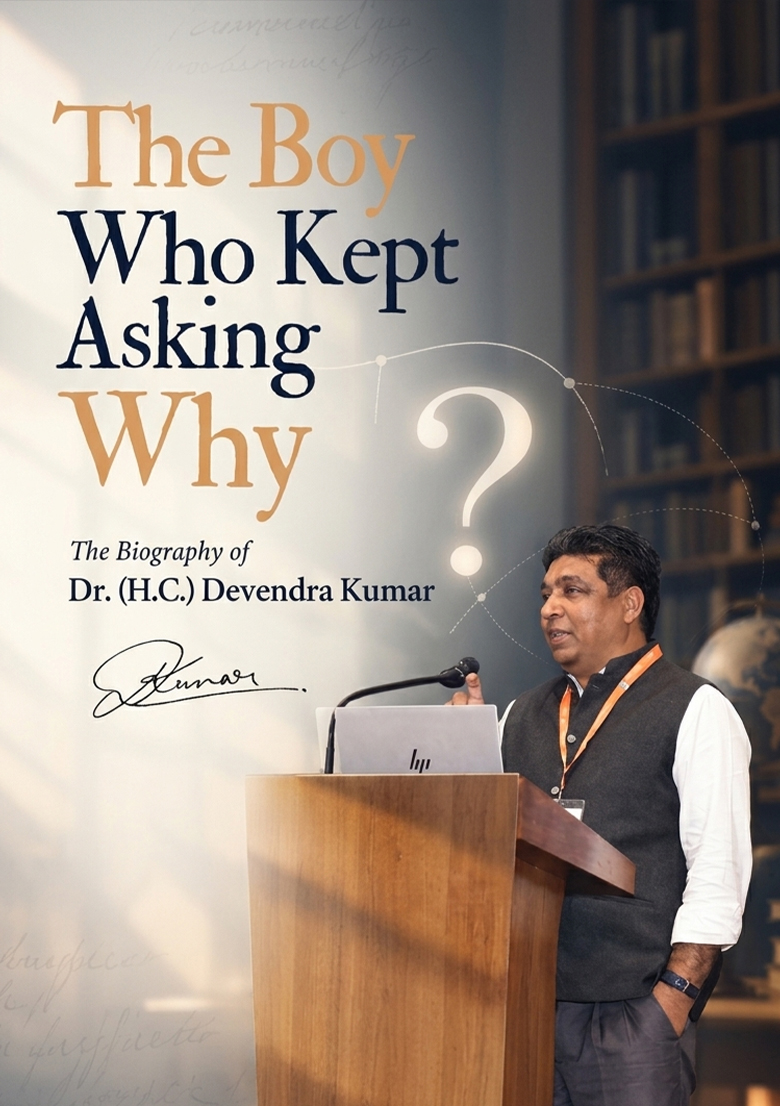
“My mother died days after I was born. A village without power raised me. I sold what I had to study, and I never stopped asking why. This is the story of how a farmer’s son became an engineer who protects lives, told in the only way I know how: honestly.”
Introduction
Long before the first power line reached Bhatu Village, one of its sons had already decided to become an engineer. He could not have known what that decision would ask of him. He only knew the world he was born into: fields that needed tending, a joint family that filled the house with voices, and relatives whose lives pointed in different directions. Some practised medicine. His father worked the land, and from that work came something Dr. Devendra Kumar still carries. His father taught him to reason. Not through lectures or textbooks, but through questions, through practical explanations offered while the two of them stood close to the soil. That was his first education in problem-solving, long before the problems involved turbines or safety systems or the immense machinery of power generation.
He was born on 3 December 1971. Within days of his birth, his biological mother was gone. His grandmother raised him, with help from his aunts and the wider household. He called her Maa. The family placed real weight on education, and his youngest uncle watched over his studies with particular attention, making sure the boy did not drift. Mathematics and physics became his favourite subjects. He was drawn to challenges, especially the ones other people called difficult. That instinct would serve him well.
It shaped his choice to study mechanical engineering at HBTI, Kanpur. Several engineering selections were available to him. He chose the one that genuinely interested him, not the one that looked easiest or most prestigious. After graduation, Delhi brought a new ambition: the civil services. It also brought a practical question. How would he support himself while he prepared? Family assistance helped. So did the money from selling his old car, and so did his friend Ajay Upadhyay, whose support belonged to those uncertain years when the outcome was anything but guaranteed.
Postgraduate study at IIT Delhi gave his engineering interests somewhere concrete to go. He worked on separating carbon dioxide from biogas, trying to improve the fuel’s usefulness through methane enrichment. Teaching was another path he considered. Money, as it often does, nudged him toward a different decision. He turned his attention to employment with NTPC. His first posting was at Vindhyachal, and his responsibilities carried him into industrial safety.
From there, his career unfolded through assignments at Dadri, Koldam, and a plant acquired from the Bihar government. One assignment tested him in ways he still speaks about. He was sent to document conditions that needed correction before generation could resume. The pressure to restart operations was immense. His report made the case for why preparation could not be rushed simply because people were impatient. Elsewhere, his work addressed energy consumption, environmental handling, workforce awareness and the warning arrangements that must surround a hydroelectric station, where the stakes of failure are measured in human lives.
At NTPC Koldam, his responsibilities reach beyond the immediate workplace. Downstream warnings, induction programmes, communication about hazards: these connect technical decisions to everyday lives. Further study and professional training have accompanied the work. Recognition has followed, including the Power Excel and Visionary Leader awards. As Deputy General Manager in safety, he brings engineering knowledge to a role that also demands coordination and judgement, the ability to hold a room together when the decisions matter.
"She was not the woman who gave me birth, but she was the woman who gave me life. I called her Maa, and that word held everything I needed."
Phase 1: The Mother He Found, Not Lost
The woman he called Maa was his grandmother. That was how Dr. Devendra Kumar knew her from childhood, and it was the name he continued to use. When he spoke about who had raised him, the answer returned to her. His aunts had cared for him too, within a household large enough for responsibility to be shared. But his grandmother held a particular place. She was the person he identified with his upbringing, the woman to whom the word ‘mother’ belonged in everyday life.
He was born on 3 December 1971. A few days later, his biological mother passed away. He described that fact plainly, without offering remembered scenes or conversations. She had given birth to him; their time together had ended almost immediately. The care he needed came from the family around him. His account of those years was clear on this point: because he belonged to a joint family, his upbringing did not suffer for want of people willing to look after him.
His paternal aunts and the wife of his father’s elder brother helped care for the child. Their contributions remained part of his recollection, even as he gave his grandmother the foremost place. He did not describe himself as having been left alone. The household had people who took responsibility for him, and he acknowledged them directly. To understand his childhood through the loss alone would therefore leave out something essential: the family care he said had accompanied his growing up, with his grandmother at its centre.
That family lived in Bhatu Village, a place he described as underdeveloped, where farming was the principal occupation. During his childhood, the village had no electricity. He remembered his household as the village’s educated family, although education had taken different forms for different members. Some relatives had entered medicine. Others worked the land. These were people belonging to the same family, living with different responsibilities and making different contributions to its life.
His grandfather was a farmer. Agriculture needed labour, and the family needed someone to help him. Of his six sons, the second, Shri Karam Singh, remained in farming. While an elder brother and a younger brother became doctors, he continued with the work at home. His son explained this without treating farming as evidence of lesser ability. His father had not received much formal education, but he was intelligent. The distinction mattered to the boy who learned from him.
What his father offered was a habit of asking why. He would raise a question about how something happened, invite the child to consider it and explain what he did not understand. There was a practical quality to this learning. An answer had to make sense. The explanations were connected to things that could be understood through observation and reasoning. His son credited him with the logical approach he acquired in childhood, recognising an education that did not depend upon his father having studied extensively.
His youngest uncle, Shri Rishipal Singh, also remained connected to agriculture and worked alongside his father. He had not studied very far himself, yet he paid close attention to the child’s education. He watched the balance between study and play. When other village children spent their time playing and gave little attention to schoolwork, he advised his nephew to keep some distance. He also decided when it was appropriate for him to go out and when it was time to stay with his studies.
“I recited words I could not read, until one sharp moment changed everything. That slap taught me more than years of silence ever could. I learned to see.”
Phase 2 : Beyond the Page He Had Memorised
The book lay open, and the lesson came easily. The little boy could recite the poem about Gandhiji from memory. He knew how it sounded, the rhythm of it, the places where his voice should rise and fall. When his teacher asked him to stand and deliver, he stood and delivered. Yet something important remained hidden beneath that performance. He could not properly recognise the letters on the page. What appeared to be reading was remembering, and for months the same familiar chapter allowed the difference to go unnoticed.
At the government primary school, Dr. Devendra Kumar had found a way to answer without acquiring the skill the answer was meant to demonstrate. He opened the book at the poem and recited what he knew. His teacher, Vikram Singh, eventually noticed that the boy had remained on the same lesson for about six months. He called the child to his table, asked for the book and turned to an earlier chapter about a fair. This time, memory could not supply the words.
He began trying to read. To his own surprise, some of it came correctly, though he still did not understand how to identify the letters with confidence. When he stumbled, the teacher slapped him and told him to read properly. He remembered that incident as a turning point. It was a sharp interruption to the routine that had concealed his difficulty, and he associated it with the beginning of learning to read rather than continuing to repeat a lesson he already knew.
His progress afterwards was rapid. While still in Class 2, he could solve mathematics problems intended for children in higher classes, including Classes 3, 4 and 5. He placed this development within the months following that classroom incident. The child who had struggled with letters displayed a particular ease with numbers. When older children were asked to solve a problem and could not, relatives sometimes called him over. He would work it out quickly, becoming the younger child whose answer others were asked to notice.
Mathematics and physics became his favourite subjects. He described himself as hard-working and smart, and he remembered becoming a favourite among his teachers. Difficulty held an unusual attraction for him. Hearing that mathematics was a tough subject encouraged him to choose it. He wanted to attempt what sounded demanding. That preference was already visible in the satisfaction he took in solving questions beyond the level of his own class, where the work gave him something substantial to do.
School life also included games, though he was frank about usually finishing behind other children. He remembered being treated as the smaller player for whom the rules were softened. Kabaddi was the exception. There, he described himself as a champion and spoke confidently about the strength of his team. His abilities were uneven in the ordinary way a child’s abilities can be: less capable in many games, assured in one, and increasingly comfortable with the subjects that drew his attention.
His schooling continued at the Gurukul in Haridwar. He described those years as largely straightforward, with neither exceptional adventures nor major difficulties dominating them. Friendships were important, even though many school companions eventually lost contact. The years away from home formed part of his education without requiring a dramatic account of separation. Lessons, classmates and the everyday course of school occupied this period, which he remembered with a simplicity quite different from the vivid primary school episode.
"Five thousand rupees and a dream. I sold what I had, borrowed what I could, and refused to let go of the ambition that burned inside me."
Phase 3 : Five Thousand Rupees and a Delhi Address
Five thousand rupees was the amount his grandfather placed in his hands. There were other children in the family to consider, he explained, and he could not devote unlimited resources to one person. Dr. Devendra Kumar wanted to prepare for the civil services examination. His grandfather gave him what he could and left him to decide how to use it. The ambition was his. So was the practical question of making that money last while he studied.
He placed his move to Delhi in 1999. He had heard that the civil services examination was exceptionally difficult, and he wanted to attempt it. Coaching and preparation required money, but so did remaining in the city. He owned an old car and sold it, adding the proceeds to the funds he took with him. That sale was a concrete contribution to his plan: something he already possessed became money he could spend on the opportunity he wanted.
He joined coaching classes and began preparing. Soon, however, he recognised that the funds available were insufficient to sustain him in Delhi. Continuing required another arrangement. He prepared for GATE, achieved a strong percentile, and secured admission to IIT Delhi. Postgraduate study offered accommodation and financial support alongside an academic programme. It gave him a place to stay and a means of continuing his preparation without depending entirely on the money he had brought from home.
Civil services remained part of his plans while he studied. He advanced as far as the interview, but the final selection did not follow. His explanation centred on the subjects he had chosen, which he felt had worked against him. He did not describe the outcome as proof that the effort had been pointless. It was an examination he had prepared for seriously, reached an advanced stage in, and ultimately not cleared. Alongside it, his postgraduate work continued.
The subject was energy studies, and one project gave him a problem with a clearly defined purpose. Biogas contained carbon dioxide along with the methane that made it useful as fuel. Carrying the unwanted component in cylinders added weight without contributing the desired energy. He wanted to improve that arrangement. His work focused on separating carbon dioxide from the gas and enriching its methane content, so that what remained would be more useful to transport and burn.
He designed a device to perform that separation. He described the project as successful and economical, emphasising the practical value of reducing the burden of carrying gas that did not supply useful fuel energy. The explanation was characteristic of how he approached the work: identify what was unnecessary, understand its effect, and develop a way to remove it. His M.Tech. in Energy Studies, completed in 2005, included this attempt to turn an observed inefficiency into an engineering solution.
Life around the academic work had its own unusual hours. He studied in the library until about two in the morning. Afterwards came lawn tennis, sometimes continuing until three or half past three, followed by Maggi and tea before sleep. He would rise around ten, get ready, and take bread along as he headed to class. The routine had late study, recreation, and hurried breakfasts within it. These were the details he remembered, the ordinary habits around a demanding period of education.
Note of Thanks
Dr. Devendra Kumar offers his gratitude to the people whose care, guidance and help have held a place in his life. His thanks begin with his grandmother, whom he calls Maa, and his grandfather. He acknowledges the upbringing they gave him and the family responsibilities they carried. His aunts and the wider joint family deserve recognition for the care through which he grew up surrounded by people willing to look after him.
He thanks his father, Shri Karam Singh, for teaching him to ask questions and understand things through reason. His appreciation extends to Shri Rishipal Singh, whose attention to his studies helped keep education important in his childhood. He remembers Vikram Singh for the classroom intervention he identifies as a turning point in learning to read, and acknowledges the teachers who contributed to his education.
Special gratitude belongs to Ajay Upadhyay. His financial help during the Delhi years remains a contribution that deserves to be named. He also thanks the friends who accompanied him through that period and came to the railway station to see him off.
Among his professional colleagues, he acknowledges V. Thangapandyan for lessons in teamwork and involvement, and Ramnath Pujary for encouraging patience and consideration in difficult discussions. His appreciation includes junior colleagues, senior colleagues, workers and the teams at NTPC from whom he has learned and with whom he has worked.
At home, his thanks belong to his wife, Jyotsna Dev, for her support and the understanding they share. His daughter, Shreya, holds a dear place in these acknowledgements, as does her maternal grandmother. To everyone named here, and to the relatives, friends, teachers and colleagues whose contributions remain part of his experience, he offers his thanks with respect and affection. Their names belong beside the experiences and lessons he has chosen to share in this book.
thanks,
– Dr. (H.C.) Devendra Kumar

AIMLAY is a leading global education platform empowering ACADEMIC and EXPERIENTIAL learners, uniquely focused on recognizing knowledge gained through experience and building a diversified community of doctorates and aspiring researchers.