Introduction
Dr. Hutchinson’s story begins in Trinidad and Tobago and moves through education in England, artistic exploration, family responsibility, therapeutic work, curriculum development and community leadership. At its centre sits a belief that has held steady through every change of circumstance: art can do more than decorate a space. It can help people learn, heal, remember, communicate and belong. That belief grew slowly. It began in a childhood full of encouragement, artistic influence, and room to explore. It deepened when she met the limits placed on international students and the narrow expectations surrounding Caribbean artistic expression. It became more purposeful still when she saw what art could do for cancer patients, elderly people, and children who were not always reached by conventional teaching.
Her work has always circled back to people. Even as a student, her attention moved past technique towards questions of identity, history, and belonging – who gets to define artistic value, and whose contribution goes unseen. Her bright colours, her interest in what is dismissed as “primitive” art, and her study of African and Indian influence on Western art all came from the same instinct: to examine the origins of what society accepts as established knowledge. When art entered therapeutic spaces, it took on another meaning again. It became a way of supporting people facing illness, isolation, ageing, or emotional difficulty-and she learned that its value could not always be measured in a finished product.
Sometimes it lay in the confidence restored, the memory awakened, or the connection made possible. Her return to Trinidad brought these ideas into education. She watched her own children struggle to move from a more playful learning environment into a heavily academic system, and rather than accept that contrast, she began looking for ways to make learning active and engaging – weaving art through science, mathematics and language. That search eventually produced educational resources, community programmes, and an organisation through which she could reach far more people than she ever could alone. I.C.T.A. marked a significant widening of her purpose.
What began with a small group of women seeking better educational opportunities for their children grew into work spanning curriculum development, art therapy, community projects, sustainability and cultural preservation, reaching children, cancer patients, elderly people, autistic learners, and whole communities looking for ways to grow through creativity. Her approach to Autism Spectrum Disorder reflects the same refusal to let people be defined by narrow categories. She questioned programmes that ignored a child’s age, ability or social needs, and focused instead on practical skills, sensory experience and genuine participation in society – shaping her teaching around what she observed in each child, rather than a fixed formula.
That same instinct shaped the Golden Years Programme, which carried her use of art and sensory learning to elderly people living with dementia and Alzheimer’s disease. Music and art became routes back to memory and connection, proving that creative engagement can remain meaningful across a lifetime, even once conventional communication grows difficult. Alongside this direct service, Dr. Hutchinson became an author and creator of educational resources. Her books span language, visual arts, culture, heritage, sustainability, and the newer questions raised by artificial intelligence – always written to speak to Caribbean children in terms they recognise, and always treating creativity not as separate from knowledge, but as a way of investigating the world.
“Before art became her profession, it was already the way she looked at the world.”
Phase 1: A Childhood Shaped by Family, Freedom and Artistic Curiosity
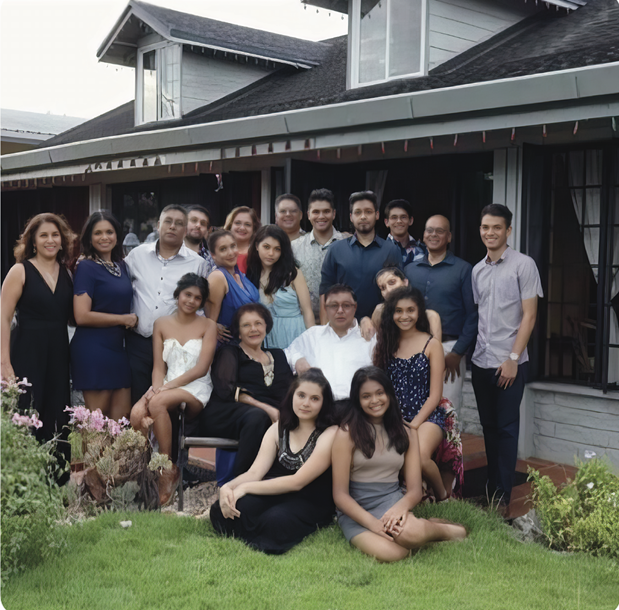
Dr. Hutchinson was born on 30 September 1973 in Trinidad and Tobago into a close household of two brothers, a sister, and parents who placed a high value on togetherness. Family holidays mattered most of all. Her father made a deliberate effort each year to bring everyone together, and the children remembered those trips fondly not for any expense or elaborate planning, but simply for the time spent as a family. Her home also gave her room to imagine. Her parents supported her artistic instincts even while she was still unsure of her own ability, and at a time when art was widely seen as a far less secure choice than a profession like law, their belief carried real weight – they saw potential in her before she had fully named it herself.
An uncle, himself an artist and teacher, became her first serious introduction to the artistic world. He let her explore materials rather than treating them as out of reach, took her to draw outdoors from life, and introduced her to local artists and older masters whose work was rooted in Trinidad and Tobago. Through him, art became something living and close at hand rather than something confined to galleries and finished paintings – a mango beside a river, a passerby, an ordinary community scene could all become subjects worth her attention. That same freedom shaped her character. She remembered herself as adventurous, visiting friends, exploring different households, and moving through her community with easy confidence – sometimes preferring a friend’s home cooking to her own packed lunch, a small joke that hints at a child who was curious and unafraid to step outside the expected routine.
Neighbours, too, were never distant strangers; people visited one another, shared food, and looked after each other’s children, and that sense of shared responsibility later reappeared throughout her community work. Her interest in teaching also began here, in watching how her uncle worked with learners and inspired their confidence. She never saw teaching as simply handing over information – to her, it meant encouraging people to observe, attempt, experiment, and find their own way of expressing what they understood. At the same time, she felt a strong pull toward justice – toward fairness, investigation, and uncovering what lay beneath the surface of an issue – which later led her to consider law as a field of study.
It was not really a departure from her artistic nature; both law and art demanded observation, interpretation, and a willingness to question appearances. The foundations of her later work were already in place. Family gave her emotional security and a belief in togetherness. Her father gave her encouragement. Her uncle opened the door to artistic practice. Her community showed her what shared responsibility looked like. And her adventurous nature gave her the confidence to explore whatever came next. None of this amounted to a fixed plan – rather, it gave her a way of meeting the world: to look closely, to ask questions, and to trust her own instincts when something felt wrong. That combination of creativity, courage and concern for others would carry her through education, artistic dissent, social commentary and, eventually, a life of community service.
“I believe in what I do.”
Phase 2 : Choosing Art Over Law
When it came time to choose a direction, law seemed the natural fit – Dr. Hutchinson’s interest in fairness and investigation made the field genuinely attractive. But art had never let go of her, and even as law offered the more practical path, creativity remained where she felt most alive. She travelled to England, completing a foundation course at Kent Institute of Art and Design before pursuing her degree in Kingston upon Thames, where she found herself among students from across the world and, at times, among attitudes that tested her sense of artistic openness. In her final year, she grew increasingly aware of how international students were treated and how Caribbean artistic expression was sometimes measured against standards that favoured other visual traditions entirely.
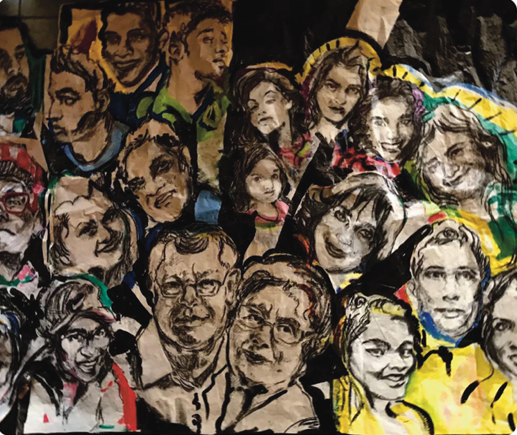
One tutor criticised her use of bright colour; to Dr. Hutchinson, the remark said less about taste than about a refusal to see where those colours came from – the Caribbean, and the visual world she had grown up in. She refused to erase that part of herself to make her work more palatable. Her final exhibition became a statement about people who feel confined yet strive to appear as though they belong: distorted figures, enclosed in boxes, gilded in gold, trapped by expectation while performing an acceptable outer appearance. It was not made to satisfy an academic requirement; it was made to say something.
That decision had consequences. Her marks fell, the work judged too political, too challenging, and her father, who had watched her perform strongly in earlier years, questioned the result. Dr. Hutchinson accepted the disappointment without regretting the choice. She knew she could have played it safer. She chose not to. What followed confirmed something she would carry for the rest of her career: although the institution did not reward the exhibition, every piece in it sold. People responded to the colours, the language, the ideas behind the figures. Formal approval and genuine connection, she realised, were not always the same thing – a work could be marked down within an institution and still find its audience outside it.
Her thesis carried the same conviction further, examining what she called “the art of the other” – the way forms associated with African and Indian cultures had shaped, and been absorbed into, the Western art world. Her interest went beyond history; she was questioning how artistic contributions get recognised, renamed, or quietly folded into someone else’s tradition, and the work deepened her belief that art carries cultural memory that deserves to be seen from more than one vantage point. A fellow student sharpened that conviction further. She had watched the work of a friend from Botswana whose imagination ran to copper elephants, painted ostrich eggs, and ambitious architectural ideas – concepts built around photosynthesis, water, sensory space, and accessibility, inviting people to learn through movement, sight, touch, and smell.
When he failed despite the strength of those ideas, largely for lack of the equipment and presentation others had access to, Dr. Hutchinson felt an injustice she could not ignore, and it strengthened her resolve to speak up whenever she saw someone treated unfairly. These experiences pushed her firmly toward social commentary. Art became a way of examining how people were treated, what assumptions institutions carried, and whose stories fell outside accepted definitions of excellence. Colour, form, material, and composition, she came to believe, could carry social weight just as easily as any argument. Choosing art over law never meant abandoning her sense of justice – it simply found a new language.
“Art became more than something she created. It became something she Offered.
Phase 3 : When Art Became a Form of Healing
After her studies, Dr. Hutchinson’s ties to England continued through marriage and work. She married a Trinidadian while abroad, returned briefly to Trinidad and Tobago, then went back to England for professional opportunities, carrying with her artistic interests that had
already begun to move beyond the studio. A turning point came at a conference where she met Patch Adams, the physician and humanitarian whose approach to care left a lasting impression on her, showing how creativity, compassion and healing could exist in the same gesture. It pushed her to think seriously about using art in spaces where people were facing illness, fear or isolation.
She began volunteering three days a week with Arts for Health in Manchester, working with cancer patients and elderly people, using artistic activity to draw out engagement and emotional release. Here, art was never an ornament tacked on after the “real” work was done – it was the work itself. She also helped archive the organisation’s earlier projects, an experience that taught her how easily community work disappears when no one keeps a record of what has been learned a lesson that would later surface in her own writing and cultural projects. The therapeutic setting reshaped her sense of what success looked like.
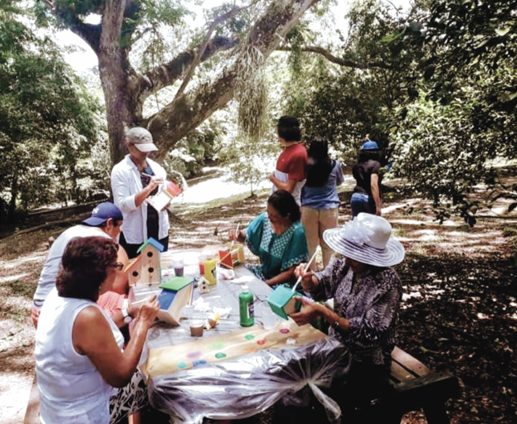
A finished painting was not always the point. Sometimes what mattered was a withdrawn person picking up a material for the first time, a conversation that emerged mid-activity, or the calm that settled over a room working quietly with colour and texture. Working with the Manchester City Corporation, she took some of this practice outdoors, helping older participants create collages from leaves and other natural materials gathered in the park – proof that creative engagement need not stay inside a studio or classroom. Participants were not simply producing objects; they were observing their surroundings, gathering materials, and taking part without the pressure of formal performance.
It was during this period that she became a mother, her first daughter arriving as a new dimension to a life already balancing artistic and therapeutic work. She was learning to care for vulnerable people professionally while learning, just as urgently, what it meant to raise a child. Everything she saw in Manchester – art supporting people through chemotherapy, illness, ageing, emotional difficulty; a well-designed activity opening a door where conventional communication had closed – would later shape the programmes she built back home. She learned to observe before assuming what someone needed, since no single activity suited everyone: some responded to colour, others to texture, movement, music, or simply the chance to work with their hands.
The practitioner had to stay attentive and adapt. That principle would become central to her later work with autistic children and elderly people living with dementia, never beginning from the assumption that one method fits every participant, but watching first, then adjusting the environment to what she saw. Eventually, after her marriage ended, she returned to Trinidad and Tobago with her three daughters – a transition of personal upheaval and family responsibility, but one she met carrying everything Manchester had taught her: that art could serve people directly, through relationships and carefully structured experience, not only through exhibitions. Her years in England became a bridge between artistic practice and community service, teaching her to value results easily overlooked elsewhere – a person growing calmer, a memory surfacing through an image, a patient finding a moment’s relief, and a child discovering the confidence to try.
Note of Thanks
Dr. Hutchinson begins her gratitude with God, whose strength and mercy have sustained her through every demanding season and every new responsibility – a faith that has remained a steady source of courage, especially when she had to carry on without certainty or immediate support. She offers sincere appreciation to her parents, Tyrone and Veronica, for the love, encouragement and stability they gave her throughout her life. Their home remained a place of belonging, and their support mattered most of all when she returned to Trinidad and Tobago with her children – she remains grateful for the care they extended to her family and the example they continue to set.
She thanks her siblings and her wider family for the relationships that have shaped her and holds her children in a special place in her gratitude – they have grown up alongside her work, absorbed its demands on her time, and remained a lasting source of happiness and motivation. She remembers her late best friend, Vanessa, with affection and appreciation for the friendship, presence, and memories they shared, and holds Cynthia McLean in the same fond remembrance. She acknowledges Peter Kwang, whose interest in art and connections within the gallery world encouraged her artistic development, along with Dr. Isaiah Boodhoo, whose place in her life has remained meaningful.
She remembers, too, her uncle, David Banks, who first opened the world of art to her, and thanks her cousins, her childhood friends, and the friends who have encouraged her on this journey – Denise, Tamara, Trish, Dani, Sashri, Asad and Paul. She offers a special word of affection for Benjie, her dog, whose presence has brought comfort and warmth – a quiet companionship woven into the everyday life that exists alongside professional achievement and public recognition. Finally, she thanks the children, families, older people, colleagues, educators, community partners and institutions connected to her work, whose participation turned her ideas into real programmes – every class, project, conversation and shared activity teaching her something new in return. For Dr. Hutchinson, gratitude is never just a list of names; it is an acknowledgement of every relationship, lesson and act of kindness that has kept her committed to the work she believes in.
thanks,
– Dr. (H.C.) Deborah Hutchinson

AIMLAY is a leading global education platform empowering ACADEMIC and EXPERIENTIAL learners, uniquely focused on recognizing knowledge gained through experience and building a diversified community of doctorates and aspiring researchers.