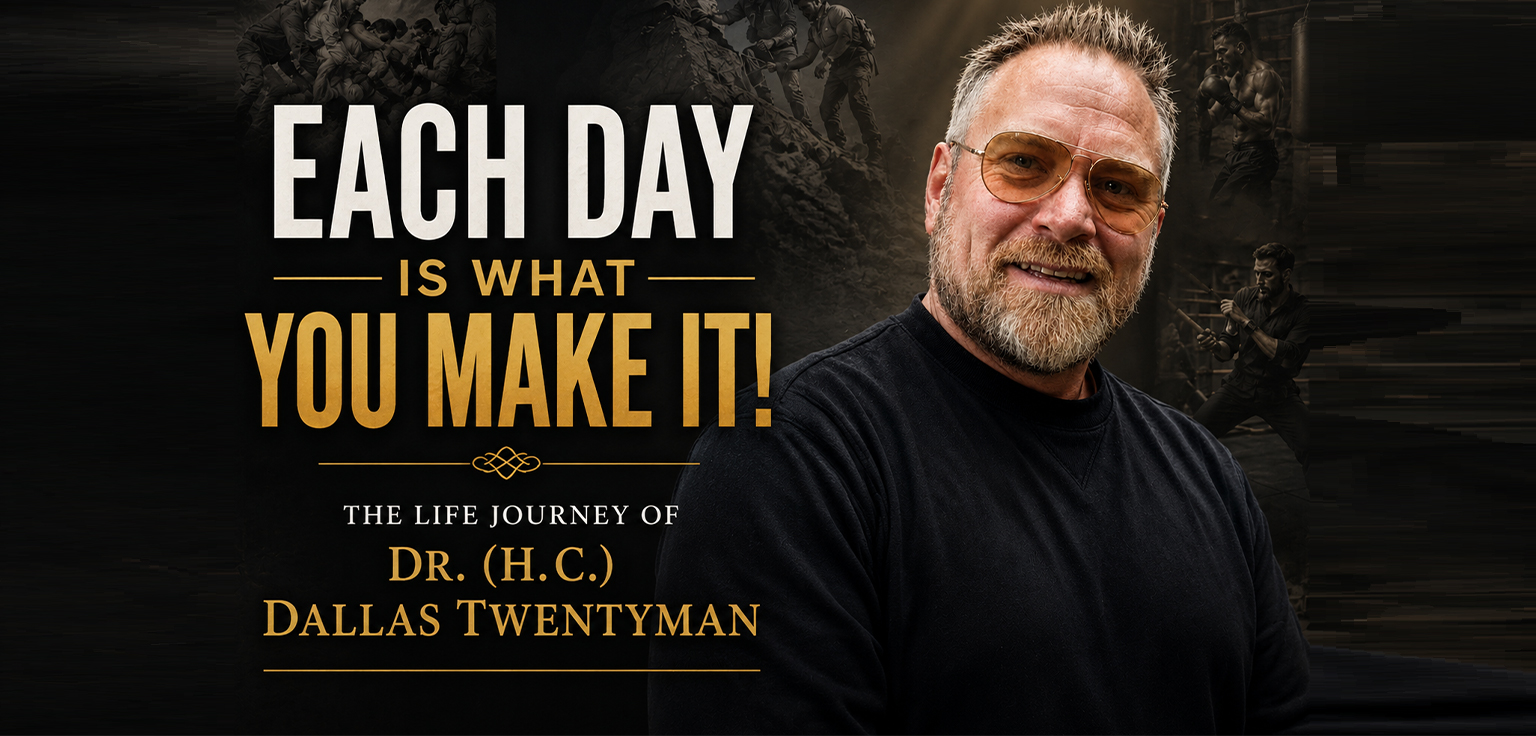
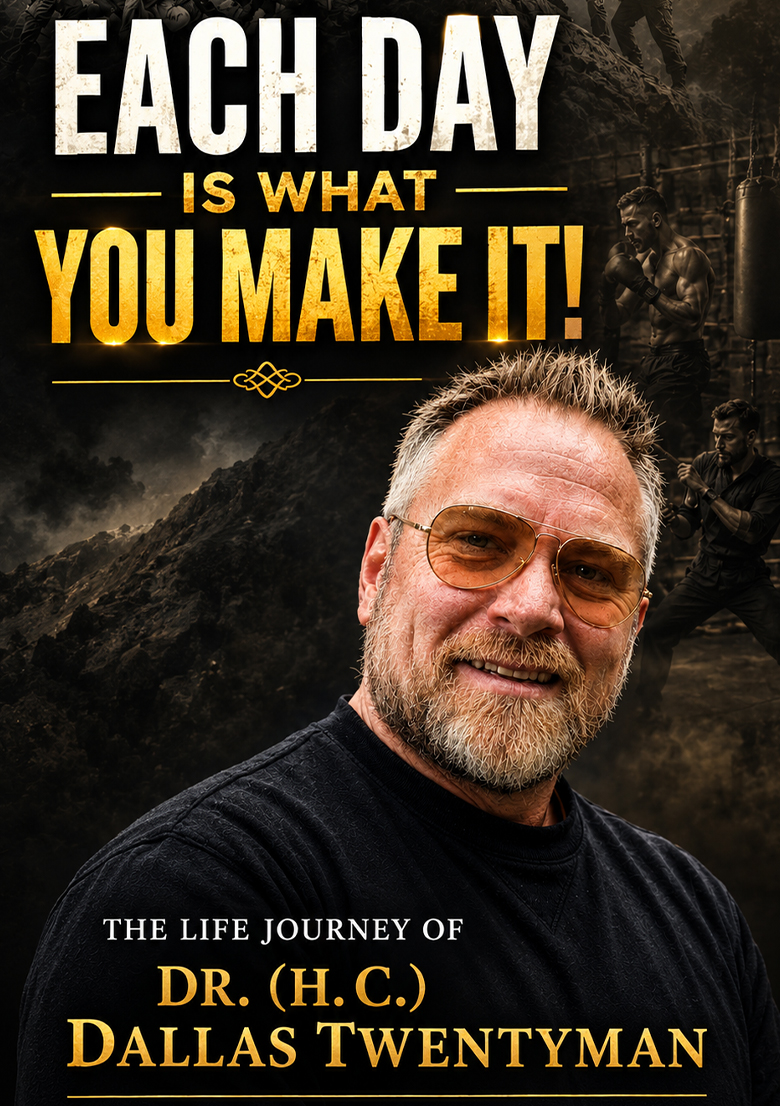
“Each day is what you make it! The most important words you will ever hear are the ones you say to yourself.”
Introduction
The story of Dr. Dallas Twentyman is not defined by a single profession, achievement, or title, but by a life shaped through experience, discipline, and continuous self-reflection. His journey reflects a steady evolution, one grounded in environment, family values, practical learning, and an enduring commitment to personal responsibility. It is a life built not through shortcuts, but through consistency, effort, and the willingness to confront challenges directly.
Born in Bacchus Marsh and raised in Melton, in the western suburbs of Victoria, Dr. Dallas Twentyman spent the first twenty-two years of his life in a setting that deeply influenced his character. Melton, at that time, carried a strong country-town atmosphere, close-knit, raw, and direct. Childhood memories were shaped by walking or riding bikes to school, gathering neighbourhood children along the way, and spending long days outdoors. It was a life of freedom, adventure, and constant interaction, where everyone knew one another and accountability was part of everyday living. This environment fostered independence, adaptability, and an early understanding of community.
Family values formed the core of his upbringing. His parents placed strong emphasis on work ethic, responsibility, and leading by example. His father’s repeated words, “It’s not what you make, it’s what you save”, left a lasting impression, reinforcing discipline, restraint, and long-term thinking. His mother provided balance through warmth, care, and emotional grounding, representing a steady source of support and nurturing. Together, these influences shaped an understanding that effort must come before reward and that character is revealed through actions rather than words.
From an early age, Dr. Dallas Twentyman demonstrated an inquisitive, hands-on nature. He was drawn to understanding how things worked, often dismantling and rebuilding mechanical and electronic objects. This curiosity was not driven by instruction but by instinct, a desire to explore, break down, and reassemble. Time spent in sheds, working with tools, and experimenting with mechanics laid the foundation for his later technical training. This natural inclination led him to pursue formal trade education, completing a Certificate III in Automotive Mechanical – Heavy Vehicle Transport from Kangan Batman TAFE in January 2008, a qualification that formalised years of practical learning and mechanical aptitude.
As his professional journey progressed, so did his commitment to structured education. Recognising the importance of leadership and management, Dr. Dallas Twentyman pursued further studies at Victoria University, completing a Certificate IV in Business and later a Diploma of Management. These qualifications supported his transition into roles requiring organisational responsibility, communication, and leadership across multiple industries. His career would span mechanical work, recruitment, energy, pest control, workplace health and safety, and business leadership, reflecting adaptability shaped by experience rather than convenience.
Alongside his professional development ran a parallel path of intense physical and mental discipline through martial arts. Over an eighteen-year period, Dr. Dallas Twentyman immersed himself in Wing Chun Kung Fu, Brazilian Jiu-Jitsu, wrestling, Muay Thai, Judo, and Kali-MDW. His journey through Brazilian Jiu-Jitsu, under Cia Paulista Australia – Brazilian Jiu-Jitsu, led to the attainment of Purple Belt, Black Belt, and eventually Black Belt – First & Second Degrees, awarded by Master Carlos Eduardo de Souza Vieira. Each progression was achieved through merit, conduct, knowledge, and discipline and came with significant sacrifice. Injuries, pain, recovery, and endurance became part of daily life, reinforcing resilience and mental fortitude beyond the physical demands of training.
“The place you grow up in stays with you. It teaches you how to move through the world long before you realise you are learning.”
Phase 1: Growing Up in Melton: Childhood, Environment, and Early Values
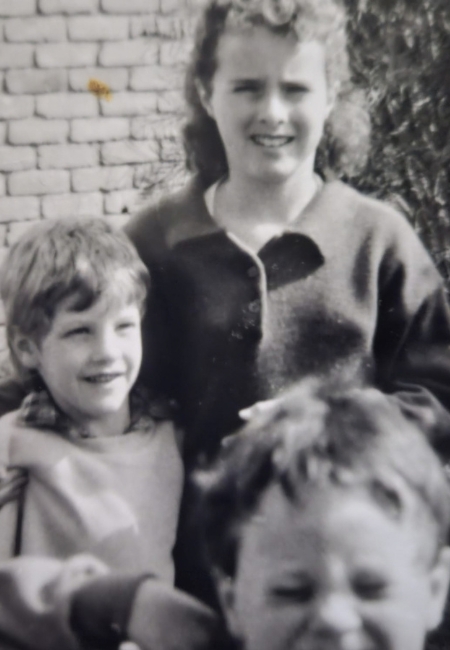
Dr. Dallas Twentyman was born in Bacchus Marsh, just outside Melton, and was raised in Melton, located in the western suburbs of Victoria. He spent twenty-two years of his life growing up there. At the time, Melton was very different from what it is today. It was smaller, more rural in character, and carried what he describes as a strong country-town feel. Over the years, the town changed significantly, growing in size and population, but the version of Melton he grew up in shaped his early experiences and outlook on life.
His childhood was filled with simple routines and shared experiences. Each morning, he would walk to school, often meeting neighbourhood children along the way and travelling together. Walking to school was a regular part of life, regardless of weather. Riding bikes was another major part of growing up. Bikes were used to get around town, to challenge one another, to attempt jumps, and to spend time outdoors. These activities were a constant presence in his childhood and formed the backdrop of everyday life.
Melton, as Dr. Dallas Twentyman recalls, was considered a tough area. There were frequent confrontations, particularly on weekends, and disagreements often escalated into physical altercations, especially around local pubs. If something happened, people from nearby streets or areas would quickly become involved. He describes some situations as feeling like the “Wild West”. At the same time, firearms were rare, and knives were not as popular as they are today. Conflicts were very different from what is seen today. Despite the roughness, there was familiarity everywhere. Wherever one went in Melton, there was usually someone known, someone connected through neighbourhoods or shared history.
There was also a sense of ease and safety in daily life. People walked around town barefoot without concern, even entering local pubs that way. The environment allowed freedom of movement, and there was little fear associated with everyday activities. Over time, Melton’s geography and social structure changed, with new businesses opening and others closing, but his memories remain rooted in that earlier version of the town. 3337.
“You learn early that nothing comes before the work. Responsibility is not asked for , it is expected.” Get it Done!
Phase 2 : Family Influence and the Formation of Work Ethic

As Dr. Dallas Twentyman moved through his teenage years, the values introduced during childhood became more clearly defined through everyday expectations at home. This phase of his life was shaped less by place and more by principle. The household he grew up in placed consistent emphasis on responsibility, effort, and leading by example, and these expectations became part of his daily routine.
His parents believed strongly in a practical work ethic. Rewards were never given without effort. If Dr. Dallas Twentyman wanted to stay at a friend’s house or enjoy social time, he was first required to complete tasks at home. Washing cars and finishing assigned chores were conditions that had to be met before permission was granted. This approach reinforced the understanding that enjoyment followed responsibility, not the other way around. He openly acknowledges that discipline did not come naturally during his teenage years and that it was something he developed gradually over time.
His father played a central role in reinforcing these values. One phrase that was repeated often and stayed with him into adulthood was “It’s not what you make, it’s what you save.” This message went beyond money. It reflected a mindset built on restraint, long-term thinking, and personal accountability. His father believed strongly in leading by example, demonstrating effort rather than simply demanding it. The expectations placed at home were consistent and clear, leaving little room for ambiguity.
His mother balanced this structure with care and emotional support. She was described as loving and nurturing, someone he could turn to for reassurance and comfort. Where his father represented discipline and direction, his mother represented warmth and stability. Together, they created an environment that balanced firmness with compassion, allowing expectations to exist alongside understanding.
“I learnt by pulling things apart and trying to put them back together. That was always how my mind worked.”
Phase 3 : An Inquisitive Mind: Curiosity, Observation, and Learning by Doing

As Dr. Dallas Twentyman moved further into adolescence, one quality became increasingly evident: his natural inquisitiveness. This phase of his life was shaped not by formal direction, but by an instinctive need to understand how things worked. Curiosity was not encouraged through instruction; it existed naturally and consistently, emerging whenever he found himself bored or without structure.
From an early age, Dr. Dallas Twentyman enjoyed observing the world around him. He was drawn to art, history, black-and-white images, and watching people. These interests reflected a tendency to notice detail and reflect quietly. Alongside this reflective nature was a strong mechanical curiosity. When there was nothing specific to do, he would begin exploring his surroundings, opening drawers, examining objects, and looking for something to engage with.
This curiosity often took a practical form. Cassette players, Walkmans, mechanical pumps, electric motors, and other items became subjects of investigation. He would dismantle them to see what was inside and then attempt to put them back together. Sometimes this worked, sometimes it did not, but the outcome was secondary to the process. Understanding came through trial and error rather than instruction. Breaking things down and rebuilding them became his way of learning.
Much of this exploration happened around sheds and mechanical spaces, often connected to his father’s interest in engines, motors, and mechanical systems. Time spent in these environments was informal but influential. Without realising it at the time, Dr. Dallas Twentyman was developing a comfort with tools, components, and mechanical logic. These experiences taught him how to look at a system as a collection of parts rather than a single object, an approach that would later align with his mechanical trade path.
Note of Thanks
This biography concludes with sincere gratitude from Dr. Dallas Twentyman to the people and influences that shaped his life, guided his decisions, and stood alongside him through every phase of growth, challenge, and understanding. Each experience described in these pages is connected to the presence of others who contributed, directly or indirectly, to his journey.
First and foremost, Dr. Dallas Twentyman expresses heartfelt thanks to his parents. From them came the foundations of discipline, responsibility, and care. The values imparted by his father, especially the enduring lessons “It’s not what you make, it’s what you save” and “Hat off inside”, remain a guiding principle in his life. Equally, he acknowledges his mother, whose love, warmth, and nurturing presence provided emotional grounding and strength through every stage of his development.
His deepest gratitude is also extended to his children, who remain central to his purpose and perspective, shaping how he views responsibility, growth, and the future. He also acknowledges his former partner, Lisa, recognising her place in the journey and the role she played during significant chapters of his life.
With respect and appreciation, Dr. Dallas Twentyman thanks the mentors, coaches, and guides who influenced his thinking and discipline over the years. This includes Master Carlos Eduardo de Souza Vieira, whose guidance in Brazilian Jiu-Jitsu shaped years of training and personal discipline, as well as mentors and influences such as Ron Smith, Dr. Don Ewart, Christopher Shen, Les Twentyman, and others who contributed knowledge, perspective, and example.
He also expresses gratitude to Sakshi Sethi and the larger team that supported this work and made it possible for his story to be told, as well as to Harleen Kaur for the thoughtfulness and expertise that went into writing this biography.
Above all, Dr. Dallas Twentyman offers thanks to God, acknowledging a higher power with humility and appreciation for life itself. This note stands as recognition that every step forward was shaped by connection, guidance, and shared moments, each leaving a lasting mark on the journey told here.
thanks,
– Dr. (H.C.) Dr. Dallas Twentyman