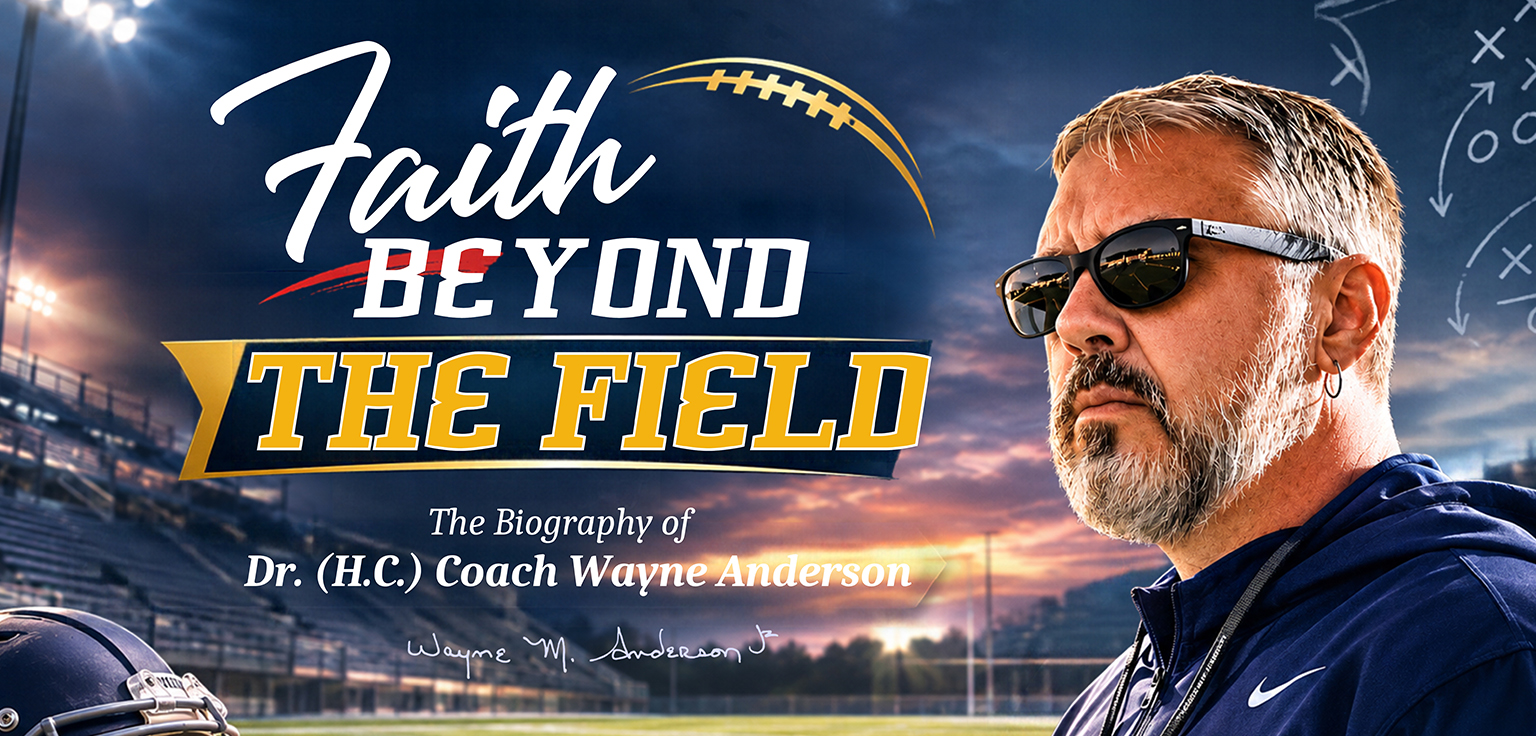
“I’m a very simple but complex man.”
Introduction
The story of Dr. Coach Wayne Anderson begins far from the stadiums, universities, professional organisations, international clubs, clinics, and championship games that would eventually shape his working life. It begins in Candor, New York, a small farming community where he grew up as the elder of two sons born to Wayne and Nancy Anderson. His family background was rooted in dairy farming, discipline, work, and a history that reached back to relatives who had migrated from Sweden generations earlier.
He was not the child people would automatically imagine becoming a coach who would spend decades communicating with athletes. He remembers himself as shy and introverted. Athletics created a temporary opening in that reserve. Football, basketball, and baseball gave him places where he could compete, participate, and step outside himself. What began as sport gradually became a language through which he learned confidence, resilience, responsibility, and eventually leadership.
Education became another important crossing point. He became the first person in his family to attend college, the first to graduate, and the first to play a college sport, competing in basketball while attending Tompkins Cortland Community College. His formal coaching life began while he was still a young man, and over time the sideline became the place where many separate parts of his character began meeting one another: competitiveness, curiosity, discipline, faith, history, communication, and an instinct to teach.
The journey was never simple. There were moments of recognition and moments of rejection. There were positions that opened possibilities and situations that forced him to question his motives. One such experience in 1998 became a dividing line in his understanding of his profession. After being dismissed from a coaching staff, he found himself confronting a question that reached beyond football: was he coaching for himself, or was he coaching for God? His answer changed the direction in which he viewed every opportunity that followed. That spiritual turning point did not remove ambition from his life. It changed what ambition was meant to serve.
The years that followed took him through high school football, collegiate programmes, minor league and professional environments, and international teams. He coached across levels in the United States and took the game into several European countries before later working in Brazil. Football carried him to places that the boy from rural New York had once known only through books. He still remembers standing inside the Roman Colosseum and understanding that coaching had opened experiences he never could have imagined in childhood.
His commitment to learning remained just as important as his movement between teams. Returning to university as an adult required him to confront challenges he had carried for years without fully understanding. Testing identified ADD and a form of dyslexia, helping explain why certain academic tasks demanded far more time and effort from him than they seemed to require from others. Instead of allowing that knowledge to close a door, he and his wife considered how he could work with it. His love of history offered the answer. At Florida Atlantic University, he pursued history while also serving as an undergraduate assistant during the early years of the football programme. He completed his degree, maintained a GPA above 3.0, and became a member of Phi Alpha Theta, the National History Honour Society. Working around Howard Schnellenberger during that period added another important layer to his development.
"Long before he learned how to lead a team, he was learning what it meant to belong to a family, respect discipline, and get back up."
Phase 1: Before the Whistle: Roots In Candor

Before football became a profession, before coaching carried him across oceans, and before anyone addressed him from the sideline as Coach Wayne, Dr. Wayne belonged to a small farming community in upstate New York. He grew up in Candor, the elder of two sons born to Wayne Anderson Sr. and Nancy Anderson. His father’s side of the family came from dairy farming, and those roots carried a history beyond America. He understood that his family had migrated from Sweden in the 1890s, bringing with them a background that, in later years, remained part of the way he understood where he came from.
Family was not something abstract in those early years. It had names, routines, expectations, and people whose influence stayed with him long after childhood. His grandparents, Dana and Marian Anderson, became two of those lasting figures. He has spoken of them as major influences on his life. Their place in his memory is tied not only to affection but to survival itself. When he was around three years old, he nearly choked to death on a piece of steak. The situation became desperate. His grandmother first tried to dislodge it by lifting and shaking him. When that failed, she reached into his mouth and throat and removed the obstruction herself.
The memory later carried spiritual meaning for him. He came to believe that God’s grace had been present in the wisdom and action that allowed his grandmother to save his life. The adult coach could look back on that childhood moment and understand how narrowly everything that came later might never have happened at all. His parents were young. He remembers that they were roughly twenty years younger than many of his friends’ parents, and by the time they were around thirty-five, he had already finished high school. That age difference gave his childhood family dynamic a character that stood out to him even many years later. From his father came one of the values he identifies most clearly: work ethic.
Dr. Wayne saw work not simply as something a person did when motivated, but as something expected. His father also believed in discipline. As a child, that discipline was not always welcome. With adulthood came perspective. He later recognised that the boundaries his father imposed had taught him something about responsibility and consequences. Years afterward, when Dr. Wayne became a father and eventually a grandfather to eight grandchildren, he found himself viewing those early lessons differently. What once felt restrictive now made sense within the responsibilities of raising younger people.
That understanding gradually became part of his approach to coaching as well. Yet the boy who would eventually spend his life directing athletes was not naturally outspoken. Dr. Wayne remembers himself as extremely shy and introverted. He did not begin with the personality commonly associated with commanding a team or addressing a locker room. That part of him developed. Sport provided the opening. Football, basketball, and baseball introduced environments in which shyness could temporarily give way to action. Once competition began, there was a role to perform, a task to complete, teammates to respond to, and an opponent to face. Those hours gave him a way to step beyond the boundaries of his quieter personality. He never forgot what that felt like.
“He did not have to become the loudest person in the room. He only had to keep finding the courage to step on to the floor.”
Phase 2 : When Sport Gave Him A Voice

Athletics had already begun loosening the grip of Dr. Wayne’s natural shyness by the time he entered his high school years. He played football, basketball, and baseball, moving between sports while learning how differently each one demanded attention, discipline, movement, and teamwork. Basketball travelled with him into college. That step carried a significance beyond competition. He became the first member of his family to attend college, the first to graduate from college, and the first to participate in collegiate athletics. For someone whose family history had not previously included a path through higher education, those milestones belonged to more than a transcript. They marked the opening of a door. At Tompkins Cortland Community College in Dryden, New York, he pursued an Associate of Science in Recreation Leadership. His studies covered areas connected to recreation, communication, psychology, sociology, biology, leadership, and physical activity. He completed the programme in 1993 with a GPA of 3.05.
Education and athletics were beginning to move toward the same point. Recreation leadership was not merely an academic title for someone already drawn to sports. It offered a framework for thinking about how activities could be organised, how people could be guided, and how participation could develop skills beyond competition itself. His involvement with younger athletes had actually begun well before his college graduation. During 1980 to 1982, he served as an assistant coach through the Candor Youth Commission, helping in Pop Warner football, Little League Baseball, and Babe Ruth Baseball. In 1984, he worked as an assistant coach at the Candor Basketball Clinic. Those experiences placed him on the teaching side of sport while he was still close enough to his own playing years to remember what it felt like to be the young person receiving instruction. That distinction mattered.
Some people discover coaching only after their playing days have finished. For Dr. Wayne, the movement toward coaching appeared early enough that playing and teaching existed beside one another for a time. College brought additional community experiences. At the Greater Ithaca Activities Center in 1991, he supervised indoor and outdoor recreation activities. In 1992, at George Junior Republic in Freeville, New York, he supervised and refereed intramural basketball games. That same year, he served as a liaison for the Candor Youth Commission Pop Warner Football Program. These were not headline achievements. They were the kind of experiences that usually disappear from the public version of a career once larger appointments arrive. Yet they reveal something important about the way his working identity was forming. He was not only interested in competition. He kept returning to environments where sport, supervision, organisation, instruction, and young people met.
The transition from athlete to coach was therefore less like a sudden turn than a gradual shift in responsibility. As an athlete, he had learned what it meant to receive direction. As an aspiring coach, he began learning what it meant to give it. That is a much harder task than it appears. A coach can know the correct technique and still fail to reach a player. He can understand a system and still struggle to explain it. He can recognise effort without knowing when to encourage it or when to demand more. Dr. Wayne would spend decades refining that balance, but the early years gave him his first exposure to the responsibility. His own reserved personality again became useful rather than limiting. Because he knew what it was like to need time before opening up, he gradually understood that confidence could not always be shouted into another person. Some athletes responded to forceful direction. Others needed patience. Some were ready to speak. Others first needed someone willing to notice them.
The game itself also continued teaching him. Football became particularly important because its structure mirrored the realities he later saw in adult life. A player might perform his assignment perfectly and still watch a teammate make a mistake. A team might prepare well and still lose. Someone stronger might defeat you. Someone underestimated might surprise you. The next play arrives whether or not the previous one ended the way you wanted. That rhythm became part of Dr. Wayne’s thinking. He would eventually use everyday examples when explaining the principle. If a car breaks down, a person has to deal with it. If grief enters a family, sorrow is real, but life still asks what comes next. If people who do not naturally get along share a workplace, they still have obligations to one another and to the organisation that depends on them. Football gave him a way to make those truths visible.
“A coaching career is built one practice at a time, long before anyone thinks to call it a career.”
Phase 3 : The First Sidelines of Becoming Coach Wayne
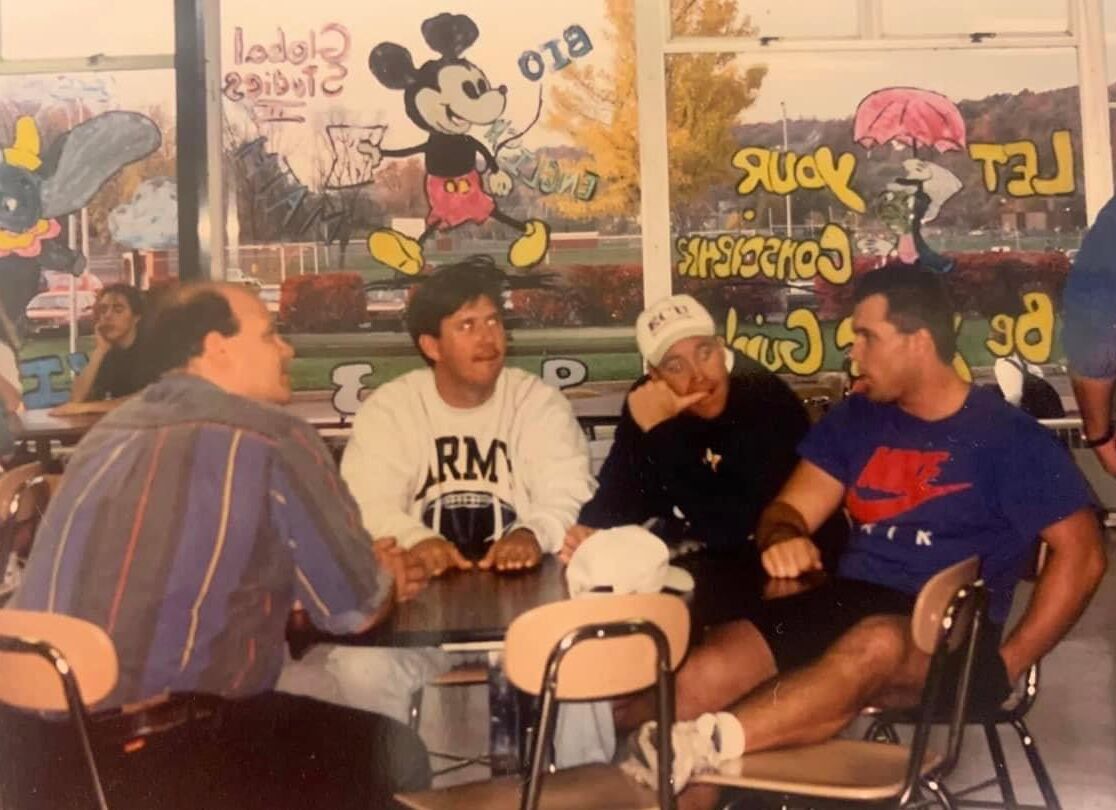
Dr. Wayne’s formal coaching journey began in 1989 at Moravia Central School in New York. There was no way to know then that the first appointment would become the beginning of more than three decades of work across different levels of American football. What existed at that moment was simply an opportunity to coach. At Moravia, his responsibilities included serving as head modified football coach and modified offensive coordinator. The results were encouraging. The passing offence reached the top ranking in New York State, the quarterback ranked first in passing yardage, and two receivers produced more than thirty catches and seven hundred yards. Numbers mattered because they showed execution. What mattered just as much, however, was that Dr. Wayne was beginning to understand the daily life behind those numbers.
Coaching meant preparation before players arrived. It meant seeing errors quickly enough to correct them. It meant teaching the same concept in different ways until it made sense to different minds. It meant accepting that the person with the whistle carried responsibility even when the player was the one making the decision on the field.
In 1990, his path took him to Ithaca High School, where his responsibilities expanded across several roles during the years that followed. He worked with quarterbacks, scouting, modified teams, offensive responsibilities, and different position groups. Ithaca teams earned state rankings, reached the playoffs, competed in Section 4 Bowl games, won STAC Division I titles in 1992 and 1993, and in 1992 were featured on ESPN Scholastic Sports America.
The variety of assignments became one of the defining features of his coaching education. Rather than learning the game through one narrow position, he spent years moving across responsibilities. Offence, scouting, quarterbacks, receivers, running backs, the defensive line, defensive backs, and modified football all appeared in his early professional development. That range forced him to keep studying. It also brought him into contact with mentors. One of the earliest and most lasting was Frank Fazio. Dr. Wayne would carry one particular lesson from Coach Fazio for decades. At the beginning of a season, he learned to tell players that he cared about them equally, but equal care did not mean identical treatment. One player might need firm correction. Another might need reassurance. The responsibility of the coach was to understand the person well enough to know which response would actually help. That idea stayed with him through every level he later coached. It also fitted his own personality. Dr. Wayne was never drawn to leadership built entirely on intimidation. He understood that some athletes respond to confrontation, but others shut down under the same approach. Leadership, to him, had to begin with observation.
After his early period at Ithaca, additional assignments followed, including Onondaga Central School in 1994 and another period at Ithaca from 1994 to 1995. His work included associate offensive coordinator duties, quarterback and receiver coaching, defensive backs, scouting, and other responsibilities. During this period, one Ithaca team earned honourable mention in the state rankings and received the number one fall sports GPA award in 1994. Academic performance alongside athletic competition mattered to him. The field was never the only place a player’s life was being formed. That belief would become stronger as he matured and eventually shaped the way he described his own legacy. A coach could help a player perform better on Saturday and still fail him as a person if nothing carried into the rest of his life. In 1996, Dr. Wayne also worked at Cayuga Community College, beginning his exposure to coaching beyond the high school level.
Meanwhile, he actively sought opportunities to learn outside his own programmes. From the early 1990s onwards, he attended clinics and visited football environments that allowed him to listen to other coaches, observe practice organisation, and study systems. His résumé records football clinics connected with Syracuse University, Lock Haven University, Ithaca, Binghamton, and other programmes. He had even appeared as a featured speaker in a SUNY Cortland football class in 1990 on the subject of the Run n Shoot offence. The Run n Shoot would eventually become deeply associated with his coaching identity.
His growth in that system also led him toward Darryl “Mouse” Davis, the coach he would later describe not only as a mentor but also as a close friend. Coach Mouse developed the offence Dr. Wayne came to run, and his influence eventually became important enough that preserving that coaching legacy became one of Dr. Wayne’s own motivations. Other influential coaches entered his journey over time, including June Jones, Howard Schnellenberger, Hal Mumme, and John Sprague. Dr. Wayne has never spoken as though his coaching knowledge emerged independently. He readily acknowledges the people who taught him, challenged him, and gave him examples from which to build his own approach.
Note of Thanks
Dr. Coach Wayne Anderson carries deep gratitude for the people whose presence helped shape both his life and his coaching journey.
His thanks begin with Darryl “Mouse” Davis, whose friendship, mentorship, and development of the Run and Shoot offence gave Dr. Wayne knowledge he would carry through teams and countries for years. Keeping Coach Mouse’s coaching legacy alive remains personally important to him. He is equally grateful to Frank Fazio, from whom he learned an enduring lesson about coaching people according to what they genuinely need. That lesson became part of the way he approached players throughout his career. His appreciation extends to John Sprague, whose mentorship entered Dr. Wayne’s life during an important period of personal and professional change. He also gives heartfelt thanks to his close friend J. David Miller.
Beyond individual names, Dr. Wayne remains thankful for every player he has coached, every coach beside whom he has worked, and every team that trusted him with a place in its journey. He believes plainly that without those people, he would not be where he is today. Each relationship added something different. Some taught him football. Some challenged his thinking. Some gave him an opportunity. Others gave friendship, loyalty, perspective, or memories that outlasted the season. His gratitude therefore reaches far beyond a list of achievements. The career may carry his name, but its story was built through countless lives that crossed his path. For every lesson, every opportunity, every friendship, and every shared season, Dr. Wayne remains sincerely thankful.
thanks,
– Dr. (H.C.) Coach Wayne Anderson

AIMLAY is a leading global education platform empowering ACADEMIC and EXPERIENTIAL learners, uniquely focused on recognizing knowledge gained through experience and building a diversified community of doctorates and aspiring researchers.