“Excellence is not an act, but a habit.”
Dedication
Dr. Alan Bates dedicated this book to the quiet strength that underpinned every outward achievement in his life. It is for the mentors who pushed him to his limits, the colleagues who trusted him in tough times, and the teams who supported him through uncertainty and change. First, it believes that beneficial leadership is about responsibility, not power.
Titles alone have never been sufficient to define the journey that Dr. Alan Bates has lived and experienced. Discipline that was gained at a young age, resilience that was built through experience, and integrity that was tested in tough settings have all contributed to its formation. The work that is being presented here is a tribute to the numerous moments that are not included on resumes or certificates. These moments include the long hours, the ethical considerations, and the patience required to construct systems correctly rather than quickly.
Additionally, it is devoted to future professionals who will take the place that Dr. Alan Bates once occupied, managing the ever-evolving industries, the ever-changing technological landscape, and the responsibility that comes with being human. Dr. Alan prays that his life’s narrative would serve as a reminder to them that progress is most effective when it is led by principles and that leadership is most sustainable when it continues to be founded in service, responsibility, and purpose.
“We are what we repeatedly do. Excellence, then, is not an act, but a habit.”
Phase 1: Foundations Of Character And Discipline
The narrative of Dr. Alan Bates begins not with accomplishments but with the milieu in which he was raised. His character was formed inside the calm rhythms of family life, schooling, and early responsibilities. This transformation occurred a long time before he received professional acclaim, academic milestones, or public impact. The first phase serves as the foundation upon which everything else is built. This setting facilitated the inculcation of ideals, the acquisition of discipline, and the gradual development of a mindset of endurance.
Dr. Alan Bates was born on June 8, 1966, in Islington, England, and he spent his childhood in an environment that was reflective of the reality of professional life on a daily basis. The environment was one where work was valued, consistency was expected, and advancement was earned. During his formative years, his home environment instilled in him the concept that stability develops via responsibility rather than entitlement. Although the names of family members are not listed in this biography, it is clear that they had a significant impact on the principles that he upheld throughout his life. These values include respect for work, accountability in action, and tenacity in the face of adversity.
Over the course of his childhood, Dr. Alan Bates had a personality that was both perceptive and reflective. He did not act irresponsibly, nor was he motivated by attention. Instead, he exhibited patience and a willingness to first comprehend how things functioned before taking any action. It was during his time spent in school that these characteristics became very apparent. His time spent in school was more than just a place where he received instruction; it was also a place where he developed habits. He became more attentive to what was being said, he became more consistent in his efforts, and he became aware that learning was more of a process than a performance.
His experiences in schooling helped him develop a sense of organization and routine. Both his instructors and mentors remarked on his seriousness toward responsibility as well as his capacity to connect with learning in a practical manner.
“Knowledge comes, but wisdom lingers.”
Phase 2 : Formal Education, Professional Discipline, And Intellectual Direction

Through the process of formal schooling and professional certification, Dr. Alan Bates was able to translate early discipline and practical exposure into structured knowledge throughout the second phase of his career. This phase is characterized by intellectual direction, academic grounding, and the conscious alignment of learning with duty in the actual world. It was in this moment that his professional identity shifted from being based on instinct and effort to being based on informed judgment and the ability to use strategy.
Following the completion of his primary and secondary studies in England, Dr. Alan Bates made a conscious decision to continue his study at a higher level. He learned how to think scientifically and analytically. The scholastic phase he went through helped him become more proficient in approaching problems in a methodical manner, evaluating data, and comprehending complicated processes. The scientific discipline that he learned during this time would subsequently impact the way that he viewed safety, systems, and operational decision-making throughout his entire time in the workforce.
Dr. Alan Bates pursued a wide variety of professional certifications in fields that are associated with construction management, health and safety, risk assessment, and governance. Because of these certificates, he demonstrated his dedication to structured practice and compliance with regulatory requirements. Another aspect of his beliefs was that they mirrored his notion that leadership in high-responsibility and high-risk situations must be underpinned by confirmed ability.
In 2008, Dr. Alan Bates completed professional training in Managing Safely in Construction through IOSH, London. This was one of the first formal learning commitments he made at this point in his career. This training helped him better grasp that health and safety is not a procedural duty but rather a responsibility that falls on the shoulders of those in leadership positions.
“The function of leadership is to produce more leaders, not more followers.”
Phase 3 : Leadership, Governance, And The Test Of Responsibility

In Phase Three, Dr. Alan Bates completely assumed senior professional leadership, taking on responsibility not just for projects but also for people, processes, safety, and outcomes. This stage is the period in which he fully stepped into senior professional leadership. This phase tested his technical foundation, academic discipline, and ethical perspective in some of the most rigorous construction and infrastructure environments in England. The years he spent in these surroundings reflect this phase. In this particular instance, leadership ceased to be based on position and instead became visibly accountable.
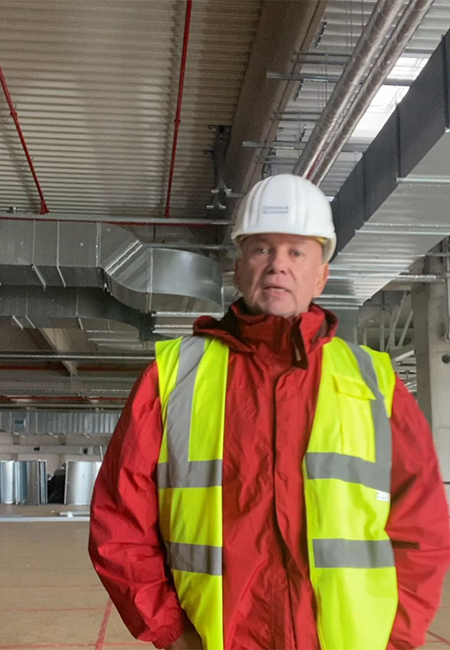
Dr. Alan Bates’s tenure as Senior Building Services Manager at McLaren, London, which lasted from March 2015 to September 2015, is widely regarded as one of the most significant chapters that occurred during this time. He was responsible for two big business projects in London as part of his job. One was on Chancery Lane, and the other was on 1 King William Street. Together, they were worth more than sixteen million pounds. For these projects, complete oversight was necessary across the entirety of the project lifecycle, beginning with the early stages of procurement and design coordination and continuing all the way through commissioning and the final handover.
Dr. Alan Bates was responsible for managing all areas of building services delivery at McLaren. He made certain that the design intent, contractual duties, and construction realities were all in alignment with one another. He was responsible for directing and monitoring the progress of activities involving design development, construction execution, and commissioning. He maintained momentum while safeguarding quality and compliance. He ensured that numerous stakeholders, including designers, contractors, and internal McLaren teams, consistently coordinated their efforts as part of his responsibilities.
Conducting factory acceptance tests, in addition to planning and chairing meetings on progress, sequencing, and programming, was a particularly important task that was assigned to me. In addition to technical expertise, these activities required authority, clarity, and foresight on the part of the participants.
Note of Thanks
Dr. Alan Bates would like to express his heartfelt gratitude to everyone who has, whether deliberately or unknowingly, contributed to the development of his journey. This biography is provided with gratitude. It is impossible for a single person to be solely responsible for the construction of a life that is created over decades of duty, difficulty, learning, and purpose. Whenever it occurs, it is always the result of moments spent together, direction, patience, and belief.
In the United Kingdom, Germany, and the Netherlands, Dr. Alan Bates would like to express his deepest gratitude to the coworkers, teams, and experts with whom he collaborated. Each project, conversation, and shared strain taught lessons that went far beyond providing technical services. Not only did these experiences contribute to his professional development, but they also influenced his comprehension of leadership, accountability, and interactions with other people.
We also owe deep thanks to the individuals who stood by him during periods of personal hardship and transition. Their presence, encouragement, and quiet support often sustain his strength.
We would want to use this opportunity to express our gratitude to everyone who participated in open talks by listening, speaking, or sharing their own personal experiences. Those moments once again demonstrated the power of speech to heal, guide, and develop understanding. Dr. Alan Bates remains grateful for every opportunity to learn from others and make meaningful contributions in return.
This piece of work is a manifestation of the collective impact, common humanity, and unwavering respect that exists among people.
Thanks,
– Dr. Alan Bates