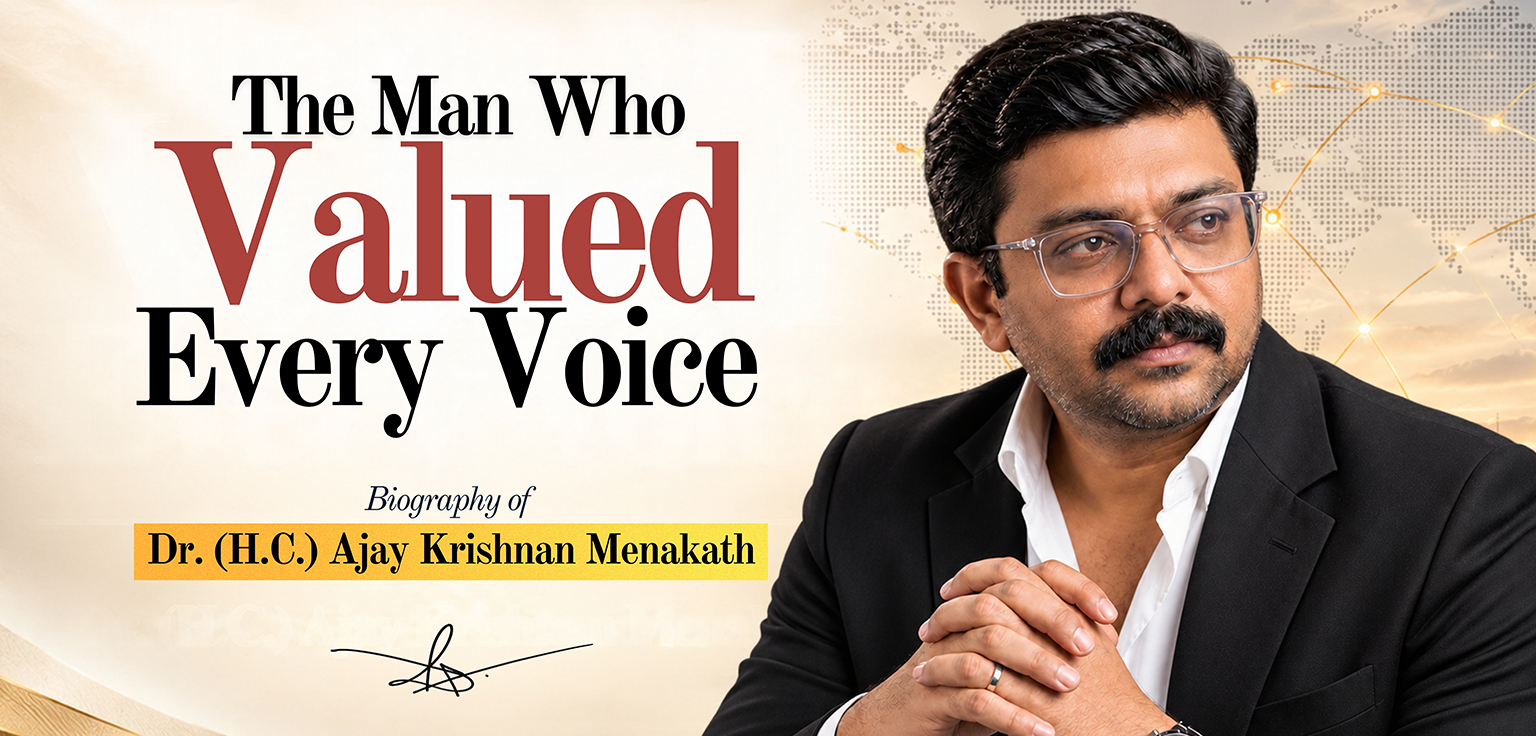
“He believed that a setback was not a stop sign; it was a lesson waiting to be read, rewritten, and risen from.”
Introduction
Some lives unfold according to careful plans. Others are shaped by moments that demand an immediate response. The journey of Dr. Ajay Krishnan Menakath belongs to the second kind. Born on 10 April 1979 and brought up in Ottapalam, Palakkad, Kerala, he spent his early years within a joint family. His childhood carried the liveliness of shared relationships, changing schools, youthful mischief, and exposure to different systems of education. College brought a change that could not have been anticipated. His father, the late Krishna Das, had been working overseas before returning home because of illness. Regular college education was no longer practical.
His earliest employment came through photo printing. The work demanded far more than collecting and delivering photographs. In the evening, he would carry films by train to a printing studio located several hours away. After handing them over, he always slept outside the shop on the floor with newspapers beneath him at night. When the processed photographs were ready the following morning early, he travelled back, delivered them to studios in his hometown, returned home briefly, and continued to college. For this demanding routine, he earned approximately 1,500 rupees a month.
The limited income encouraged him to search for other possibilities. He entered computer sales and servicing, accepted contracting work, explored stock market trading, and became involved in constructing roads, buildings, and houses in his hometown. He was not trained as a civil engineer, yet circumstance repeatedly required him to learn practical skills and act upon them. Several businesses operated, but they did not produce enough profit to match the family’s growing needs and the liabilities created through loans. The experience left him with a disciplined understanding of finance. He learned that earning money was only one part of stability. What was earned also had to be managed, invested, and allowed to grow.
The opportunity took him abroad and placed him in an unfamiliar country where he initially knew no one. His accommodation was in a labour camp, where four people shared a room. The conditions were difficult, yet the companionship of people living through similar experiences helped ease the pressure he carried from home.
The field soon revealed an unexpected connection with his natural abilities. Safety required technical knowledge, but it also demanded leadership. Procedures could be written, yet their effectiveness depended upon whether people understood and followed them. Dr. Ajay found that he could communicate with workers, recognise their concerns, guide behaviour, and connect practical realities with organisational expectations. What began as a decision shaped by necessity gradually became a profession in which his management skills could mature.
His work eventually extended across refineries, aluminium smelters, iron ore processing plants, power plants, and ferroalloy manufacturing facilities. He handled assignments in India, the Middle East, and Malaysia, working among multicultural teams and within demanding industrial environments. His responsibilities included risk assessments, audits, incident investigations, emergency preparedness, contractor management, occupational health, environmental compliance, and HSE team leadership. Projects under his involvement achieved significant safety milestones, including zero Lost Time Injuries, more than one million safe man hours, and many recognition from clients.
Education continued alongside employment. Since direct study was no longer possible, he chose distance education. He completed a Bachelor of Arts in Public Administration from Shobhit University and a Master of Arts in Public Administration from Periyar University, earning First Class. He also pursued extensive professional qualifications in occupational health, safety, auditing, incident investigation, first aid, firefighting, and management systems.
“A childhood surrounded by many voices teaches a person that every life carries its own feelings, needs, and lessons. ”
Phase 1: Roots in Ottapalam and the World of a Joint Family
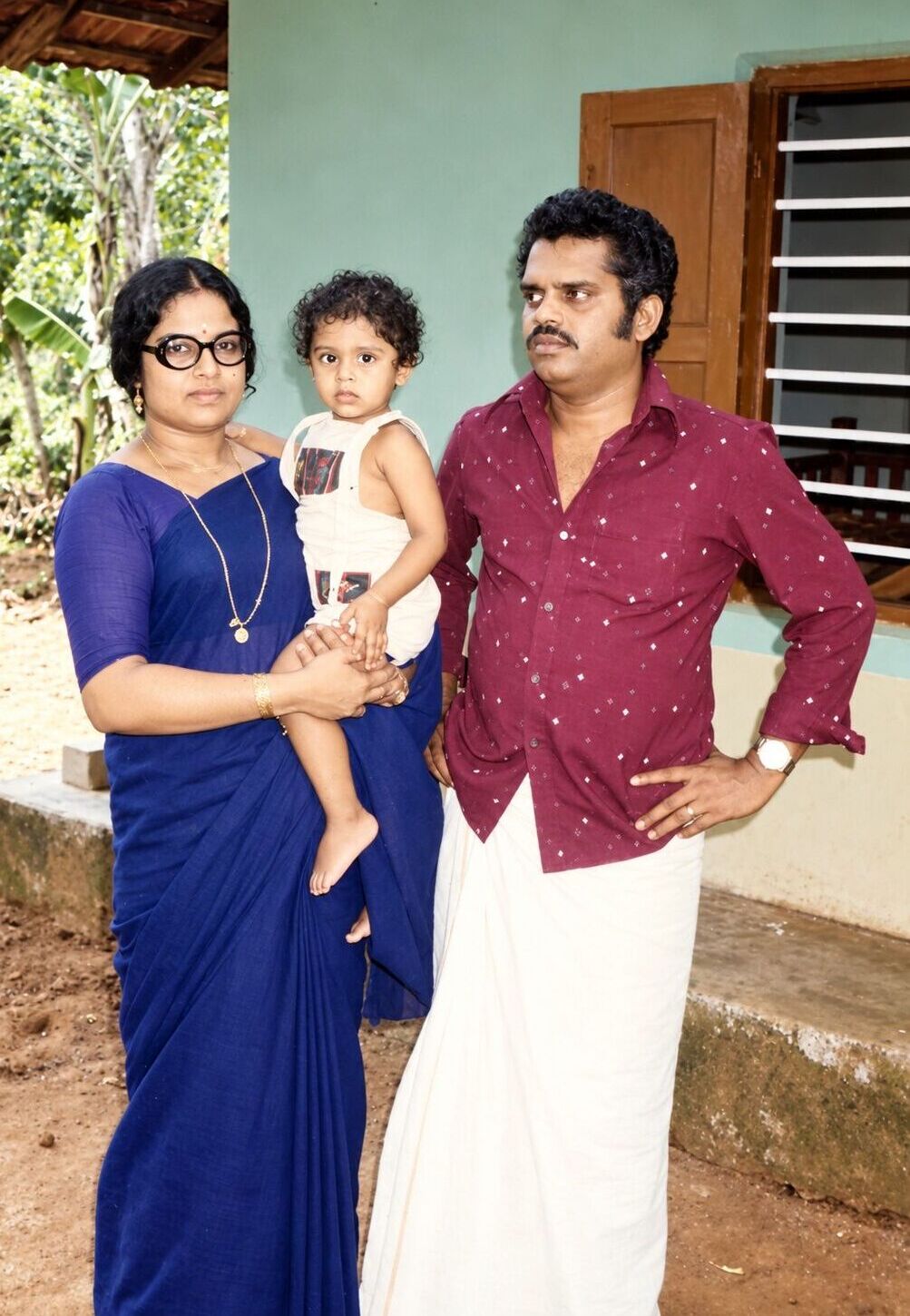
Dr. Ajay Krishnan Menakath’s life began on 10 April 1979. He was brought up in Ottapalam, in the Palakkad district of Kerala, within a family environment that was considerably different from the nuclear households he would observe in later years. His childhood unfolded in a joint family, where everyday life was shared among several people and relationships extended beyond parents and children. The home place in which he grew up was filled with the presence of family members around, different personalities, collective responsibilities, and constant human interaction. Long before he entered a workplace or accepted a management position, he was learning what it meant to live among people whose needs and ways of thinking were not always the same.
His father, the late Krishna Das, and his mother, Mrs. Omana Das, stood at the centre of those formative years. Alongside them were his younger brother, Mr. Anil Krishnan, and his younger sister, Ms. Anjali Krishnan. As the eldest among the three children, Dr. Ajay occupied a position that would later carry significant responsibility. During childhood, however, family life was remembered less through the weight of future obligations and more through the closeness of a shared household.
Within such an environment, a child rarely grows in isolation. Conversations, decisions, disagreements, celebrations, and ordinary domestic moments become part of an education that no school can formally provide. For Dr. Ajay, the family introduced him to people at close range. It allowed him to see how individuals responded differently to the same situation and how relationships required patience as well as adjustment.
He also remembered himself as a very naughty child. His early years contained the mischief and restlessness that often accompany an active mind. When asked to identify one particular childhood incident that remained with him, he did not present a carefully polished example. Instead, he acknowledged that there had been many mischievous moments. This simple admission offers an honest glimpse of his early personality. He was not a child whose development could be reduced to perfect behaviour or uninterrupted discipline. He was energetic, curious, and still learning how to direct those qualities.
There was also a personal reason behind some of those changes. Dr. Ajay later explained that his childhood mischief contributed to his movement between schools. The truth of his school years therefore contained both parental aspiration and youthful restlessness. His parents were concerned about his education, while he was still discovering the boundaries of his own behaviour. Rather than presenting these changes as disruptions, his later life shows how repeatedly entering new environments may have helped him become comfortable with transition. That ability would eventually matter when his work took him beyond Kerala and placed him among people from different regions and cultures.
The final portion of his school education included approximately six years in a missionary school. That period gave greater continuity to an academic path that had previously involved several transitions. By then, he had experienced multiple syllabuses and different institutional settings. The variety was not the result of professional relocation because the family had not been moving from place to place for employment. It emerged from decisions connected with his education and conduct. His parents continued searching for an environment that could guide his learning effectively.
“Responsibility did not wait for him to feel prepared. It arrived through loss and asked him to become dependable before he had finished becoming a student.”
Phase 2 : The Loss That Changed the Course of His Life
There are moments that separate life into a clear before and after. For Dr. Ajay, that moment came during college, when his father, Late. Krishna Das, returned home after working overseas. Illness had brought him back to the family, but his return was followed by a loss that no one had expected. He passed away after suffering a heart attack, leaving behind a household that suddenly had to understand how it would continue without him.
Until then, Dr. Ajay’s life had carried the familiar concerns of a young student. Education remained important, and the future was still something he could approach gradually. His father’s passing changed that rhythm. Grief entered the home, but it did not arrive alone. It brought financial uncertainty, unfinished responsibilities, and the immediate needs of a family that could not pause while he considered what to do next.
As the eldest child, he found himself facing obligations that were larger than his age and different from anything he had previously managed. His younger brother, Mr. Anil Krishnan, and younger sister, Ms. Anjali Krishnan, were still pursuing their education. Their progress mattered to him, and he wanted them to receive the opportunity to complete their studies and establish their own lives. The responsibility before him was therefore not limited to finding a way forward for himself. He had to consider the future of the entire family.
This was the point at which his life moved away from the expected college route. Continuing regular studies required time, attendance, and a degree of stability that was no longer available to him. The family needed income and practical support. He could not remain occupied only with his own education while urgent responsibilities waited at home. The choice was not presented as a comfortable decision between two equally possible paths. Circumstances had already made the conventional path difficult to sustain.
Dr. Ajay did not abandon the value of education. What changed was the manner in which he could pursue it. Direct study had to give way to a life in which learning would continue alongside work, family duties, and financial pressure. At that stage, however, there was no clear view of how each part would eventually fit together. He first had to respond to what was immediately in front of him.
The transition demanded more than physical effort. It required him to revise the way he understood his own position within the family. He was no longer only a son receiving guidance from his parents. He now had to participate directly in decisions that affected the household. The loss of his father placed him in a role where hesitation carried consequences. Expenses continued, education had to be supported, and the family’s future depended upon actions taken in the present.
His mother, Mrs. Omana Das, was also navigating the same loss. The family’s response did not rest upon one person alone. She had studied Accounts and began working in the accounts department of a factory, contributing to the household during that difficult period. Her decision to work reflected the reality the family faced. Everyone who could contribute had to do so. Dr. Ajay and his mother carried the responsibility together until he later reached a point of stable income.
“Some lessons were written in books, while others were learned on railway journeys, outside closed shops, and in the quiet decision to keep going.”
Phase 3 : Nights on the Road and Mornings in College
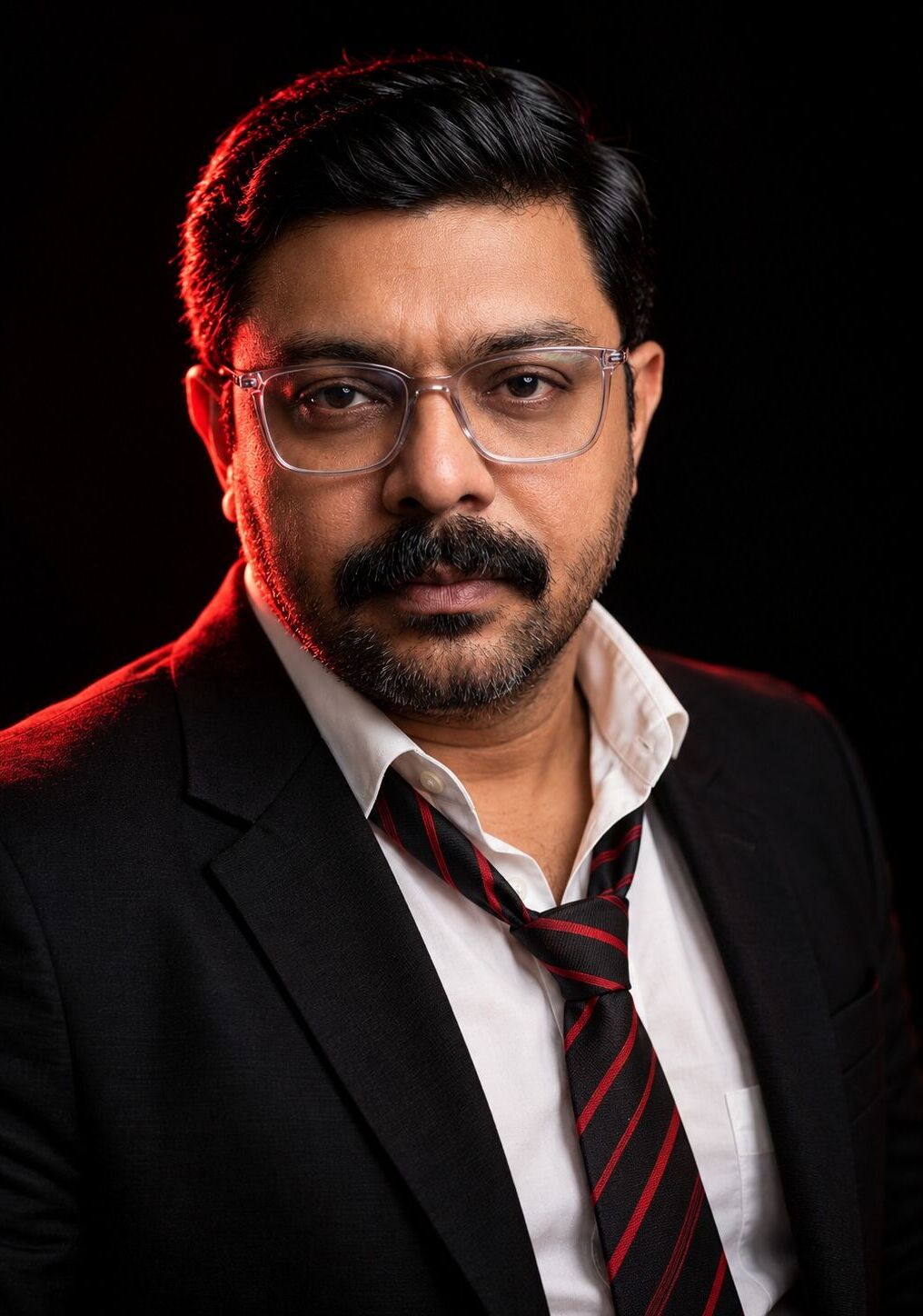
The first job of Dr. Ajay Krishnan Menakath was far removed from the management positions he would hold later in life. There was no office, organised schedule, or professional title. His work involved collecting photographic films, carrying them to a printing studio located nearly one hundred kilometres away, waiting for the photographs to be processed, and returning them to studios in his hometown. It was a modest job, but it answered an immediate need. He required an income while continuing his studies, and his family needed whatever contribution he could provide.
The routine began in the evening. At approximately five o’clock, Dr. Ajay would take the films and board a train. The journey to the printing location required more than three hours. While other students might have used the evening for rest or study, he spent it travelling with material entrusted to him by local studios. The films had to reach the printing studio safely because the work depended upon his reliability. His responsibility was not complete when he handed over the package. He still had to wait until the processing was finished and carry the completed photographs home.
When the printing studio employees arrived, they would wake him and hand over the prepared photographs. He would collect the bag, go quickly to the railway station, and board the return train. The journey back offered another three hours in which he could sleep for a while. That rest was limited, yet it helped him prepare for the remaining part of his day.
Once he returned to his hometown, the work continued. He delivered the photographs to the studios that had entrusted him with the films. Only after completing those deliveries could he go home, bathe, prepare himself, and leave for college. His night had been spent travelling and waiting, but his morning still belonged to education. He did not treat employment as a reason to abandon his studies, nor could he treat college as an excuse to avoid earning. Both demands existed together, and he responded to each one within the same daily cycle.
This routine formed part of his pre-degree college life. The sequence was demanding but clear. Evening meant collecting films and beginning the outward journey. Night meant reaching the studio and sleeping outside the shop. Morning meant receiving the processed photographs, returning by train, completing the deliveries, and preparing for college. Each stage depended upon the previous one being completed properly. If he failed to reach the printing studio, the photographs would not be processed. If he missed the return journey, deliveries would be delayed. If he did not prepare himself quickly after reaching home, his education would be affected.
For this work, Dr. Ajay earned approximately 1,500 rupees per month. The amount was limited in relation to the effort involved, but it represented his first salary and his earliest direct contribution to the family. At that stage, work could not be measured only by comfort or financial reward. It had to be considered in terms of what was available and what it allowed him to provide.
The job introduced him to a form of discipline based upon necessity. He had to respect train timings, protect the material he carried, coordinate with the printing studio, return promptly, and complete his local deliveries. No one needed to explain that other people were depending upon him. The studios waiting for their photographs and the family waiting for his contribution made that responsibility visible.
Note of Thanks
Dr. Ajay Krishnan Menakath expresses his heartfelt gratitude to his mother, Mrs. Omana Das, whose courage and contribution helped the family continue through a difficult period. He remembers his father, Late. Krishna Das, with enduring respect, recognising how his unexpected passing changed the direction of his life and deepened his understanding of responsibility.
His sincerest appreciation belongs to his wife, Mrs. Suvarna, whose emotional strength, practical support, and willingness to share every challenge gave him confidence during uncertain times. He is equally thankful for the happiness brought into his life by their children, Akshay and Aditi, whose presence gives personal meaning to everything he has worked to achieve.
He gratefully acknowledges his aunt, Mrs. Prema Kumari, whom he considers his second mother and Mrs. Rema Devi who helped him during his child hood. He also values the progress of his younger brother, Mr. Anil Krishnan, and younger sister, Ms. Anjali Krishnan, whose settled lives remain deeply meaningful to him.
Dr. Ajay extends special thanks to Mr. Riad Faour, a mentor whose guidance shaped the course of his career. His advice, encouragement and professional trust, and his willingness to recognise Dr. Ajay’s management abilities and entrust him with broader responsibilities, contributed significantly to his advancement.
He remains thankful to the managers who guided him, the colleagues who worked beside him, and the employees who trusted him with their professional and personal concerns. Each relationship added knowledge, perspective, and humility to his journey.
Above all, Dr. Ajay offers gratitude for every lesson carried by success and every setback. Together, they taught him to keep learning, continue trying, value people, and use his progress in service of others.
thanks,
– Dr. (H.C.) Ajay Krishnan Menakath

AIMLAY is a leading global education platform empowering ACADEMIC and EXPERIENTIAL learners, uniquely focused on recognizing knowledge gained through experience and building a diversified community of doctorates and aspiring researchers.