"The best portion of a good man’s life - his little, nameless, unremembered acts of kindness and love.”
Dedication
This biography is devoted with deep love and gratitude to the two souls who shaped the rhythm of my life my dearest parents, whose quiet selflessness and boundless compassion taught me what it truly means to live in the service of others.
To my father, Mr. Baksoola Khan whose generosity knew no limits and whose heart opened to every child, every stranger and every soul in need. You taught me that true respect is earned not through position, but through how we treat people when no one is watching. Your life was a testament to kindness, and your legacy lives on in every act of service I offer. You were a father not just to me, but to a family of 11 foster and 6 biological children, each of us raised with the same unwavering love. I carry your values in every decision I make, every hand I reach for, every injustice I seek to mend.
To my mother, Mrs. Hamidan Khan the silent pillar of our vast and vibrant household. In a home of 21 people, you never once complained. You served with grace, with patience, and with a love that stitched all of us together. You were the heart of our family, teaching me that the strongest women are often the quietest fighters. Your strength gave me the courage to stand tall in rooms where my voice once trembled. Your prayers carried me through every storm. You are an inspiration who still finds time to help everyone including relatives, friends and the community whoever is in need no matter how occupied you are.
To my late husband, who walked beside me with dignity and strength, even when life demanded much from us. Though we worked in different places, your unwavering support never faltered. Your belief in my purpose helped me persevere.
And finally, to every young woman who feels unseen, unheard, or underestimated, this story is for you. Let it remind you that your background does not define your destiny. That no title can outweigh character. That every kind act, every hour of service, every refusal to give up has the power to echo far beyond your imagination. May this book stand as a reflection of the life I was gifted and the life I chose to live in return.
“The end of all knowledge should be service to others.”
Phase 1: House Full of Hearts
In a humble home in Guyana, nestled among the warmth of laughter, shared meals, and the sounds of childhood, Dr. Haliema Khan was born. Her home was unlike any other with 21 people, including her parents, two dedicated maids, and seventeen children. Among those children, six were biological and eleven were lovingly embraced into the family as foster sons and daughters. The Khans never spoke of “real” or “not real” children, they simply extended love to every child who needed it. Her parents, both community-minded and deeply compassionate, became symbols of generosity and unity in their neighborhood.
Her father was widely respected. People came to him for advice, comfort, and support. Alongside his wife, he devoted his life to helping others, not for fame or recognition, but from a genuine place of service. The couple lived the values of social responsibility with quiet dignity, earning deep respect from their community. From them, Dr. Haliema Khan absorbed a lifelong commitment to caring for others.
Growing up in such a household taught Dr. Haliema Khan the importance of sharing, empathy, and resilience. Despite financial pressures, her parents ensured that every child received a proper education. They believed knowledge was the most valuable inheritance they could offer. Their dedication was evident in the way they juggled resources to afford school fees, uniforms, and books. They knew the importance of education and worked relentlessly so that their children could dream bigger than the world they were born into.
Dr. Haliema Khan was a diligent student from an early age. She completed her primary and secondary education in Guyana, walking the path of academic perseverance with discipline and determination. School was not merely a place for her to gain knowledge, it was where she began to understand the kind of woman she wanted to become. Watching her parents work for the community planted in her a deep-rooted desire to follow in their footsteps.
“Give your hands to serve, and your hearts to love.”
Phase 2 : Foundations in Public Service
After stepping away from her early dream of teaching, Dr. Haliema Khan found herself at a crossroads. She had walked into classrooms with high hopes but left with a quiet realization that her talents and passion lay elsewhere. With humility and courage, she accepted that teaching, despite its nobility, was not her calling. What followed was a period of trial and transition, what some might call a patchwork of jobs, but for Dr. Haliema Khan, it was a journey of learning, reflection, and strength.
One day, seemingly ordinary yet life-changing, Dr. Haliema Khan came across an opportunity that would redirect her path permanently. She saw an opening at the National Insurance Scheme (NIS), the government’s social security service. The position was not glamorous, but it was rooted in serving the public, especially the vulnerable. The idea of working in a role where she could make a real difference struck a powerful chord. She decided to apply.
Writing her application was an act of both hope and determination. With her varied work experience and passion for helping others, she made a compelling case. Soon, she was invited for an interview. Nerves and excitement mixed as she prepared to face a panel that could change the trajectory of her life. And indeed, it did. She aced the interview with her sincerity, clarity, and depth of character, and was offered the job.
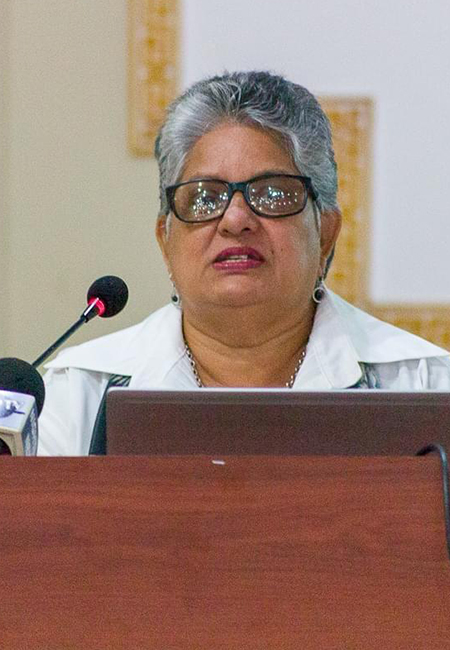
For Dr. Haliema Khan, joining NIS wasn’t just employment, it was an entry into a world where she could live her values. She found herself surrounded by files, forms, and government processes, but behind each paper trail was a human story. She approached each claim with diligence and empathy, aware that behind every request was a person or family depending on her efforts.
One moment in particular became etched in her memory and deepened her commitment. On a chillingly cold day, an Indian woman arrived barefoot, dressed in only a skirt and top, seeking her pension.
“Being of service to others is what brings true happiness.”
Phase 3 : A Hand in Service for the People
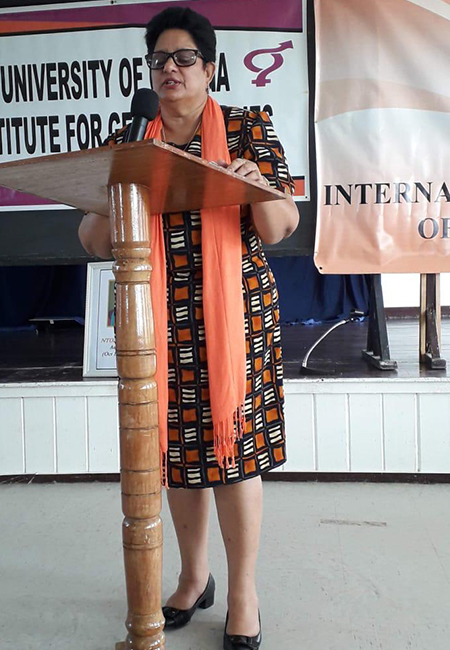
While Dr. Haliema Khan served with distinction in her role at the National Insurance Scheme (NIS), her passion for helping others extended far beyond the walls of her office. Public service, for her, wasn’t a job description, it was a calling that shaped every aspect of her life. Inspired by her parents’ enduring legacy of compassion, she naturally gravitated toward the world of social work, where she could work directly with the communities that needed her most.
From her earliest days, Dr. Haliema Khan had been raised to believe in humanity over religion, kindness over judgment, and action over words. Her parents, though devout, never let religion divide them from their neighbors. Hindu, Muslim, or Christian, it didn’t matter. Everyone was welcomed at their home, and everyone was treated with the same dignity. This principle of inclusivity stayed with her, forming the moral compass of her social work.
One of her earliest forays into organized social efforts was through youth groups. As a teenager and young adult, Dr. Haliema Khan participated in various interfaith and multicultural youth programs. Her brothers were also involved, and together they became strong voices in their community. She was eventually appointed Secretary of one such group, a role that nurtured her leadership skills and gave her firsthand experience in grassroots organizing. From organizing events to settling disputes among young people, she quickly learned that social work wasn’t about titles, but about consistent, genuine effort.
Her journey continued with her involvement in the Leo Club, the youth arm of Lions Club International. Here, Dr. Haliema Khan took her passion for change to a wider platform. Starting as a Secretary, she soon rose to become the Vice President of the club. She focused on pressing issues such as poverty, women’s health, education for girls, and access to resources for underserved communities. Her ability to organize, inspire, and act made her a pillar in the club and a trusted voice among her peers.
But her most enduring contributions were in the field of women’s welfare. Though her own household had been a safe and supportive space, she was deeply disturbed by the widespread domestic violence and economic inequality faced by many women in her community. She worked closely with women facing abuse, abandonment, and marginalization, providing them not only emotional support but helping them access financial assistance, shelter, and counseling services.
Note of Thanks
Writing the biography of Dr. Haliema Khan has been an enlightening and deeply moving experience. To be entrusted with telling the story of a woman whose life is woven with compassion, resilience, and quiet revolution is both a privilege and a responsibility. I am sincerely grateful to Dr. Haliema Khan for allowing me access to her life’s journey, a journey that began in a modest, crowded home and rose steadily into a life of public service, leadership, and social advocacy.
This narrative would not be whole without honoring the extraordinary foundation laid by her parents. Their boundless kindness, inclusivity, and unwavering sense of duty shaped not only the upbringing of their 11 foster and 6 biological children, but also instilled in Dr. Haliema Khan the values that would guide her lifelong mission: empathy, integrity, and service without discrimination. The memory of her father and the quiet strength of her mother remain living influences in every chapter of her life.
My heartfelt appreciation extends to the community of mentors, colleagues, and civil servants who walked beside her through her professional milestones, from her earliest clerkship to her rise as a senior inspector and manager at the National Insurance Scheme. Their support and shared commitment to public good gave strength to her tireless work ethic, her late nights, her lunchtime hours spent resolving unpaid claims, and her fervent dedication to the welfare of others.
A sincere thanks must be given to the many women and families whose stories shaped Dr. Haliema Khan’s resolve. Each encounter with someone in need became not just a case to manage, but a human moment to learn from, to feel deeply, and to act upon. Their lives helped define her purpose beyond the walls of any institution.
Special gratitude goes to the organizations and institutions that recognized and celebrated her decades of dedication—Lions Club International, the Guyana Police Force, Hope Foundation, and many others. These accolades are more than framed certificates; they are reflections of a woman who chose to lead from the heart and serve with grace.
Lastly, to you, the reader, may this biography serve not only as an account of achievements but as a living testament to what it means to serve selflessly. In a world that often values visibility over virtue, Dr. Haliema Khan stands as a quiet, unwavering force for good. May her story remind us that strength lies in humility, leadership grows from empathy, and legacies are built not in grand gestures, but in daily acts of care, courage, and conscience.
Thank You
– Dr. Haliema Khan