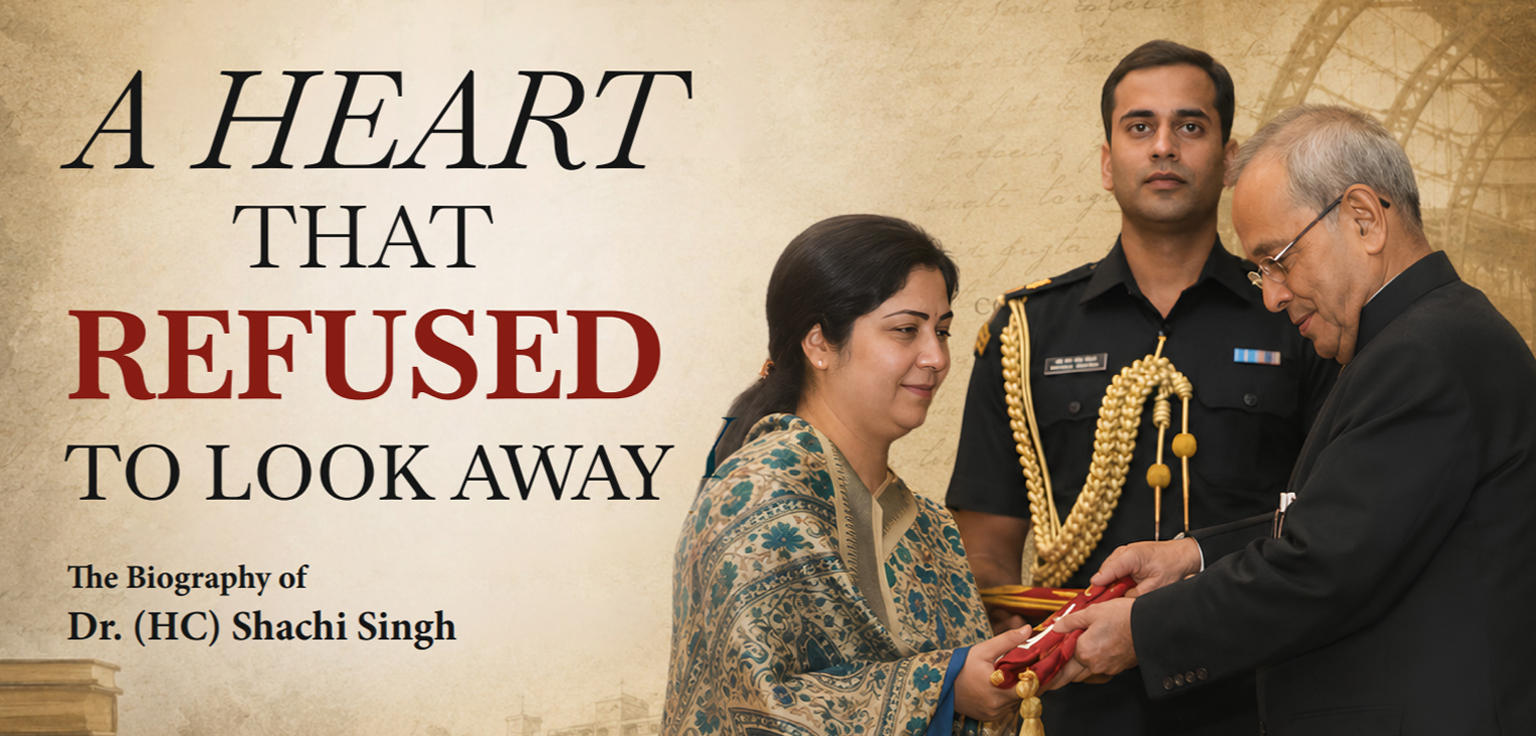
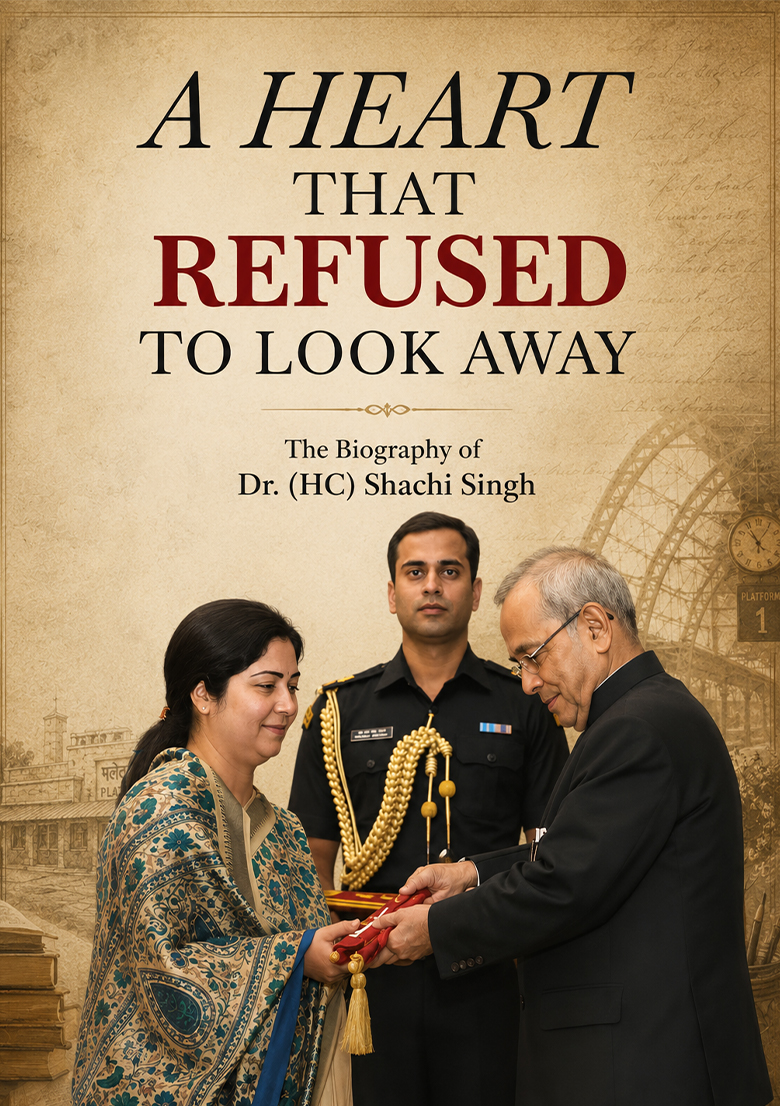
“I chose this path not for recognition but because I could not look away, and once you truly see, you do not step back; you step forward.”
Introduction
Some lives are planned step by step, while others seem to unfold with a quiet sense of knowing. The journey of Dr. Shachi Singh belongs to the latter. It is not marked by a single turning point but by a series of deeply felt decisions that began early and stayed consistent over time. There is a certain stillness in the way her path has evolved, as if the direction was always there, waiting to be followed with sincerity.
Born on 6th October, she was raised in a joint family in Lucknow, where life was shared in the most genuine sense. It was a home where people, not possessions, defined richness. Growing up among grandparents, siblings, and extended family members, she absorbed values not through instruction, but through everyday living. Acts of service were not extraordinary events; they were part of the rhythm of life. Visiting orphanages on special occasions, being mindful of one’s words, and learning to see the good in others were simple practices that quietly shaped her thinking.
As a child, she was observant in a way that went beyond her years. Certain moments stayed with her more deeply than others, especially those that revealed the harsher realities of life. She found herself asking questions that did not always have easy answers. Why did some children have to struggle for basic needs? Why did inequality exist in such visible ways? These thoughts did not pass with time; instead, they settled within her, gradually forming a sense of purpose.
This sense of purpose soon found expression in action. At sixteen, she began teaching children from underprivileged backgrounds, inviting them into her home and spending hours with them every day. There was no grand plan behind it, no structured programme, just a genuine desire to do something meaningful. Yet, even in that simple beginning, there was a glimpse of what lay ahead. The connection she built with those children, and the effort she put into supporting them, reflected a commitment that would later define her life’s work.
Her academic choices followed the same direction. She pursued a degree in Home Economics with a specialisation in Child Development from Delhi University, choosing a field that aligned with her natural inclination towards working with children. The experience exposed her to both theory and practice, helping her understand the broader context of social issues. It also strengthened her belief that meaningful work requires both empathy and knowledge.
She then went on to complete her Master’s in Social Work from Lucknow University, a decision guided by her desire to return and contribute to the city that had shaped her. For her, change was not something to be pursued at a distance. It had to begin where one belonged. During this period, she immersed herself in fieldwork, gaining firsthand experience of the realities she had long been thinking about.
“I grew up in a house where people, not possessions, defined richness. And kindness was not taught; it was lived.”
Phase 1: Roots of Compassion and Quiet Awareness
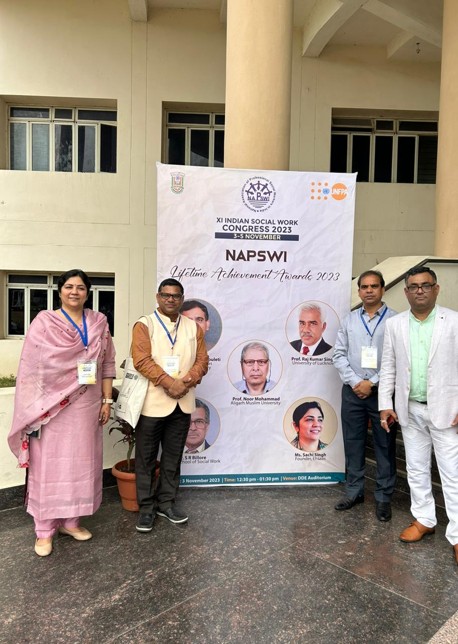
The early years of Dr. Shachi Singh unfolded in a home that was always full, not just in numbers, but in presence. Growing up in Lucknow in a joint family of nearly fifteen people, she was surrounded by constant movement, shared routines, and an unspoken rhythm that came from living closely with others. Life was not divided into personal spaces or separate worlds. It was lived together, in conversations over meals, in everyday interactions, and in the quiet understanding that everyone belonged.
As a child, she may not have fully understood the significance of these experiences, but they stayed with her. Over time, they began to shape how she responded to the world. Kindness, for her, was not something that needed an occasion. It was something that could exist quietly in everyday choices. Even language was approached with care. She grew up hearing that words carried weight, that what one said could affect others more deeply than one realised. This awareness stayed with her, influencing how she expressed herself and how she listened.
There was also a spiritual dimension to her upbringing, though it never felt restrictive. It did not impose rigid definitions of right and wrong. Instead, it encouraged reflection, asking not just what is correct but what one’s responsibility is. This way of thinking allowed her to develop a broader perspective, one that moved beyond judgement. It helped her understand that people’s actions are often shaped by circumstances that are not always visible on the surface.
From an early age, she seemed to notice things that others might pass by. She was observant in a way that was not loud or expressive but deeply internal. Certain images stayed with her, especially those that revealed the inequalities around her. Seeing children without basic comforts, or living in difficult conditions, did not feel distant. It stirred something within her that she could not easily ignore.
One moment, in particular, left a lasting mark. During a visit to a relative’s home, she heard the sound of a child crying. It was not just the crying itself but the desperation in it that stayed with her. The child was being beaten, pleading repeatedly to be allowed to go home. She never saw his face, but she did not need to. The emotion in his voice was enough to leave an imprint that would not fade easily.
Even after she left that place, the incident continued to haunt her. On the way back, she found herself unable to hold back her reaction. She was deeply unsettled, trying to understand why something like this could happen. When she asked about it, the answers she received spoke of rules, of systems meant to prevent such situations. Yet, even at that age, she sensed that something did not add up. There seemed to be a gap between what existed in theory and what people actually experienced. That gap stayed with her, quietly shaping her thoughts. She began to feel that real change could not come from rules alone. It needed people who were willing to step in, to act, and to care.
“The child who could not speak on stage became the woman who would not stop speaking for those who had no voice.”
Phase 2 : Awakening of Purpose and the First Steps into Action

As Dr. Shachi Singh moved through her teenage years, something within her began to settle with quiet certainty. What had earlier been a collection of thoughts, questions, and emotional responses slowly started finding direction. It was not a loud realisation, nor was it something she spoke about often. It was more like an inner knowing that stayed with her, growing stronger with time.
While many around her were still exploring possibilities, she found herself drawn towards a path that felt deeply personal. The idea of becoming a social worker did not come to her as a sudden decision. It had been forming gradually, shaped by what she had seen, felt, and reflected upon over the years. By the time she was in her early teens, she was already clear in her mind about the kind of life she wanted to lead. It was not driven by ambition in the usual sense but by a sense of responsibility she had quietly accepted.
In Class 6, Shachi struggled with a speech difficulty; she could not pronounce certain words clearly, and it often became a reason for others to laugh. The first time she stepped onto a stage with a microphone to read the news, she could not make it past a single paragraph. Her heartbeat echoed loudly within her, so intense that she felt as though the entire auditorium of eight hundred students could hear it too. Overwhelmed, she stepped down and told her house captain that she would have to do this every week—precisely because she felt she could not.
Instead of retreating, she turned inward and chose to work on herself. She went to the library, picked up books on public speaking, and spent hours practising alone in front of a mirror, day after day. What began as fear slowly transformed into confidence through persistence and discipline.
By Class 10, she had earned the trust and respect of her peers and was elected Head Girl. By Class 12, she had become the Captain of her basketball team. Through this journey, she discovered a powerful truth: public speaking is not a gift; it is a skill that can be learned, shaped, and mastered with effort. She completed her Class X at Loreto Convent, Lucknow in 1993 with First Division and later finished her Class XII (PCB) from HAL, Lucknow, in 1995, also in First Division.
“I told the interviewer I had filled only one form. If not this, then nothing. Because some paths are not alternatives — they are the only way.”
Phase 3 : Choosing Purpose Over Convention
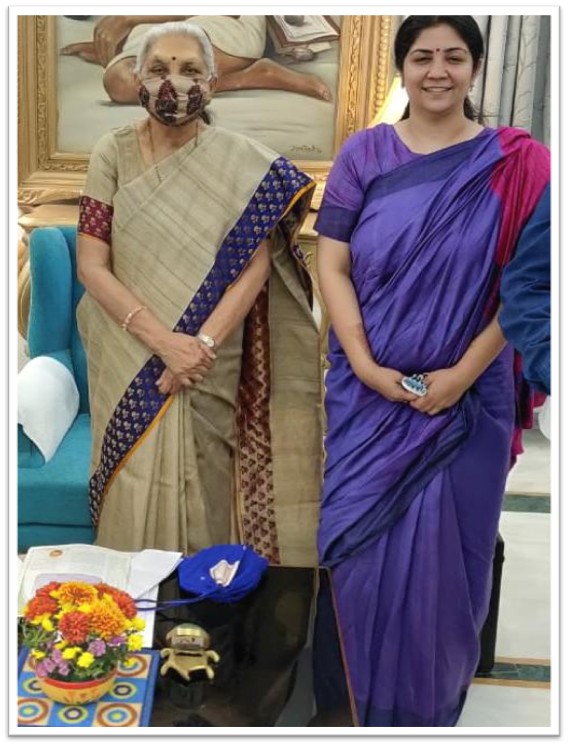
By the time she stepped into higher education, the questions that once lived quietly within her had already found their direction. For Dr. Shachi Singh, this phase was not about discovering what to do next but about aligning her choices with what she had long known within herself. After completing her schooling, she opted for science in her senior years. At that point, the decision was guided by a simple thought that perhaps this stream would open pathways to contribute meaningfully. But as she moved closer to defining her future, that broad idea began to take a more specific shape.
She pursued a degree in Home Economics with a specialisation in Child Development from Delhi University, graduating with a B.Sc. (Hons.) in 1999 in First Division. She then went on to complete her Master’s in Social Work from Lucknow University, earning a First Division in 2000. Her comfort around children, something she had experienced since her early years, now found a direction that felt both natural and meaningful. It did not feel like choosing a subject; it felt like stepping into something she already understood at a deeper level.
Those years were not confined to classrooms. The course opened doors to the field, allowing her to observe organisations working closely with communities. She began to see the lived realities behind the ideas she had grown up with. It was one thing to feel empathy, and quite another to understand the layers beneath it. Through these experiences, she started seeing how issues around children were rarely isolated. They were woven into larger concerns of health, education, family structures, and access.
There was a quiet shift in her thinking during this time. What had earlier been an emotional response to the world around her slowly began to take the form of informed understanding. She was no longer just reacting to situations; she was learning how to read them.
When she completed her graduation, the next step did not come with confusion. She chose to pursue a Master’s in Social Work from Lucknow University, with a clarity that left little room for alternatives. At a stage when most students explored multiple options, her approach remained simple. This was the path she had decided on, and she was willing to stay with that decision.
During her interview for the Master’s in Social Work at Lucknow University, the Head of Department asked her a simple yet defining question: why she wanted to pursue this course. Her response was honest and unwavering: “I have filled only this one form. If you do not grant me admission, I will not be able to pursue my master’s at all.
Note of Thanks
The journey of Dr. Shachi Singh is not one that can be captured through milestones alone. It is held together by moments, by people, and by the quiet influences that often remain unnamed yet deeply felt. This note of thanks stands as a gentle acknowledgement of all those presences that shaped the path, directly and indirectly.
At the heart of it all lies the family that formed the earliest foundation. In a home where people lived togetherness rather than just spoke about it, the values of empathy, respect, and shared responsibility shaped everyday life. Those early influences did not ask for recognition, yet they became the roots from which everything else grew. The elders, through their actions more than their words, left behind impressions that stayed long after the moments had passed.
There is also gratitude for every individual who became a part of her journey along the way. Each interaction, whether brief or lasting, carried its significance. Some offered guidance, others brought challenges, and many simply shared space and time. Together, they contributed to a deeper understanding of people, of life, and of what it truly means to connect.
A quiet acknowledgement is also due to the young minds she engaged with over time. Their openness, their questions, and their willingness to explore added a new dimension to her work. In many ways, these interactions became a two-way exchange, where learning flowed in both directions without the need for definition.
Above all, this note recognises the unseen thread that runs through the entire journey. It is the presence of purpose, not as something rigid or imposed but as something that revealed itself gradually. It guided without force and allowed each step to unfold in its time.
In offering thanks, there is no sense of conclusion. Instead, there is a quiet recognition that every part of the journey continues to live on, shaping what lies ahead.
Thanks,
– Dr. Shachi Singh