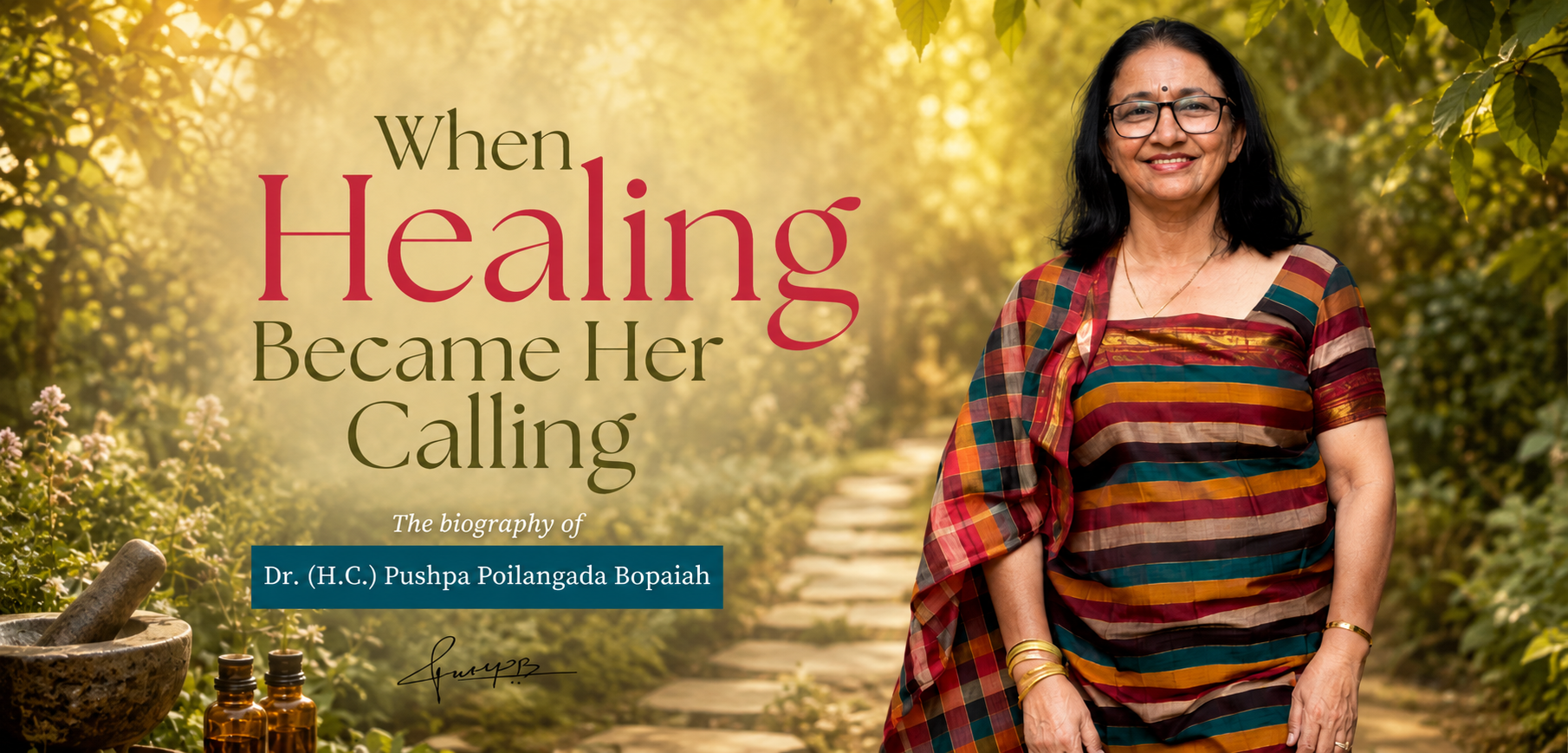
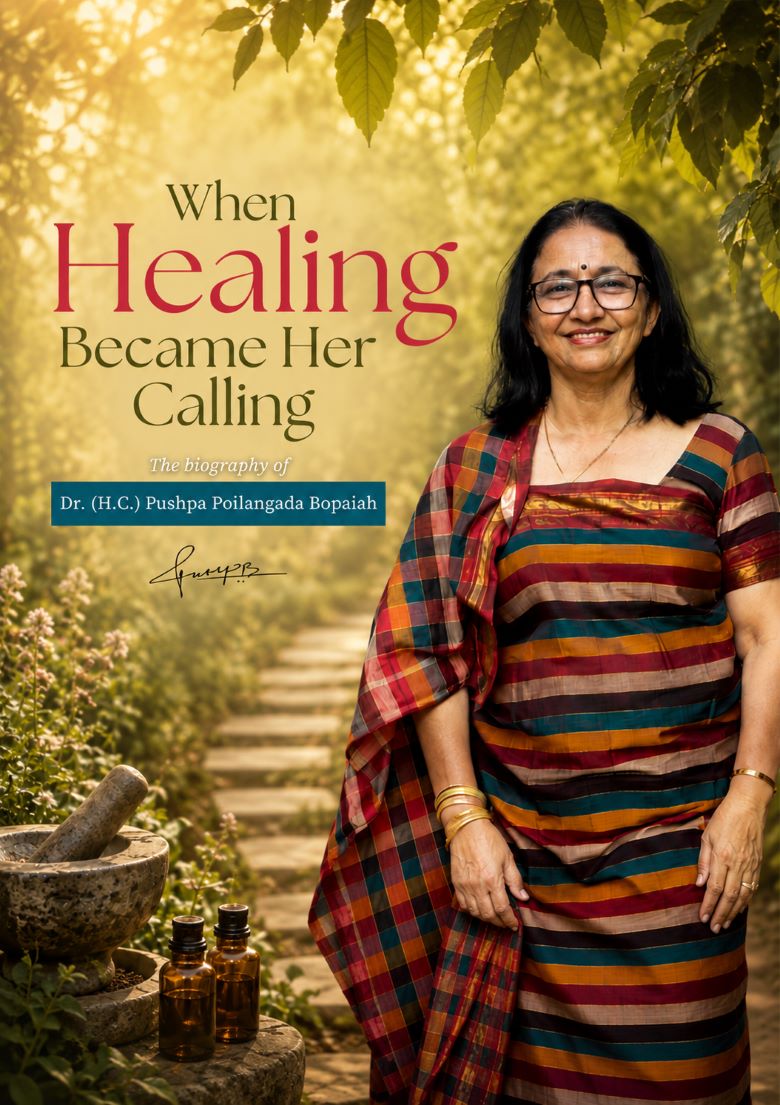
"I was just a girl from Coorg who walked six kilometres to school with dust on my feet and dreams in my heart. The hills raised me, the horses healed me, and the children taught me that every soul deserves to be seen. I do not count my years; I count the smiles I have witnessed, the hope I have helped restore, and the love I have been blessed to give. My journey began with a single step, and it continues with every life I touch."
Introduction
The life of Dr. Pushpa Poilangada Bopaiah is best understood not as a sequence of events, but as a continuous unfolding of purpose, shaped by compassion, resilience, and an unyielding devotion to others. Her journey begins in the quiet, mist-laden landscapes of rural Coorg, where simplicity was not a choice but a way of life, and where every sunrise carried lessons that would later define her worldview and professional mission. It was here, amid the whispering hills and open fields, that the seeds of an extraordinary life were first sown.
Growing up in an agriculture-based family, she was introduced early to the rhythm of hard work and humility. Childhood was marked by long distances walked to school, often nearly six kilometres each day, through terrain that demanded both physical endurance and mental strength. The absence of modern comforts, electricity, and easy transportation did not diminish her curiosity about life. Instead, it sharpened her ability to adapt, observe, and persevere in ways that would serve her for decades to come. These early realities became deeply etched into her character, shaping a foundation built on discipline and inner resilience that no amount of privilege could have ever provided.
Her world was alive with nature and community, where animals, fields, and shared human experiences formed the fabric of everyday existence. These surroundings quietly nurtured her sensitivity toward living beings and cultivated in her a natural sense of empathy. Even before formal education and professional identity took shape, she was already learning the essence of care, coexistence, and responsibility.
As she progressed through her schooling in government institutions, her journey reflected not privilege but persistence. The challenges of limited resources, coupled with the effort required to access education, created a strong internal drive to learn and grow. She moved forward with quiet determination, carrying the values of her upbringing into every stage of her academic life. These experiences gradually shaped her understanding that education was not merely a pathway to opportunity, but a sacred responsibility toward society.
The academic path of Dr. Pushpa eventually led her to St. Joseph’s College, Bengaluru, and later to a Master’s degree in Sociology from Bangalore University. This transition marked a significant expansion of her intellectual and social perspective. Sociology opened her mind to the layered realities of human society, inequality, and community life. It allowed her to view the world beyond personal experience and to understand the deeper structures that influence human behaviour and social systems.
During these formative years, her life was also enriched by meaningful relationships and mentorship. Encounters with individuals such as Dr. Uma, Late Dr. Sridhar, and Sarla Mary Josephine added profound depth to her academic and personal growth. These influences did not simply guide her studies; they shaped her understanding of service, responsibility, and social awareness.
"The hills of Coorg did not just raise me; they shaped me. Every walk, every season, every living being around me whispered lessons that I would spend a lifetime understanding."
Phase 1: Rooted in the Earth, Raised by the Hills
The life of Dr. Pushpa Poilangada Bopaiah begins in the quiet, green embrace of rural Coorg, where agriculture was not merely a profession but the very heartbeat of existence. Born into an agriculture-based family, her earliest memories were woven from the soil, the seasons, and the simple rhythms of a life lived close to nature. Her world was not defined by comfort or convenience, but by authenticity. Every sunrise brought a new lesson, and every season carried its own quiet wisdom. The land did not just sustain her family; it shaped her soul.
She grew up in a setting where modern facilities such as electricity and transport were distant dreams, making life dependent on effort, adaptation, and patience. In this environment, she learned early that survival and growth require acceptance of circumstances and the courage to move forward despite limitations. These early surroundings naturally built a sense of endurance within her, even before she fully understood its significance. The lack of conveniences was not a hardship in her eyes; it was simply the way life was, and she embraced it with quiet grace.
Her childhood was also marked by one of the most defining routines of her early life: walking nearly six kilometres every day to attend school. This journey, repeated day after day, rain or shine, became more than a physical necessity. It slowly carved her discipline, fortified her willpower, and taught her the art of consistency. The long walks through rural paths allowed her to observe life closely, quietly building awareness and resilience without formal instruction. With each step, she was not just moving toward a classroom; she was moving toward a future she could not yet see but already believed in with all her heart.
Nature played an equally profound role in shaping her inner world. Surrounded by fields, animals, and open landscapes, she developed a natural connection with living beings that would stay with her forever. This close coexistence with animals and the environment nurtured a sense of compassion and sensitivity that no textbook could ever teach. The birds, the cattle, the rustling leaves, and the changing skies were her companions, and they taught her more about life than any classroom ever could.
Life in Coorg also carried a strong sense of community and shared living. Values such as respect, simplicity, and mutual responsibility were naturally absorbed through observation and participation in daily life. These values became part of her internal framework, guiding her behaviour and shaping her understanding of human relationships. She learned early that dignity is built through conduct, not circumstance, and that the strongest bonds are forged not in grand gestures, but in small, everyday acts of kindness.
Even in the absence of luxury or comfort, curiosity remained alive within her. The simplicity of her surroundings allowed her to observe life more deeply, paying attention to people, nature, and situations with quiet focus. This habit of observation gradually strengthened her understanding of the world, forming an early foundation for empathy and awareness. She learned to listen more than she spoke, to watch more than she acted, and to understand more than she judged.
Discipline, too, was not imposed but naturally cultivated through her environment. The demands of rural living required responsibility at a young age, and she adapted to them with quiet strength. Whether through her education or daily routines, she learned to remain steady, consistent, and self-reliant. These qualities became deeply embedded in her personality over time, shaping her into someone who could weather any storm with patience and resolve.
"Education is not preparation for life; education is life itself."
Phase 2 : Every Step a Lesson: The Discipline of Distance
The schooling years of Dr. Pushpa Poilangada Bopaiah unfolded in a setting where education was earned through effort rather than convenience. After her early upbringing in rural Coorg, she entered government schools where learning continued under limited resources but with steady personal commitment. There was no grand ceremony marking the beginning of her academic journey; there was only the quiet understanding that education was a privilege she could not afford to waste. She knew, even as a young girl, that every lesson was a gift, and she received each one with reverence.
Her journey to school itself became a defining part of this phase. Every day involved a walk of nearly six kilometres, a routine she followed without interruption, rain or shine. This repeated journey gradually became part of her daily rhythm, shaping how she approached time, responsibility, and consistency in small but lasting ways. The path she walked was not just a route to a building; it was a corridor to possibility, and she traveled it with unwavering determination. With every step, she was not just moving forward physically; she was moving toward a future she had already begun to envision.
The school environment offered structured learning, but it also demanded adaptability. With fewer academic resources available, she learned to work with what was accessible and continue her studies with focus. This ability to adjust without losing direction became a natural part of her schooling experience. She discovered that creativity often flourishes in constraint and that resourcefulness is born from necessity.
What stood out during this phase was not just the academic progression but the way everyday conditions influenced her thinking. The combination of long travel and classroom learning created a balance between effort and observation. While walking through rural paths daily, she absorbed her surroundings quietly, storing impressions that would later shape her understanding of people and life.
Unlike a conventional academic experience shaped by comfort or abundance, her schooling was defined by continuity. The repetition of effort, attending school, returning home, and repeating the cycle, gradually shaped how she viewed consistency. She learned that the most profound transformations often happen not in dramatic moments, but in the quiet accumulation of daily efforts.
"My father taught me dignity through silence. My mother taught me love through presence. Together, they gave me roots so deep that no storm could ever uproot me."
Phase 3 : The Unseen Architects of Character
The next chapter in the life of Dr. Pushpa Poilangada Bopaiah is deeply rooted in the influence of her family and the values that shaped her inner world long before her professional identity began to take form. After her early experiences of schooling and rural life, this phase reflects the quiet but powerful role of her parents in building the emotional and moral foundation that guided her throughout life. It was within the walls of her childhood home that the seeds of her extraordinary character were first sown, in the sacred space where love was not spoken but lived.
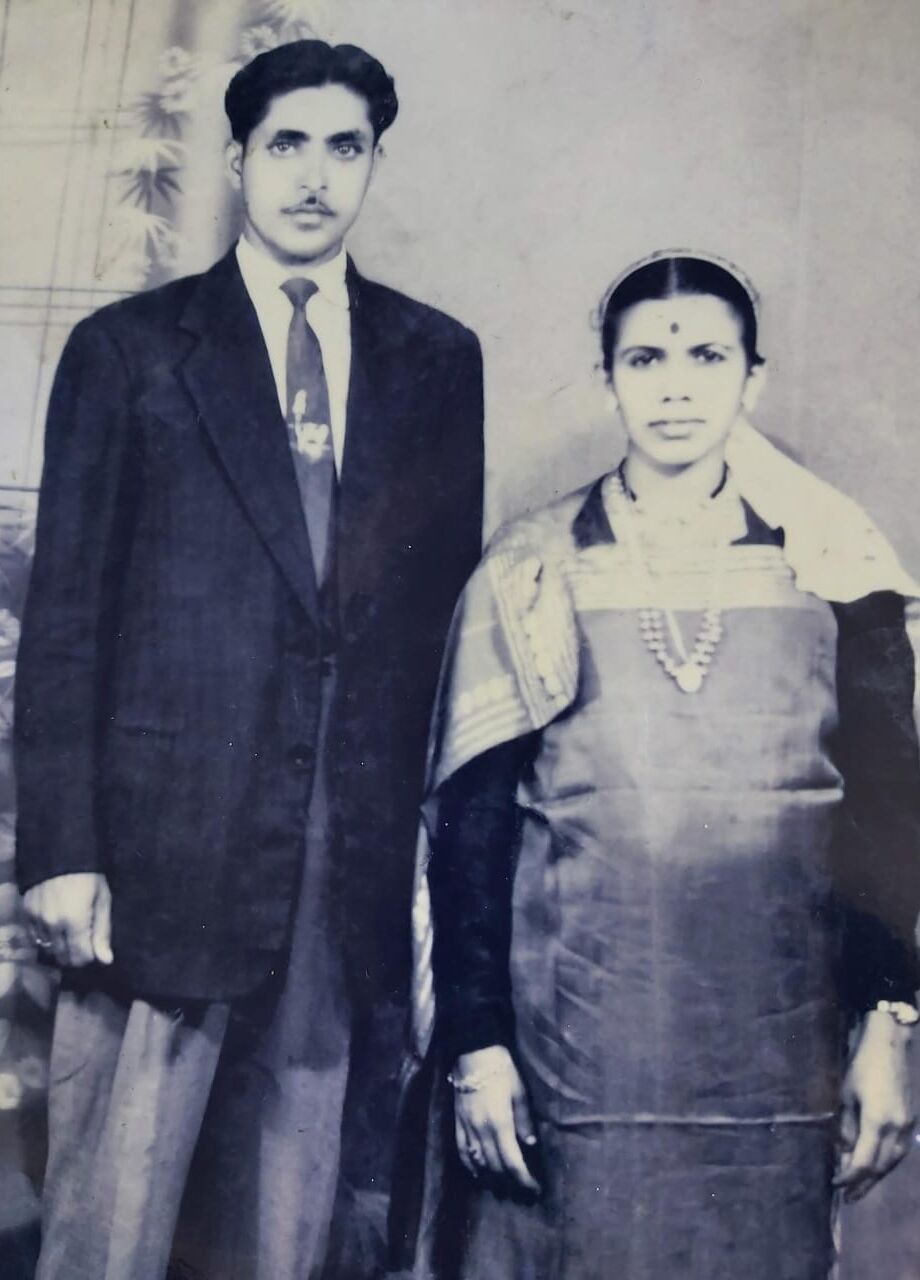
Born to Late Bopaiah P. A. and Mrs. Parvathi B. P., she grew up in a household where values were lived more than spoken. Her father, a farmer by profession, embodied discipline, responsibility, and grounded living. His connection to agriculture and land reflected a life built on hard work and consistency, where effort was understood as a daily necessity rather than an occasional requirement. From him, she absorbed the importance of sincerity in work and the dignity that comes from self-reliance. He taught her, without ever saying a word, that the earth rewards those who tend to it with patience and care.
Her mother brought emotional strength and stability into the family environment. Through her gentle presence, Dr. Pushpa experienced the essence of care, patience, and emotional balance. The household became a space where respect and humility were not taught through instruction but demonstrated through everyday actions. These early impressions slowly became the framework through which she understood human behaviour and relationships. Her mother’s quiet strength was a constant reminder that love is not always loud; sometimes, it is found in the gentlest gestures and the most patient silences.
Within this family environment, she learned that life is not shaped only by external circumstances but also by internal values. The simplicity of their agricultural lifestyle reinforced the idea that fulfilment does not come from abundance, but from contentment and meaningful effort. She observed how responsibilities were carried with quiet dignity, and how challenges were met with acceptance rather than resistance. There was no room for complaint in their home; there was only room for action and grace.
The presence of both parents created a balanced foundation in her upbringing. While her father’s practical approach to life introduced her to discipline and structure, her mother’s nurturing nature developed her emotional understanding and sensitivity. Together, these influences shaped her ability to view life through both strength and compassion, a balance that would later become central to her work and personality.
In this phase, family was not just a support system but an active source of learning. The values she witnessed at home became deeply embedded in her character. Respect for others, humility in behaviour, and a strong sense of responsibility were not separate lessons but part of daily life. These values gradually formed her internal compass, guiding her actions even in unfamiliar situations.
Note of Thanks
This biography stands as a humble reflection of a life shaped by compassion, resilience, and an unwavering commitment to service. It is the result of many voices, experiences, and relationships that have quietly contributed to the journey of Dr. Pushpa Poilangada Bopaiah, each leaving behind an imprint that cannot be measured in words alone.
With deep gratitude, this work acknowledges her beloved parents, Late Mr. Bopaiah P. A. and Mrs. Parvathi B. P., whose values of simplicity, discipline, and integrity formed the earliest foundation of her life. Their silent sacrifices and enduring strength remain the guiding force behind her journey, shaping her understanding of humility, responsibility, and compassion. They gave her roots so deep that no storm could ever uproot her.
Heartfelt appreciation is extended to her mentors and guides, including Dr. Uma, Late Dr. Sridhar, and Sarla Mary Josephine, whose presence during her formative years provided direction, wisdom, and encouragement. Their influence helped shape her academic vision and deepened her commitment to social responsibility and human welfare. They were beacons of light, illuminating paths she had not yet dared to imagine.
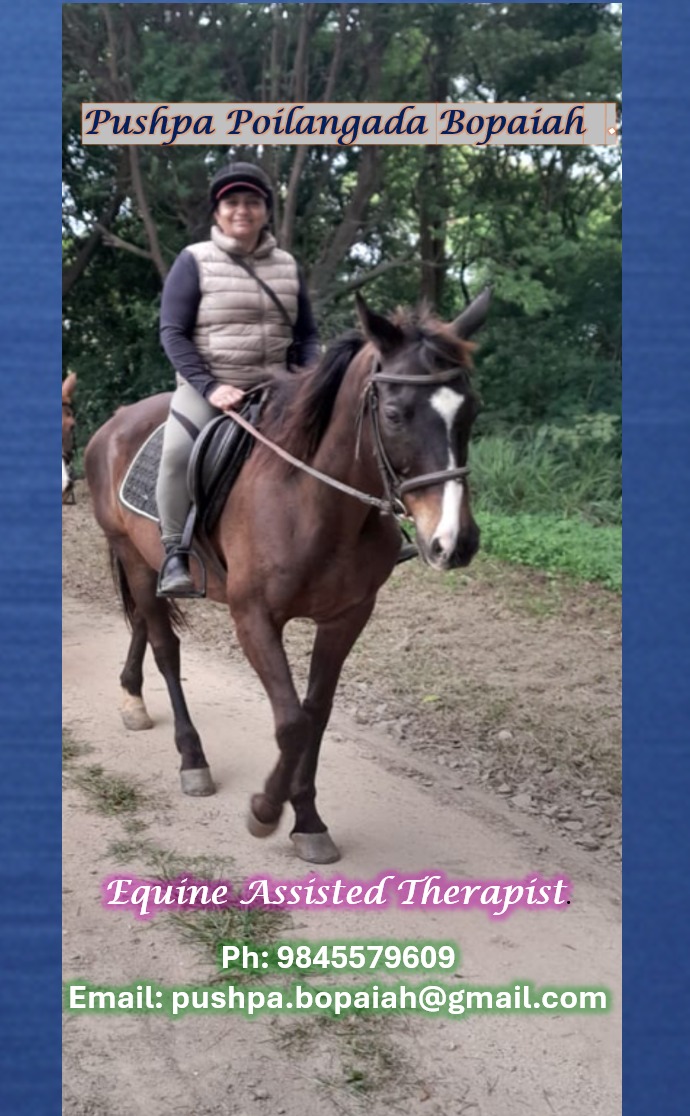
Special thanks are offered to the many professionals, collaborators, and international influences she encountered during her journey, including those connected with her equine-assisted therapy training and global learning experiences. Their knowledge and perspectives enriched her understanding of healing, inclusion, and holistic care. They reminded her that the essence of healing is universal, transcending borders and cultures.
This biography also expresses sincere gratitude to the countless children, families, and individuals who placed their trust in her through Healing Horses and Nino’s Preschool and Daycare. Their belief, openness, and shared journeys of healing have been the true essence of her work and continue to give meaning to her mission. They taught her that healing is not a one-way process but a shared journey of understanding between souls.
Above all, this work acknowledges Dr. Pushpa Poilangada Bopaiah herself, for her courage to follow purpose, her patience in building change, and her lifelong dedication to making lives better through compassion and service. She walked miles not just to reach school, but to reach hearts. She crossed oceans not just to learn, but to return and give.
May this biography serve as a tribute to every soul who has walked alongside her, and to the quiet power of a life devoted to healing others. It is a reminder that the quietest lives often leave the deepest footprints, and that the greatest legacy is not what we leave behind, but what we set in motion, one act of kindness at a time.
thanks,
– Dr. Pushpa Poilangada Bopaiah