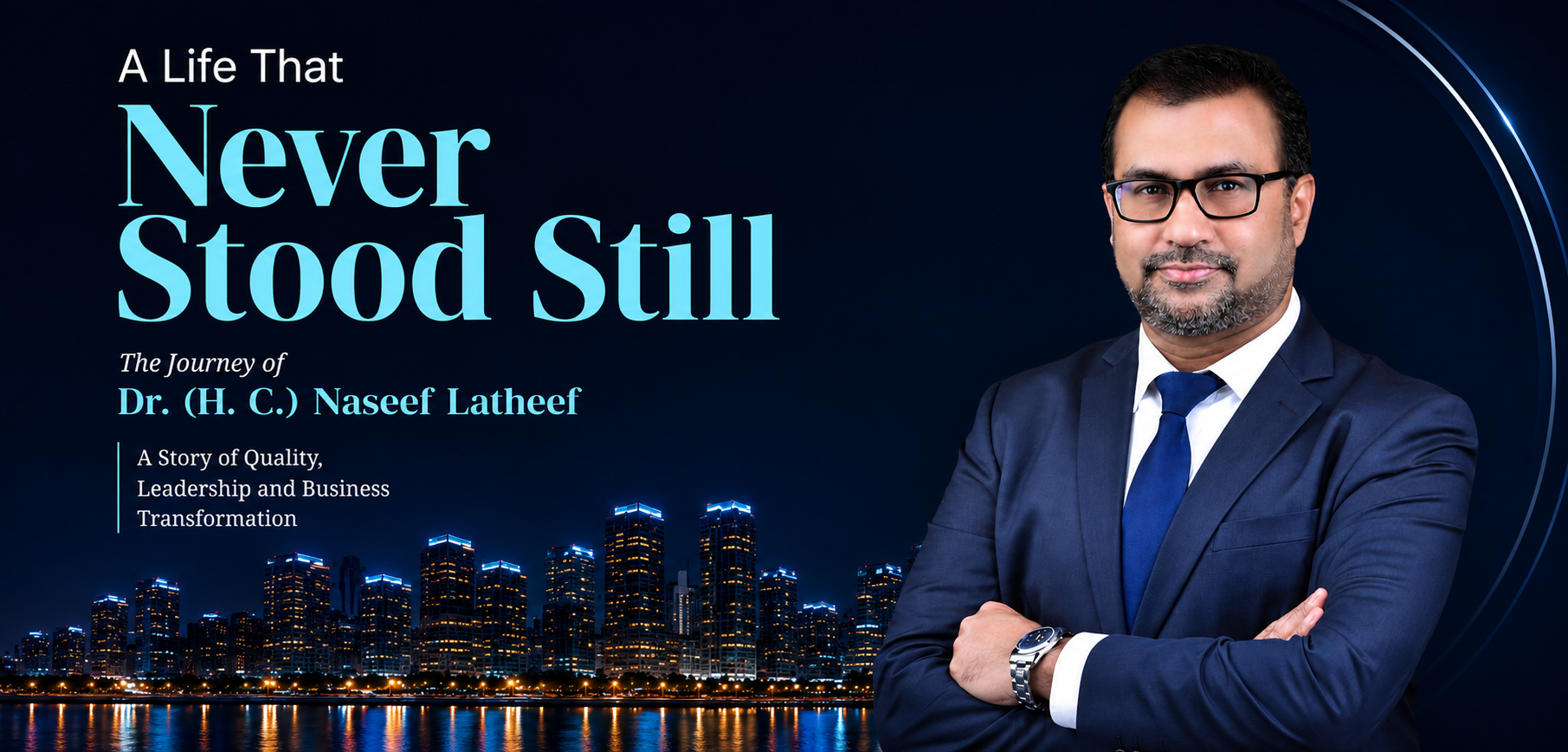
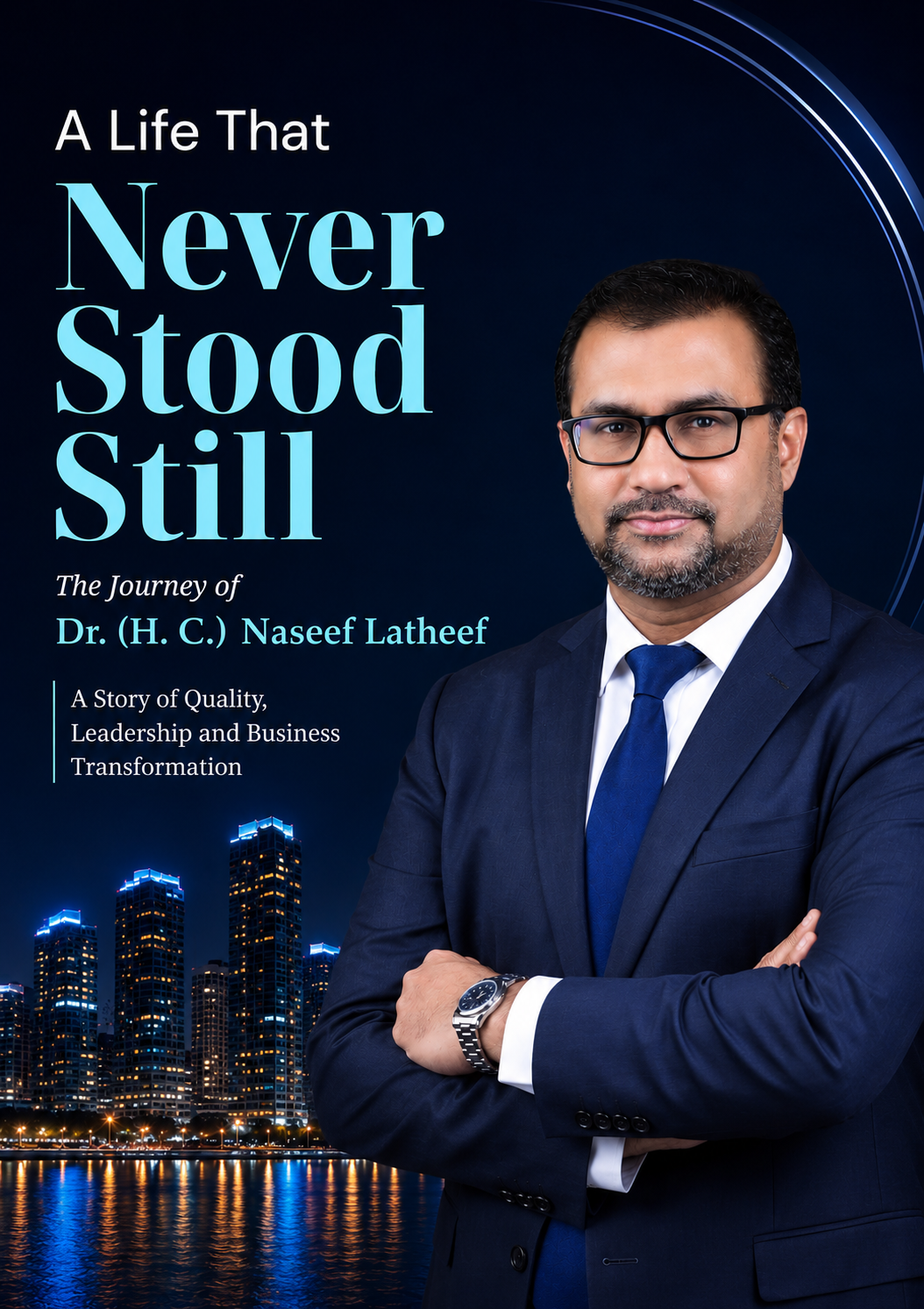
“I do not give less value to anything. Everything has value.”
Introduction
The life of Dr. Naseef has been shaped by movement, but never by aimlessness. His path crossed countries, cultures, industries, and responsibilities, each transition asking him to begin again without discarding what earlier experience had taught him. Such a journey does not fit easily into one professional label. It is better understood as the gradual formation of a mind that learned to look for connections, identify gaps, and improve whatever had been placed under its care.
From an early age, he encountered the relationship between discipline and sacrifice. Work was not presented to him as an abstract virtue. It was visible in the routines of his household, in the responsibilities carried by his parents, and in the quiet organisation required to keep family life steady. Education was treated with equal seriousness. It offered not only the possibility of a career, but also the ability to stand independently, respond intelligently to change, and remain useful in unfamiliar circumstances.
That foundation became important when life moved him beyond the environment he knew. Adaptation was not immediate or effortless. New settings brought different expectations, ways of speaking, social structures, and ideas about belonging. Instead of allowing those contrasts to divide his identity, he gradually absorbed something valuable from each place. The UAE gave him an early awareness of multicultural life and disciplined public service. Kerala widened his exposure to community relationships, student concerns, public action, and the realities of families whose opportunities could be affected by seemingly small decisions.
Technology first appeared to offer the most natural direction for his curiosity. It spoke to a generation witnessing rapid change and promised a profession built around problem-solving. Yet technical knowledge became only one layer of his development. Teaching revealed that knowledge grew stronger when shared. Management showed that ability had to be joined with dependability. Customer support taught patience across cultures and time zones. Quality management then brought these lessons together by giving him a systematic way to examine how organisations function.
In that field, Dr. Naseef found more than an occupation. He discovered a professional language for principles he already valued. Requirements had to be understood before they could be met. Processes had to be clear before people could be held accountable for following them. Problems had to be examined at their source rather than repeatedly corrected at the surface. Improvement had to be sustained, not announced once and forgotten. These ideas influenced the way he approached audits, compliance, governance, digital systems, and organisational change. They also shaped the manner in which he assessed his own decisions.
His career continued to grow because he did not regard expertise as a reason to stop learning. Professional certifications, formal degrees, specialised training, and practical experimentation remained part of the same habit of development. He moved between technical, operational, regulatory, and leadership concerns with an engineer’s attention to structure and a manager’s awareness that even the best-designed system depends upon people. The result was a career that combined detail with scale. He could examine a procedure closely while also considering how it affected departments, stakeholders, and long-term organisational resilience.
"The Child is father of the Man."
Phase 1: Where Discipline First Took Root
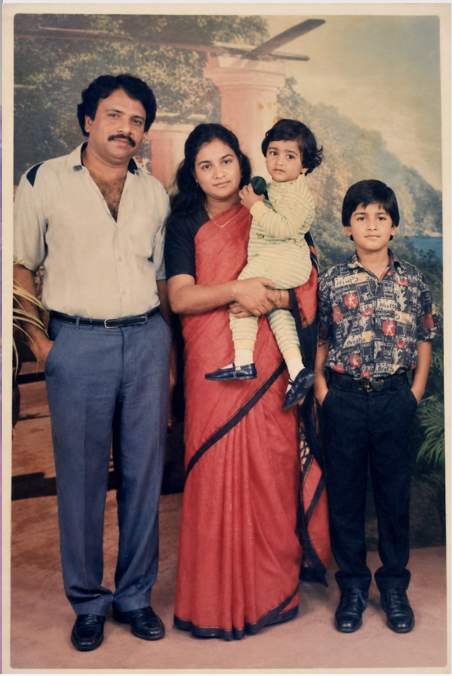
Dr. Naseef was born in Ras Al Khaimah, United Arab Emirates, in 1981. The surroundings of his childhood were urban, multicultural, and closely connected to the working rhythms of a rapidly developing country. Within the family home, however, the most lasting lessons came through ordinary routines. His father served for approximately thirty five years in the electricity and water department of the UAE federal government. His mother was a dedicated homemaker, and his younger sister completed the close family circle in which he grew up.
The household valued integrity, respect, responsibility, and hard work. These were not ideas repeated only when children needed correction. They were demonstrated through the manner in which daily life was managed. His father’s work in an emergency department followed a demanding rotation. Two morning shifts were followed by two afternoon shifts and then two night shifts. After that came a short break before the cycle began again. The arrangement repeatedly disturbed natural sleeping hours, yet it continued for decades because the family’s security depended upon that commitment.
For a young Dr. Naseef, the pattern created both admiration and absence. There were times when his father needed to sleep during the day while the household continued around him, and nights when the family remained at home without him. His mother carried the emotional and practical responsibility of keeping the home secure. Living in another country, with limited closeness to many of the surrounding local families during those years, added to the anxieties she quietly managed.
His father nevertheless understood that work should not consume every opportunity for connection. During the breaks between rotations, he took the family to parks and beaches. Those outings did not remove the difficulty of the schedule, but they restored moments of companionship. Dr. Naseef came to recognise that responsibility was not simply the willingness to work hard. It also involved noticing what sacrifice cost the people around a person and making deliberate space for them whenever possible.
School revealed another side of his character. From Grade One through Grade Seven, he consistently stood among the top students in his class. Academic achievement came despite a recurring health difficulty. The dusty environment aggravated allergies that sometimes became serious enough to require hospital treatment. On certain examination days, he travelled directly from the hospital to school. Illness could interrupt his comfort, but he refused to allow it to determine his performance. Even under those circumstances, he maintained his position as a leading student.
These experiences gave resilience a practical meaning very early in life. He learned that difficulty could exist beside achievement and that preparation remained valuable even when circumstances were unfavourable. The lesson was not that pain should be ignored, but that it did not automatically cancel responsibility. Years later, when professional projects met resistance or personal obligations became demanding, the memory of continuing through those early examinations remained part of his instinctive response.
"We know what we are, but know not what we may be."
Phase 2 : A Childhood Rewritten Across Two Countries
After Grade Seven, Dr. Naseef’s life changed through a decision made for the sake of his future. His father believed that continuing his education in Kerala, India, would provide stronger academic opportunities. The intention was protective, but its emotional consequences were immediate. The family would no longer live together in the same country. His father remained in the UAE for work, while Dr. Naseef moved to India with his mother and younger sister.
The separation arrived at an age when a child still depends upon the different forms of strength offered by both parents. His mother now had to manage the household and the children’s needs without her husband’s daily presence. His father could return only about once a year. In an era before WhatsApp calls, video meetings, and constant digital connection, communication depended upon a landline. Every Friday, the family waited for his call. Those conversations were valuable, but they could not reproduce the ease of having him physically present.
Dr. Naseef missed his father deeply. The distance made him more conscious of what parental presence means, not only in moments of crisis but in the ordinary exchanges that shape a young person’s sense of security. At the same time, he began to see his mother’s strength more clearly. She carried responsibilities that had once been shared and guided both children through an environment that was also different from the life they had known in the UAE.
The move demanded adjustment at almost every level. Kerala was part of his heritage, yet living there was not the same as visiting. The language around him was different in rhythm and everyday expression. Social expectations, school routines, friendships, and the texture of community life all required attention. He entered Grade Eight at a strict Central Board of Secondary Education school in Alappuzha and found himself learning far more than the prescribed subjects.
One detail from that first year remained vivid because it captured his sense of displacement. The school’s uniform required him to wear shorts in Grade Eight. Having arrived from another educational environment, he found the experience embarrassing. The rule was ordinary to everyone already familiar with the system, but to him it became a daily reminder that he was the newcomer expected to adjust. In time, even that discomfort became part of the wider lesson that adaptation often begins with accepting what cannot be changed immediately.
He had left the country of his birth and entered a setting that others assumed should automatically feel like home. His experience was more complicated. The UAE remained emotionally familiar, while Kerala represented ancestry, extended relationships, and a new social world that had to be discovered personally. Missing Ras Al Khaimah did not prevent him from forming new friendships. Feeling different did not stop him from learning how to belong.
Family gatherings gave him a kind of exposure that had been less available in the UAE. He encountered relatives, neighbourhood connections, and friendships rooted in local community life. Doors and windows seemed to open onto a wider social field. People were linked through histories, obligations, celebrations, and disagreements that could not be understood from a distance. The experience showed him dimensions of life that his earlier environment, however secure, had not been able to provide.
"Injustice anywhere is a threat to justice everywhere."
Phase 3 : The Campus That Awakened His Public Voice
Dr. Naseef entered Sanatana Dharma College in Alappuzha for the two year pre degree programme that then served as the equivalent of Grades Eleven and Twelve. The period, approximately from 1998 to 2000, placed younger students directly within a college environment. For him, the shift was dramatic. The structured rhythm of school gave way to a campus where classes could be attended, boycotted, or abandoned, and where education extended into public questions far beyond textbooks.
He had previously been known as a consistently high performing student. College allowed another part of his personality to emerge. He wanted to explore the freedom, arguments, friendships, and social movements surrounding him. A cousin who was already active in campus politics provided a visible example of how students could organise and speak collectively. Dr. Naseef became drawn to the idea that young people could stand for their rights rather than accept every decision without question.
He joined a student political organisation but later chose not to identify it. What mattered to him was not the label, but the learning it created. He participated in an election, gained opportunities to lead, and saw how student concerns moved from private complaints to organised action. Politics at that level was not merely about speeches. It required listening to grievances, deciding which issues deserved collective support, and accepting the consequences of public participation.
One campaign remained especially meaningful. Students were entitled to concessionary fares on private buses when travelling to and from college, yet the arrangement was not being honoured. For families with limited means, the difference between a regular fare and a student fare affected the daily affordability of education. The matter therefore reached beyond convenience. It concerned whether students, including those from poorer households, could travel without an unnecessary financial burden.
The students organised a large protest. Roads were blocked, buses stopped, and normal transport was interrupted. Passengers were inconvenienced, police became involved, and the action had to be sustained more than once. Dr. Naseef understood the tension within such a protest. Public disruption affected people who were not responsible for the problem, yet quiet requests had not produced the required change. The students believed that collective pressure was necessary to secure a right intended for everyone.
Eventually, the concession was granted. Students could show their identity cards and travel at the reduced rate. For Dr. Naseef, the result demonstrated that systems influenced daily life most clearly at the point where rules met implementation. A policy might exist, but its value remained theoretical if those responsible did not apply it. Years later, this same distinction would appear in another form throughout his quality and governance work. A procedure on paper had meaning only when translated into consistent practice.
Campus activism also exposed him to questions of affordability within the college itself. When institutional decisions placed pressure on students who could not easily bear additional costs, organised representation offered them a voice. The student group possessed connections beyond the campus, which made the administration more willing to engage. Dr. Naseef learned that leadership carried influence, but also the obligation to use that influence for concerns larger than personal preference.
Note of Thanks
Dr. Naseef extends his sincere gratitude to every person who became part of his journey. He chooses not to limit this acknowledgement to a short list of names, because support reached him through many individuals, workplaces, classrooms, friendships, and relationships across different stages of life. Some offered formal guidance, while others helped through trust, encouragement, opportunity, or a timely word that strengthened his resolve.
His appreciation embraces the teachers who developed his curiosity, the seniors who recognised ability before experience was complete, and the colleagues who worked beside him through demanding assignments. It includes the employees and audit teams willing to learn new systems, the leaders who entrusted him with responsibility, and the mentors who shared knowledge without treating another person’s growth as a threat.
He remains thankful to those who supported his personal responsibilities with patience and understanding. Family members, friends, professional associates, and community well wishers each contributed in ways that may not always be visible within formal achievements. Their presence made difficult periods more manageable and meaningful moments more complete.
Dr. Naseef also remembers those who helped an unfamiliar idea take its first practical form. Guidance in finance, assistance in care operations, and encouragement from people who understood the social need behind the effort allowed concern to become action.
Above all, his gratitude is directed to God, whose plan he trusts through both fulfilment and loss. Every opportunity to learn, serve, lead, and begin again is accepted with humility. To all who walked beside him, whether briefly or for many years, Dr. Naseef offers enduring thanks and the assurance that their contribution remains part of his life’s foundation.
thanks,
– Dr. (H.C.) Naseef Latheef