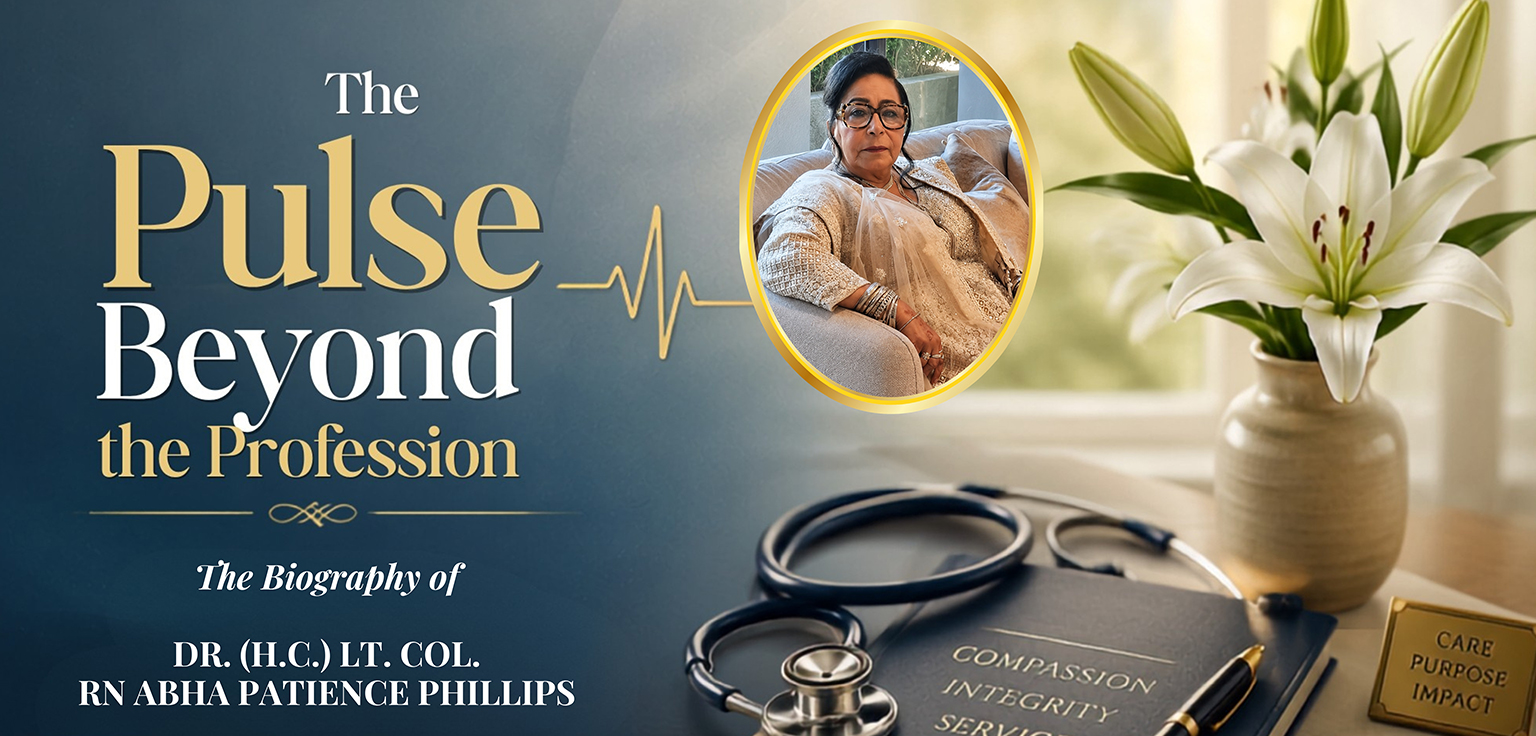
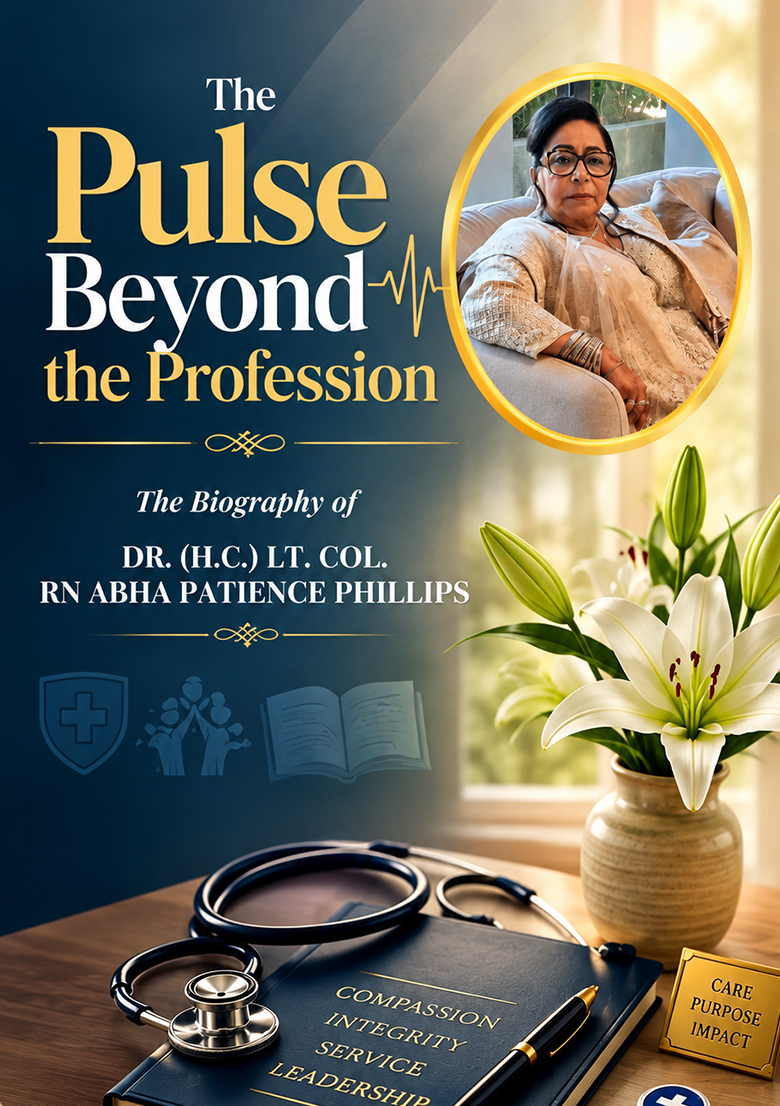
“I have worn many uniforms, but the one that fits best is compassion. I have crossed many borders, but the one that matters most is the one between fear and courage. My journey is not complete, and perhaps it never will be. Because as long as someone suffers, I will keep showing up.”
Dedication
This is for the woman who never stopped showing up. For the one who rolled up her sleeves when the work was hard, who stayed when walking away would have been easier, and who looked at every obstacle and saw not a wall, but a door waiting to be opened.
Dr. Lt. Col. RN Abha Patience Phillips has spent a lifetime in motion. Not the restless kind, but the purposeful kind. The kind that comes from knowing that growth is not a destination; it is a daily choice. She made that choice again and again, through uncertainty, through change, through moments that tested her resolve and moments that rewarded her faith.
This book is dedicated to her quiet courage. The courage to begin again in unfamiliar places. The courage to lead when the path was unclear. The courage to remain tender in a world that often rewards hardness.
It celebrates not just the milestones, but the millions of small, unseen moments that built them. The late nights spent preparing for a class. The gentle words offered to a frightened patient. The stubborn hope she carried when systems failed and she had to find a way through anyway.
But beyond the titles, beyond the certificates, beyond the decades of service, this is a tribute to the woman herself. To her warmth, her fire, her unshakable belief that every person deserves dignity and every life holds meaning. She never forgot that, even when the world tried to make her.
She believed that every experience, no matter how painful or perplexing, carried a gift. She unwrapped them all with patience and grace, tucking each lesson into her heart and letting it shape the person she would become.
May these pages hold her story the way she has held so many others. Not perfectly, but honestly. Not with polish, but with truth. Because she has always known that a life well lived is not about being flawless. It is about being real.
And she has been, above all else, real.
This dedication is for her. For the strength she found, the passion she poured out, and the quiet, stubborn belief that she could make a difference. She did. She still does. She always will.
“Long before she wore a uniform, she wore kindness like a second skin. She learned early that the world does not need more achievers; it needs more witnesses who truly see.”
Phase 1: The Calling Behind the Caregiver: The Inner Foundation Before the Career
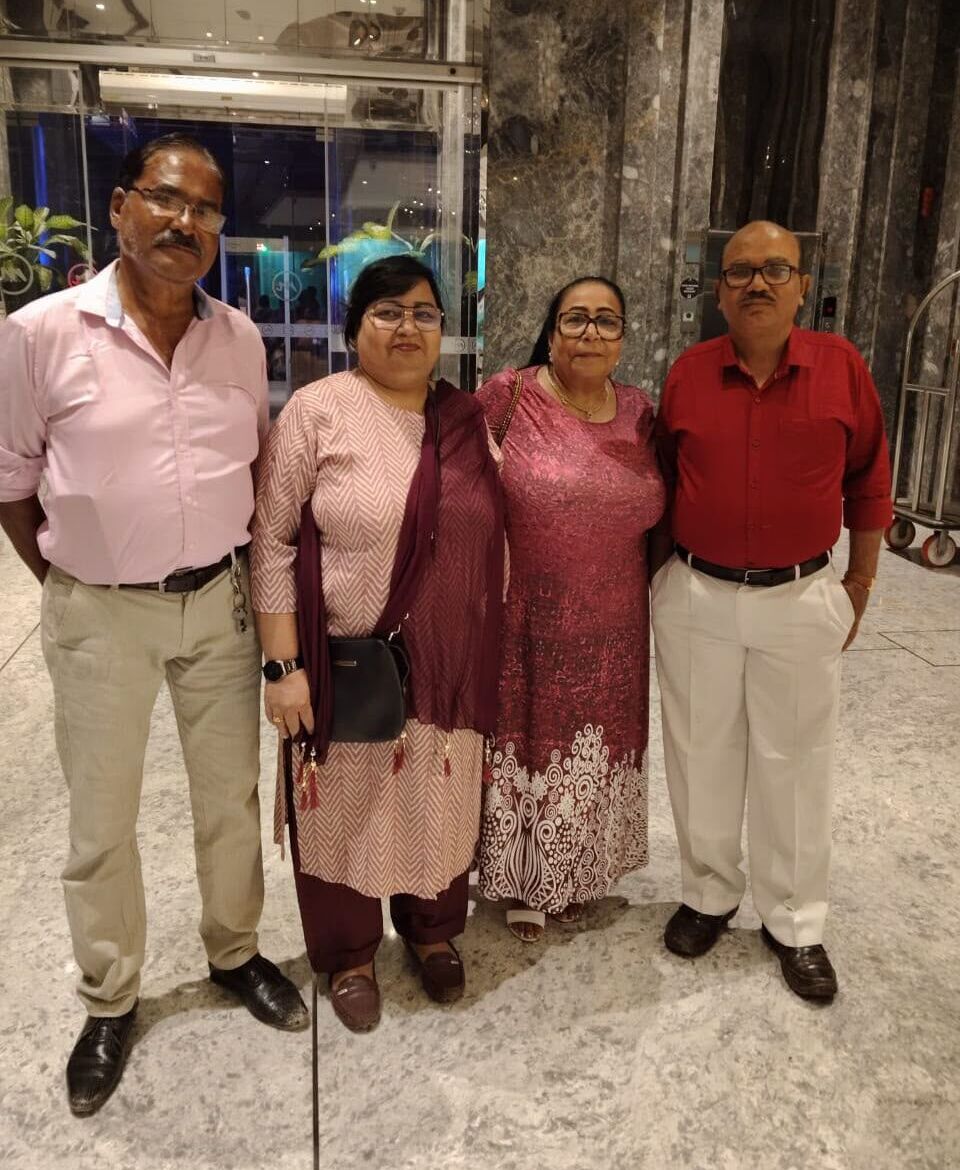
She learned it in the quiet moments. In the way her mother looked at her students, not as faces in a classroom, but as futures waiting to unfold. In the way her father rose before dawn to tend to his business, not for recognition, but because responsibility was simply what you did. In the way her family gathered together, imperfect and loving, teaching her that connection was not a luxury. It was a lifeline.
Dr. Lt. Col. RN Abha Patience Phillips was born in Chunar, Uttar Pradesh, a small town that held big dreams within its dusty streets, and she lived her initial childhood there with her maternal grandparents. She was the eldest of five siblings, of three sisters and two brothers, and that position came with an unspoken weight. She learned to watch over the younger ones, to notice when someone was struggling, and to offer her hand before anyone had to ask. Being the eldest also meant learning responsibility before she was ready for it. There were moments when she had to put aside her own wishes because someone else needed her attention. Looking back, she realised that those early sacrifices quietly prepared her for the years ahead, when many people would depend on her. These were not lessons taught from a textbook. They were lessons lived, day after day, in the ordinary chaos of a house full of children.
Her father, Mr. Robinson Crusoe Phillips, worked in a family transport business that included buses, carrying people from one place to another. He understood movement, progress, the importance of showing up on time, and delivering on your promises. Her mother, Mrs. Iris Priobala Phillips, was a teacher. She understood patience, the slow burn of planting seeds and waiting for them to grow. Between the two of them, Abha absorbed a powerful truth: that hard work and kindness were not opposites. They were companions.
When her grandparents moved to Ghazipur, she started her schooling in Lourdes Convent up to 5th standard, and later she moved to her parents in Varanasi, the ancient city of light and learning, where Abha’s education began in 6th standard at St. Mary’s Convent. Those halls became her second home. She loved the rhythm of school, the smell of chalk dust and old books, and the feeling of a new lesson clicking into place inside her mind. English, in particular, captivated her. She fell in love with the way words could paint pictures, could comfort, could inspire. That love never left her. It would later become a quiet thread woven through her career, helping her connect with patients, write with clarity, and speak with conviction.
But school was not just about grades. It was about discovery. She discovered that she was curious, hungry for understanding, and unafraid to ask the difficult questions. She discovered that she had a steady presence, the kind that made people feel safe. She discovered that learning was not a destination but a journey, and she intended to travel far.
Her education continued at Government Girls Inter College and later at Baring Union Christian College, Batala, Punjab. Each institution shaped her a little more, sanding rough edges and polishing her natural gifts.
She studied hard, not because she was told to, but because she genuinely wanted to know more. The world was wide, and she was determined to understand her place within it.
Remembering her college days, she said that was the first time she was in the home away from home called a hostel; being independent with new friends was challenging yet interesting. Be it those hours in the canteen, bunking classes, participating in inter-college functions or going to present the programme on the radio, all gave her a new learning platform.
“She chose the harder road because the easier one led nowhere meaningful. She understood that comfort is the enemy of purpose, and she refused to be comfortable when others were suffering.”
Phase 2 : A Young Woman Choosing Service Over Comfort
Dr. Lt. Col. RN Abha could have chosen comfort. She could have chosen a path that was simpler, safer, less demanding. But something inside her refused to settle for easy.
By the time she reached the crossroads of her education, she already knew that her life would not be measured by what she accumulated, but by what she gave. Science fascinated her, not because it was abstract, but because it was alive. The human body, with all its mysteries and vulnerabilities, felt like a language she was meant to learn. And nursing felt like the conversation she was meant to have.
She was drawn to the idea that knowledge could be a bridge. That what she studied in textbooks could one day become comfort for a frightened patient. That her steady hands could hold someone’s fear and help it dissolve. That her voice, calm and certain, could cut through confusion and offer clarity. This was not ambition for its own sake. This was purpose calling her forward, and she answered.
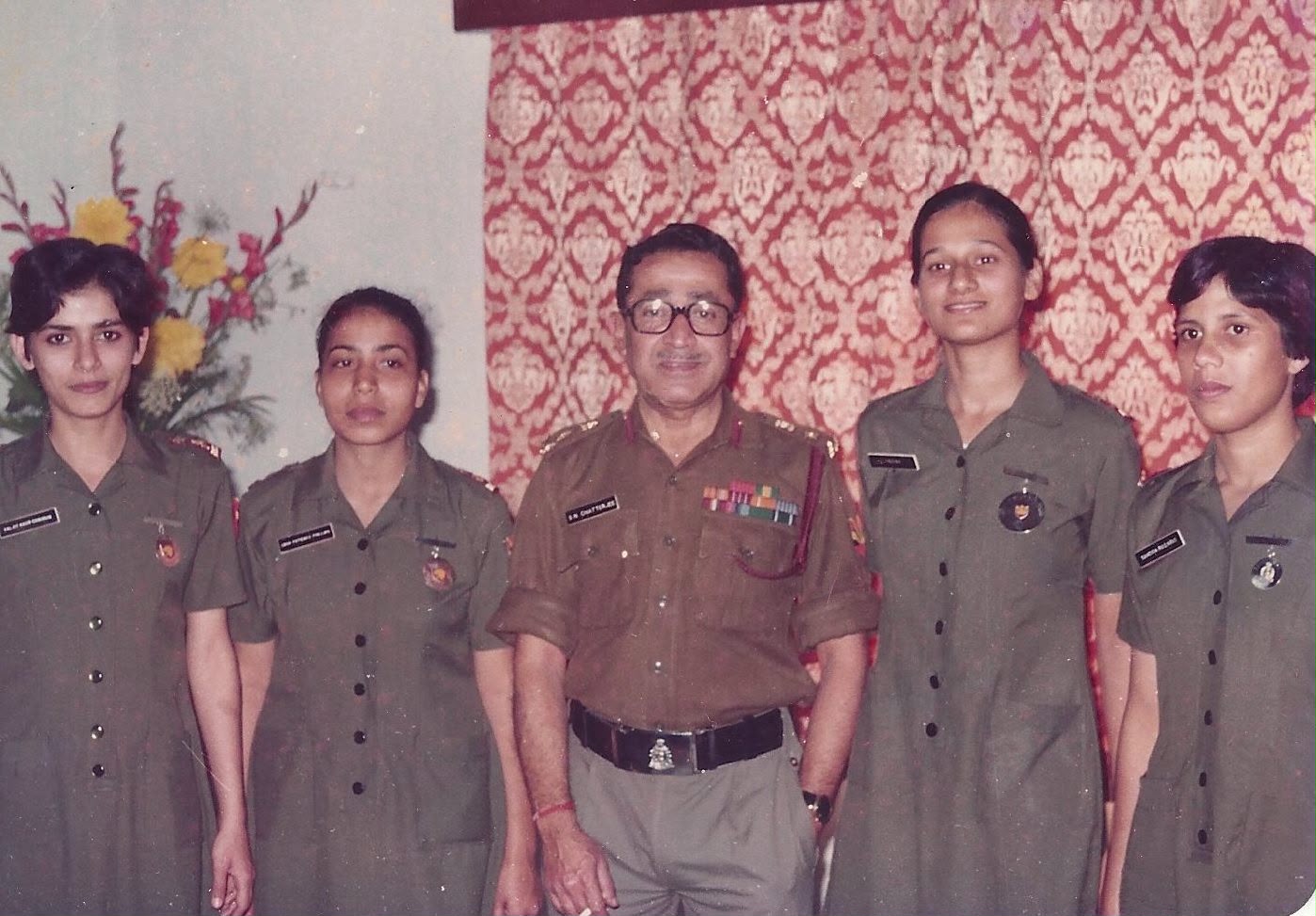
In 1980, she made a decision that would define the rest of her life. She joined the military nursing services as a nursing cadet at Command Hospital, Eastern Command, Calcutta. It was a bold move for a young woman, stepping into a world that demanded everything she had and then asked for more. But she was ready. She had been preparing for this moment her entire life, even when she did not know it.
She cherishes those moments of her training: getting up early for PT, the uniform parade in the morning, where she was often checked for not polishing her shoes properly, long night shifts of one month at a stretch, strict tutors but decent food.
The military did not coddle her. It tested her. It pushed her beyond what she thought she could endure and then showed her that she could endure even more. The days were long, the expectations exacting, and the stakes impossibly high. Every procedure mattered. Every decision carried weight. Every patient who walked through those doors was someone’s mother, father, child, or beloved. She never forgot that.
But the military also gave her something invaluable. It gave her structure, the kind that anchors you when everything else feels uncertain. It taught her that discipline is not about rigidity; it is about freedom. Freedom from chaos. Freedom from doubt. Freedom to act with confidence when others are frozen in fear. She learned to trust her training, to rely on her team, and to lead with quiet authority long before she ever held a formal leadership title.
She also learned that nursing was not a mechanical act. It was a human one. Behind every diagnosis was a story. Behind every wound was a history. Behind every frightened pair of eyes was a person who needed more than medicine; they needed presence. They needed to feel seen. She made it her practice to see them, truly see them, not as cases but as fellow travellers on this uncertain journey called life.
“The military gave her structure; she gave it soul. She learned that true strength is not the absence of fear, but the decision to move forward while fear still whispers in your ear.”
Phase 3 : Forged in Fire: Where Discipline Met Tenderness
The uniform hung in her closet, crisp and immaculate, a symbol of everything she was about to become.
But when she put it on for the first time, she felt the weight of it, not on her shoulders, but in her chest. This was not just clothing. This was a promise. The military years did not shape her gently. They shaped her with fire. They demanded things she did not know she had, pushed her into places she did not know she could survive, and then showed her that survival was not enough. She had to rise. She had to lead. Leadership did not arrive with complete certainty. There were moments when she carried the responsibility of decisions that affected others and wondered whether she was doing enough. But those moments taught her that leadership was not about having no doubts; it was about making the right choice despite them. She had to become someone others could depend on, even when she was terrified, even when she was exhausted, even when the weight of it all threatened to crush her. And she did.
She stepped into a world where precision was not optional and where every action carried consequence. A misplaced dose, a delayed response, or a moment of hesitation could mean the difference between life and death. She learned to move with purpose, to think clearly under pressure, and to trust her training even when her heart was racing. The military did not forgive mistakes easily, but it rewarded consistency, discipline, and the quiet courage to keep going when everything inside you wanted to stop.
But here is what the military could not teach her, because she already knew it. It could not teach her compassion. That was already there, woven into her bones, breathed into her lungs by the family who raised her. The military gave her the structure to channel that compassion effectively. It gave her the tools to turn her natural empathy into action. She learned that kindness without competence was hollow, but competence without kindness was dangerous. She needed both, and she cultivated them with fierce determination.
Her further specialisation training took her through intensive care nursing, pediatric nursing, and midwifery. Each specialty revealed a new facet of human vulnerability. In the intensive care unit, she witnessed the fragility of life, the razor’s edge between survival and loss. In paediatrics, she saw the raw terror of parents who would trade their own lives for their child’s. In midwifery, she held the miracle of new life in her hands, a reminder that even in the midst of suffering, hope persisted.
She cared for soldiers wounded in body and spirit. She held the hands of young mothers terrified of childbirth. She stood beside the elderly who had outlived everyone they loved. And in every single encounter, she offered the same gift: her full presence. She did not rush. She did not look away. She stayed.
Note of Thanks
No journey is ever walked alone. That is a truth she has carried with her through every season of her life. Behind every step forward, there were hands that held her steady. Behind every leap of faith, there were hearts that believed in her, even when she doubted herself. Behind every achievement, there were souls who whispered, “You can do this,” and meant it with their whole being.
As Dr. Lt. Col. RN Abha Patience Phillips looks back on the long, winding road she has traveled, she sees not just her own footprints, but the footprints of so many others who walked beside her, carried her, lifted her, and never let her fall.
Her first and deepest gratitude belongs to God Almighty,Jesus Christ, whose grace has been her anchor through every storm. In moments of uncertainty, when the path was unclear and the weight felt too heavy to bear, her faith and God’s grace became her compass. It reminded her that she was never truly alone, that every challenge was a lesson in disguise, and that every ending was simply the prelude to a new beginning. Her faith gave her the courage to keep going, even when going felt impossible.
She carries her maternal grandmother for all her love and parents in her heart, always. Robinson Crusoe Phillips and Iris Priobala Phillips, the two people who shaped her before she even knew she was being shaped. Her father taught her the value of hard work, the dignity of responsibility, and the quiet strength of showing up every single day. Her mother taught her patience, the kind that does not fray under pressure, and compassion, the kind that sees humanity in every person. They gave her the foundation upon which she built everything else. She hopes they know, wherever they are, how deeply she cherishes every lesson they ever gave her.
Her family has been her shelter. Her children, Prateek and Prateeksha, her daughter-in-law, Anupriya, son-in l aw, Uzair; and both grandkids, Pratyansh and Aayansh, have been her constant companions on this journey. Their love has been her refuge, their belief in her fuel. They celebrated her victories and held her through her struggles. They understood when she had to work late and cheered when she came home exhausted but fulfilled. They gave her a reason to keep striving, not for herself, but for them. She is who she is because of the family that surrounds her.
To the members of her in-laws’ family, her siblings Bholu , Meetu and Rinku, and extended family, she offers her deepest thanks. Though distance and time have sometimes separated them, the bond they share has never weakened. Their love has travelled across continents and through decades, a steady thread connecting her to her roots, her history, and the people who knew her before she became Dr. Lt. Col. RN Abha. Their encouragement has been a gift beyond measure.
She is also profoundly grateful for the mentors, colleagues, and friends who crossed her path at just the right moments. The army colleagues who stood beside her during the demanding years of military nursing. The training batch members who became more than peers – they became family. The healthcare professionals in Australia who welcomed her with open arms and helped her find her footing in a new land. The students who challenged her to be a better teacher. The teams who trusted her leadership and walked with her towards excellence. Every relationship, every collaboration, every shared struggle and triumph, all of it shaped her.
And finally, she thanks the patients, families, learners, and communities who entrusted her with their vulnerability. They allowed her into their most fragile moments. They taught her that care is not a one-way street; it is a mutual exchange of trust, dignity, and humanity. They gave deeper meaning to her purpose. They reminded her, again and again, that success is not measured by titles or awards, but by the difference you make in the life of another person.
Dr. Lt. Col. RN Abha feels that this note of thanks would remain incomplete without expressing her sincere appreciation to the Aimlay Team. Their dedicated efforts in documenting her life and preparing this biography have made the memories of her journey even more meaningful. She deeply values the care with which her experiences have been brought together and preserved. This contribution will always hold a special place in her heart and will be remembered with lasting gratitude.
This biography is a reflection of her journey, but it is also a tribute to everyone who became part of it. Every hand that guided her. Every heart that supported her. Every voice that encouraged her. Every person who helped transform a life of service into a legacy of compassion, excellence, and lifelong learning.
Dr. Lt. Col. RN Abha does not carry this journey alone. She never has. And for that, she is eternally, humbly, and profoundly grateful.
thanks,
– Dr. Lt. Col. RN Abha Patience Phillips