
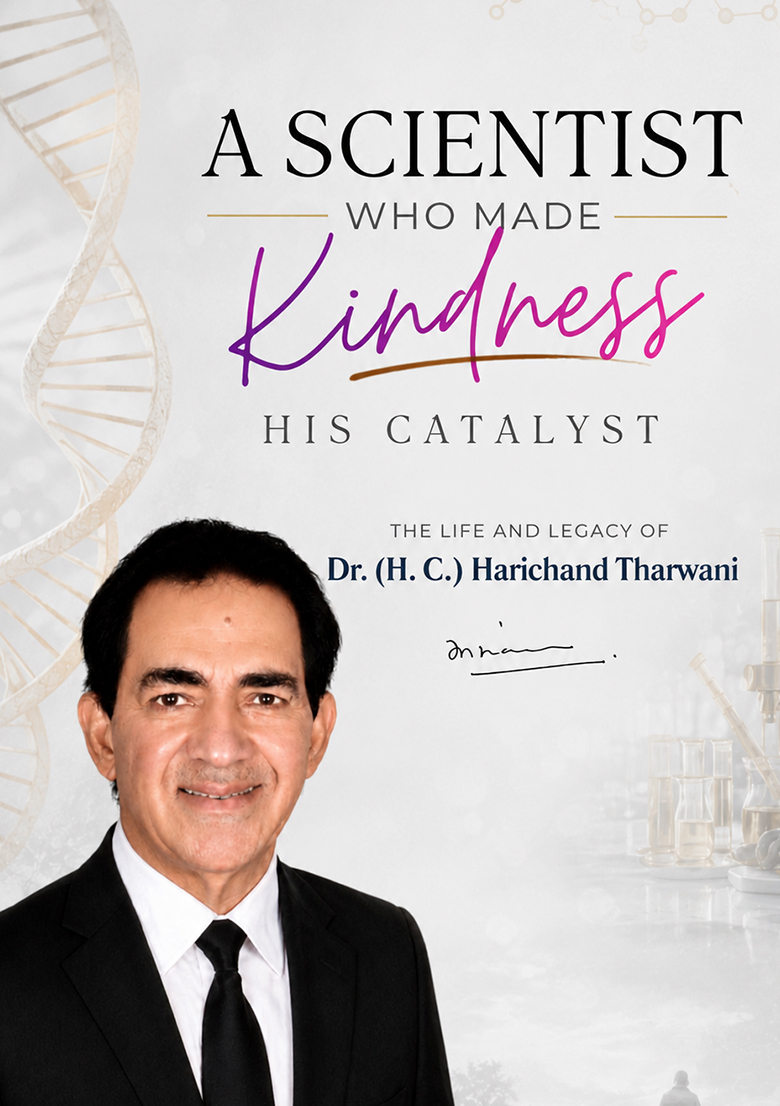
"A meaningful life is not defined only by the milestones we achieve, but by the knowledge we share, the values we uphold, and the lives we inspire along the way."
Introduction
The life of Dr. (H.C.) Harichand Tharwani is a story of perseverance, learning, leadership, and service. Born on 15 July 1955 in Satna, Madhya Pradesh, he grew up in a modest family where honesty, hard work, and compassion were not merely taught but practiced every day. His father, Shri Laxmichand Tharwani, a small businessman, and his mother, Smt. Sushila Devi Tharwani, instilled in him values that would remain the guiding force throughout his life. Equally influential were the spiritual teachings associated with his grandmother’s Guru Swami Atma Prakash ji, which nurtured a lifelong commitment to ethical conduct and humility.
From an early age, he displayed a natural curiosity and a passion for learning. Despite limited resources, he developed the habit of reading extensively and exploring subjects beyond the classroom. This intellectual curiosity gradually evolved into a deep interest in science, particularly chemistry, which would ultimately shape his academic and professional career.
After early schooling in Government Schools and then in Jain School, simplicity was brought into his thoughts and actions. He then completed his Higher Secondary with mediocre marks, which came as an opening incident, and he started taking studies seriously.
After completing his B.Sc. at Government College, Satna, he pursued an M.Sc. in Organic Chemistry from Awadhesh Pratap Singh University, graduating with First Division honours. His academic training provided not only scientific knowledge but also a disciplined approach to observation, analysis, and problem-solving.
His professional journey began in the Customs and Central Excise, Ministry of Finance, where he served in several important assignments across the country and eventually rose to senior leadership positions. His expertise was further strengthened through specialised DEA Forensic Drug Chemistry training in New Delhi and Vienna, Austria, which deepened his understanding of scientific investigation, regulatory compliance, and public responsibility. He then got posted at the Opium and Alkaloid Department of the Government of India as Joint Director and he took a challenging assessment of Plant and Process modernisation of Opium and Alkaloid plant. After completing the process, we were felicitated with Apprehension Certificate by the ministry. By this time Dr. Tharwani had completed 25 years of glorious service and decided to take voluntary retirement and explore something new in life. Mrs Meena Tharwani was very supportive and stood by his side for whatever decision he made.
Following a distinguished government career, Dr. Tharwani entered the world of entrepreneurship. As Promoter Director of Aditya Marine Limited, he built a respected enterprise in the maritime sector with like-minded shipping genius Mr. Harshad Gandhi. Aditya Marine Limited made a name for itself in the next 20 years and became a name to reckon with. Simultaneously, Dr Tharwani took another challenge and contested a coveted election and was elected Chief Executive Officer of Sindhu Resettlement Corporation Ltd., a company known for contributing significantly to township development and refugee rehabilitation initiatives in Gandhidham and Adipur.
“Character is built long before success arrives. The values we learn as children become the compass that guides us through life.”
Phase 1: Roots in Satna : Family, Values and Early Influences

Dr. Harichand Tharwani was born on 15 July 1955 in Satna, Madhya Pradesh, at a time when opportunities were limited but values were abundant. His childhood unfolded in a modest household where honesty, discipline, compassion, and hard work were not abstract ideals but daily practices.
His father, Shri Laxmichand Tharwani, earned a living through a small business and was widely respected for his integrity. Customers trusted him because they knew that fairness and honesty would always guide his dealings. Watching his father interact with people taught young Harichand that reputation is built over years but can be lost in moments.
His mother, Smt. Sushila Devi Tharwani, was equally influential in shaping his character. Through her kindness, discipline, and concern for others, she demonstrated that true success is measured not only by personal achievement but also by the positive impact one has on others.
Another significant influence came through the spiritual teachings associated with his grandmother’s Guruji Swami Atma Prakash ji. Those teachings emphasised humility, self-discipline, ethical conduct, and inner strength. Though he would later build a career in science and business, these spiritual foundations remained a constant source of guidance throughout his life.
Growing up in a middle-class environment meant that resources were limited. Luxuries were rare, and every opportunity had to be earned through effort. Yet these circumstances became a blessing in disguise. They taught him resilience, resourcefulness, and gratitude. Most importantly, they cultivated an appreciation for education as a pathway to personal growth and social contribution.
From a young age, Harichand displayed an unusual curiosity about the world around him. He enjoyed asking questions, observing people and situations, and understanding how things worked. Whether reading newspapers, borrowing books, or engaging in discussions with elders, he actively sought knowledge wherever it could be found.
“The lessons that shape us most deeply are often learned outside textbooks.”
Phase 2 : School Years : Learning Through Adversity
School life introduced young Harichand to both challenges and opportunities. While he was naturally curious and eager to learn, academic success did not always come easily. Like many students, he encountered subjects that tested his patience and confidence. Mathematics, in particular, often demanded greater effort than came naturally.
Rather than becoming discouraged, he developed a mindset that would remain with him throughout life: persistence matters more than immediate success. He discovered that setbacks are not failures but opportunities to learn and improve. Each challenge overcome strengthened his confidence and reinforced the value of disciplined effort. Young Harichand made his weaknesses into his strengths.
His school years were characterised by a growing commitment to self-improvement. He learned to study systematically, manage his time effectively, and remain focused on long-term goals. These habits would later become invaluable in higher education and professional life.
Teachers played an important role during this period. Beyond imparting academic knowledge, they demonstrated the importance of discipline, responsibility, and ethical conduct. Their influence helped him appreciate that education is not merely about acquiring information but about developing character and judgment. His years in Jain School taught him to understand and love all religions.
Equally important were the friendships and social interactions that shaped his understanding of teamwork, empathy, and mutual respect. Through classroom activities and everyday experiences, he learned how cooperation and communication could help individuals achieve shared goals.
Reading became one of his most valuable habits. Limited resources never diminished his desire to learn. Books and newspapers provided access to ideas far beyond his immediate surroundings and helped expand his understanding of science, society, and human nature. This habit of continuous self-learning would remain a defining characteristic throughout his life.
As he progressed through school, he became increasingly aware of the transformative power of education. He recognised that knowledge could create opportunities, overcome limitations, and contribute to meaningful change. This realisation strengthened his determination to pursue academic excellence despite any obstacles he encountered.
“Curiosity becomes powerful when it is guided by knowledge and discipline.”
Phase 3 : Discovering Science at Government College, Satna
The transition to Government College, Satna, marked an important turning point in Dr. Harichand Tharwani’s life. For the first time, he found himself immersed in an environment that encouraged intellectual exploration on a much broader scale.
Pursuing a Bachelor of Science degree, he studied Chemistry, Botany, and Zoology. The scientific method appealed naturally to his inquisitive mind. The opportunity to investigate, analyse, and understand complex phenomena aligned perfectly with the habits of observation and inquiry he had developed since childhood.
Among all the subjects he studied, chemistry captured his imagination most deeply. It offered a unique blend of theory and practical application. The laboratory became a place where abstract concepts could be tested, observed, and understood through experimentation.
College life also broadened his horizons beyond academics. Participation in discussions, competitions, and interactions with fellow students enhanced his communication skills and expanded his perspective. He learned to appreciate diverse viewpoints and developed the confidence to express his own ideas clearly and thoughtfully.
Laboratory work played a particularly important role in his development. Scientific experiments required patience, precision, and attention to detail. Every observation had to be recorded carefully. Every conclusion had to be supported by evidence. Through this process, he learned that scientific progress depends not on assumptions but on disciplined inquiry.
His professors served as mentors who inspired him to think critically and approach problems systematically. They encouraged intellectual rigour while reinforcing the importance of ethical conduct in scientific work. Their influence helped shape both his academic development and his professional philosophy.
Despite financial limitations, he remained committed to expanding his knowledge beyond the classroom. Scientific journals, reference books, and independent reading supplemented his formal education and strengthened his understanding of emerging developments in science.
As he approached graduation, it became increasingly clear that chemistry would play a central role in his future. His academic achievements, growing confidence, and passion for scientific inquiry prepared him for the next stage of his educational journey.
Government College, Satna, did more than provide a degree. It transformed a curious student into a disciplined scholar capable of analytical thinking, collaborative learning, and scientific investigation. These qualities would serve as the foundation for his advanced studies and future professional achievements.