
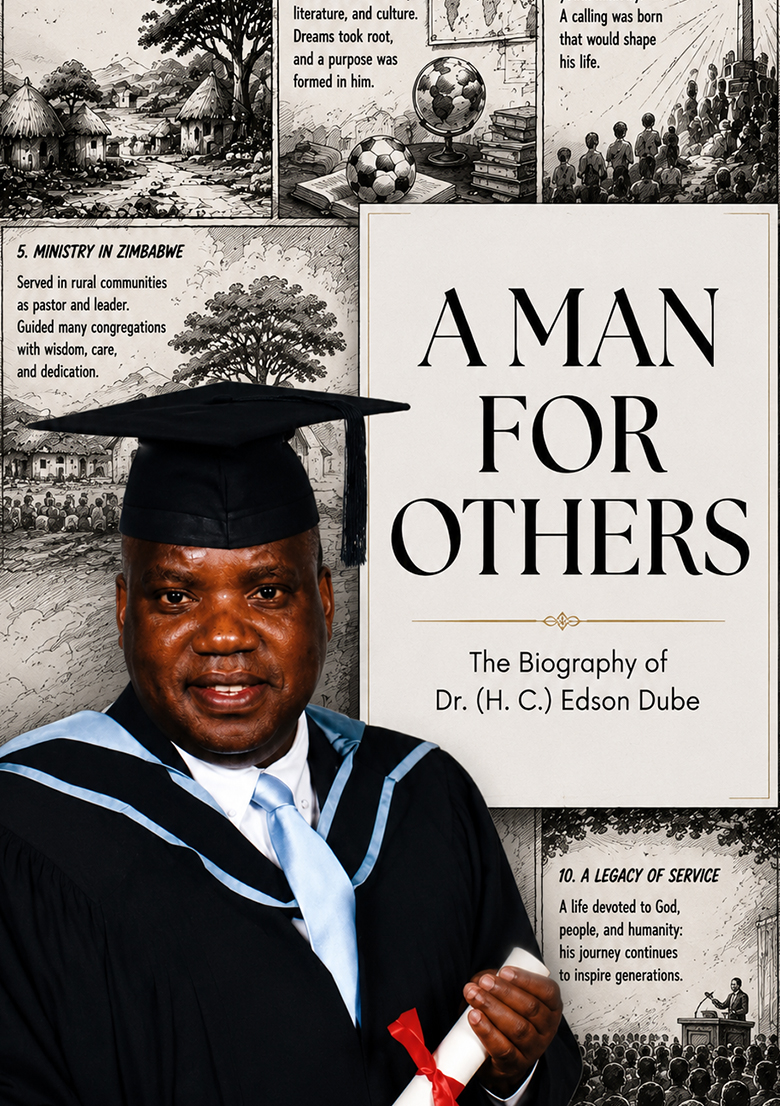
“A life’s true measure is found in the lives it holds together.”
Introduction
From childhood, he was guided by strong moral and spiritual values. His father taught him that education was the key to opportunity, while his mother’s nurturing presence gave him the warmth and stability to pursue it. Alongside this, the influence of extended family and community life reinforced a sense of belonging and responsibility that extended beyond the household.
His upbringing within a village setting introduced him to the philosophy of Ubuntu, where life is understood through interconnectedness and shared humanity. In this environment, individual identity was not separate from the community, and every action carried collective meaning. These values remained deeply embedded in him, influencing the way he views leadership, service, and human relationships.
Academically, Dr. Edson’s early journey reflected both challenges and determination. While he did not begin as a top-performing student, his perseverance allowed him to progress steadily through his education. His interest in history, geography, agriculture, and environmental studies reflected his curiosity about people, society, and the natural world. Alongside academics, football became a consistent passion that remained with him throughout his early life.
A significant transformation in his life emerged through his spiritual calling. After completing his schooling, he embraced Christianity more personally and began working with the church in youth ministry. This marked the beginning of a lifelong path in service, eventually leading him into formal theological training and ministry preparation. His journey into leadership began at a young age, eventually growing into responsibilities that extended across multiple church communities.
As his calling deepened, Dr. Edson Dube progressed through years of theological formation and practical ministry experience. His early training included structured theological education and international exposure that broadened his understanding of faith and service. These experiences prepared him for leadership roles that would later define his professional and spiritual identity.
This biography is not a chronicle of dates. It is a portrait of a life shaped by values, guided by faith, and strengthened by experience.
“Identity is first shaped where roots run deepest, where history, language, and belonging quietly build the foundation of who a person becomes.”
Phase 1: Roots in zimbabwe and the shaping of identity
The life of Dr. Edson Dube begins in Zimbabwe, a land once known as Rhodesia during the era of British colonial rule. He was born into a large family of eight children, consisting of four boys and four girls, where he held the position of the sixth child. This setting of a large household created an early environment where sharing, adjustment, and collective living were part of everyday life. Resources were modest, yet the family remained united through responsibility and mutual support, forming the earliest framework of his understanding of life.
His origins are deeply connected to the Matebele people, a group rooted in history as a branch of the Zulu lineage. This ancestral connection traces back to migration across the Limpopo River from South Africa, particularly from the Natal and Durban regions, during historical periods shaped by the rise of Shaka Zulu and the movement of his followers. This cultural inheritance placed Dr. Edson within a rich historical identity that carried both pride and continuity across generations. Although born in Zimbabwe, his roots carried a dual connection, reflecting both Zimbabwean birth identity and South African ancestral lineage.
Growing up within this cultural landscape, he was naturally exposed to a blend of languages and traditions. He became fluent in both Shona, widely spoken in Zimbabwe, and Zulu, which formed part of his traditional identity. This linguistic duality shaped his ability to connect with diverse people and understand cultural depth from an early stage in life. Language was not only a tool of communication but also a reflection of identity, belonging, and cultural continuity within his environment.
His father worked in the mines as a clerk, a role that represented steady but modest employment, while his mother dedicated herself fully to the household, ensuring the care and upbringing of the children. Together, they maintained a stable family structure despite financial limitations. Life was not marked by abundance, but by resilience, responsibility, and determination to ensure that each child grew within a value-driven environment.
The household was firmly rooted in a traditional Christian foundation, where faith was not occasional but a consistent way of life. Church attendance and Sunday school were not optional activities but part of the expected upbringing of every child. Within this structure, religious teaching became a natural part of childhood development, shaping early perceptions of discipline, morality, and purpose. Faith was experienced not only within church walls but within the daily rhythm of family life.
Education and faith were closely intertwined in his early environment. Even before personal choice came into play, the expectation of attending school and participating in religious learning was already established. This created a structured upbringing where direction was clear, and discipline was consistently reinforced. The values of obedience, respect, and responsibility were embedded through both family expectations and community norms.
“Strength begins in a home where discipline is lived, respect is learned early, and education becomes the doorway to every possibility ahead.”
Phase 2 : The architecture of values and early discipline
Within the household of Dr. Edson Dube, the foundation of life was shaped by the presence of his parents, Simon Dube and Margaret Dube, whose influence remained deeply rooted in his upbringing. His father stood as a firm and disciplined figure whose outlook on life was shaped by structure, order, and responsibility. His approach to raising children was grounded in clarity and consistency, where expectations were defined and values were not merely spoken but demonstrated through daily living. His mother complemented this strength with warmth, care, and a nurturing presence that ensured the household remained balanced, steady, and emotionally grounded.
In this environment, discipline was not treated as restriction but as a guiding principle for personal growth. Every child was expected to understand responsibility from an early age, not as an abstract idea but as a lived practice within the family structure. Respect for elders was consistently reinforced, not as a cultural formality but as a deeply embedded principle that shaped behaviour, communication, and interaction within and beyond the home. The presence of structured expectations created an environment where accountability became a natural part of development.
Education stood at the centre of his father’s worldview. It was regarded as the most powerful pathway toward opportunity and transformation. This belief was not presented as suggestion but as certainty, shaping the expectations placed upon every child in the family. Education was understood in its most practical form, rooted in classroom learning, discipline in study, and commitment to academic progress. The idea of passing examinations and progressing through formal learning stages carried significant weight within the household, as it was seen as the gateway to a meaningful future.
Despite financial limitations, the household maintained a strong commitment to ensuring that each child received education. His father’s conviction that education could open doors shaped the direction of the entire family’s upbringing. This belief was particularly significant in a context where resources were limited, yet aspirations remained high. The emphasis was not on privilege but on perseverance, ensuring that every child understood the importance of applying effort, discipline, and consistency in their studies.
The family environment also extended beyond the immediate household structure. Relatives and extended family members played a meaningful role in shaping daily life, reinforcing the idea that upbringing was not confined to a single nuclear unit. Within this broader network, responsibility and behaviour were observed and guided collectively, creating a shared system of accountability. The influence of cousins and extended relatives formed part of the social fabric that contributed to shaping his early understanding of human relationships and communal living.
“In a village where every child belongs to everyone, character is not formed in isolation, it is shaped through the wisdom of many voices.”
Phase 3 : Life within the village and the spirit of ubuntu
Within this setting, the idea that a child is raised by the village was not symbolic but practical. Every elder carried a sense of responsibility toward the younger generation, and every child was expected to understand that their actions reflected not only themselves but the wider community. Behaviour in public spaces was closely observed, and correction was considered a collective responsibility. If a child behaved inappropriately, any elder had the authority to correct them, and such correction was accepted as part of the communal system. This practice reinforced discipline through shared accountability, ensuring that values were consistently upheld across the entire environment.
This structure created a strong sense of belonging, where no individual existed outside the influence and care of others. The boundaries between family and community were naturally interconnected. Life was experienced as a shared journey, where achievements were celebrated collectively and mistakes were corrected collectively. In this environment, Dr. Edson learned early that personal conduct carried wider meaning, and that individual behaviour was always connected to communal perception.
The philosophy of Ubuntu, deeply rooted in African wisdom, became a guiding principle within this upbringing. It expressed the idea that a person exists through others, and that humanity is interconnected in its essence. The understanding that “I am because we are” was not merely a saying but a lived reality. It shaped how relationships were understood and how responsibility toward others was internalised. Within this philosophy, existence itself was seen as relational, where identity was strengthened through connection rather than separation.
This sense of interconnectedness shaped his awareness of human relationships from an early stage. It reinforced the understanding that no individual operates independently in life. Every action influences others, and every presence is shaped by the existence of those around them. This awareness formed a lasting perspective that remained embedded in his worldview as he grew older.
In the village environment, discipline was reinforced through collective oversight. Elders played a central role in maintaining order, ensuring that cultural expectations were preserved and passed on. Children were taught that respect was not limited to immediate family members but extended to all elders within the community. This created a strong culture of accountability, where behaviour was continuously aligned with shared values.
Note of Thanks
This biography of Dr. Edson Dube reflects a journey shaped by faith, perseverance, and a lifelong commitment to service. His life, rooted in Zimbabwe and carried across continents, stands as a testament to dedication within ministry, education, and community leadership. From his early beginnings in a large family guided by discipline and strong values, to his extensive years of service within the Methodist Church in Britain, his path has been marked by consistency, humility, and responsibility.
Deep gratitude is extended to his parents, Simon and Margaret Dube, whose love, discipline, and guidance laid the foundation for his values and direction in life. Their sacrifices and unwavering support provided the early strength that shaped his understanding of education, respect, and responsibility. Their influence remains central to the principles he carried throughout his journey.
Special appreciation is also given to his wife, Samukeliso Dube, whose steadfast support and encouragement accompanied him through the demands of ministry across different regions. Her presence and partnership offered stability and strength, enabling him to continue his service with commitment and balance.
Heartfelt thanks are expressed to his daughters, Nomthandazo and Nozipho, whose love and encouragement have remained a constant source of pride and inspiration. Their journey alongside him reflects a shared strength that has contributed meaningfully to his life experience.
Acknowledgment is also extended to his grandchildren, Isabella, Isaiah, and Elijah, whose presence brings joy, continuity, and renewed hope within the family. Their lives represent the continuation of a legacy built on faith and service.
Gratitude is further extended to colleagues, church communities, and individuals who have supported and walked alongside him throughout his ministry. Their encouragement, cooperation, and shared commitment have contributed to the impact of his service across churches, communities, and leadership roles.
This note comes from a heart of gratitude for everyone who walked alongside Dr. Edson Dube. His life was enriched by the people he served, the bonds he formed, and the shared purpose that carried him forward.
thanks,
– Dr. Edson Dube