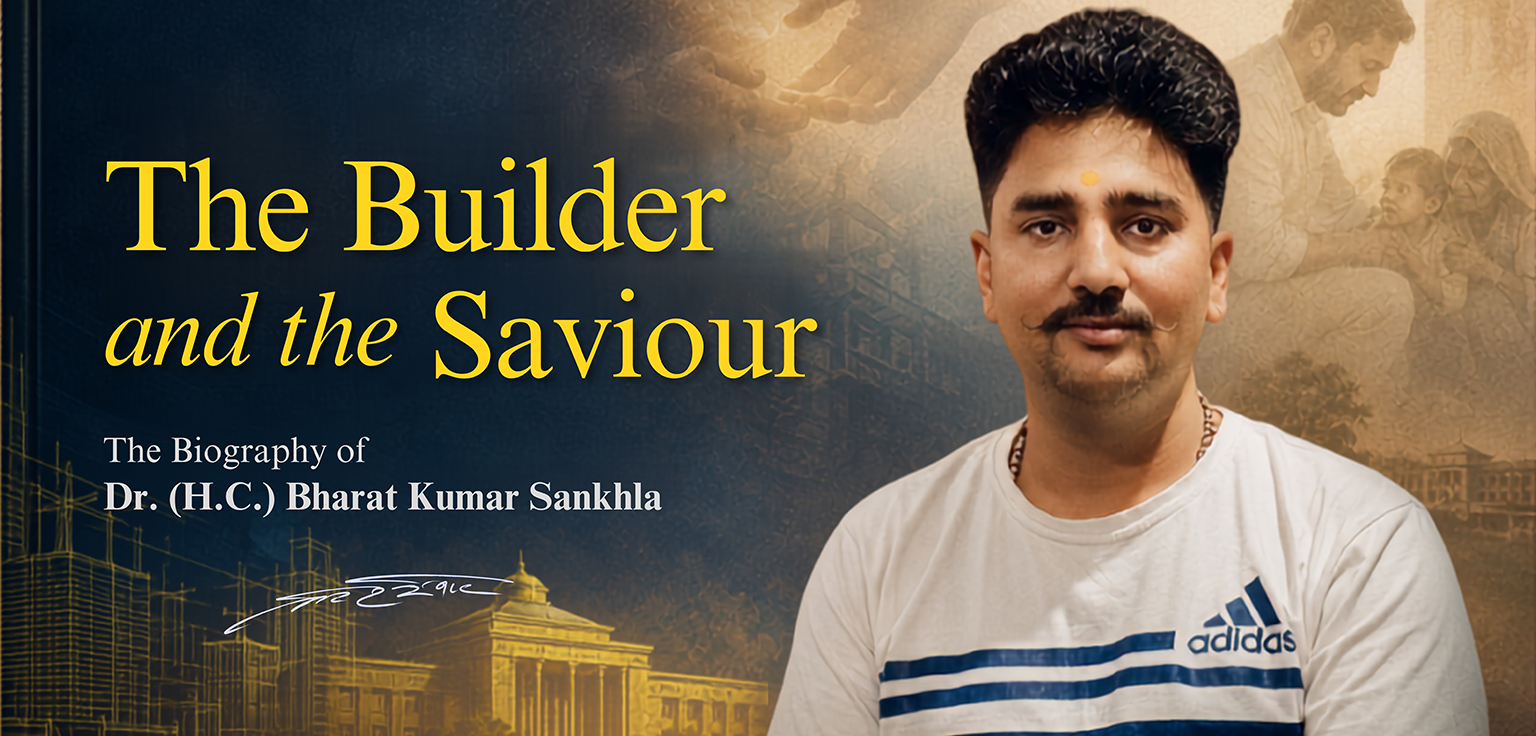
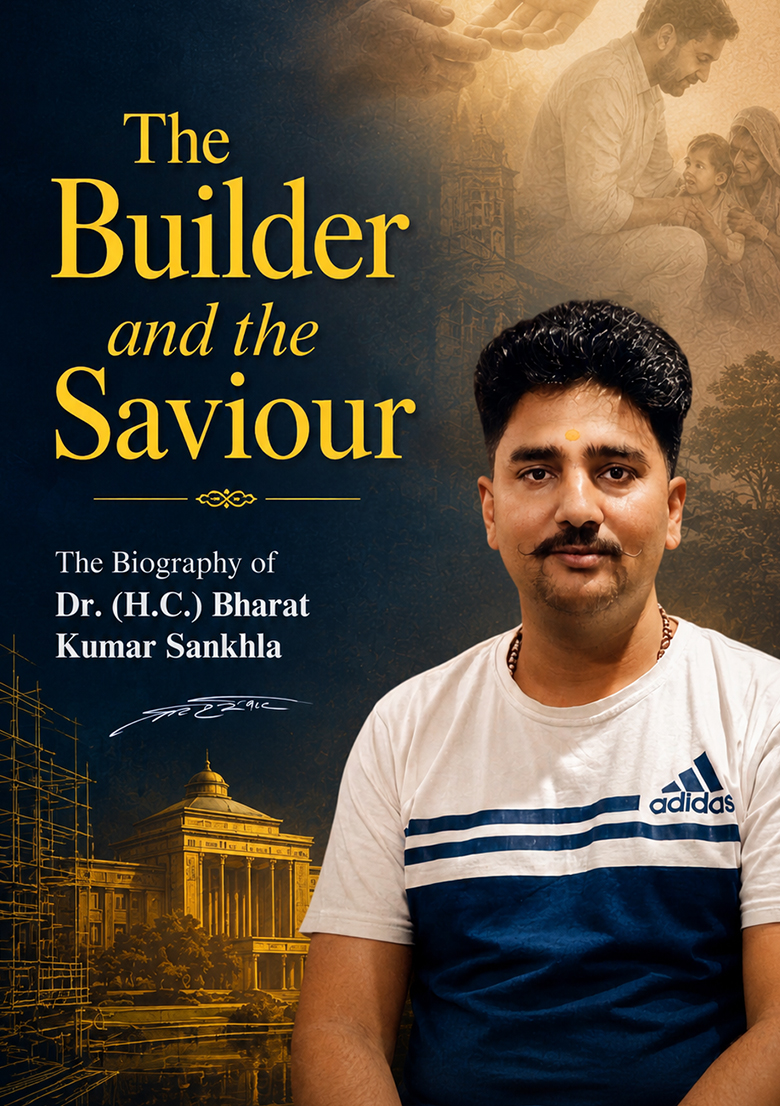
"Every day is a new page, every experience a lesson, and every moment a gift."
Introduction
There are lives that are understood through professional accomplishments, and there are others whose meaning is found in the responsibilities they willingly accept. The journey of Dr. Bharat Kumar Sankhla belongs to both. His story moves through family circumstances, education, sport, enterprise, friendship, social responsibility, and an enduring concern for animals. Each part reveals a different dimension of his personality, yet all are connected by a quality he has carried since childhood: once he decides to do something, he remains committed until it is accomplished.
Born on 10 April 1988, Dr. Bharat grew up with his elder brother, Rajendra Prasad Sankhla, and three elder sisters. His parents, Gopal Lal Sankhala and Shanti Devi, formed the foundation of his early life. The death of his father in 1992 brought a profound change to the family while he was still a young child.
His education continued through the Board of Secondary Education, Ajmer, Rajasthan, followed by the National Institute of Open Schooling. Mathematics held his interest more strongly than other subjects. During these formative years, Anil Chhipa, his science teacher, and Sunil Chhipa, his mathematics teacher, became important mentors. Their guidance remained associated with a period in which his interests and abilities were taking shape. Painting offered him another form of expression, while wrestling introduced him to the discipline of physical effort. His commitment to the sport eventually took him to the Delhi Nationals in 2016.
Alongside his responsibilities stand his mother, Shanti Devi, his elder brother, Rajendra Prasad Sankhla, his three elder sisters, his wife, Neetu Devi, and their children, Jagriti, Krishna, and Govind Ram. His mother’s spiritual guidance, his siblings’ support during difficult years, his elder brother’s fatherlike responsibility, and his wife’s understanding form an important part of the life within which his business and service continue to grow.
“Childhood does not always explain itself while it is being lived; sometimes its deepest lessons become visible only in the strength a person carries forward.”
Phase 1: Roots Formed Through Family and Early Loss
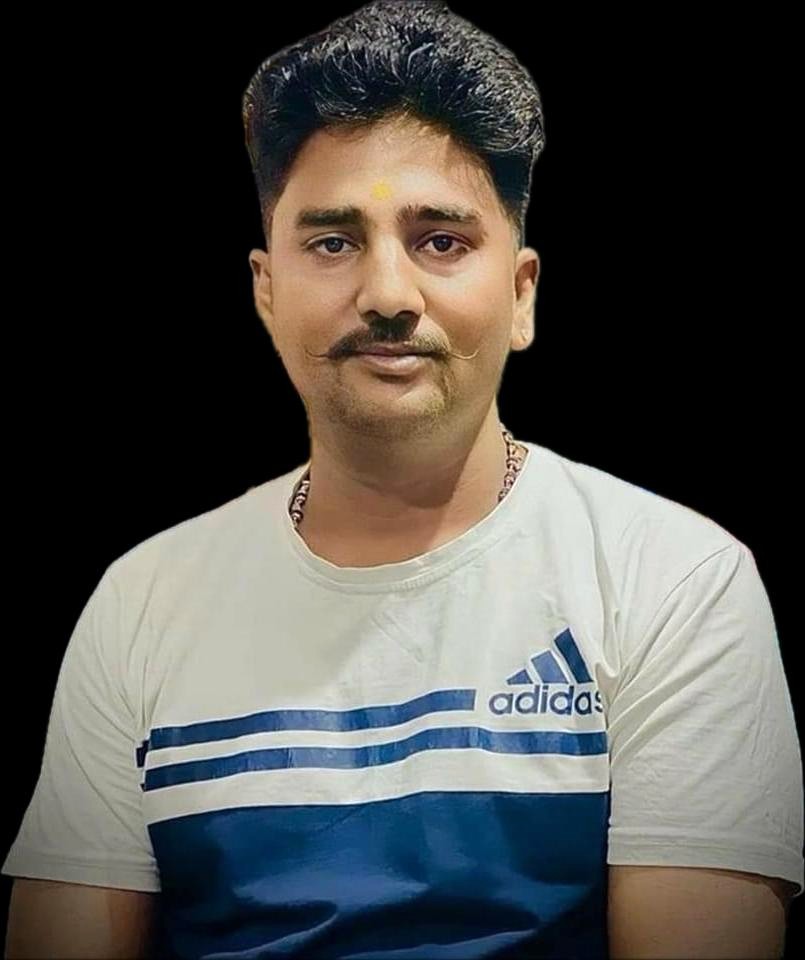
Every life begins within a circle of people, circumstances, and relationships that quietly shape the person one eventually becomes. For Dr. Bharat Kumar Sankhla, that first circle was his family. Born on 10 April 1988, he entered a household shared by one elder brother and three elder sisters. It was within this large family that he first encountered the realities of living together, adjusting to different personalities, and finding his own place among many voices.
His father, Gopal Lal Sankhala, and his mother, Shanti Devi, stood at the centre of those early years. Their names belong not merely to a record of his family background, but to the beginning of his identity. The values associated with home would remain connected to the way he understood relationships, responsibility, and personal conduct as he grew older.
In 1992, when Dr. Bharat was still a young child, his father passed away. The loss came at an age when a child cannot fully understand death or express everything it changes. Yet the absence of a parent becomes part of a family’s life in ways that extend far beyond the moment itself. It changes the atmosphere of the home, alters responsibilities, and leaves memories that are carried differently by every member.
For a family with five sons and two daughters, the passing of Gopal Lal Sankhala was not simply an individual sorrow. It was a loss shared across the household. Each child stood at a different stage of life and would have understood it according to his or her own age and awareness. Dr. Bharat was still forming his earliest understanding of the world when this change entered his life. Although he did not later describe his childhood through prolonged accounts of hardship, the fact of that early loss remained an inseparable part of his beginning.
His mother, Shanti Devi, continued to occupy an essential place within the family. In a home with seven children, daily life naturally involved many needs, expectations, and responsibilities. The family remained the setting in which Dr. Bharat observed how people stay connected through changing circumstances. He grew up not as an only child moving through an individual world, but as one member of a large family in which space, attention, and experiences were shared.
Shanti Devi’s influence was closely connected with devotion. Her spiritual way of life created a devotional atmosphere within the home and helped keep her children away from harmful habits, improper food choices, and paths she believed were wrong. Dr. Bharat considers her guidance an important reason that he remained connected with disciplined conduct as he grew older.
“Education is remembered not only through the lessons written in books, but through the teachers who recognise an interest and help it find direction.”
Phase 2 : Lessons Beyond the Classroom
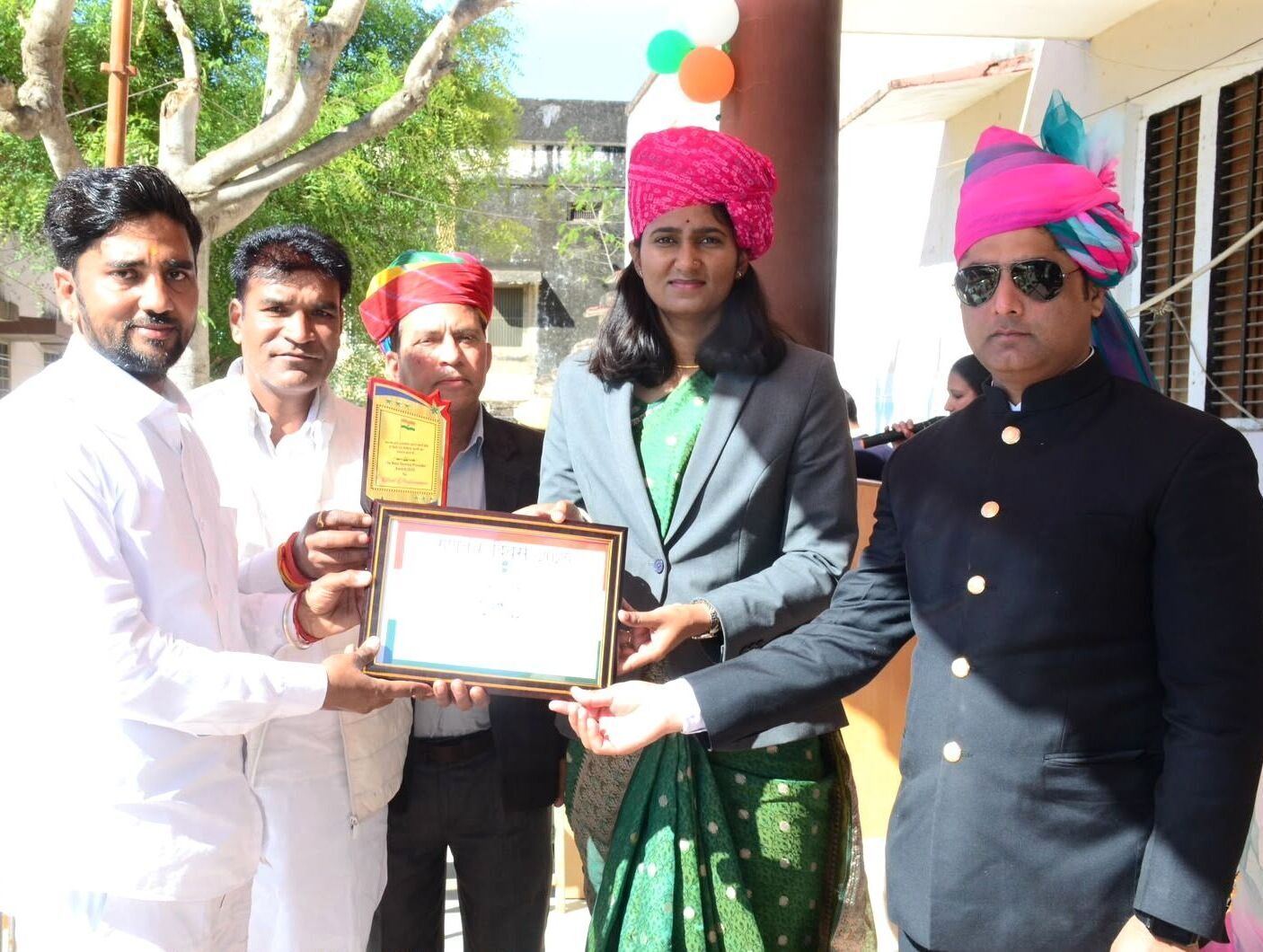
As childhood gradually gave way to the years of formal learning, Dr. Bharat Kumar Sankhla entered a stage in which his interests began to acquire a clearer shape. Education became an important part of this period, but his development was never limited to prescribed lessons or examinations. It also emerged through the subjects that naturally held his attention, the teachers whose guidance he valued, and the creative activity that gave him a different way to engage with the world around him.
His academic journey included completing his secondary education through the Board of Secondary Education, Ajmer, Rajasthan. He later completed his senior secondary education through the National Institute of Open Schooling, commonly known as NIOS. These qualifications formed the formal structure of his schooling and marked the educational stages through which he progressed.
Among the subjects he encountered, mathematics became his clear favourite. Its appeal was distinct and lasting. Mathematics requires attention, order, and the willingness to remain with a problem until a solution begins to emerge. An answer cannot be reached through appearance alone; it demands a process. Each step must connect logically with the next, and a small oversight can change the final result.
Dr. Bharat’s preference for mathematics reflected an attraction to this structured way of thinking. He was drawn to a subject in which clarity mattered and where careful reasoning produced a definite outcome. The interest was not something he later added to his story for effect. When asked directly which subject he had enjoyed most, his response was immediate and uncomplicated: mathematics.
Two teachers held an important place in his memories of education. Anil Chhipa, who taught science, was one of his mentors. Science invited learners to observe, question, and understand how things work. It encouraged an interest in causes, processes, and outcomes rather than accepting everything only at the surface level. The guidance he received from his science teacher became part of the educational environment that influenced him during those formative years.
His other mentor was Sunil Chhipa, his mathematics teacher. Because mathematics was already the subject that interested Dr. Bharat most, the role of the person teaching it carried particular significance. A teacher can determine whether a student merely completes a subject or develops a genuine connection with it. The presence of a mentor in a favourite subject can make learning feel less like an obligation and more like a skill worth strengthening.
“Strength is not measured only by how firmly a person stands, but also by how faithfully he remains beside those who once stood with him.”
Phase 3 : Strength in the Arena, Loyalty Beyond It
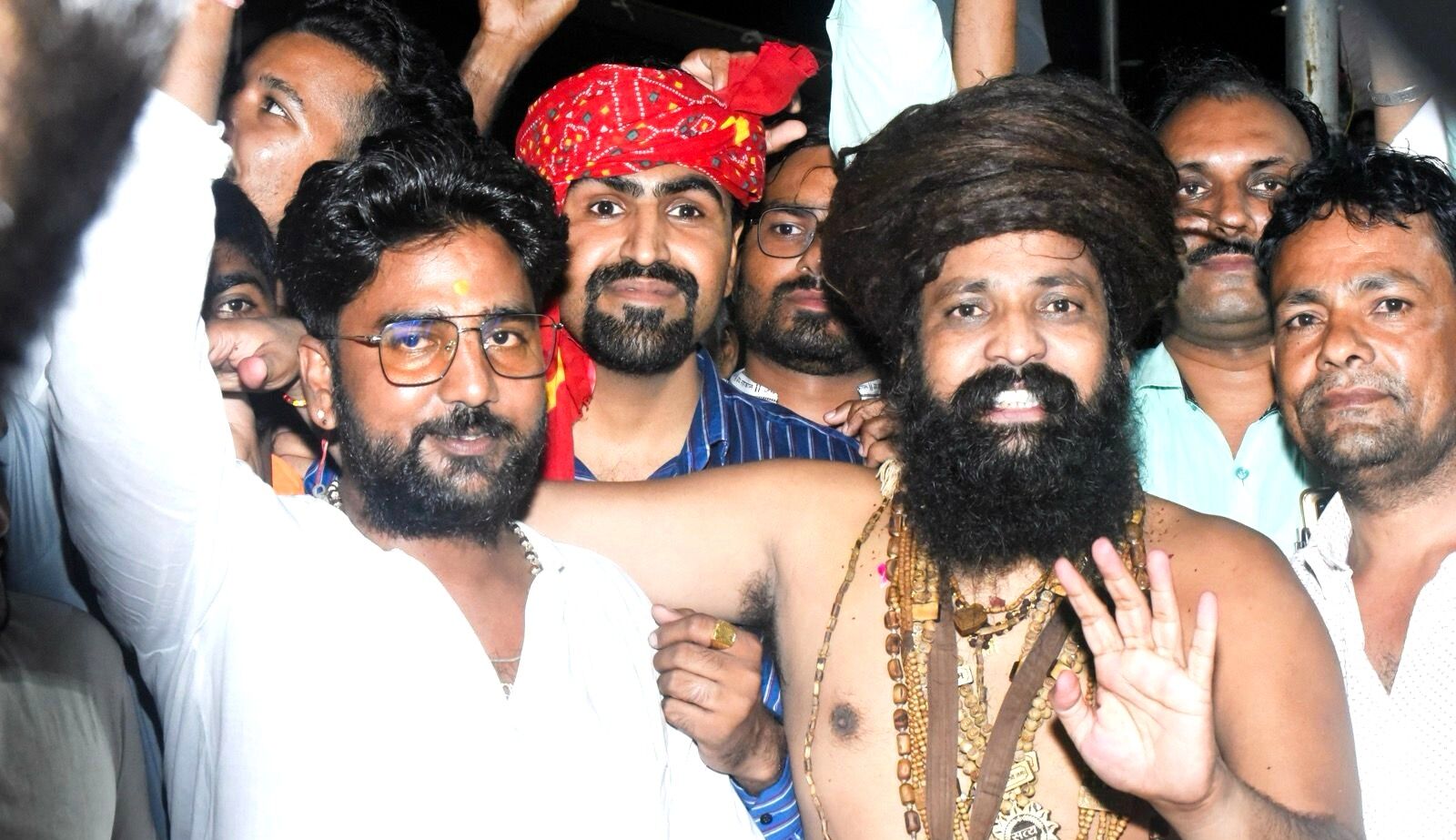
Some stages of life shape the body, while others test the heart. For Dr. Bharat Kumar Sankhla, wrestling and friendship became two distinct yet closely connected expressions of strength. One demanded discipline in the arena, while the other revealed loyalty through changing circumstances. Together, they added endurance, humility, and emotional depth to his developing character.
Dr. Bharat practised wrestling for approximately two years. Pehlwani was not merely a casual interest added to his routine. It required physical effort, repeated practice, and the willingness to remain disciplined even when progress was gradual. The sport demanded that he test his ability against resistance rather than remain within familiar limits.
Wrestling offers no place to hide uncertainty. Two competitors enter the same space, and each must rely on preparation, balance, strength, and presence of mind. A moment of hesitation can change the direction of a contest. Physical ability matters, but so do patience and control. A wrestler must know when to act, when to hold position, and how to recover when an opponent gains an advantage.
These demands suited Dr. Bharat’s willingness to commit himself fully to something once he had chosen it. Training over two years required continuity. Each session asked him to return with the same seriousness, 15 carrying forward what he had learned and improving through effort. The value of such practice lies not only in competition, but in the habits it develops away from public attention.
His involvement in the sport eventually took him to the Delhi Nationals in 2016. Reaching the national arena became an important moment in his wrestling journey. It represented the distance he had travelled from taking up Pehlwani to participating at a higher competitive level. The experience gave a definite outcome to the time and energy he had invested in the sport.
The significance of the Delhi Nationals did not depend on a medal or a public claim. Dr. Bharat did not describe the event through exaggerated language, nor did he present it as the only measure of his effort. Participation itself carried meaning. It showed that an interest pursued with discipline could take him beyond local practice and into a national competition.
His approach to this achievement remained straightforward. When asked about wrestling, he stated that he had practised for two years and had competed at the Delhi Nationals. He did not attempt to enlarge the account. That simplicity reflects the way he often speaks about milestones. He recognises what happened, values the experience, and then allows the journey to continue.
Note of Thanks
“Gratitude is the quiet recognition that no meaningful journey is completed alone; every step carries the presence of someone who guided, trusted, supported, or served beside us.”
As the story of Dr. Bharat Kumar Sankhla reaches this point, he acknowledges the people whose presence gave strength and meaning to different stages of his journey.
His gratitude begins with his late father, Gopal Lal Sankhala, and his mother, Shanti Devi. He remains deeply thankful to his mother for creating a devotional environment at home and guiding the family away from harmful habits and unsuitable paths. He also acknowledges his three elder sisters, whose support became especially meaningful after their father’s passing.
He offers particular gratitude to his elder brother, Rajendra Prasad Sankhla, who carried responsibilities resembling those of a father during the family’s difficult years. His sacrifices, guidance, supervision, and commitment to the family helped Dr. Bharat become capable of managing business, social responsibility, and Gau Seva. He attributes an important share of his progress and ability to serve to his mother and elder brother.
He expresses heartfelt appreciation to his wife, Neetu Devi, and their children, Jagriti, Krishna, and Govind Ram. He is especially grateful for his wife’s understanding when service takes him away from home or requires him to devote family time to Gau Mata and other lives in distress. Her acceptance has enabled him to continue responding without being made to feel that his commitment to service is a failure of responsibility toward his family.
Dr. Bharat also remembers his mentors, Anil Chhipa and Sunil Chhipa, with sincere respect for the guidance they provided during his education. He remains grateful to his childhood friend Vimal, whose companionship demonstrated the lasting value of loyalty and mutual support.
His appreciation extends to every customer who placed confidence in his work, every colleague and employee who contributed to the progress of Ganraj Builders and Colonizers Private Limited, and every individual whose professional association helped strengthen the organisation.
He offers special thanks to the team of Om Go Seva Kendra Trust Danta. Their readiness to rescue, treat, protect, and care for vulnerable animals has enabled compassion to become sustained collective action. Every life saved reflects their shared dedication.
Finally, Dr. Bharat remains grateful to everyone who recognised and encouraged his work. He receives that respect not as an honour belonging to him alone, but as recognition of the institutions and people serving beside him. Above all, he thanks God for giving him the ability, time, and opportunity to remain useful to others.
thanks,
– Dr. Bharat Kumar Sankhla