
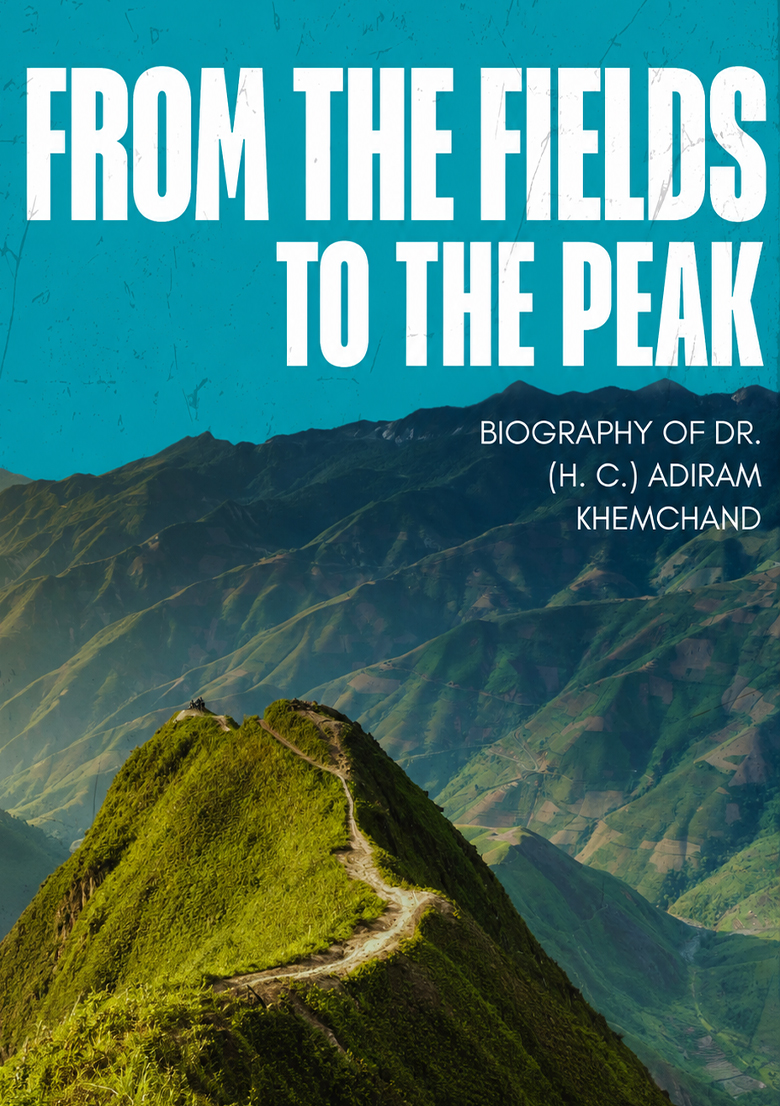
“It is not the mountain we conquer but ourselves.”
Introduction
The life of Dr. Adiram Khemchand is a remarkable narrative of perseverance, resilience, and purposeful living. Born on 15 February 1969 at San Fernando General Hospital in Trinidad, his early life was marked by modest beginnings, challenging circumstances, and the quiet influence of a family whose guidance and support would leave an enduring imprint. Growing up in Tableland, he faced the realities of rural life, walking along narrow bush-lined paths to reach school, sometimes without shoes, and balancing the demands of education with physically demanding work in the cane and rice fields, at Barrackpore.
He grew up for nine years in Tableland and later in Barrackpore, hunting birds and other animals; fishing in the ponds and rivers around, and helping to raise chickens, ducks, geese, turkeys, goats, cows, and also water buffaloes which were harnessed to carts for transportation purposes. These activities were taught to him by his father, using the produce from these animals to supplement the family meals and income, instilling within him practical survival skills. He clearly recalled seeing a boa constrictor having engulfed a domestic chicken and finding another large one, about two meters long, in the family’s Cocoa House which was used to prepare and dry this produce when harvested for sale. These early experiences instilled in him the value of hard work, responsibility, and perseverance, laying a foundation that would guide him through every stage of life.
Education played a transformative role in shaping Dr. Khemchand’s future. Despite the challenges of his surroundings, he consistently excelled academically, often emerging at the top of his class. His preparation for the secondary school entrance examination, closely guided by his uncle, Frank Adiram, became a significant moment. The attention and mentorship he received ensured that the lessons he learned translated into success, earning him a place at St. Stephen’s College, Princes Town. From 1980 to 1987, he pursued studies under the Caribbean Examination Council (CXC), mastering subjects such as English, Mathematics, Principles of Accounts, Principles of Business, Geography, and Social Studies. He further strengthened his academic foundation by completing the English Language examination through the University of London School Examinations Board in January 1987.
After formal schooling, Dr. Khemchand entered a period of labour that would shape his resilience and work ethic. This period also included a powerful phase of self-discipline, during which he transformed himself physically through years of rigorous exercise, personal training, and the mantra, “I will overcome.” He assisted his father in the cane and rice fields, participated in construction work, and trained with an electrician. These experiences demanded physical endurance, discipline, and adaptability, while providing him with valuable lessons in responsibility and persistence. His dedication and reliability during these formative years were integral in shaping his professional character.
A major turning point came with his entry into the Trinidad and Tobago Electricity Commission (T & TEC) in 1999, following a chance encounter with a retired employee who encouraged him to apply. With the support of mentors and careful preparation, he passed the entrance examination and completed the routine pulmonary training required. His initial years included temporary employment and organizational changes, yet he remained committed and ultimately attained permanent status in 2005.
“Do not judge me by my success, judge me by how many times I fell down and got back up again.”
Phase 1: Roots in Trinidad : A Childhood Shaped by Simplicity and Struggle
Every meaningful life begins somewhere, often in a place that quietly shapes the strength of the person who will one day rise from it. For Dr. Adiram Khemchand, that beginning was neither surrounded by comfort nor defined by privilege. It was rooted in simplicity, struggle, and the kind of early hardship that teaches a person to value every step forward. His journey began on 15 February 1969, when he was born at San Fernando General Hospital in Trinidad, West Indies. From that moment, his life would gradually unfold through experiences that demanded patience, endurance, and courage long before he could fully understand the meaning of those words.
In his early years, he lived at Ramkissoon Trace, Tableland, a place that became closely connected with the memories of his childhood. Much of his young life was spent there, and in that environment his earliest understanding of family, survival, and determination began to take shape. There was no electricity, no pipe borne water, or telephone services available in that area. Oil lamps were used to illuminate his home at night, rainwater was collected in tanks and metal drums for drinking and cooking and from a nearby pond for washing, bathing and rearing animals; outside communication was done by entrusting messages to villagers who had vehicles, leaving to conduct their business in the town areas. His early childhood was not marked by ease. It carried the weight of the ordinary struggles faced by families who had to make do with what was available and keep moving forward despite their limitations. Yet, within those limitations, there was a quiet discipline. There was a daily rhythm of adjustment, acceptance, and perseverance. These early surroundings did not give him everything easily, but they gave him something deeper. They gave him the ability to adapt and endure.
His schooling began in that same environment. As a child, he attended the Tableland Anglican Primary School and the path to education itself was not always simple. The journey to school required him to walk through a long, narrow road with bushes surrounding both sides. It was not a smooth or comfortable route. At times, there were snakes, scorpions, centipedes, large hairy spiders, and even stray dogs resting on the road surface, which demanded courage and bravery to get past. He resolved this situation by using available sticks and stones to chase them away, which carried the uncertainty and difficulty of rural life. For many children, going to school may simply mean entering a classroom, but for him, it began much earlier, with the physical act of walking through difficult surroundings just to reach that classroom. That daily walk became more than a routine. It became an early lesson in persistence.
There were also times when even basic necessities were not guaranteed. He remembered moments when he had to go to school without shoes because his family could not afford to buy them. Such memories reveal the reality of his childhood with honesty and humility. They were not small inconveniences. They were signs of a life where every ordinary thing carried value. A pair of shoes, a safe road, a comfortable home, and a peaceful school day were not things to be taken for granted. They were part of a world where hardship was visible and where a child had to continue despite discomfort.
“Education is the passport to the future, for tomorrow belongs to those who prepare for it today.”
Phase 2 : Education, Discipline, and the First Signs of Determination
For Dr. Adiram Khemchand, education was never merely a matter of attending classes or passing examinations. It was a doorway to possibility, a chance to move beyond the restrictions of circumstance, and a way to prove that determination could survive even where resources were limited. His early schooling years revealed something important about him. He was not a child who allowed difficulty to define his ability. He carried within him a natural brightness, a quiet confidence in learning, and a willingness to compete academically even when life around him was not easy.
During his school years in Tableland, he developed a reputation for being a strong student. He remembered himself as very bright, often coming first in tests. There were other students who competed with him for that position, and he recalled that perhaps once he came second, but his academic performance generally remained strong. This early achievement was not simply about marks. It reflected focus, alertness, and a mind that responded well to learning. At an age when many children are still discovering their abilities, he was already learning the value of effort and the discipline required to remain ahead.
That sense of competition also played a meaningful role in shaping him. It was not presented as a rivalry filled with bitterness but as a natural part of school life that pushed him to keep doing well. Competing with other bright students gave him a reason to stay attentive and consistent. It helped him understand that talent must be supported by preparation. Even as a young boy, he was beginning to build qualities that would later become important in his professional life, including concentration, patience, and the ability to stay committed to a goal.
A turning point came when it was time for him to write the entrance examination for secondary school. This was an important moment in his educational journey because it would determine the next stage of his schooling. Around the last year before the entrance exam, his father arranged for him to leave home and stay with his siblings, who had moved out of Tableland seeking better living conditions at New Grant. During this period, his uncle, Frank Adiram, his father’s brother, took him to St. Micheal’s Anglican Primary School, where he taught the common Entrance Examination class, which paved the way for Secondary School. This played an important role in teaching and guiding him. More than giving him academic preparation, this phase placed him in an environment where family support became a strong source of encouragement.
His aunt, Indra Adiram, his father’s sister, was also a motherly and deeply caring presence in his life during that same period. She made sure he had food, clean clothes, and the necessities he needed that made him feel comfortable while he was going through his school challenges. Her care helped him feel supported during a demanding stage of his childhood. In that year of preparation, he received not only academic guidance from Frank Adiram but also emotional warmth and protection from Indra Adiram and the rest of his father’s siblings who lived there at that time.
“The best way to find yourself is to lose yourself in the service of others.”
Phase 3 : Labour Before Stability: The Years That Built Endurance
The journey of Dr. Adiram Khemchand did not move directly from education into comfort, position, or professional security. A demanding period of physical labour, uncertainty, and survival came between Dr. Adiram Khemchand’s schooling and the stable career that would later define a major part of his life. This phase of his story is not simply about the jobs he did. It is about the kind of character that is formed when life does not offer easy choices, when work is accepted not for prestige but because it is necessary, and when a young man learns to keep moving even when every day feels heavy.
While attending school, he had to contend with the harsh realities of agricultural labour, helping his father cut cane after school. Attending Tableland Primary School, he helped his father care for and harvest coffee and cocoa from their plantation. Later, he helped in the cultivation and harvesting of rice and sugarcane while attending secondary school, residing at Barrackpore, gaining invaluable real-world experience and instilling in him a sense of discipline, accountability and perseverance. It wasn’t easy work, especially for someone who still had schoolwork to do. Even in the evening, it took both mental and physical stamina to cut cane in the sweltering sun. The fatigue carried over into the next day and sometimes he would nod off in class because the work had worn him out. But this was the kind of work he knew. He didn’t have to choose between effort and comfort. It was all about supporting the family and taking early responsibility.
After leaving high school, another powerful chapter of discipline began in Dr. Adiram Khemchand’s life. At that time, he described himself as a chubby and overweight boy, but he refused to remain limited by that image of himself. He started exercising with a strong personal will and determination, which slowly changed his body and strengthened his mind. The transformation did not happen at a modern gym or with professional equipment. It was built through self-discipline, creativity, and the resources available around him.
Every other night, he would speed skip, in six different styles, 100 each, respectively: straightforward, then right forward, left forward, running motion with both legs, butterfly, then reverse, always completing 5,300 skips without stopping, bare feet, with a rope constructed from used cow’s harness rope, with two pieces of plastic water lines specially cut and slipped into the rope at both ends being held in place by knots at the ends for rotation. His fastest recorded time was forty-three minutes and thirty-four seconds, while moving on concrete, slipping in his own sweat as his feet moved. In order to prevent the rope from tearing, he greased the part that made contact with the hard flooring with petroleum jelly.
Note of Thanks
Dr. (H.C.) Adiram Khemchand expresses his heartfelt gratitude to the people whose presence, support, and influence have shaped his life with strength and meaning. He remains deeply thankful to his parents, Ralph Mahabir, who taught him the necessary survival skills to embrace life as a man, and Lutchmi Adiram, who taught him the values of home economics: cooking, washing, cleaning, sewing, and even knitting fishing nets. Their lives, sacrifices, and family values became an important part of his foundation. Their efforts, guidance, and role in his upbringing helped him understand the importance of hard work, responsibility, and perseverance.
He also extends sincere appreciation to Batawah Singh, his mother’s brother, whose place in the family story remains meaningful and respected. He saw the potential in Dr. Adiram Khemchand’s abilities to excel in academic achievements and financed the foundation of his journey. He is equally thankful to Frank Adiram, his father’s brother, who taught and guided him during the important year of preparation for the Secondary Entrance examination. His support helped strengthen Dr. Adiram Khemchand’s confidence at a critical point in his education.
He also wants to express his heartfelt gratitude to his aunt, Indra Adiram, for the special motherly role she played in his life at that time. She ensured that he had the necessities he needed, made him feel comfortable, and supported him as he faced his school challenges. Her care and kindness remained an important part of his early journey.
With humility, he also acknowledges the family members and well-wishers who stood by him in different ways throughout his journey. Every lesson, every act of support, and every moment of encouragement helped him become the person he is today. This note of thanks is offered with respect, gratitude, and deep appreciation for those who contributed to the roots of his life and success.
Thanks,
– Dr. (H.C.) Adiram Khemchand