“A life guided by responsibility, patience, and integrity finds its purpose not in speed, but in steadiness.”
Introduction
The life of Dr. Devendra Singh Jhala is a testament to the idea that true achievement is not measured by titles, wealth, or speed of success, but by the values one carries through every phase of life. His journey spans more than six decades and moves across distinct worlds of heritage and hardship, service and entrepreneurship, and industry and social responsibility, yet it remains firmly anchored in integrity, discipline, and purpose. This biography seeks to present his story not as a celebration of success alone, but as a reflection on learning, resilience, and the quiet strength required to sustain a meaningful life.
Born into a family with a royal legacy, Dr. Jhala’s early life was shaped by circumstances that demanded responsibility at a young age. Privilege did not shield him from the realities of change; instead, it introduced him early to the importance of adaptability, humility, and effort. Life did not follow a predetermined path, and formal education, though important, was not uninterrupted or conventional. Yet, these limitations became catalysts rather than obstacles. They cultivated in him a deep belief that curiosity, commitment to learning, and genuine interest in one’s work matter far more than credentials alone.
His professional journey began modestly, with his first employment offering little in material terms but immense opportunity for learning. From the earliest days, Dr. Jhala gravitated toward fieldwork, practical observation, and hands-on problem-solving. He believed that understanding a subject required direct engagement with it, not distance from it. This approach allowed him to gain insights that many overlooked, and it laid the foundation for a career marked by innovation rooted in experience rather than theory alone.
Over time, his work in the salt industry became a space where technical understanding, administrative responsibility, and ethical decision-making intersected. Dr. Jhala rose steadily, not through ambition alone, but through trust earned from colleagues and seniors who recognised his clarity of thought and willingness to take responsibility. He was known for making firm decisions, often guided by logic and fairness, and for maintaining high moral standards even when compromise might have offered convenience. Leadership, for him, was never about authority or fear; it was about respect, consistency, and accountability.
A defining aspect of Dr. Jhala’s journey is his enduring relationship with learning. Despite gaps in formal education, he pursued knowledge relentlessly through correspondence studies, field experiments, and continuous inquiry. His research contributions, particularly in salt production methods and environmentally conscious industry design, earned international recognition and reinforced his conviction that innovation thrives when curiosity meets discipline. These efforts were never driven by the pursuit of recognition but by a desire to improve processes, enhance quality, and reduce environmental harm.
“Circumstances may change the path of life, but values decide how that path is walked.”
Phase 1: Roots of Responsibility and Early Foundations
The initial years of Dr. Devendra Singh Jhala were defined by a mix of inherited legacy and practical duty. Arriving on 9th December 1940 in Mohammadpur, Labhowa, Uttar Pradesh, he entered a world steeped in royal and zamindari traditions. This lineage naturally carried with it a strong sense of dignity, discipline, and social status. However, the era into which he was born also carried the heavy weight of transition. This period was marked by structural and political shifts that altered the traditional foundations of zamindari life, bringing with them fresh realities that demanded adaptability rather than mere entitlement.
Early on, Dr. Jhala was exposed to the realization that legacy alone could not secure the future. While the family’s roots instilled pride and cultural values, it also confronted him with the necessity of self-reliance. The typical comforts often associated with royal heritage were no longer guaranteed, and this environment quietly but firmly anchored his worldview. For him, responsibility was not introduced later in life; it was present from the beginning, woven into everyday experiences and family expectations.
His early education began in Uttar Pradesh, where he attended local schools and colleges. The path of formal learning, however, was not smooth or uninterrupted. Family circumstances and heavy obligations required him to shoulder responsibilities at a relatively young age, limiting his ability to pursue education in a conventional, uninterrupted manner. Though he enrolled in undergraduate studies, his academic journey could not be completed as intended. Rather than viewing this as a personal shortcoming, Dr. Jhala came to see it as a turning point, one that would redirect his entire approach to learning altogether.
These formative years built in him a critical belief that would remain central throughout his life: education is valuable, but curiosity, discipline, and genuine interest in one’s work are equally essential.
“Formal education matters, but real learning begins when one takes genuine interest in the work.”
Phase 2 : Entry into Work and Learning Through Experience
As Dr. Devendra Singh Jhala stepped out of his formative years and into professional life, the transition was neither ceremonial nor easy. Unlike many who start their careers with clearly defined academic credentials and predetermined pathways, Dr. Jhala’s entry into work was shaped by necessity, responsibility, and a willingness to learn on the job. What defined this phase was not the comfort of preparation, but the courage to begin despite limitations and to transform those limitations into strengths.
Dr. Jhala began his working life in 1963, at a time when opportunities were scarce and expectations were demanding. His first salary was ₹150 per month, a figure he later often contextualized by comparing it with the price of gold at the time. This comparison was never intended as a complaint but as a reflection of the economic realities of the era and the modest circumstances in which his professional journey commenced. The remuneration itself mattered less than the opportunity it provided to observe, to learn, and to engage directly with work that demanded both physical effort and mental attention.
During this early period, Dr. Jhala joined a private organization connected to salt-related operations. He entered not with authority or seniority, but as a learner. From the outset, he gravitated toward fieldwork rather than desk-based roles. He found value in understanding processes firsthand: how land was managed, how production unfolded across seasons, and how small variables could influence outcomes significantly. This preference for being present on the ground would become a defining characteristic of his professional life.
He has often stated that during his childhood and early youth, he never imagined working for someone else. Independence, in his mind, was a natural aspiration. Yet, reality demanded adaptability.
“Complex problems often yield to simple thinking when the fundamentals are understood clearly.”
Phase 3 : Technical Growth, Problem-Solving, and the Emergence of Leadership
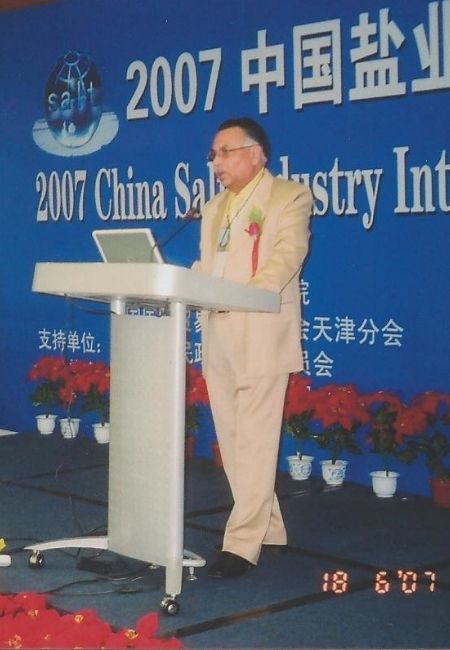
As Dr. Devendra Singh Jhala progressed beyond his initial years of learning and adjustment, his professional life entered a phase defined by deeper technical engagement and growing responsibility. This period did not mark an abrupt rise in position or authority; rather, it represented a steady expansion of trust earned through competence, reliability, and a consistent willingness to engage directly with complex challenges. What distinguished this phase was his transition from learning processes to shaping them.
By this stage, Dr. Jhala had developed a strong foundation in field operations and practical understanding of salt-related processes. His continued exposure to on-site realities sharpened his ability to observe problems in their true context. He was not content with surface explanations or routine responses. Instead, he approached technical challenges by breaking them down to their fundamentals, guided by logic and firsthand observation. This method would become a defining feature of his professional approach.
One of the most significant experiences of this phase involved a technical problem that more senior engineers were unable to resolve. The issue concerned the division of gas into equal parts within an operational process. While extensive technical discussions were underway, the problem remained unresolved. Dr. Jhala approached it from a basic, principle-driven perspective. His suggestion to first condense the gas and then divide the liquid into equal parts was straightforward, yet effective. The solution worked. This moment did not elevate him through formal recognition, but it reinforced an internal conviction that clarity of thought often holds greater value than complexity.
This incident became important not because of the problem itself, but because of what it revealed to him. It strengthened his belief that interest in the subject and practical engagement are critical to problem-solving, regardless of formal academic standing.
Note of Thanks
Dr. Devendra Singh Jhala expresses his sincere gratitude to all those who have been part of his journey, directly and indirectly, across the many phases of his life. He believes that the blessings of his forefathers, especially his beloved mother have been the most important source of his success. He acknowledges the support of his family, whose patience, understanding, and encouragement provided strength through years of responsibility, challenge, and transition. Their presence has remained a constant source of balance and purpose.
He extends his thanks to his colleagues, mentors, and seniors who guided him with wisdom, trust, and honest counsel, particularly those who believed in him during moments of uncertainty. Their guidance helped shape his approach to leadership, integrity, and decision-making.
Dr. Jhala is deeply thankful to the workers, field teams, and community members who contributed through their effort, cooperation, and trust. He also acknowledges the support of government authorities and institutions that enabled responsible industry and development.
Finally, he offers gratitude to life itself for its challenges, lessons, and opportunities that allowed him to learn, serve, and grow with humility and purpose.
Thank You
– Dr. Devendra Singh Jhala