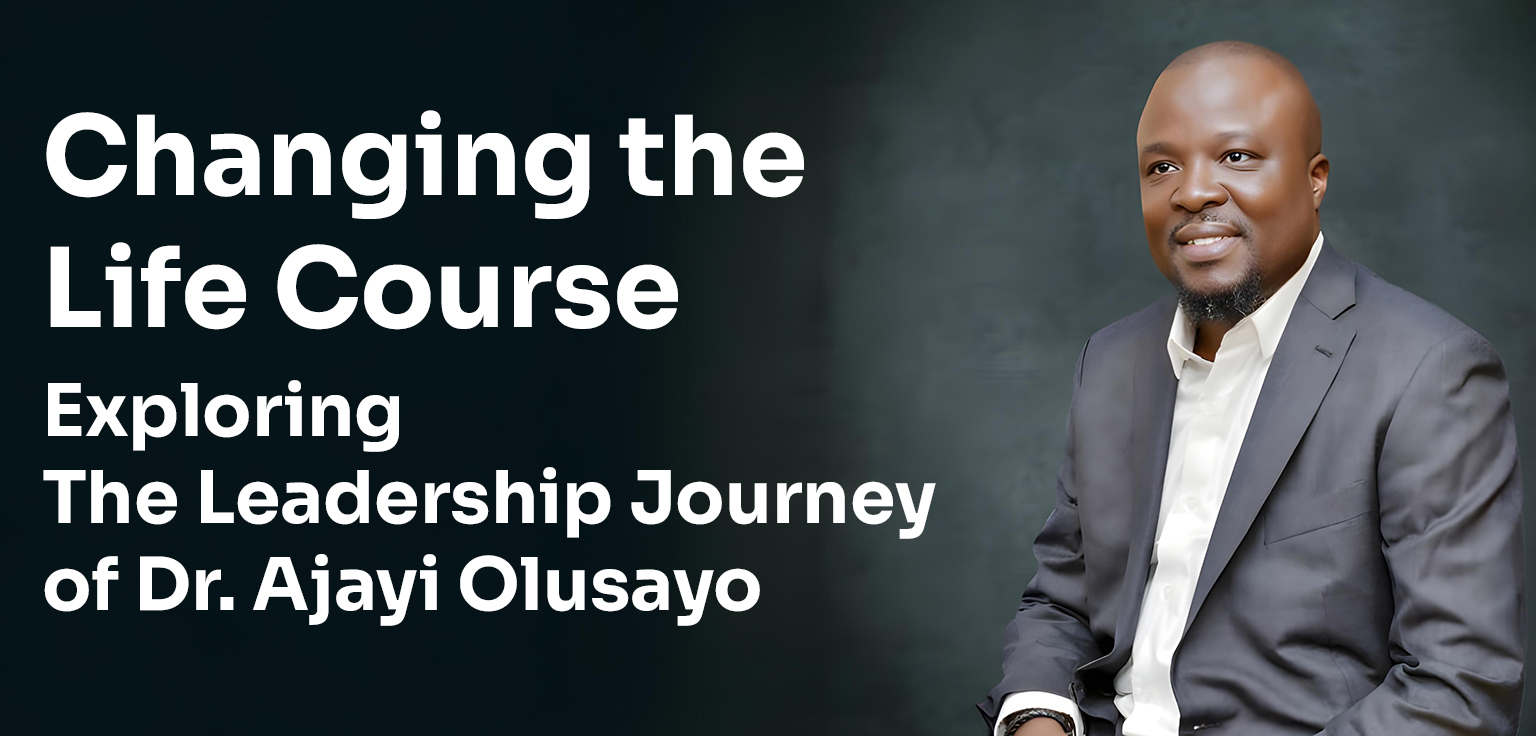
“It is not the mountain we conquer, but ourselves."
Dedication
This work is dedicated to the family that had faith in Dr. Ajayi Olusayo before he was famous, to the quiet bravery that moulded his beginnings, and the unwavering love that supported his rise. Leadership is influence, not authority, and service, not prestige; he owes this to his parents, who modelled honesty over convenience and perseverance over complaint, as well as to his siblings, who bore the burden of limited resources and the joy of shared ambitions.
This memoir is also a tribute to the various bosses, engineers, technicians, planners, and operators he has supervised, whose professionalism brought clarity to his beliefs and whose faith in him gave him the courage to act boldly. I pray that they see themselves reflected here, in the late hours, the tough decisions, and the methodical teamwork that transformed uncertainty into success and vision into reality.
This biography concludes with a dedication to his spouse, who has been a strong backbone, and children who are bundles of joy that drive his energy, as well as all the youth who are still finding their way. To leave people better off than you found them is the greatest achievement; to live a life devoid of shortcuts is to train in strength; and may this story teach that honesty is a compass, not a costume.
“The child is father of the man.”
Phase 1: Roots and Resolve
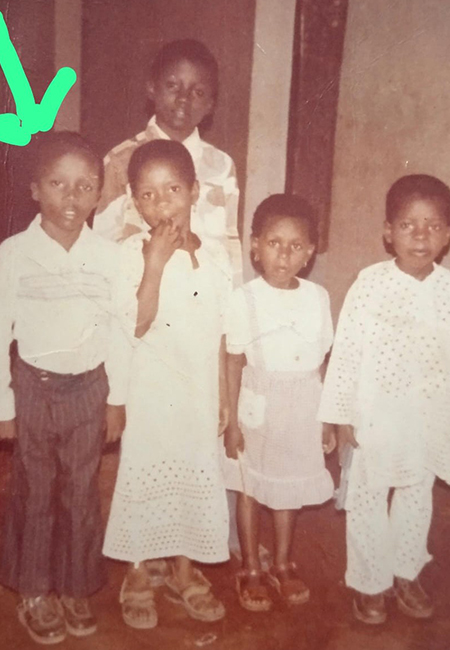
Dr. Ajayi Olusayo grew up in a home where means were modest and expectations were sincere. In that setting, he learned early that dignity is not measured by what a family owns but by what it builds together—habits of honesty, consistency, and care. He would later recall, without dramatics, that his parents’ financial capacity was limited, yet they insisted that their children reach for education with both hands; in time, every one of them made it to university. That quiet achievement formed the first outline of his character: he understood that progress is a shared discipline before it becomes a personal milestone.
Numbers met him like an old friend. From primary school through secondary school, mathematics felt less like a subject and more like a language he already spoke. He could see structure where others saw difficulty and hear solutions in the noise of unsolved problems. The delight was not only in correct answers but in the pathways that led there—the reasoning, the proof, the calm order of it all. That comfort with precision became the inner instrument he would carry into adulthood.
Even before he had a title that said engineer, he behaved like one. If the television flickered, he opened the casing; if the family car developed a minor fault, he went to the garage to listen to the problem with patient hands. To outsiders it looked like tinkering; to him it was apprenticeship—the slow, stubborn training of an attention span. He didn’t chase novelty for its own sake; he kept looking until causality showed its face. Those early repairs were small laboratories where he learned that problems, however loud, are usually precise, and that the right question is often the beginning of the right fix.
School sharpened that instinct. Teachers who demanded more than comfort taught him how to work when the path was narrow. He discovered that endurance is not a mood but a method: read twice, check the boundary conditions, show your workings, respect the constraints, and then, only then, declare the answer. If the task called for physics, he met it with curiosity; if it required patience, he brought patience in full measure.
“Chance favors the prepared mind.”
Phase 2 : Becoming an Engineer
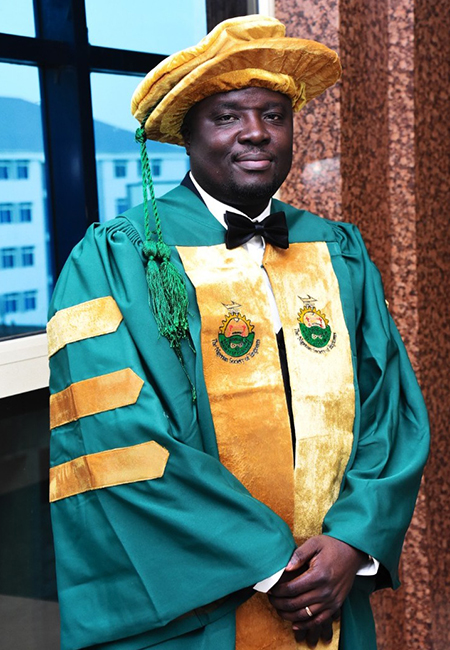
If childhood provided him with curiosity, university taught him coherence. Entering the Department of Mechanical Engineering at Obafemi Awolowo University (OAU), Dr. Ajayi Olusayo carried with him the calm precision of a boy who liked to know how things worked and the discipline of one raised to finish what he started. The campus, known for its architectural grandeur and academic intensity, quickly became his crucible. The lectures were demanding, the laboratories exacting, and the professors uncompromising—but these were precisely the conditions in which his resolve thrived.
At OAU, he learned to think not only like a student but like an engineer—someone who sees beyond appearances to mechanisms, constraints, and possibilities. Mathematics matured into modelling; physics evolved into design. He no longer looked for answers alone; he looked for meaning. Equations became languages for describing the balance of forces, the conservation of energy, and the responsibility of precision. In this environment, where errors could mean collapse and accuracy meant progress, he found both humility and confidence.
His final-year thesis on Fuzzy Logic Systems revealed his attraction to the frontier between certainty and doubt. He looked into how systems could make sense of unclear data and how machines might make decisions based on degrees of truth instead of strict binaries. The research demanded both mathematical dexterity and philosophical patience, for fuzzy logic, like life, thrives on gradients. That project became a quiet metaphor for his future: leadership, too, would require judgment in shades rather than absolutes.
Outside the classroom, he participated in practical workshops that tested the translation of theory into utility. He learned machining, thermodynamics, and design of machine elements—not as isolated courses but as symphonies of interdependent parts. Late nights in the mechanical laboratory were common; the hum of lathes and compressors often replaced the silence of dormitories. In those moments, he realized that engineering is not merely invention but stewardship—an ethic of care for the integrity of materials and the safety of people.
“Be sure you put your feet in the right place, then stand firm.”
Phase 3 : Deepwater, Deep Lessons
By the time Dr. Ajayi Olusayo entered the deepwater oil and gas sector, he had already acquired the patience, discipline, and precision that marked a true engineer. Yet nothing in the university or his early consultancy could fully prepare him for what deepwater operations demanded. The ocean, vast and unpredictable, became his next classroom—one where each wave reminded him that control is borrowed, not owned. The transition from theory to practice was not gentle, but it was defining.
His first assignments with Shell Nigeria Exploration and Production Company (SNEPCo) immersed him in development planning and field concept design, where he began to appreciate how complex engineering converges with economics, logistics, and human behaviour. Offshore systems do not exist in isolation; they are living networks of pressure, flow, risk, and time.
Senior engineers mentored him, teaching him that a true professional translates drawings into deliverables without losing sight of the people behind the scenes.
Within a few years, his ability to grasp intricate systems made him indispensable. His supervisors noticed that while others sought quick fixes, Dr. Ajayi sought understanding. When problems arose, he broke them down to their smallest truth—whether the issue was mechanical fatigue, interface misalignment, or data uncertainty. His reports were crisp, his analyses defensible, and his communication deliberate. The result was trust. In an environment where equipment worth millions rested on judgement calls, trust was currency.
He advanced steadily—from development planning to senior subsea engineering roles, where he would coordinate complex design interfaces between flowlines, risers, manifolds, and subsea trees. Each day began with the awareness that a single miscalculation could compromise an entire asset’s productivity. The stakes were enormous; the margins for errors were microscopic. He thrived on that balance. As colleagues would later say, “Ajayi has the rare ability to stay calm when the pressure gauge climbs.”
Exposure to global operations accelerated his professional growth. He worked alongside teams in Houston, Aberdeen, and Lagos, collaborating with vendors, regulators, and project partners from multiple countries. In those multi-time-zone meetings and multilingual discussions, he discovered that leadership is as much about empathy as expertise. Technical decisions often carried cultural nuances; communication was as important as calibration. He learned to listen to the accent as much as the argument and find consensus without compromising safety.
Note of Thanks
Dr. Olusayo Ademola Ajayi extends his heartfelt appreciation to every individual, mentor, bosses, colleague, and family member who has walked alongside him in his remarkable journey.
He acknowledges the unwavering support of his beloved immediate family, whose patience, prayers, and encouragement have been the silent strength behind his every success.
He expresses sincere thanks to his colleagues and teams at Shell Nigeria Exploration and Production Company, Oryx Gas-to-Liquids Qatar, and all professional organizations that shaped his career and trusted his leadership. Their collaboration and belief in shared purpose turned challenges into milestones and dreams into tangible achievements.
He remains grateful to his mentors who guided him with wisdom and to his mentees who reminded him daily of the joy of service and learning.
Above all, he gives thanks to God Almighty, whose grace has illuminated every path, sustained every season, and inspired every vision.
This biography stands as a humble tribute to everyone who believed in him, worked beside him, and became a part of his long-time legacy of excellence, integrity, and faith.
“The measure of my success lies in the lives I’ve touched and the values we’ve shared.”
Thank You
– Dr. Ajayi Olusayo