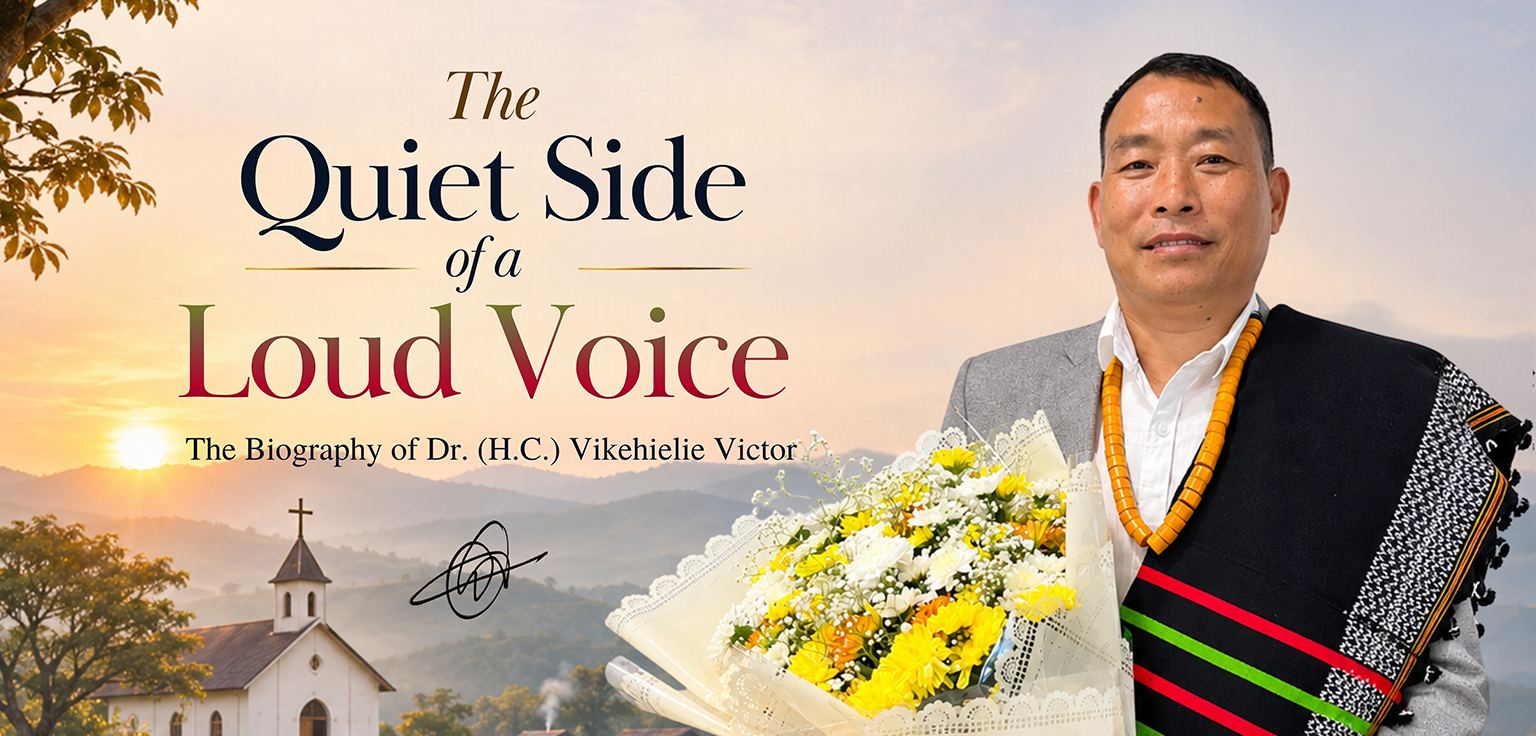
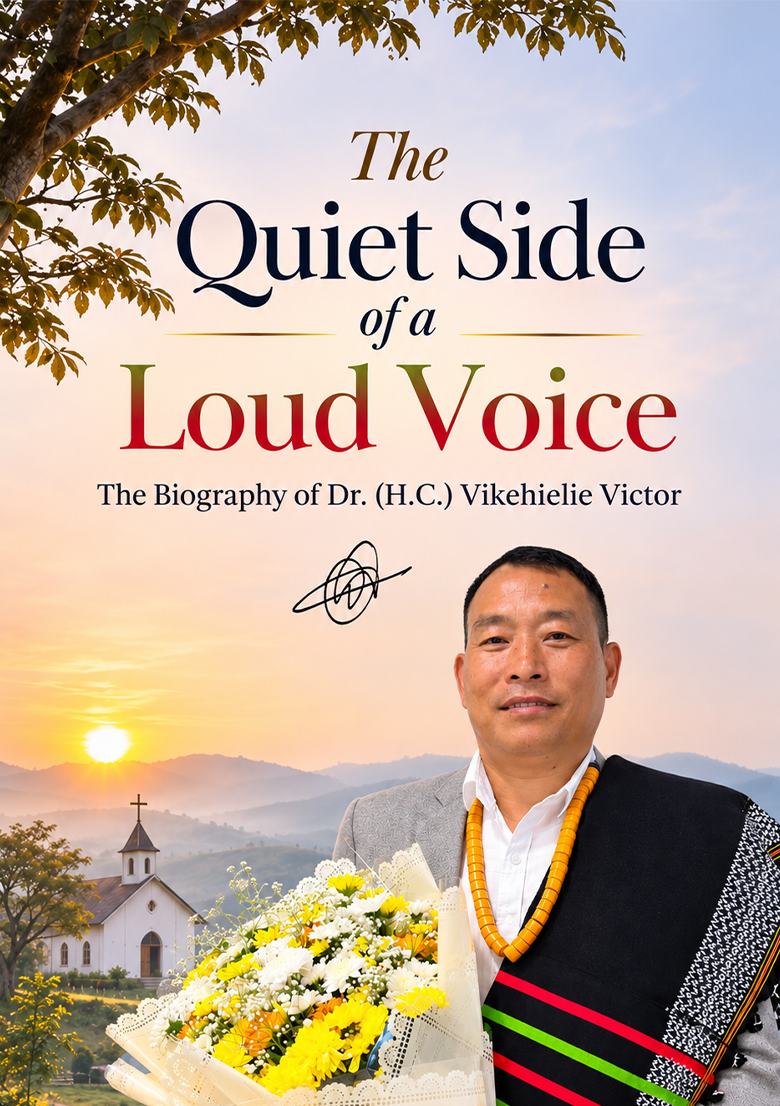
“I wanted to speak before crowds. Life taught me to sit beside them instead. This is the story of how I found my voice by learning when not to use it.”
Introduction
There are lives that take shape through a single profession, and there are lives that gather meaning from many kinds of responsibility. Dr. Vikehielie Victor’s story belongs to the latter. His life has moved through family, education, teaching, faith, student leadership, social service, politics, rural development and community leadership, yet the thread running through these different roles is remarkably consistent. He has repeatedly found himself in places where people needed to be heard, guided, represented, or brought closer to one another. The positions changed. The underlying sense of responsibility did not.
Born on 25 January 1972, he grew up as the only son among four siblings, with two elder sisters and one younger sister. His early understanding of life was closely tied to his family. His father’s example of service and faith became an important part of the household in which he grew up, while his mother’s belief in education gave him another early standard by which to understand the value of learning.
Family history also gave him a strong sense of what earlier generations had carried. His forefathers were remembered for their wisdom, leadership, and efforts to maintain understanding between people. Those stories mattered to him. He has spoken of an inherited, almost unwritten knowledge of leadership, something learned through the example of those who came before rather than through formal instruction. The idea of becoming a good and responsible person began there, long before public positions gave that idea a name.
His adolescence brought an early encounter with responsibility that changed the direction of his education and work. The experience forced him to place immediate family needs alongside ambitions he had carried since childhood, and it became an important turning point in the way he understood duty.
Teaching gave him something unexpected. He entered the classroom because it was a responsibility he could take up, yet he found genuine meaning in the interaction with students. He came to believe that teaching was never simply about passing knowledge from one person to another. The teacher learned as well. That understanding remained connected to his own desire for education. While working, he pursued a Bachelor of Arts through correspondence education, refusing to let employment and family obligations close the door on further study. His later theological education came from a different need. Through his work as an interpreter in the Catholic Church, he wanted a deeper understanding of the Bible so that he could interpret its teachings with greater knowledge and clarity.
Long before politics became a formal part of his life, public speaking and organisation had already given him a place among people. His early organisational responsibilities gradually widened his understanding of what it meant to serve people. Student concerns, youth development and community welfare brought him into situations where listening, communication and practical action mattered as much as formal authority.
Politics eventually gave his early interest in public speaking a formal setting. His organisational experience prepared him for a role in which communication, coordination and responsibility carried consequences beyond himself. When he eventually entered the Bharatiya Janata Party, the transition from aspiration to political responsibility was substantial. Administrative work, communication with district units, coordination with visiting leaders, and drafting public statements gave him practical experience of how an organisation functioned.
"My father built a church with his own hands. My mother never entered a classroom and still taught me everything. Between those two, I was given more than I could ever repay."
Phase 1: Where the First Lessons Settled
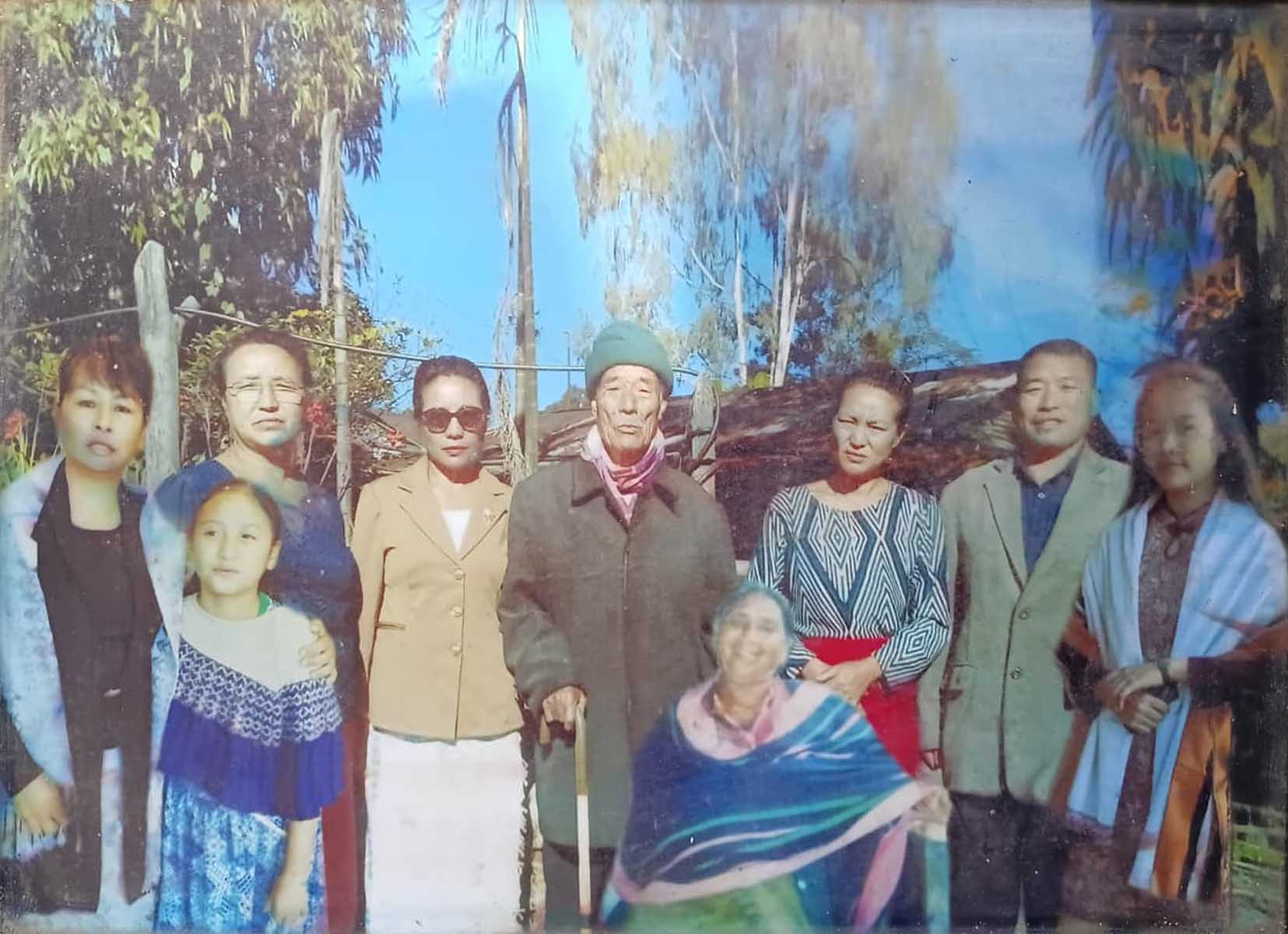
Before public responsibilities gave Dr. Vikehielie Victor a place in the wider community, there was a much smaller world, and it is there that his understanding of people first took shape.
He was born on 25 January 1972, the only son among four children, with two elder sisters and one younger. He grew up wrapped in the presence of his parents and his sisters, in a household where family history, work, faith, and the example of earlier generations were not reserved for special occasions. They were simply part of ordinary life, woven into the rhythm of each day.
His father, Kevise Kuotsu, had entered government service young, and he had entered it the hard way. His own childhood was marked by loss. After his parents died, he and his elder brother were left to each other during one of the most difficult periods in Nagaland’s history. That brother was later killed by a Sikh regiment. With the family suddenly reduced, village elders guided the surviving son toward government employment. In 1956, he joined the service in the Deputy Commissioner’s Office in Kohima. His working life carried him through other government responsibilities before he eventually stepped away from formal service.
There was another side to the man. At a time when roads had not yet reached the village, he took up contract work connected with road construction from Zubza toward the village. That work brought him into contact with Christian missionaries and Catholic priests, and the relationship deepened into something he would carry for life. He took an active role in the Catholic faith and eventually became the founder of the Catholic Church in Mezoma. For the children growing up around him, religion was never an abstract idea kept apart from daily life. They watched their father embrace it, and they watched it enter the family through him.
That influence reached the young boy naturally. He was taken to Don Bosco School, where his early schooling unfolded in an environment where education and Catholic faith existed close together. He was baptised a Catholic, and Victor became his baptismal name. The name stayed with him, eventually becoming part of the identity by which he would be known.
Yet faith was only one part of what he inherited. Family history carried its own lessons. He has spoken with particular respect about his forefathers and grandparents, remembering them as wise people who carried responsibilities within their communities. From the stories he heard about them, he came to understand that leadership could mean building a bridge between people rather than standing above them. He recalls ancestors who were trusted to help create understanding between different sides, including during the period when the British came to the region. Another grandfather was remembered as a well-to-do man trusted by the British administration in matters connected with the boundary between Assam and Nagaland.
These stories did not arrive as a formal curriculum. No written manual explained what he was expected to become. Instead, the examples of earlier generations settled into him quietly, and he describes it as an unwritten knowledge, something that seemed to exist within him through the family history he had inherited. When older people who knew that history spoke to him as a young boy, telling him that one day he would become a man, their words stayed with him.
“I was sixteen when I understood that my plans belonged to me, but my responsibilities belonged to everyone. It was not a sad realisation. It was simply the end of childhood.”
Phase 2 : The Weight of a Single January
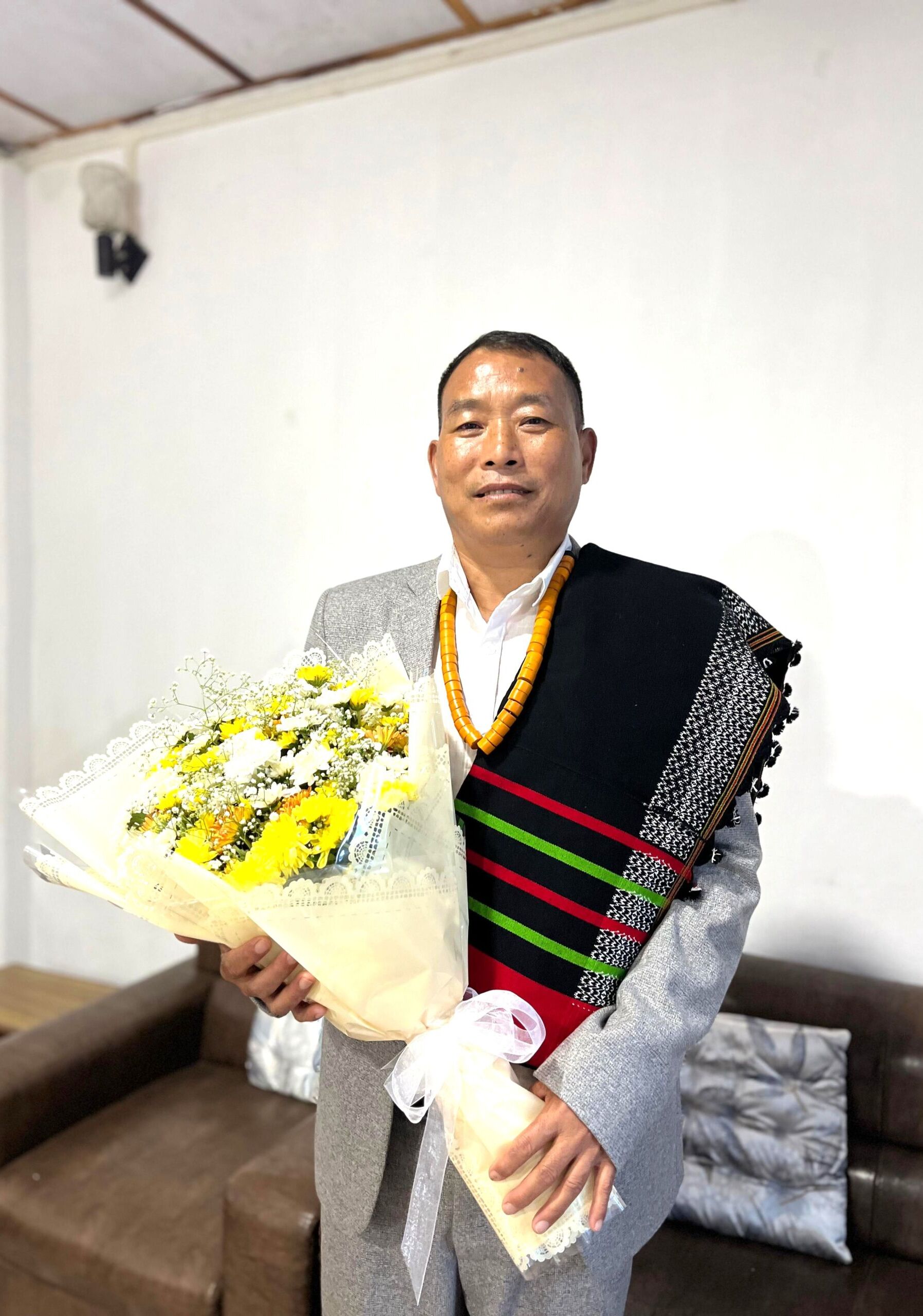
There are moments in a young person’s life when circumstances make the decision before the person is old enough to understand that a decision is being made at all. For Dr. Vikehielie Victor, 1986 was that year. Until then, education belonged to the ordinary rhythm of growing up. There were schools to attend, studies to finish, and a vague, comfortable sense that the future would arrange itself in due course. After 1986, the meaning of responsibility became something much more immediate.
On 2 January 1986, his father suffered an accident while travelling to a neighbouring village. The trouble had begun elsewhere, in a conflict between groups after a man accidentally shot his friend during a hunt. Elders and leaders from Mezoma went to meet the neighbouring village, and his father was among those who accompanied them. The terrain was hilly. As night came down, the path grew harder to read. Somewhere along the way, he fell and injured his thigh.
For the family, the accident was never just an isolated incident. His mother had to care for him while the children were still young and studying away from home. The sisters were in boarding school. A household once organised around ordinary routines now had to reorganise itself around an unexpected need for care, and no one inside it could remain untouched.
Then came the second blow. His mother, already carrying the weight of nursing her husband, suffered a mild stroke. The right side of her body was affected. Suddenly, the person who had been caring for another family member needed care herself. For children still trying to make sense of their own lives, the circumstances were difficult to absorb.
The effects did not lift when the immediate crisis passed. As his elder sisters eventually married and the question of responsibility pressed harder, he found himself looking at his own education differently. He had reached the stage at which he would ordinarily have continued into higher secondary, or what was then called pre-university. Instead, the practical needs of his family demanded attention. He had to work.
That decision carried a quiet weight. It was not born from any loss of interest in education. Quite the opposite. He still wanted to study, and he had ambitions of his own. From childhood, he had imagined himself entering politics, standing before people, becoming a politician. That aspiration had lived in him long before circumstances forced him to think about employment. But dreams do not always arrive at the moment life is ready to accommodate them.
There was also his mother’s influence, and it pointed in a particular direction. She had never attended school herself, yet she had always believed that education could give her children a better life. She wanted them educated and settled in professions she regarded as respectable, teaching or medical service above all. Her words stayed with him. When circumstances required him to take up employment, becoming a teacher allowed him to work while still moving toward something his mother valued.
“I learned that you cannot carry someone else’s words unless you have first made them your own. That is why I went back to study, with grey beginning to show at my temples.”
Phase 3 : The Classroom That Taught the Teacher
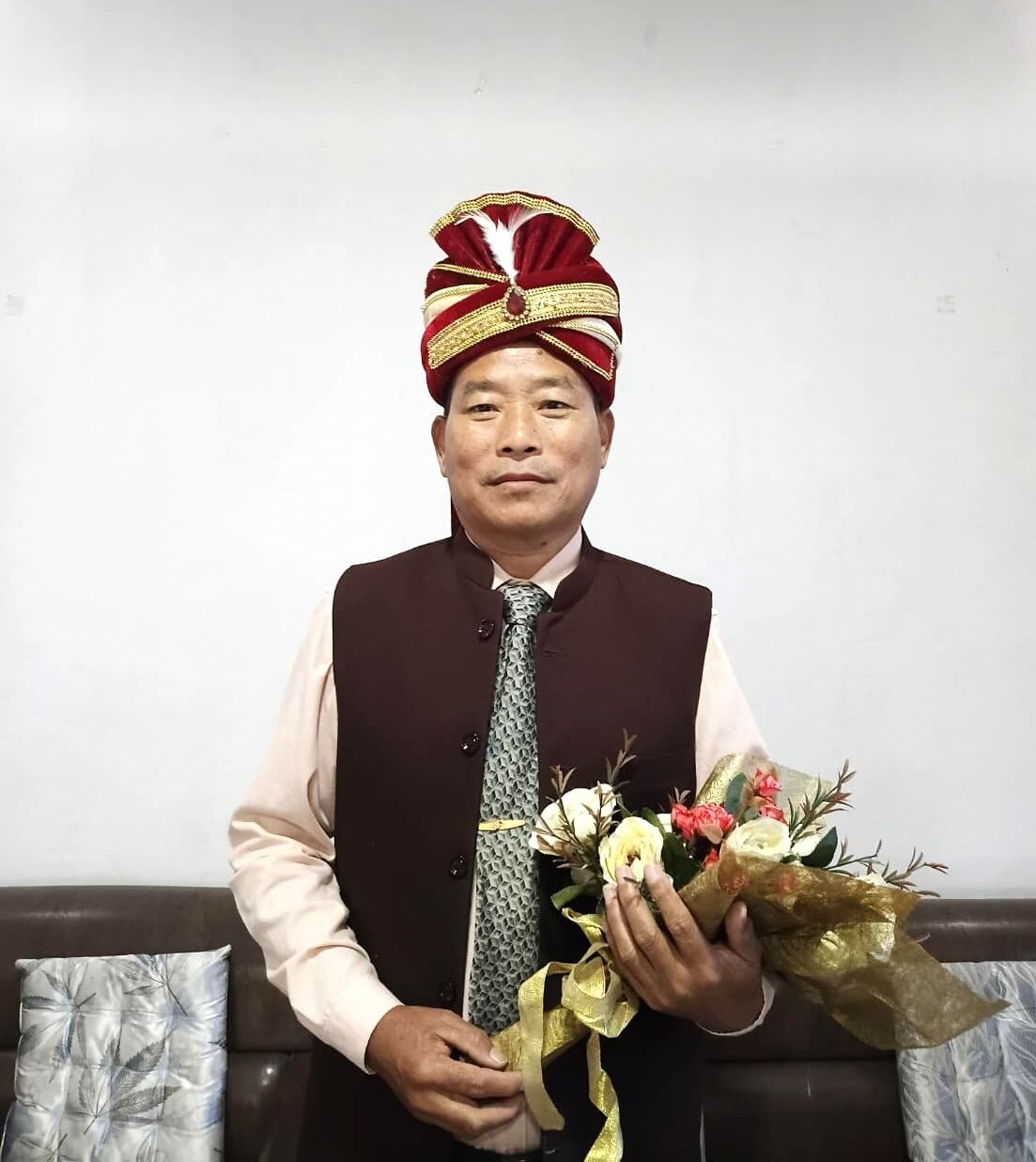
The classroom gave him something he had not expected when he first accepted the teaching post. He had entered government service because his family needed him to work, and because teaching was a profession his mother had always held in quiet reverence. Yet once he stood before his students, the role grew beyond a practical answer to difficult circumstances. It became a place where he discovered that knowledge could move in both directions.
He liked being with students. Their questions, their presence, the plain daily demands of the work, all of it forced him to examine what he actually understood. He began to see that a teacher could not remain intellectually still. To explain a thing clearly, he first had to understand it more clearly himself. The classroom became a place of reciprocal learning. He taught, and he kept learning.
That realisation mattered because his own education was far from finished. Work and family had already interrupted the straightforward academic path he might once have imagined, but the desire to study had not gone anywhere. He did not want employment to become the point at which his education quietly stopped. While continuing to teach, he discussed further study with his family and looked for a way to continue without abandoning his responsibilities.
The answer came through correspondence education. He enrolled with Varanasi Sanskrit Vishwavidyalaya for his Bachelor of Arts, studying while remaining in employment. It was a demanding arrangement. His work could not simply be set aside, and his family still needed his attention. The study had to fit around a life that already carried obligations.
There was a particular satisfaction in getting through it. He had wanted higher education, and now he was pursuing it while working. The degree was therefore more than another qualification placed beside his name. It proved that the desire to learn had survived circumstances that could easily have killed it.
His approach to education was practical rather than ornamental. He never spoke of learning as something valuable merely because a certificate could prove it. His experience in the classroom had already shown him that knowledge had use. It changed how a person thought, how a person communicated, and how effectively that person could serve others.
Years later, another form of learning drew him back into formal study. His Catholic faith had become closely connected with his work as an interpreter within the Church. Priests and religious figures from other communities, including mainland India, would speak in settings where interpretation was needed. He would translate their words into his dialect so that others could understand.
Note of Thanks
At the end of these pages, there are many names and memories that deserve to be acknowledged. No life is shaped in isolation, and Dr. Vikehielie Victor recognises that whatever he has been able to accomplish has been accompanied by the presence, the encouragement, the prayers, and the goodwill of people who stood beside him at different stages.
His first thanks belong to his family, whose presence remained a source of strength through changing responsibilities and demanding circumstances. He holds a special place in his heart for his wife, Neilhouviu Khalo, and for their children, whose love and understanding gave meaning to the private side of his life. Their support held steady even when his public responsibilities required time and attention beyond the ordinary.
He offers heartfelt gratitude as well to his friends, whose companionship added warmth and encouragement to his years of work and service. Their presence reminded him that friendship is often found in the simple act of standing beside someone, especially when circumstances are demanding.
A special word of appreciation goes to his sisters and brother-in-law. Their support and their relationship have been part of the family circle that accompanied him through life, and their place in his story is acknowledged here with affection and sincere thanks.
He remains grateful to the many people with whom he worked and interacted through different responsibilities. Whether through education, student welfare, social service, political activities, rural development, or community leadership, each association contributed something to his understanding of people and of responsibility.
Above all, his gratitude rises to the Almighty God. He acknowledges God’s presence, guidance, protection, and grace throughout his life.
With humility, he offers these thanks to everyone who walked beside him, supported him, believed in him, and contributed, in ways both visible and unseen, to the life recorded in these pages.
thanks,
– Dr. (H.C.) Vikehielie Victor

AIMLAY is a leading global education platform empowering ACADEMIC and EXPERIENTIAL learners, uniquely focused on recognizing knowledge gained through experience and building a diversified community of doctorates and aspiring researchers.