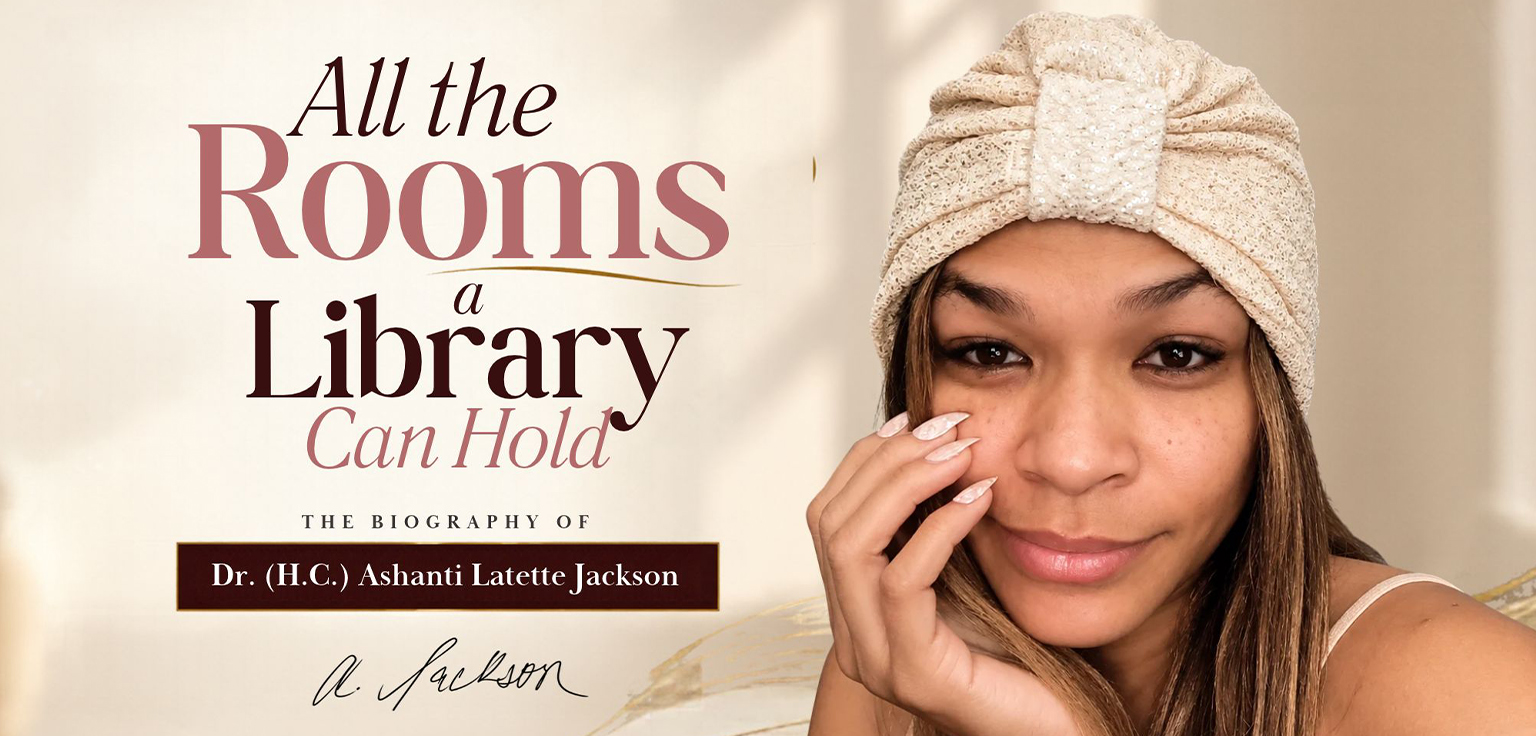
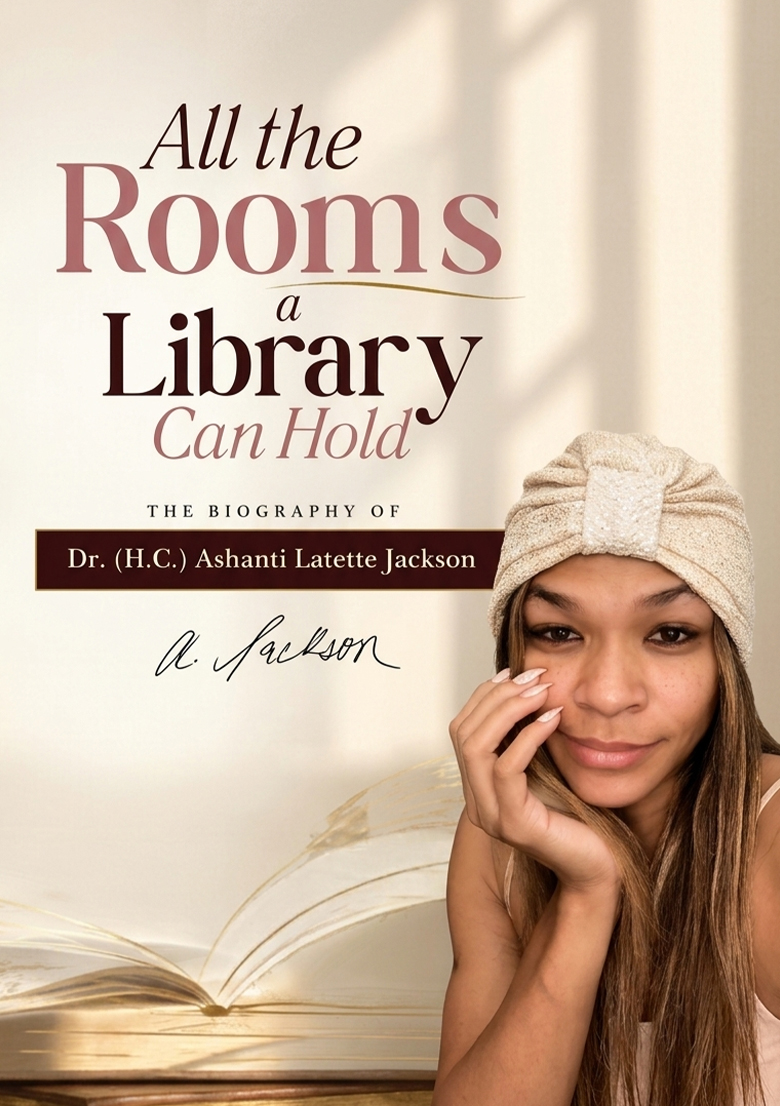
“I believe knowledge becomes meaningful when it helps us listen better, teach better, and serve with greater purpose.”
Introduction
Dr. Ashanti Latette Jackson is one of those people who somehow manages to be both deeply intellectual and genuinely warm. She is endlessly curious not in a distant, academic way, but in a real, bone-deep sense of wanting to know how the world works and why people are the way they are. That did not start in a lecture hall. It started when she was a kid, wandering the library aisles with her mother, Gail Stewart Haith. Her father, Eric Haith, was also an integral part of her upbringing. He raised her with care, steadiness, and presence, helping create the foundation in which her curiosity, confidence, and love for learning could grow. Those hours spent moving from picture books to chapter books were not just about learning to read. They opened up whole worlds she had not seen before, and they taught her something she never forgot: Knowledge is not something you only get in school, and empathy really does come from hearing other people’s stories.
Even as a little kid, she was fascinated by history, folklore, and cultural tales. She wanted to understand how communities worked, why traditions persisted, and how one person’s actions could ripple out into something larger. That curiosity never faded. If anything, it grew into the thing that drives her whole life as a researcher and teacher.
Her formal education shows how deliberately she built that path. She majored in Political Science and African American Studies as an undergrad, where she delved into history, governance, and social equity. Then came a Master of Arts in Liberal Studies and a Master of Library and Information Studies at the University of North Carolina at Greensboro. There, she threw herself into research, study abroad opportunities, and a lively community of international scholars. All of that shaped how she sees different perspectives and how research can actually be useful in the real world, not just in theory.
At the California Institute of Integral Studies, she pushed even further into Transformative Leadership and cultural narratives. The mix of rigorous scholarship, supportive faculty mentors, and exposure to all kinds of communities drove home a point she already suspected: Academic knowledge and community work cannot really be separated. Her research style became both sharp and compassionate. She started using cultural stories and literature to build bridges between different generations and communities.
Her early jobs as an educator only sharpened those instincts. She tutored middle and high schoolers. She taught English language arts, literature, and history at different schools. At Abundant Life Christian Academy and later with Brainfuse, Inc., she got good at taking complicated ideas and making them feel accessible without dumbing them down. She has helped students with creative writing, SAT preparation, and history research, always emphasizing critical thinking, empathy, and practical application.
Her work has not stayed inside classrooms. She has done community research as well, studying Southeast Asian refugee undergraduates and looking at how clergy can support young men aged 18 to 25 in diverse urban neighbourhoods. Her work draws just as much from people’s lived experiences as from academic texts.
Along the way, mentors and peers made a difference. Faculty at UNCG, including Dr. Frank Woods, Michael Cauthen, Sally Ann Ferguson and Dr. Clara Chu, recognized Dr. Ashanti’s ability to connect ideas across different fields and supported her in building her path in teaching, research and interdisciplinary scholarship. Their encouragement, coupled with her own natural drive, positioned her for a career founded on interdisciplinary scholarship and a conviction that education should be transformative.
"I always have been a lifelong learner, and I don’t think I’ve ever lost interest at any point in learning something new."
Phase 1: The First Language of Curiosity
Long before Dr. Ashanti Latette Jackson became known for her work in research, education, writing, library studies, and cultural inquiry, she was simply a child whose world opened first through books. Her earliest memories of learning were not shaped by grand opportunities or distant travel but by the quiet wonder of reading, the patient encouragement of her mother, and the endless doors that seemed to swing open every time she stepped inside a public library. As an only child, she found genuine companionship in words, stories, histories, and the kind of questions that linger long after the page is turned. She has described herself with warmth and honesty as a certifiable nerd, a phrase that captures not only her love for learning but also the unmistakable joy with which she embraced knowledge from a very young age.
She learned to read when she was only four years old. By the time she was six, her mother would take her to the public library, a place that became, for her, so much more than shelves and books. It became a sanctuary of discovery, somewhere a young girl could travel without ever leaving town, could listen to voices from the past, and could begin to grasp that every story carried a history behind it. Her family wasn’t rich and they didn’t travel much, but books opened doors to places, people, and experiences that stretched far beyond the borders of her immediate world. Through reading, she could imagine the wider world, and through that imagination, she began quietly forming the foundation of a life devoted to study and service.
What made her early curiosity so unusual was the depth of what drew her attention. As young as six years old, she had already begun reading folklore and slave narratives. These were not subjects from her own lifetime, yet they called to something deep within her. They ignited a longing to know more about the past, not as a chronological list of events, but as a living force that still shapes people, communities, and entire systems. Even then, she was not simply reading for information. She was reading to understand. She wanted to know how people lived, how cultures carried memory across generations, how systems were formed, and how older realities continued to ripple into present conditions.
This early attraction to history and culture did not fade as she grew older. If anything, it became more refined and more purposeful. She developed a lifelong habit of probing beneath the surface, a quiet refusal to accept easy answers. She was never satisfied with learning only what was placed directly in front of her. She wanted to ask what came before, what remained hidden, and what could be understood when different fields of study were placed beside one another. This instinct would later become central to her academic path, but its roots were already visible in childhood. Her curiosity was never narrow. It moved naturally from books to people, from stories to systems, from culture to identity, and from personal learning to the larger needs of communities.
For her, learning has always carried a profound sense of fulfilment. She has spoken of books as some of her most faithful companions, with documentary films close behind, especially because they allow her to continue discovering fresh perspectives. Her love of learning was never limited to classrooms. It lived in libraries, in travel, in conversation, in cultural festivals, in research, and in the honest, unhurried exchange of human experience. She understood early that she might not visit every country in the world, yet whenever she had the opportunity to encounter a different country, city, culture, or group of people, she embraced it wholeheartedly. That openness, that willingness to step toward the unfamiliar with genuine curiosity, became one of the defining qualities of her life.
Her education took her further into fields that might seem separate at first glance, but for her, they belonged together naturally. Political Science provided a lens for her to understand how history and the lasting impact of older structures shape the current systems. African American Studies deepened her immersion in culture, identity, and historical experience. Library and Information Studies gave form to her passion for knowledge, research, access, and the sacred work of preservation. Transformative Leadership and Divinity later broadened her view of service, outreach, and the profound responsibility of leading communities with thoughtfulness and care. In her view, these areas are not separate. They intersect. They speak to one another. They help explain how people, institutions, histories, and communities are connected in ways that are both visible and unseen.
“The beautiful thing about learning is that no one can take it away from you.”
Phase 2 : The Studies That Gave Her Questions a Voice
The story of Dr. Ashanti‘s formal education really just picks up where her childhood left off. She came into primary and secondary school already wired to ask questions and actually enjoy learning. That’s what turned plain curiosity into real academic progress. Dr. Ashanti’s successes in school weren’t really about grades. They were about her starting to understand how social behaviour works and what historical forces shape the places she read about.
When she moved into higher education, she was deliberate about it. She chose to study Political Science and African American Studies as an undergrad because she already sensed that looking at governance, history, and culture together would give her a richer picture than any single field could offer.
She later earned her Master of Library and Information Studies at the University of North Carolina at Greensboro as an Academic and Cultural Enrichment Scholar, under a grant by First Lady Laura Bush. This opportunity strengthened her connection to library science, research, access to knowledge, and the wider purpose of education.
She applied herself to her courses with both rigour and real curiosity, spending hours on historical study, social research, and critical conversations. Each class, each assignment, each project was another chance to learn societal structures and the forces that influence them.
In college, she also had mentors who shifted her perspective on what it meant to be an academic. Her professors observed her ability to link together seemingly disparate ideas and encouraged her to continue exploring interdisciplinary approaches to her study. They pushed her to think critically, to question her own assumptions, and to apply what she was learning in ways that were both incisive and sympathetic. Mentorship was very important to her development. It provided her the direction and freedom to grow into her own independence. The encouragement she received from instructors allowed her to make a concrete commitment to higher learning.
Nor was she confined to the classroom. She sought ways to apply what she was learning. She was involved in research initiatives that required her to observe carefully, analyse critically, and synthesise diverse perspectives. Those early projects were a prelude to her later work on cultural narrative systems and transformative literature. They trained her to be exact, to attend to context, and to constantly tie research back to real human experience. Even then she showed a penchant for bringing together theory and practice, and it would be a hallmark of her scholarly manner.
"I want to continue showing how different areas converge and provide a better understanding."
Phase 3 : From Cultural Questions to Living Research
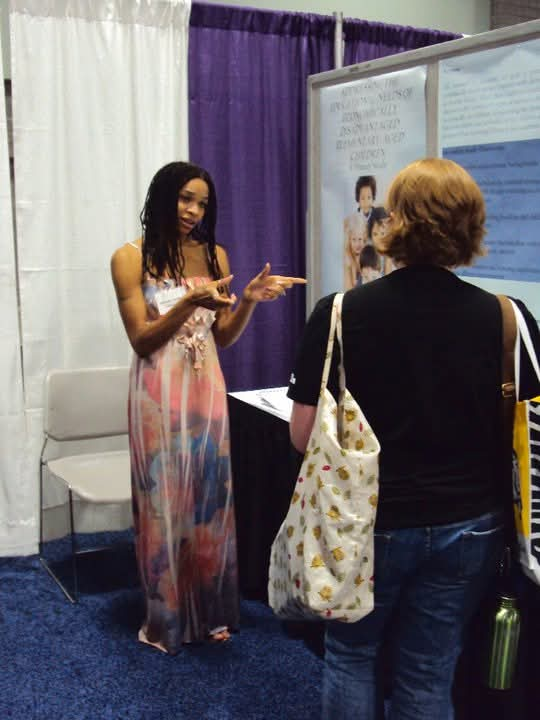
In Dr. Ashanti’s life, all of that early curiosity and undergraduate preparation finally began to transform into more concentrated graduate study and actual research. Her interdisciplinary journey truly began during this phase. Graduate school gave her the space to hone both her intellectual discipline and the empathetic lens she’d been carrying since she was a kid.
Dr. Ashanti found professors and advisors who were excited by how she could pull ideas from disparate fields and string them together. These mentors urged her to challenge her own assumptions and to think critically but also to direct her toward research techniques that were both precise and flexible. Their encouragement opened the door for her to pursue her own lines of inquiry and helped her build the independence and analytical rigour that would later define her work. Those relationships really shaped how she thinks about research, particularly the ethical responsibility that scholars have when they are trying to interpret other people’s experiences.
Graduate school also provided the chance to get involved in hands-on research that would connect theory to practice. Her projects required careful collection and analysis of data, weighing of different perspectives, and application of this knowledge to understanding social behaviours and cultural systems. It was in these early research experiences that she learned how to combine methodical precision with heartfelt empathy. She wanted her findings to be meaningful not only in an academic but also in a social and cultural context. She went beyond formal research. She actively looked for ways to involve herself with communities. She began to examine the experiences and needs of undergraduate students who were refugees from Southeast Asia.
She tackled demanding academic work through careful observation, reflection and action-oriented research. And she tried to blend empirical inquiry with a sense of ethical responsibility toward the communities she studied. These practices reinforced her identity as a scholar committed to both intellectual rigor and compassionate understanding.
Dr. Ashanti never thought of disciplines as separate boxes. Political Science, African American Studies, library studies, and cultural studies were all connected in her mind, a holistic way to think about narrative, identity, and society. That perspective became the bedrock of her way of doing research and teaching. It enabled her to examine complex social systems while never losing sight of the fact that culture and human experience were her primary focus.
Note of Thanks
This note of thanks is offered with sincere appreciation to all who were a part of the life, learning, and work of Dr. (H. C.) Ashanti Latette Jackson. Her journey has been one of curiosity, devotion, and empathy, and supported by so many who nourished her growth, directed her development and inspired her to continue pursuing knowledge and service.
Most importantly, Dr. Ashanti would like to thank her parents, Eric Haith and Gail Stewart Haith. Their silent encouragement and thoughtful mentoring were the foundation of her intellectual curiosity and her ethical grounding. Their constant support gave her the confidence to travel, to question, and to continue seeking understanding. Every stride she has taken in her academic and professional life is anchored in the teachings they taught her via care, patience and the example they established.
Her passion is further strengthened through her daughter, Kupuno Peru Jackson, who continues to inspire her commitment to learning and growth, and through her partner, Marlon Watts, whose support and assistance in her current research have become a meaningful part of her ongoing journey.
Special gratitude is given to the mentors and professors who guided Dr. Ashanti through her undergraduate and graduate studies, including Dr. Frank Woods, Michael Cauthen, Sally Ann Ferguson, and Dr. Clara Chu at the University of North Carolina at Greensboro and the California Institute of Integral Studies. They urged her to engage in multidisciplinary scholarship. They gave her serious critique, which improved her. And their conviction in her potential influences how she tackles research, teaching, and community engagement. Their effect is wherever she goes, in every classroom, every workshop, every project she touches.
This message also pays appreciation to the students, classmates, and community members who helped her grasp cultural narratives, social systems, and human experience. Their stories, their problems, their ideas have contributed to the living research Dr. Ashanti appreciates most. She never believed research was something you do from afar, and these are the folks who taught her that.
Finally, this recognition goes to the colleagues, partners and organizations that enabled her work to expand beyond academia and into genuine community participation. To all those who imparted wisdom, gave direction and helped in her endeavors, have been fellow travelers on a trip marked by learning, empathy, and service.
With their assistance, Dr. Ashanti Latette Jackson has been able to touch lives, develop bridges, and encourage future generations to approach scholarship with curiosity, compassion, and meaningful purpose.
thanks,
– Dr. (H.C.) Ashanti Latette Jackson

AIMLAY is a leading global education platform empowering ACADEMIC and EXPERIENTIAL learners, uniquely focused on recognizing knowledge gained through experience and building a diversified community of doctorates and aspiring researchers.