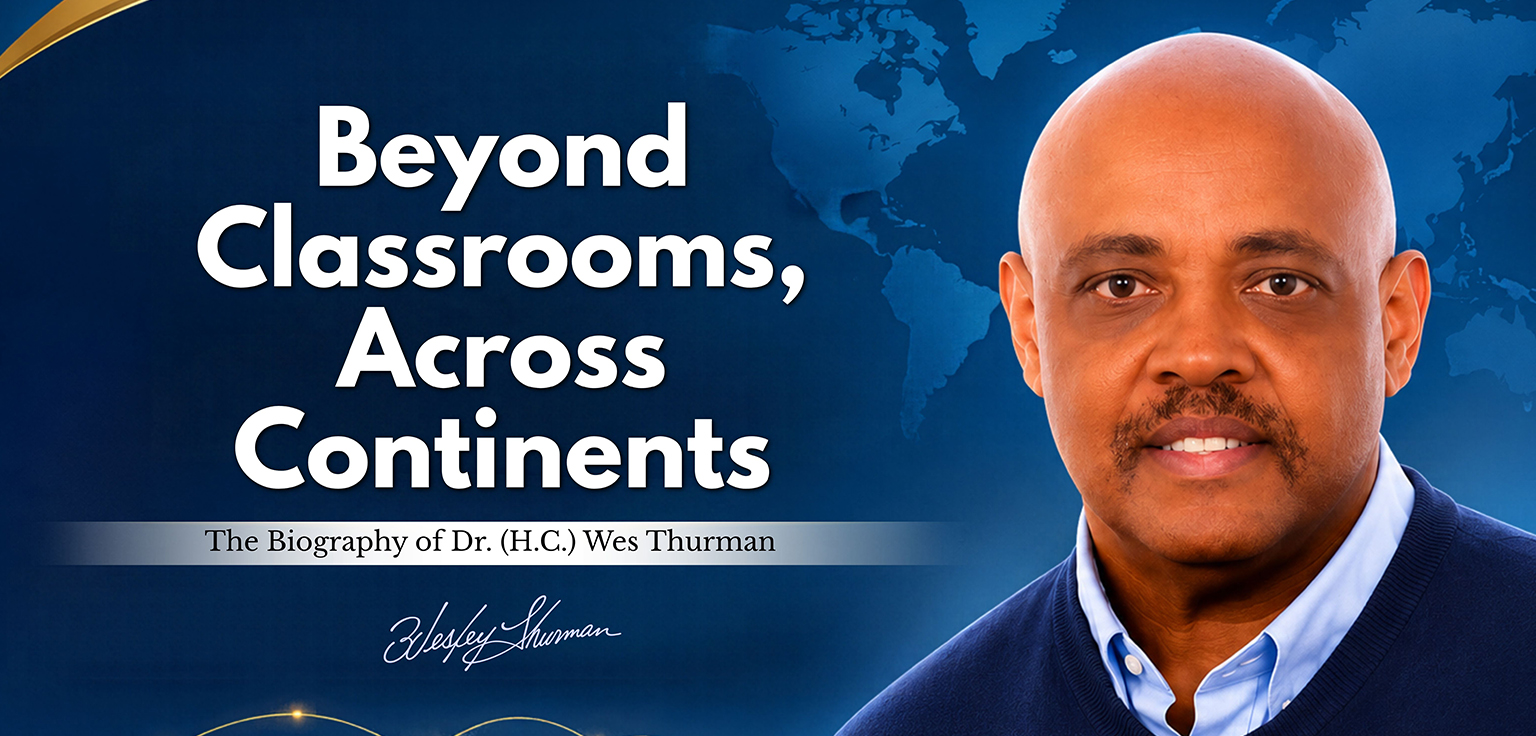
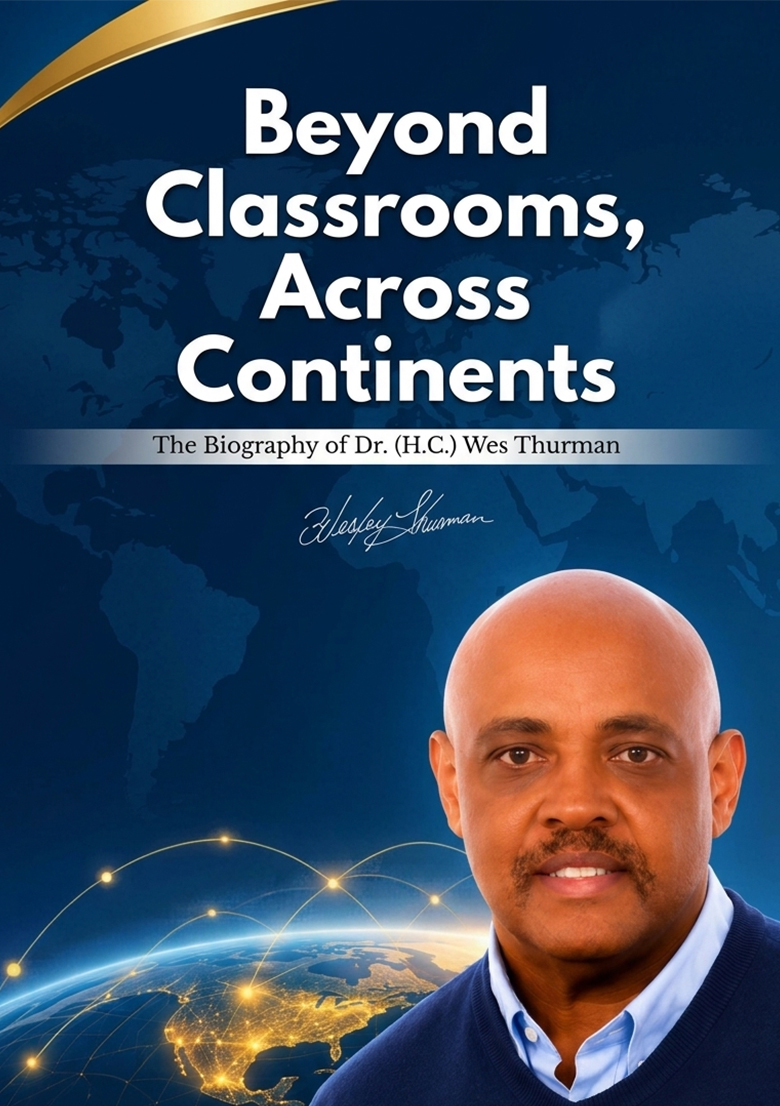
“I do not think people ever stop learning. Once they say they have stopped learning, they begin to stagnate.”
Introduction
Some lives are shaped by one profession so completely that every achievement can be placed beneath a single heading. Dr. Wes’s life resists that kind of simplicity. His work has moved through education, behavioural services, public administration, community engagement, communication, learning development, and social enterprise. These areas may look separate when listed on paper. In practice, they have been held together by one enduring concern: how people learn, how they respond to the conditions around them, and how thoughtful guidance can help them move towards greater possibility.
His curiosity has never been casual. It has always carried a practical edge. When something did not make sense, he wanted to look more closely. When a learner struggled, he did not believe the visible difficulty necessarily told the whole story. When an institution followed an established method, he remained interested in whether that method was truly serving the person before it. When he encountered another society, he did not look only for difference. He also listened for the familiar human patterns that crossed geography, language, and custom.
That disposition made him difficult to confine to one professional identity. He could think in numbers and still remain deeply interested in psychology. He could understand formal systems while questioning the assumptions beneath them. He could work with policy and yet prefer the immediacy of community. He could teach established subjects while encouraging the larger habit of inquiry. His range did not come from restlessness for its own sake. It came from a conviction that knowledge becomes more useful when connections are allowed to form between fields.
The educator in him was present long before education became a formal career. It appeared in the ease with which he related to young people, in his willingness to accept responsibility, and in his habit of explaining ideas through realities people already understood. Over time, that instinct developed into professional skill. It became the ability to design learning, assess needs, guide staff, read patterns in behaviour, and adapt methods according to the evidence before him. Experience taught him that people rarely benefit from being treated as categories. They respond when someone pays attention to the person within the description.
His international outlook grew from the same impulse. The world interested him not as a collection of distant places, but as a vast field of human experience. Languages offered entry into conversations. Travel offered comparison without requiring contempt for one place or uncritical admiration for another. Teaching abroad placed him inside educational cultures rather than at their edge. There he could observe what societies expected from learners, what they expected from teachers, and how those expectations shaped daily conduct.
Such observation gradually sharpened his educational philosophy. He came to value standards that reached beyond academic performance and considered the fuller formation of the learner. He was not interested in choosing novelty merely because it was new, nor in defending tradition merely because it was old. He looked for a working model that could preserve what formed capable, rounded individuals while making room for approaches that responded intelligently to present needs.
This combination of openness and discernment gives his story its particular character. Dr. Wes has known encouragement and obstruction, belonging and dislocation, professional recognition and moments when his contribution was not fully acknowledged. He has entered unfamiliar environments, rebuilt after personal change, and continued working after formal retirement. None of those experiences turned him away from learning. Each one gave him another angle from which to understand it.
“The child is father of the man.”
Phase 1: The Oldest Son in a Family of Eight
Dr. Wes grew up in Queens, New York, in a middle-class family whose daily life was shaped by work, responsibility, and the varied demands of a large household. He was one of eight children. Three older sisters came before him, while four younger brothers followed. His place among them was particular. Although he was not the eldest child, he was the oldest son, a position that would acquire real weight before he had fully reached adulthood.
His father, Ernest, worked for Chrysler as an automotive technician and engineer. The work was skilled and practical, joined to an older understanding of labour that came from farming. Ernest had grown up with the rhythm of a farm, where activity was not something arranged for convenience. Work waited each day and had to be done. That expectation travelled with him into family life. If he saw his children sitting without purpose, he would warn that idleness could lead them into trouble and find a task for them. Dr. Wes began working when he was around ten, and the habit of remaining active took root early.
His mother, Helen, initially remained at home to care for the family. When her son was about fifteen, she returned to school and became a nurse who worked with disabled people. Her decision added another example of adult learning to the home. Education did not belong only to childhood, and professional direction did not have to be fixed permanently at the beginning of life. Without making a formal lesson of it, her return to study showed that a person could step into a new role through preparation and resolve.
The size of the family meant that life was rarely centred on one person. There were different ages, needs, and temperaments under the same family identity. Dr. Wes learned his position among them by living it. His sisters were older, his brothers younger, and the movement between those relationships gave him both people to look up to and people for whom he would later carry responsibility. In the years that followed, all three sisters and most of his brothers passed away. Their absence gave the memories of that early household a deeper poignancy. What had once been the ordinary presence of siblings became part of a family world that he alone could not recreate.
A decisive change came when his father became ill while Dr. Wes was about fourteen. Within his culture, the oldest son was expected to step forward when the father could not carry his usual place in the household. Ernest spoke directly to him. He told him that he was now the man of the house and instructed him to do what his mother said. The words were brief, yet the responsibility behind them was considerable. He helped raise the younger children until his father’s health improved.
That experience did not allow him to remain concerned only with his own adolescence. School, friendships, interests, and ordinary teenage questions continued, yet they now existed beside duties that affected other members of the family. He had to understand that responsibility was not a performance. It consisted of being available, following direction, and helping to maintain what the household required. The lesson was practical long before it became philosophical.
These early influences created a foundation that would appear repeatedly in the choices Dr. Wes made, even when the surroundings changed. The automotive precision associated with his father’s profession, the constant labour inherited from farm life, his mother’s return to education, and the obligations of a crowded home all taught different forms of discipline. None arrived as an abstract principle. Each was attached to a person, a task, or a moment in which something needed to be done.
“We are all in the gutter, but some of us are looking at the stars.”
Phase 2 : From Monastic Peace to the Apollo Sky
One of Dr. Wes’s earliest memories began with a magazine. He was about four years old when an image led him to imagine becoming a monk. The wish was unusual for a child of that age, though the reason he later gave was simple. He believed a monk’s life would be more peaceful. He was interested in the monastic way of living and in the quiet it seemed to promise.
Peace was only part of the attraction. Even within that early dream, there was a desire to travel. The world beyond his immediate surroundings had begun to call his attention before he possessed any practical means of reaching it. Television programmes shown on Saturday mornings carried stories and images from different countries. Children in other parts of the world appeared on the screen, and their lives made distant places feel imaginable. He remembered wanting especially to see Asia, including India and China, and to move through the regions of South, Southeast, and East Asia.
Growing up in New York gave that curiosity a physical destination close to home. He enjoyed visiting the United Nations, a place where nations, languages, and public concerns met under one roof. For a young person already interested in how people lived elsewhere, such visits confirmed that the world was both larger than Queens and connected to it. International life was not purely an image on television. It could be heard in different accents, recognised in friendships, and encountered in the city around him.
His friendships reflected that openness. By the age of twelve or thirteen, his closest friend was a Polish American boy whose family had come to the United States after the First World War. His friend came from a Jewish background that was more Reform than Orthodox. Their bond endured across the decades, continuing until his friend’s death in 2020. The friendship mattered not because it could be used as an example of diversity, but because difference never prevented closeness. Dr. Wes learned early that a person from another religious or cultural background could become one of the most familiar presences in life.
Spiritual formation was also part of his own home. When he was around five, his mother required him and his siblings to attend Evangelical Christian services because she wanted them to possess a religious dimension in their lives. He responded strongly to that environment. During his teenage years, he attended seminary with the intention of becoming a cleric. While continuing school and later high school, he worked for several years as a youth pastor in the Evangelical Church.
The role placed him among young people while he was still young himself. He was repeatedly told that he worked well with them. That ability did not yet carry the title of educator, counsellor, or behaviour specialist. It appeared first as a natural way of relating. He could communicate with younger people, hold their attention, and remain present within a setting that joined belief, responsibility, and guidance. His later professions would give that instinct more formal methods, though its beginnings belonged to these years.
Around the age of ten, another possibility briefly opened. Dr. Wes received a contract to appear in commercials and act on television. The opportunity might have drawn another child towards performance, visibility, and an appetite for being seen. His response was different. He did not like the way he looked in photographs or on screen, and he never developed a fondness for having his picture taken. Even later, when images were needed to represent important periods of his work and travel, photographs remained something he had collected sparingly.
“Knowledge itself is power.”
Phase 3 : A Mind for Numbers, a Calling to Understand People
School gave Dr. Wes both encouragement and a puzzle he would understand only much later. His teachers consistently regarded him as a capable student. They told his parents that he was suited for college and possessed considerable potential. He described himself through their eyes as something of a sleeper, a student whose ability might not always appear in an obvious or predictable way, yet who could suddenly rise and distinguish himself.
Mathematics was where his confidence showed most clearly. Teachers called him a “math head” because numerical problems came naturally to him. Spelling was another strength. Reading, however, demanded more time. He could read, but his pace was slow, and decoding written language could be difficult. At the time, there was no explanation that gathered those uneven abilities into a single understanding. There was simply the reality that one form of learning moved smoothly while another required additional effort.
He nevertheless did well. The encouragement of his instructors mattered because they saw capacity alongside difficulty. They did not treat a slower reading pace as the limit of his intelligence. Their comments directed him towards higher education and gave him a language of possibility. He was “college material,” they said, even when the route towards college had not yet become clear.
His parents had not received an education as thorough as the one available to him. Dr. Wes recognised that the difference created obstacles. There were parts of the academic journey that he had to negotiate without the advantage of parents who had already travelled the same path. Their experience of school did not provide a complete map for the decisions now before their son. He had ambition and ability, though he also had to learn how educational systems worked while moving through them.
After high school, his own preference was psychology. The subject attracted him because it offered a disciplined way to understand people, thought, and behaviour. An adviser saw a different direction and urged him towards business. Dr. Wes resisted inwardly. Business was not what he had asked for, and the recommendation did not erase his interest in the human mind. Still, the adviser sent him to one of New York’s leading business schools, and he entered the field placed before him.
Once there, he proved that reluctance did not prevent performance. During his first years, he came close to the dean’s list, received honours, and earned strong academic recognition. His quantitative ability found a natural place in business study. The mind that teachers had long recognised as mathematically gifted could engage finance and economics with confidence. The experience also broadened his circle of friends. As before, those friendships crossed cultural lines, helped in part by the languages he was learning at school.
Success did not protect him from every barrier. He encountered difficulty connected with his ethnicity, and the experience forced him to redirect his course through different schools. The interruption did not mean that his ability had changed. The recognition already earned remained real, even when the environment became more difficult to navigate. He adjusted without surrendering the larger goal of completing his education.
Note of Thanks
Dr. Wes offers his deepest thanks to the Universe, the source he recognises as having formed him before his arrival in this world. His gratitude does not depend upon a single achievement, opportunity, or moment of relief. It rises from the whole of a life that has continued to unfold through work, learning, difficulty, movement, and renewal.
He gives thanks for the capacity to remain curious. That curiosity allowed him to enter unfamiliar fields without closing himself to what they could teach. It enabled him to look beneath appearances, listen across difference, and continue seeking understanding when a simple answer would have been easier. He regards that impulse not merely as a personal trait, but as part of the way his life was put together.
He is grateful for the strength to continue when established structures changed. Some paths opened through choice, while others appeared after plans had been interrupted. Through each one, the Universe allowed experience to become instruction. Encounters that seemed temporary left lasting meaning. Difficult responsibilities developed endurance. Unfamiliar environments widened his understanding of people.
His thanks also embraces the opportunities to be useful. Teaching, guiding, observing, writing, and serving all gave his abilities a purpose beyond personal advancement. Every setting asked something different of him, and each gave him another chance to learn what contribution could mean.
Above all, Dr. Wes acknowledges the Universe with humility. His note of thanks is both recognition and commitment: recognition of the source from which he believes his life came, and commitment to honour that gift through the way he continues to live and contribute.
thanks,
– Dr. (H. C.) Wes Thurman

AIMLAY is a leading global education platform empowering ACADEMIC and EXPERIENTIAL learners, uniquely focused on recognizing knowledge gained through experience and building a diversified community of doctorates and aspiring researchers.