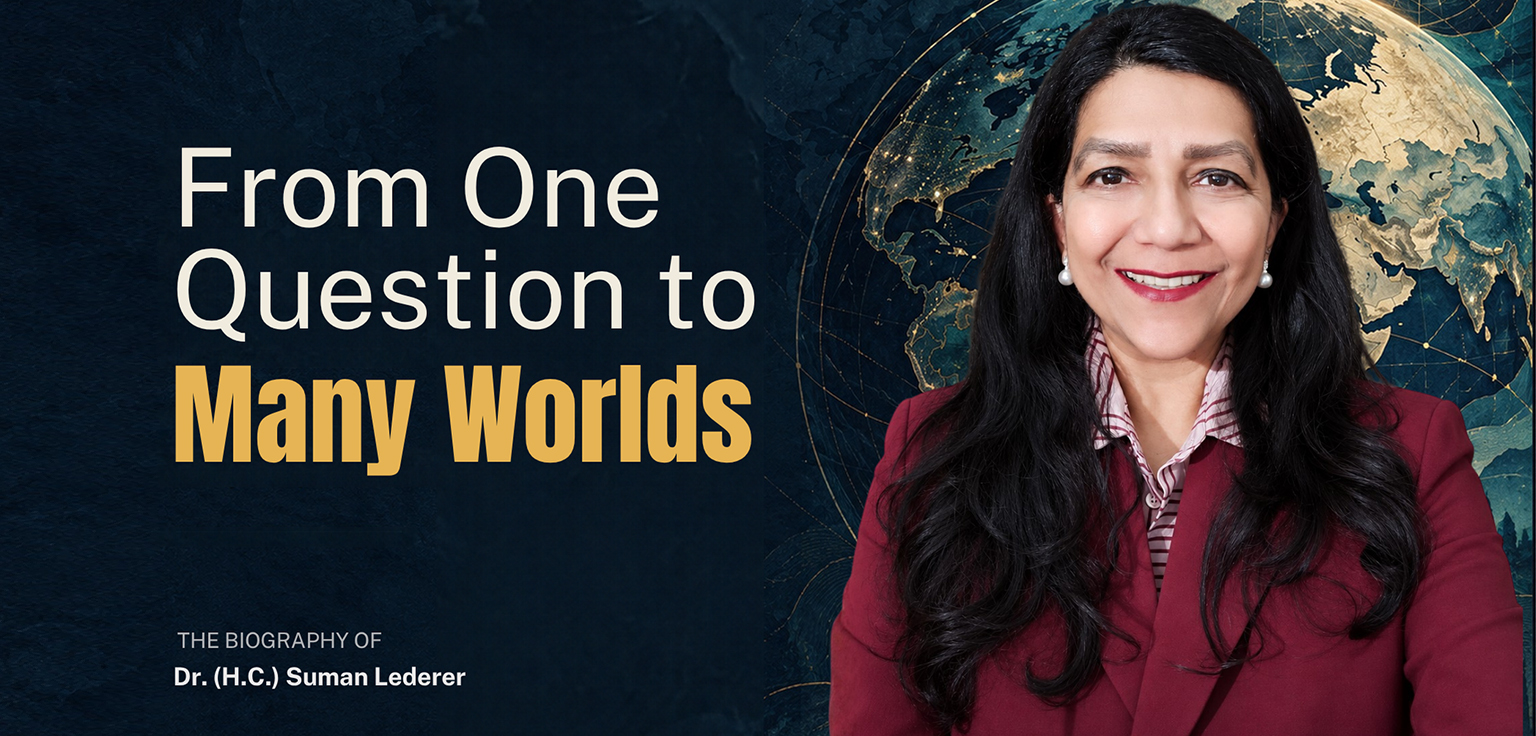
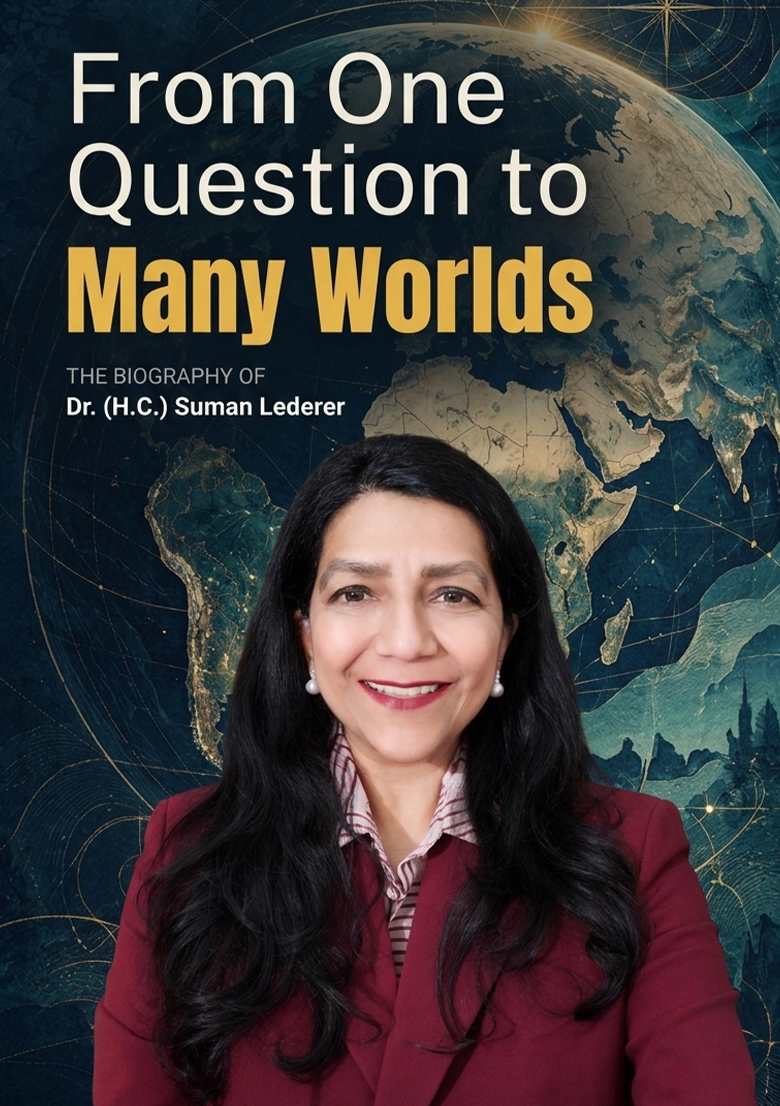
“Life does not always lead us where we thought we were going, but sometimes the unexpected turns become the memories we cherish most.”
Introduction
Dr. Suman Lederer has built a life across countries, professions, classrooms, and international organisations, with each change bringing a different kind of learning. Born in Bombay, she grew up in an environment connected to science and education before moving through very different worlds of sport, business, international affairs, research, teaching, and evaluation. Her choices were not always straightforward. Some came from necessity, some from curiosity, and others from recognising that she wanted to learn something more.
Her move from India to Germany as a young woman became one of the earliest major changes in her life. She learned a new language, worked in sales, interpreted at German courts and official authorities, travelled between cities, and gradually became comfortable managing life independently. She later pursued a Bachelor of Business Administration in International Management at Karlsruhe University of Applied Sciences. Alongside her studies, internships and work as a travel guide gave her an unusually practical education. Her interest in international affairs emerged towards the end of her degree when she began wondering how people entered the United Nations. That curiosity took her to the Diplomatic Academy of Vienna, where she completed the Special Programme in International Studies and then the Master of Advanced International Studies. The experience was demanding, financially and academically, but it also brought student activities, conferences, cultural events, her first substantial connection with international organisations, and eventually her entry into UNIDO, starting with an internship.
Research and project management gradually led her towards evaluation. What began as a short assignment eventually became a substantial area of professional work. Over the years, she worked with organisations including UNIDO, UNEP, UNODC, OSCE, and UNESCO, leading and conducting evaluations across subjects ranging from environmental issues and waste management to human rights, gender equality, renewable energy, private sector development, and heritage. She has led more than 30 project and programme evaluations, worked with experts across more than 50 countries, and conducted field missions in 16 countries.
Teaching became another important part of her professional life. What began with a desire to teach at a University of Applied Sciences developed into years of work with students in Vienna and through international programmes in Europe and beyond. She learned to change her teaching when the first experience did not go well, later experimenting with online education even before it became commonplace.
After living in Jakarta for six years, she returned to Vienna and pursued an MSc in Environmental Technology and International Affairs, while continuing her professional commitments. Today, learning remains part of her everyday life, while teaching continues to give her a valued connection with students. Her own words perhaps capture the balance most simply: “My evaluation work together with some teaching time was the ideal combination.”
"Some of the happiest memories begin with simply trying everything once and seeing where it takes you."
Phase 1: The World She First Knew
Dr. Suman Lederer’s earliest memories are rooted in a place where science, community life, school, and childhood existed unusually close together. She was born in Bombay, now Mumbai, and grew up in the residential colony of the Bhabha Atomic Research Centre, where her father, the late Mr. Sudhir Kumar Jain, worked as a scientist. The family lived in Anushakti Nagar, a place she remembers with genuine warmth. It was not a place she associates with material abundance. She remembers that researchers and scientists were not particularly well paid at the time, but the colony offered something that mattered greatly in everyday life, and she has very nice memories of her time there. The school was close by; there was a clinic, doctors, a post office, and the facilities a family needed for ordinary living. For a child, much of the world was within easy reach.
She studied at Atomic Energy Central School through Grade 10, leading the class almost throughout. She has very fond memories of the school and the teachers. School was naturally a place for studies, but it was never only about books for her. From first grade, she involved herself in almost everything the school offered. Storytelling, singing, dancing, drama, fancy dress, and other activities all found their way into her childhood, including learning Kathak for over 5 years with several stage performances. She did not seem interested in choosing one activity and leaving the others aside. If something was available, she wanted to try it. As she later described it, she had participated in “everything, everything.”
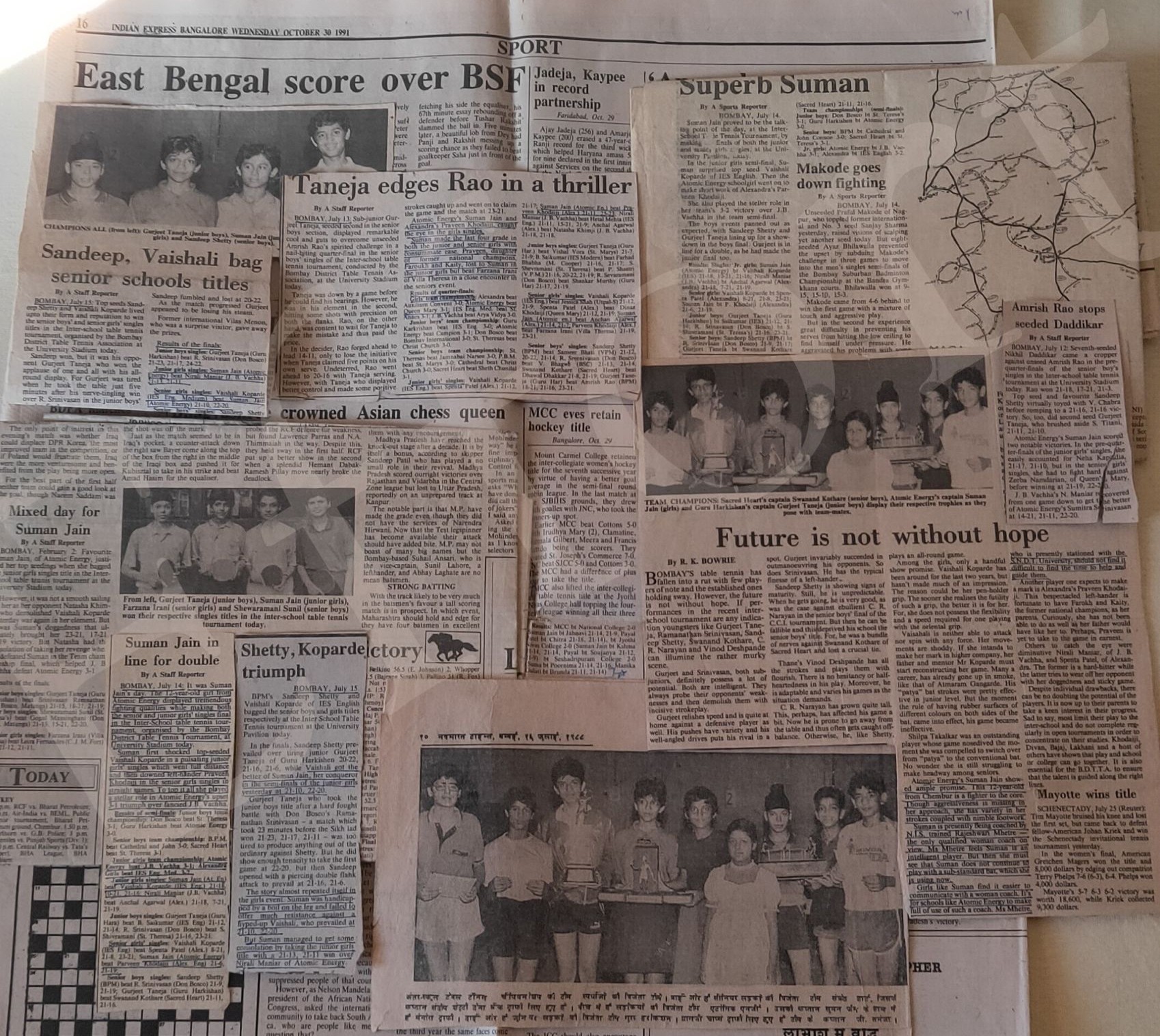
Sport gave that energy another direction. Around Grade 4, she began playing table tennis at home with her brother, using the dining table. What began as something informal gradually became competitive. By Grade 6, she had been selected by her school to compete at city level. Her first official attempt took her to the state level, where she lost. The result did not end her interest. She practised more, returned the following year with greater familiarity, and was selected to represent Maharashtra U-12 at the national level in Delhi.
That trip was also her first visit to Delhi. She was trained by Mrs. Rajeshwari Mhetre for some time and returned the following year again, representing Maharashtra U-14 once more in table tennis. She remembers those years with particular affection. She enjoyed the sport itself, but she also remembers the people she met. One table tennis acquaintance from that period has survived all these years. She says that the person is still connected with her on Facebook and, interestingly, is the only person from that time with whom she remains connected there. It is a small memory, but one that has remained attached to those early years.
Badminton became another part of her school years. She reached the state level there too, although she did not go further. Then came the National Cadet Corps. In Grade 8, she joined NCC and took the training seriously. She practised extensively and was selected for firing. In Grade 9, she attended the camps where selected students from different schools came together. Eventually, she was chosen to represent Maharashtra at the national level in Delhi for firing as well.
Delhi therefore entered her childhood through competition and effort. She went there twice through table tennis and again through NCC firing. She did not win in those competitions, yet she sees those experiences as victories, as she could participate at the national level and represent the state of Maharashtra. In table tennis, she remembers reaching roughly the top ten or twelve in her first year U-12, while the following year brought a different result. Participating in firing at the national level also ended without a win. Yet none of this stopped her from taking part, feeling curious, excited, and enthusiastic.
“Leaving what is familiar is never easy, but sometimes one difficult goodbye makes room for a life that could not have been imagined before. "
Phase 2 : When Home Changed, So Did the Horizon
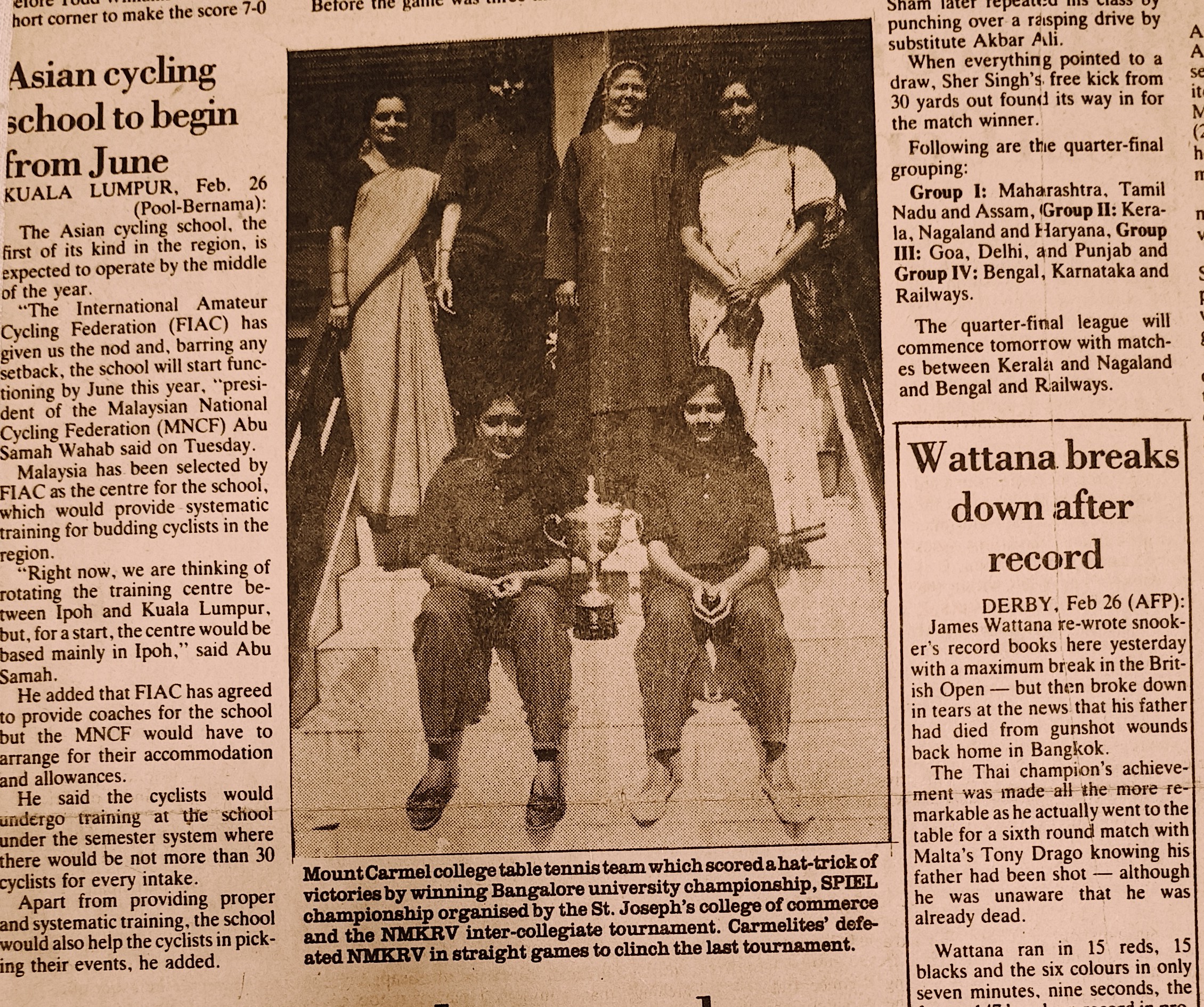
After Grade 10, life stopped feeling as familiar as it had in Anushakti Nagar. Her mother left for Germany to work, while Dr. Suman Lederer moved to Bengaluru to continue her education. She went to stay with her mother’s sister and her family, who became her guardians while she joined Mount Carmel College for Grades 11 and 12. She lived in the hostel, although even that did not happen immediately because there was no room available at first. A few months later, she was able to move into the hostel and continue her studies from there. In the beginning, she tried to continue playing Table Tennis, but due to all the changes in her life, as well as her studies, it was not sustainable.
Bengaluru was already a considerable change from the home she had known. After completing Grade 12, she joined an engineering college there and began another stage of her education. On paper, it was a sensible continuation of her studies. Personally, however, things were not working out as she had hoped. She was living away from her family, first in one arrangement and then another. The place where she stayed as a paying guest did not work well, and moving in with a few other students did not solve the problem either. Her friends tried to support her the best way they could within their own realities. She was facing a number of difficulties at a young age, while her mother was in Germany and her brother was living in another city. The family was spread across different places, and the distance was becoming difficult for everyone.
Her mother eventually asked a simple question that opened an entirely different possibility: would she like to come to Germany? Dr. Suman had only just started engineering, and she knew that stopping a degree, although not going too well due to the circumstances, and leaving the country was not something commonly done in India at the time. Still, she was around eighteen or nineteen, and the idea did not frighten her into refusing it. Instead, she considered it. “Why not?” became the thought that allowed the next decision to take shape.
The move could not happen overnight. There were official formalities to complete, and her mother told her to begin learning German. She joined Max Mueller Bhavan in Bengaluru for an intensive ten-week course. She had barely reached the fourth or fifth week when her mother called with news that the arrangements were ready. She needed to travel to Bombay, go to the German consulate, complete the necessary process, and then make her way to Germany. The language course stopped there. Her engineering studies had already been left behind, and now another part of her life was being set aside too. She was leaving India without knowing exactly what the next years would look like.
Germany presented its own immediate challenge. She had started learning German, but what she knew was nowhere near enough to live, study, and communicate fluently in the country. After arriving, she joined another intensive course in Mannheim at the Goethe Institute. She then entered a preparatory programme designed for students who wanted to pursue a degree at the university. It was not simply a language course. The programme combined German with different subjects so that students could eventually follow university studies in the language. For someone who had arrived with only a beginning knowledge of German, it meant learning how to function academically as well as linguistically in a completely new environment.
She adapted faster than she had expected. Living in Germany meant being surrounded by German every day, and the language began to come naturally through constant use. Her ability to speak Hindi gave her an additional role to play, while her rapidly improving German opened doors that would have remained closed without the language.
“A new country teaches more than a new language; it teaches the quiet confidence of knowing that you can find your way.”
Phase 3 : Finding Her Own Way in Germany

Once Dr. Suman Lederer could communicate fluently, she began taking on work as a translator and interpreter at German courts and official authorities. Speaking Hindi and quickly developing her German gave her an opportunity to work with people in situations that required trust, clarity, and the ability to move comfortably between languages. She was very impressed by the high quality and structure of German spoken in the legal courts.
Her professional life in Germany began in a rather unusual way. Instead of entering one company and remaining there, she took short-term assignments in sales. Some lasted two months, others six months, nine months, or even a year. She was not tied to one employer or one workplace. Every assignment placed her somewhere different, with different people and different working dynamics. At first, this could simply have been a way to earn a living, but she came to appreciate what it gave her. Each new workplace meant another group of people to understand, another environment in which to communicate, and another set of expectations to figure out.
She remembers this period as a particularly enjoyable one. Sales meant talking to people, and she liked that part of it. The short assignments also meant that she was constantly meeting people she had not known before. No two places were the same. The work required her to adjust quickly, and that became part of her everyday life.
There was also a growing sense of independence outside work. Within her first six months in Germany, she learned to drive and obtained her first driving licence there. Her mother bought her a second-hand car, a vehicle that was already more than twenty years old. To someone else, it might not have seemed particularly remarkable. To her, it meant freedom. Having her own car allowed her to move around more easily, take on work in different cities, and manage her own life without depending on someone else for every journey.
She was living by herself, working, travelling between cities, and gradually becoming comfortable with the practical responsibilities of adult life. She travelled to different parts of Germany and met many different people through her assignments. There was a sense of excitement in being able to decide where she went and what she did.
She had come to Germany because circumstances had pushed open an unexpected door. Now, she was beginning to discover what she could do once she was on the other side of it.
Two words came to mind when Dr. Suman thought about her first income : independent and free. Earning money for the first time gave her a strong sense of independence. It was not about the amount, but about knowing that she had earned it herself. Having the freedom to support herself and make her own decisions became deeply important to her.
Note of Thanks
There are people whose contribution to a professional life cannot be measured by a title or a single moment. For Dr. Suman Lederer, gratitude belongs to the many people who shared their knowledge, gave her responsibility, answered her questions, and allowed her to learn through experience.
She remembers her supervisors with particular appreciation because each one possessed different skills and expertise. Her early sales work introduced her to the practical side of working with people. At L’Oréal, she learned from a supervisor in the IT department despite coming from a non-IT background, while her work in logistics taught her to enter an unfamiliar task and work it out independently. At HOCHTIEF, the guidance of two supervisors in Market Development and Relations added another perspective to her professional understanding.
Her gratitude also extends to her late former boss at UNIDO, who shaped her approach to research and writing. One of her earliest supervisors had a highly structured way of thinking and an extensive collection of research material. Preparing new papers, as well as completing the backlog, gave Dr. Suman valuable experience that stayed with her in the years that followed. She also has good memories of her bosses from Austria, Peru and Sweden, whom she had worked with later.
She also acknowledges the students and fellow lecturers who have made teaching such a rewarding part of her professional life. The students, in particular, have often required her to reconsider how she explains, teaches, and challenges them. The international lecturers, staff of the international departments, and management she met through universities in Europe, especially in Lisbon and Paris, and elsewhere, also became part of an exchange that continued beyond physical classrooms through early online teaching.
Her thanks finally extend to the family members who made it possible for her to accept work, teaching responsibilities, and travel with greater confidence. Their support gave her the freedom to pursue opportunities while continuing to care for the life she was building at home, with a big thanks to her son, who has always supported her work and studies in the best possible way.
For Dr. Suman, perhaps the simplest way to express that gratitude is through her own belief that she was fortunate to have worked with and “learned from not one or two, but several intelligent and hard-working persons” over the course of her life.
In the end, she returns to a line she would like to quote from Descartes: “I think, therefore, I am.” And she remains open to what the real universe has in store for her.
thanks,
– Dr. (H.C.) Suman Lederer

AIMLAY is a leading global education platform empowering ACADEMIC and EXPERIENTIAL learners, uniquely focused on recognizing knowledge gained through experience and building a diversified community of doctorates and aspiring researchers.