
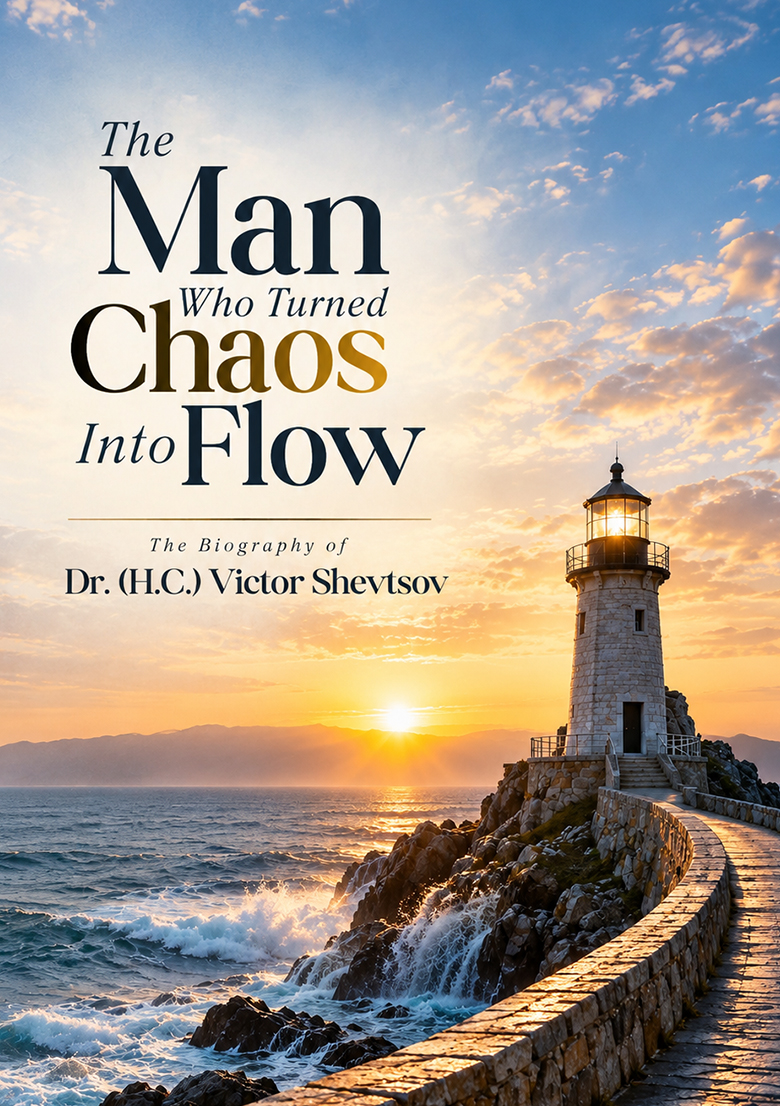
"He boy who kept starting over learned the greatest lesson of all : you don’t need a straight road. You need the courage to build one."
Introduction
A global supply chain rarely announces its difficulties one at a time. A shortage in one market can affect production elsewhere. A delay in transportation can disturb inventories, customer service, and working capital. New technology may offer an answer, yet its value depends on whether people understand how to use it. For Dr. Victor Shevtsov, leading such systems has required more than technical knowledge. It has demanded clear priorities, informed decisions, prepared teams, and the ability to connect separate operations to a common purpose.
His understanding of change began long before he entered corporate life. Born in Moscow on 7 September 1970, he spent much of his childhood moving across the former Soviet Union because his father, Anatoly Aleksandrovich Shevtsov, served in the military. By the eighth grade, he was attending his eighth school. Each relocation brought another environment to understand, and the repeated experience taught him to adjust without losing focus.
Sport added a different form of preparation. From approximately the age of ten until twenty-six, he practised judo at a professional level and became a champion of the Russian Republic. Training showed him that performance was not determined by talent alone. Organisation, discipline, tactics, and preparation could enable a person to reach results that initially seemed beyond expectation. That understanding would later influence the way he approached factories, teams, and complex transformation programmes.
Technical education gave him another foundation. He studied Radio Engineering at the Moscow State Institute of Radio Engineering, Electronics and Automation, graduating in 1996 with honours. Work in scientific and engineering settings strengthened his interest in solutions that were reliable, useful, and no more complicated than necessary. His grandfather, an aircraft-engine manufacturer, reinforced the importance of learning throughout one’s working life. The progression of engineering from basic engines to propeller and jet technologies showed Dr. Victor why professional knowledge could never remain fixed.
When he entered PepsiCo, he did not begin at the top of the supply chain. His responsibilities developed through sales coordination, shipments, planning, logistics, procurement, and production. This progression allowed him to understand how individual functions affect one another before he received responsibility for complete operations. Leadership of plants in Sochi and Moscow was followed by wider responsibility across Russia, Belarus, and the CIS. Manufacturing growth, logistics restructuring, investment projects, acquisitions, customer service, and cost management became part of a much larger operational picture.
His work later moved beyond national operations. Across PepsiCo Europe and South Africa, he dealt with multiple product categories, manufacturing locations, franchise bottlers, contract manufacturers, capital planning, and organisational transformation. The scale changed, but one principle remained consistent: results depended on identifying the actions that genuinely influenced performance and directing resources towards them.
A new chapter began at Carlsberg Group in 2015. Working across Asia and Africa, he was responsible for a network of breweries, distribution centres, co-manufacturing facilities, and licensed operations. Different local practices had to be connected without ignoring the conditions of individual markets. Common performance measures, Lean and TPM programmes, S&OP, network planning, safety, technology, and talent development became parts of the regional transformation.
"Every new place asked him to adapt, but none could take away his sense of direction."
Phase 1: A Childhood Across Changing Horizons
Long before Dr. Victor Shevtsov began working across countries and cultures, change was already a regular part of his life. He was born in Moscow, USSR, on 7 September 1970, to Anatoly Aleksandrovich Shevtsov and Tatiana Vikotova Shevtsova. His father served in the military, and the responsibilities of that profession required the family to travel continually. Home was therefore not limited to one city or region during his early years.
Until he was approximately twelve years old, the family moved to a new location almost every year. Their movements took them through different parts of the former Soviet Union, from the north to the south and from the east and Far East to the west. These were not occasional holidays or brief visits. Each move meant entering another environment and continuing everyday life among different people.
The number of schools he attended gives a clear measure of how frequently those changes occurred. By the time he reached the eighth grade, he was studying at his eighth school. A new school required him to enter another established setting, understand how it operated, and continue his education despite the change around him. Before completing even the early part of his schooling, he had already repeated that process several times.
Frequent relocation placed flexibility at the centre of his upbringing. He could not depend upon one familiar school, one neighbourhood, or one fixed social environment. Instead, he had to continue adapting as the family moved from one part of the country to another. The surroundings changed, the people changed, and the local environment changed, but his need to continue learning remained.
He learned to enter a new environment without treating unfamiliarity as a reason to stop. Moving regularly also exposed him to people whose backgrounds and daily surroundings differed from those he had known elsewhere. His understanding of the former Soviet Union was formed through living in its different regions rather than knowing it from a single location.
The experience gave him an early awareness that one approach could not simply be carried unchanged into every setting. Each place had to be understood as it was. That did not require him to abandon his own direction. It required him to recognise the environment, adjust where necessary, and continue moving forward.
This distinction became important in how he later described himself. Flexibility did not mean losing concentration whenever circumstances changed. Adaptability and focus existed together. He became accustomed to responding to the environment while remaining attentive to what needed to be done. In his own words, “It is difficult to distract me from something.”
"Discipline turns effort into preparation, and preparation gives ambition a real chance to succeed."
Phase 2 : Sixteen Years on the Judo Mat
At approximately ten years of age, Dr. Victor began a sporting pursuit that would continue for the next sixteen years. Judo became a serious part of his life, extending through childhood, education, and the early years of adulthood. He trained at a professional level until the age of twenty-six and reached the distinction of becoming a Champion of the Russian Republic.
The length of this involvement mattered as much as the title he achieved. Sixteen years allowed him to experience the complete course of a competitive sporting career. He began without standing or distinction, progressed through sustained training, reached the highest point of his performance, and eventually came to understand that every sporting career has a limited duration.
He later described sport as a small model of human life. An athlete starts from the beginning, develops through effort, approaches the peak of performance, and then gradually moves beyond that peak. In sport, however, these stages happen within a relatively short period. The compressed nature of that cycle made progress, achievement, and decline visible in a way that remained meaningful to him after his competitive years ended.
One tournament gave him a particularly direct lesson about standards. He finished in second place and was happy to receive a silver medal. His coach questioned why he was pleased. Dr. Victor answered that he had earned the silver medal and was number two.
His coach responded, “Number two is just first among the losers.”
The remark was severe, but its meaning stayed with him. Entering a competition was not simply a matter of taking part or being satisfied with a respectable position. Once a person chose to compete, the goal should be the strongest result that could be achieved. For Dr. Victor, the lesson was not that every situation would always end in victory. It was that the standard set before beginning would influence the preparation and effort that followed.
That distinction shaped the way he understood ambition. A person could recognise circumstances, limitations, and the relevant time horizon without lowering the purpose of the work from the beginning. The result might not always be first place, but the intention could still be directed towards the maximum attainable outcome. Settling too early could limit performance before the real test had begun.
Another lesson emerged from the structure of training itself. High-level performance could not be built through effort without direction. Training, tactics, and strategy had to work together. Physical preparation alone was insufficient if an athlete did not understand how to compete. Strategy alone also had little value without the discipline to prepare and apply it.
"Knowledge must keep moving forward, and leadership must sometimes act before certainty arrives."
Phase 3 : Engineering Honours and the Courage to Decide
While professional judo was teaching Dr. Victor how to prepare for demanding competition, technical education was training him to examine systems, understand their purpose, and solve …problems with precision. In 1987, he entered the Moscow State Institute of Radio Engineering, Electronics and Automation. He completed the full course of study in 1996, specialising in Radio Engineering and receiving the qualification of Radio Engineer.
Technical education was also connected to an influence that had been present much earlier in his life. His grandfather, who passed away several years ago, was a manufacturer of aircraft engines. Dr. Victor regarded him as the most important person in his life and the greatest influence on his general development, professional thinking, and approach to learning.
His grandfather’s career extended through major changes in aircraft technology. When he began working in the 1930s, the engines being built were comparatively basic. The field later moved towards more advanced propeller engines, and by the end of his career, he was working with jet engines. Each stage required knowledge that had not been sufficient for the one before it.
From that experience came a clear lesson. Remaining relevant in any profession required continuous learning. Earlier knowledge could provide a foundation, but it could not answer every future development. His grandfather explained that the specific field did not change this responsibility. Whether Dr. Victor eventually worked with spacecraft or produced Pepsi or Carlsberg products, he would still need to learn every day because progress would continue moving forward.
That advice stayed relevant as technology changed. It shaped his understanding that experience should not become an excuse to stop learning. A long career could remain useful only when the person continued developing with the work. Decades later, he applied the same idea to artificial intelligence, recognising that people who learned to use emerging tools could work differently from those who ignored them.
His academic training was followed by early work in scientific and engineering environments. He worked as a Research Engineer at the Russian Academy of Sciences, Institute of Space Research, during the period listed from 1994 to 1995. He then worked in the technical department of a Siemens joint venture from 1995 to 1996. These roles placed him in settings where ideas had to be converted into solutions that could function reliably.
During his association with the Space Research Institute, he met Soviet cosmonaut Alexei Leonov. Their interaction left Dr. Victor with lessons that he later used when guiding people in management roles. One concerned the design of technical systems. Leonov advised him not to overengineer what he was building. A solution needed to deliver what it was expected to deliver, but it should remain as simple as possible.
Note of Thanks
Dr. Victor offers his sincere thanks to the people who have shared in the different stages of his personal and professional life. Every responsibility he accepted was connected with family members, teachers, managers, colleagues, employees, and partners whose presence contributed to the work recorded in these pages.
He remembers his parents, Anatoly Aleksandrovich Shevtsov and Tatiana Vikotova Shevtsov, and respectfully acknowledges his late grandfather, whose example as an aircraft-engine designer shaped his belief in continuous learning. He also remains thankful for the coach who guided him during his sixteen years in judo and taught him to prepare for the strongest result.
His warmest thanks go to his wife, Tetyana, and children, Victor, Arina, Aksynia, and Vasilisa. Their place in his life extends beyond the professional responsibilities, international assignments, and corporate results described in this biography.
He acknowledges Duncan Monroe, Jim Costa, and Cees ’t Hart for the roles they played at important points in his career. Gratitude is also extended to Rajendra Gursahaney, Jeff Malcolm, Pete Ernsting, Chris Warmoth, Graham Fewkes, Roland Lawrense Tobias Wetzel, Thomas Hollnberger, and James J. Costa for their professional association, trust, cooperation, and considered assessments of his work.
Dr. Victor further thanks the teams he led across PepsiCo and Carlsberg Group. The improvements achieved across plants, markets, regions, and global operations depended upon people who accepted demanding goals, developed new capabilities, worked across functions, and carried responsibility at every level.
To everyone who offered knowledge, opportunity, honest challenge, practical cooperation, or support, he extends his lasting appreciation. Their contributions remain an inseparable part of this account.
thanks,
– Dr. (H.C.) Victor Shevtsov

AIMLAY is a leading global education platform empowering ACADEMIC and EXPERIENTIAL learners, uniquely focused on recognizing knowledge gained through experience and building a diversified community of doctorates and aspiring researchers.