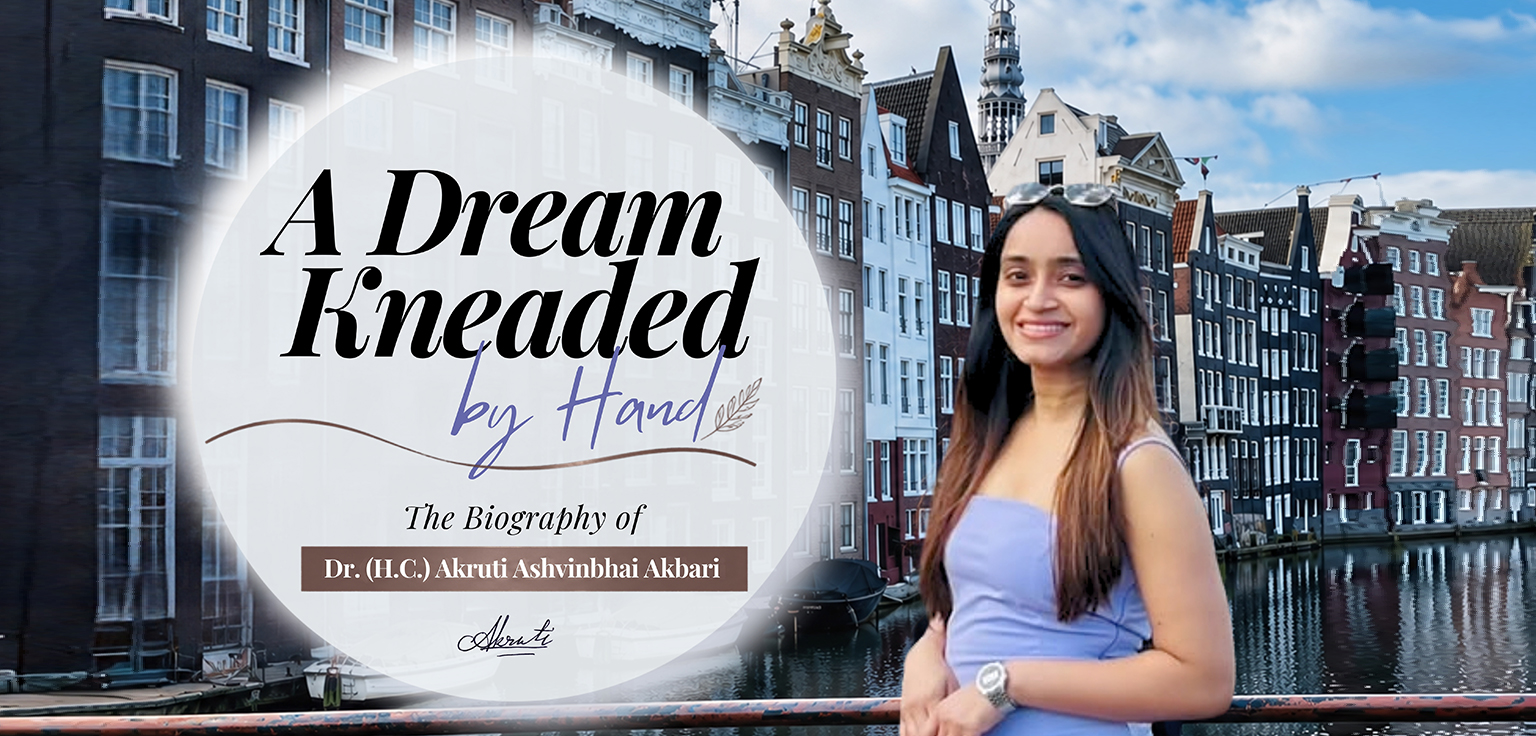

"Some forms of growth are measured not by how loudly a person speaks, but by how carefully she chooses what deserves her attention."
Introduction
Born on 18 April 1998, Dr. Akruti Ashvinbhai Akbari grew up within a family that gave her room to make choices while remaining closely connected to those who supported her. Her father, Ashvinbhai Devrajbhai Akbari, encouraged her to try without allowing the possibility of failure to stop her. Her mother, Sarojben Ashvinbhai Akbari, offered the emotional understanding that made open conversation possible. Alongside them was her younger brother, Utsav, whose own studies and business activities formed another part of a family environment shaped by education and enterprise.
Naturally introverted, Dr. Akruti did not depend upon a large social circle. The friendships she formed, however, remained meaningful and continued across distance. Her principal from Class 12 also became a trusted source of guidance, someone she could approach when she needed advice. Outside formal study, her interests included rifle shooting, watching films, and reading books about business and habits. These activities reflected different sides of her personality, from quiet observation to the focus required to pursue an individual interest.
Business had attracted her attention from an early stage. She wanted to establish a company of her own and therefore chose commerce rather than science or the arts. Economics particularly interested her, and reading newspapers helped sustain that curiosity. Her academic foundation took shape through a Bachelor of Commerce from Veer Narmad South Gujarat University in Surat. She completed the Special External programme in June 2018, with Advanced Accounting and Auditing as her special subject. The degree was formally conferred on 26 February 2019.
Her father’s association with an event company and production house later influenced another educational decision. Dr. Akruti moved to Ahmedabad to study event management, where learning extended into practical responsibility. She became involved in celebrity events, corporate programmes, marriages, and large weddings conducted in Ahmedabad, Rajasthan, and Chennai. The experience introduced her to the demands of planning, coordination, and working with people in situations where details mattered.
A desire to study further eventually took her to London. She regarded the decision to pursue education abroad as a defining change in her life. Her studies there focused on finance and economics, including accounting and finance. The move also required adjustment beyond the classroom. She had to use public transportation, live in shared accommodation, manage unfamiliar weather, and learn how to connect with people in a different environment. During four years in London, she gradually learned to manage shared living and unfamiliar social expectations
Living abroad also changed the way she understood people. Having grown up in a protected environment, she initially expected goodwill from everyone. Experiences of betrayal taught her to observe behaviour more carefully and deal with different personalities without abandoning her own values. Friends and colleagues offered practical guidance, helping her adjust to the expectations of daily life and work.
Her professional development began with a one-year position at Tesco, where she worked in human resources and administration. Her responsibilities included interviewing people, supporting their entry into the workplace, and providing training. The job also brought demanding schedules, including late shifts followed by a lengthy return home. It taught her to manage responsibility within circumstances that were new to her.
"Just try; if you fail, you fail, but just try. Don’t give up."
Phase 1: A Home That Allowed Her to Choose
Born on 18 April 1998, Dr. Akruti Ashvinbhai Akbari was brought up in Rajkot within a family that combined close personal bonds with the freedom to make individual choices. She was introverted by nature and did not always express herself easily to everyone. At home, however, her personality was understood rather than treated as something that needed to be changed.
Her father, Ashvinbhai Devrajbhai Akbari, was associated with an event company and a production house. His professional background meant that business was already a visible part of family life. More important to Dr. Akruti, however, was the way he approached her choices.
From her perspective, young women around her were not always given the same independence as young men. Some were expected to return home early, avoid certain activities, or remain within tightly defined limits. Her experience with her father was different. He did not impose those restrictions upon her. Instead, he trusted her to make decisions and supported her when she wanted to explore new possibilities. That trust became especially important as her academic plans grew and eventually required her to consider studying outside India.
The lesson he repeated was practical and direct. She should do her best, keep trying, and refuse to give up merely because success was uncertain. Failure, in his view, was not a reason to avoid making an attempt. This principle did not promise that every decision would produce the desired result. It placed value on effort, persistence, and the willingness to begin. His guidance gave her a straightforward way of approaching unfamiliar opportunities: assess what she wanted to do, make the effort, and accept that a setback could be part of trying.
Her relationship with her mother, Sarojben Ashvinbhai Akbari, offered a different form of support. While her father encouraged action and persistence, her mother became the person with whom she could first discuss personal matters. Dr. Akruti found it easier to share emotional concerns with her, especially when she needed understanding before deciding what to do next. Their connection gave her a dependable place for honest conversation.
This emotional availability mattered because being introverted affected the way she communicated. She was not naturally inclined to speak freely with everyone, and she took time to understand people. Her mother did not demand immediate explanations or push her toward a more outward personality. She remained supportive and listened when her daughter chose to speak. In this way, the family’s support was not limited to education or future plans. It also included acceptance of how Dr. Akruti related to others and processed personal experiences.
"Some forms of growth are measured not by how loudly a person speaks, but by how carefully she chooses what deserves her attention."
Phase 2 : Quiet Confidence Beyond the Classroom
School introduced Dr. Akruti to an environment where sporting activities received considerable encouragement. The institution supported participation in sports, but she did not develop a strong interest in the activities promoted there. She was clear about that difference and did not present herself as someone naturally drawn to every opportunity simply because it was available. Her school years were shaped more strongly by lasting friendships, personal observation, and the gradual discovery of interests that suited her temperament.
One of the most enduring aspects of those years was the group of friends she had known since approximately the first standard. The length of those relationships gave them a significance that extended beyond ordinary school companionship. They grew through the same educational period and remained connected even after their lives moved in different directions. Years later, she could still speak of those childhood friends as people who were doing well and remained part of her life.
Maintaining those friendships mattered because Dr. Akruti did not consider herself someone with a large social circle. She formed fewer connections, but the ones she retained continued over long periods. Some of her friends later moved to Canada, which changed the form of their communication without ending it. They remained supportive online, showing that distance did not remove the understanding already established between them.
Her reserved nature influenced the way she connected with others. She did not immediately become open or conversational in every setting, nor did she seek attention through constant social participation. People who knew her well learned to understand that her quietness was part of her personality. The friends who remained close did not require her to perform a more outgoing version of herself in order to belong. Their acceptance allowed the friendships to continue naturally.
The names associated with that circle include Surbhi, Ayushi, Khushboo, Yesha, Harsh, and Anand. Each belonged to a limited but valued group of people whom she chose to recognise in the account of her life. Their place was not based on the number of occasions they shared or on constant physical proximity. It rested on continued understanding, support, and the ability to remain connected as education and later responsibilities carried them to different places.
Although conventional school sports did not appeal to her, Dr. Akruti later became interested in rifle shooting. The distinction is important. Her lack of interest in the sports encouraged at school did not mean she rejected disciplined physical activities altogether. She simply found an activity that suited her after completing school. Rifle shooting became one of the interests she identified as her own, separate from the sporting culture she had encountered as a student.
Her other hobbies were quieter and more closely connected with reflection. She watched movies and sometimes read books about business and habits. These were not presented as formal sources of qualification. They were activities she selected during her own time. Reading about business was especially consistent with an interest that would later influence her academic choices, although at this stage it remained an area of curiosity rather than a defined professional plan.
"From childhood, I wanted to do business. I want my own company."
Phase 3 : Commerce as a Route to Enterprise
By the time Dr. Akruti began considering the direction of her higher education, one preference was already clear. She wanted to understand business and eventually establish a company of her own. This was not a plan developed after entering employment or travelling abroad. It had been present from childhood and influenced the subjects she chose when the time came to move beyond school.
The available academic routes did not hold equal meaning for her. She did not want to enter science, nor did she feel drawn toward the arts. Painting, writing, and other areas she associated with that field did not match her interests. Commerce offered a more relevant direction because it brought her closer to business, accounting, finance, and the practical knowledge connected with running an organisation. Her choice was therefore based on a clear preference rather than on uncertainty about what to study.
Economics became one of the subjects that interested her most. She was curious about it and maintained that interest by reading newspapers. This habit gave her another way to engage with economic matters outside formal lessons. She did not describe newspaper reading as a specialised academic exercise. It was a regular means of following a subject she already found engaging and wanted to understand more fully.
Her decision to study commerce gave that curiosity a formal structure. She enrolled in the Bachelor of Commerce programme at Veer Narmad South Gujarat University in Surat. The programme was identified as Special External, a detail recorded as part of her qualification. It allowed her to pursue a recognised commerce degree while developing knowledge in a field aligned with her longer-term business ambition.
The degree included Advanced Accounting and Auditing as her special subject. This focus placed accuracy, financial records, and careful examination within her academic foundation. Although later employment would give these areas practical relevance, the Bachelor of Commerce marked their formal introduction into her educational development. She was learning within a discipline where figures, records, and accountability required sustained attention.
Dr. Akruti completed the programme in June 2018, receiving a Pass Class. Her Bachelor of Commerce was formally conferred on 26 February 2019 in Surat. The degree recorded her full name as Akbari Akruti Ashvinbhai, placing her family name first in the university’s format. It also recorded her father’s name as Ashvinbhai Devrajbhai Akbari. These details connected the qualification formally to the family whose encouragement had enabled her to continue her studies.
Completing the degree represented more than the addition of an academic credential. It confirmed that the choice made after school had been carried through to completion. She had selected commerce because it matched her interest in enterprise, then followed that decision through a programme centred on commercial and financial study. The qualification gave her a defined academic starting point without fixing the rest of her future into a single occupation.
Note of Thanks
Dr. Akruti extends her sincere gratitude to her parents, Ashvinbhai Devrajbhai Akbari and Sarojben Ashvinbhai Akbari, for giving her the freedom, confidence, and understanding needed to make independent choices. Their support remained constant as she continued her education, moved abroad, entered professional life, and began preparing for her own business.
She is equally thankful to her younger brother, Utsav, and to her cousins and other family members who encouraged her through different stages of her life. Their presence gave her a dependable circle of support while her responsibilities and surroundings continued to change.
Her appreciation also goes to her friends, Surbhi, Ayushi, Khushboo, Yesha, Harsh, and Anand. Whether near or separated by distance, they remained connected and understood her reserved personality without expecting her to change.
She gratefully acknowledges her teachers, her Class 12 principal, and the friends and colleagues whose guidance helped her adjust to life in London.
To every person who listened, advised, encouraged, and remained present, Dr. Akruti offers her heartfelt thanks.
thanks,
– Dr. (H. C.) Akruti Ashvinbhai Akbari

AIMLAY is a leading global education platform empowering ACADEMIC and EXPERIENTIAL learners, uniquely focused on recognizing knowledge gained through experience and building a diversified community of doctorates and aspiring researchers.