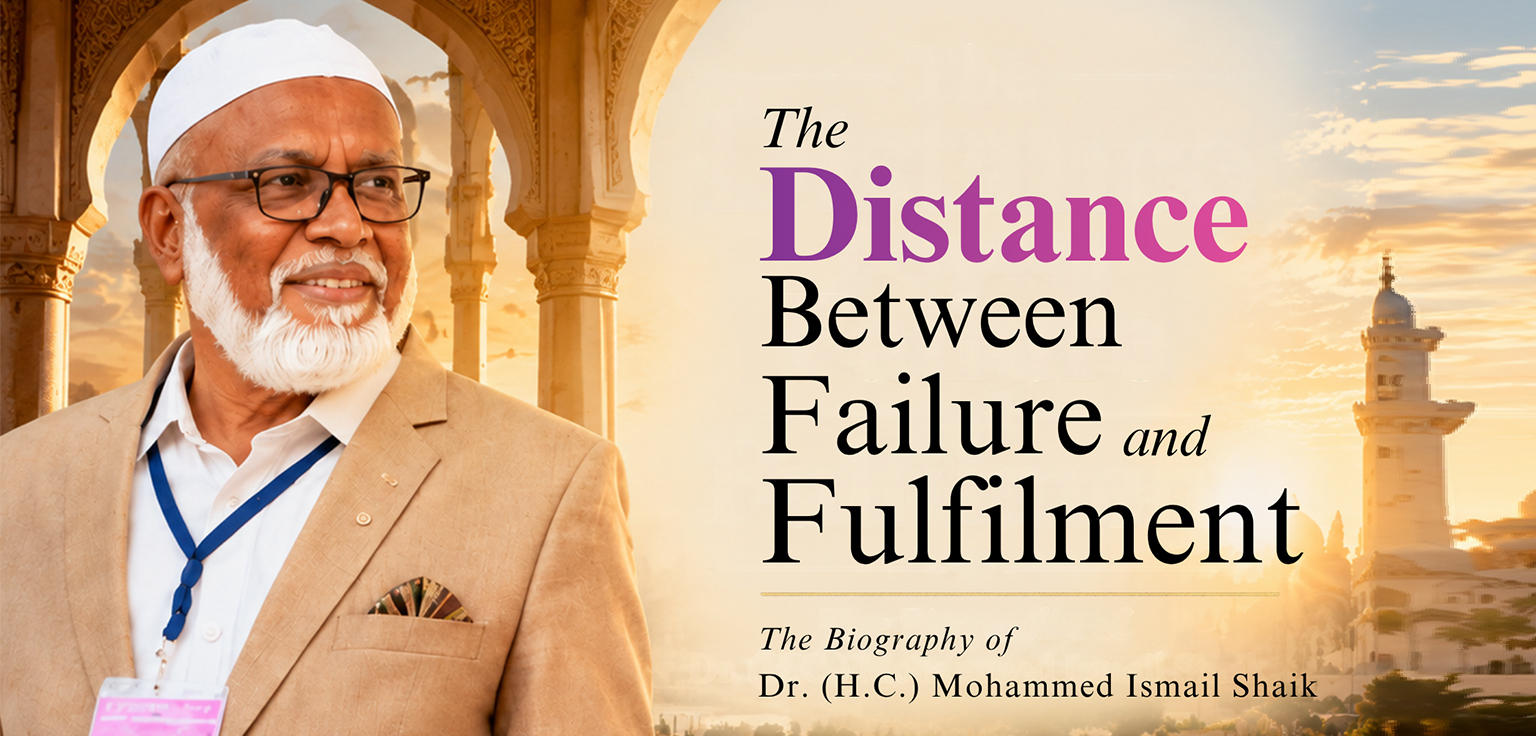
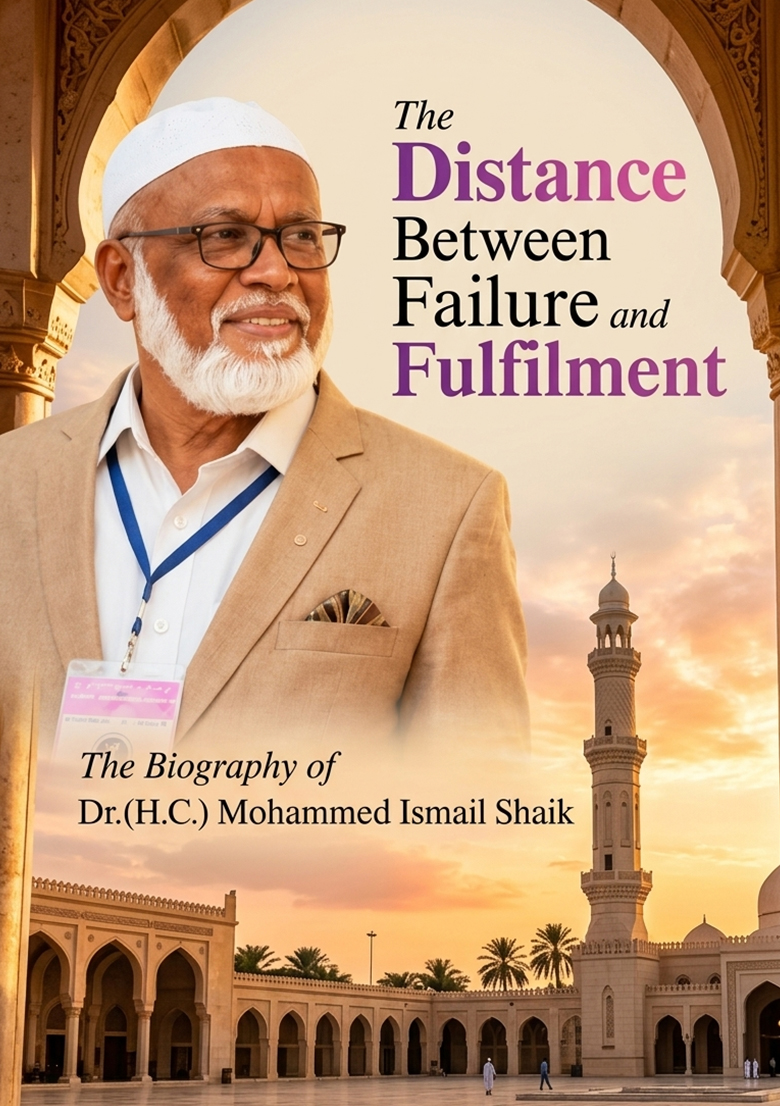
"Failure did not define my life. What mattered was how I kept learning, stood by my family, and remained useful to others."
Introduction
The life of Dr. Mohammed Ismail Shaik cannot be understood through qualifications and professional titles alone. Long before higher education and formal responsibility became part of his identity, he had already learned what work meant through everyday life beside his father. The family lived with limited means, and the cycle repair and rental shop became one of his earliest classrooms. From a young age, he learned to use his hands, accept responsibility, and understand that progress often begins with effort that receives little attention from others.
A difficult experience in school later changed the direction of his life. Failing two subjects in the tenth standard affected him deeply, especially when he regularly heard people speak proudly about the educational progress of their children. Instead of allowing that disappointment to settle into him, he used it as a reason to study with greater seriousness. Commerce became his academic starting point, followed over the years by studies in banking, English, personnel management, human resource management, and law. Learning remained important to him even while employment and family responsibilities demanded much of his time.
In 1987, he entered Life Insurance Corporation of India as a clerk. What followed was a professional life that extended across several decades and different postings. He took on administrative and customer related responsibilities that required accuracy, patience, and consistency. His work often placed him away from home, and some of the most important decisions he made were shaped not by promotion or income, but by his wish to remain close to his parents. Those choices carried professional consequences, yet family remained a responsibility he was unwilling to place second.
Outside the office, another side of his life gradually became equally visible. Education assistance for students, support for people facing financial hardship, help for prisoners, care for families in distress, and involvement with local religious and social institutions became part of his regular commitments. He preferred practical help that answered an immediate need, whether that meant paying school fees, arranging support for a grieving family, assisting a patient, or guiding someone through a difficult personal matter.
Retirement did not bring withdrawal. After completing a long career, he moved more actively into legal practice and community guidance. His legal education, completed years earlier, found a new purpose when he enrolled with the Bar Council and began practising. Alongside this, his religious studies and qualification as a Khazi gave him another way to assist families with marriage, divorce, and related concerns.
Through all these roles, one quality remains clear. Dr. Ismail has continued to see usefulness as more important than status. His life brings together work done by hand, formal education, public service, family responsibility, faith, and professional duty. The pages that follow trace how these different parts came together in a life shaped by persistence, personal choices, and a lasting desire to remain of help to others.
"Some of life’s strongest lessons are learned without a classroom, beside a workbench, through tired hands, small responsibilities, and the example of someone who never stopped working."
Phase 1: Raised Beside the Cycle Shop
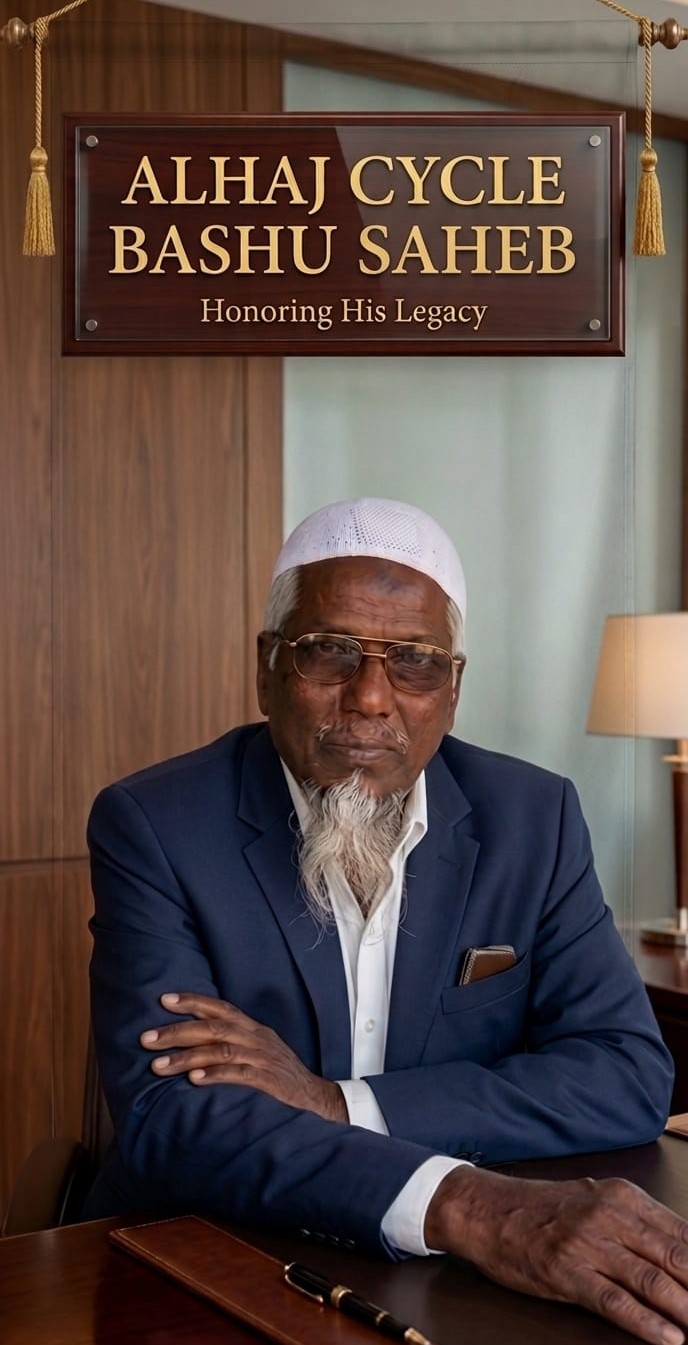
Dr. Mohammed Ismail Shaik was born on 2 February 1965 at around 8:40 PM, on an evening that remained memorable for his family. The crescent of Ramadan had been seen that night, and the following day was to be celebrated as Eid ul Fitr. His birth remained connected to a moment of faith and happiness, carrying a special memory that his family continued to cherish over the years.
Long before formal qualifications, professional responsibilities, or public recognition became part of his life, his understanding of work had already begun at home. His family lived with limited means, and earning a livelihood required steady effort. The person he watched most closely was his father, S. Mohiddin, locally known as Basha Bhai, whose own childhood had been marked by hardship. He had lost his parents when he was around seven years old and had grown up without the security that children normally expect from family. Relatives took him into their homes, but the experience was not always easy. Dr. Ismail remembered that his father was treated almost like a household boy in the homes of his maternal and paternal uncles. He worked in different ways simply to sustain himself until he was eventually able to build an independent livelihood.
That livelihood came through bicycles. His father operated a cycle repair shop and also kept bicycles that were given out on hire. At one point, there were around two dozen cycles available for customers. The shop was not merely a place of business. It was the centre of daily life for the family, particularly for young Mohammed Ismail. By about the age of five, he was already accompanying his father there and helping with whatever he could manage. Gradually, he learned how to repair cycles himself. The knowledge stayed with him so firmly that even many years later, he could still say with confidence that he knew how to repair a bicycle.
His curiosity did not stop with one skill. He became comfortable working with his hands and learned practical tasks that many people would normally call someone else to do. Electrical repairs, plumbing, basic masonry, and general repair work became things he was capable of handling for himself. He never viewed such work as beneath him. On the contrary, he described himself simply as a worker, someone willing to understand a problem and put his hands to it. This practical ability would remain part of his nature even when his life later moved into offices, academic study, law, and community responsibilities.
The bond between father and son was strengthened through those long hours together. The cycle rental business sometimes kept the shop open unusually late. Customers would hire bicycles to travel to evening cinema shows and return them after the second show, sometimes around one o’clock at night. His father would wait until the bicycles came back before closing. Mohammed Ismail often stayed with him through those hours. Their home was around three and a half kilometres from the shop, so after finishing the day, they would make their way home together and return the following morning again. The routine was demanding, but to him it became normal life rather than an unusual burden.
"There are disappointments that stay with us, not to weaken us, but to quietly change the standard we set for ourselves."
Phase 2 : The Failure That Refused to Define Him
There came a point in Dr. Mohammed Ismail Shaik’s school years when education stopped being something he simply had to complete and became something deeply personal. He had failed in two subjects in the tenth standard. For a young student, the result itself was difficult, but what stayed with him more strongly was what he heard around him afterward. People who came to the family’s shop would often speak proudly about their sons and daughters moving ahead in college and education. Their conversations were ordinary to them, yet they affected him in a very different way.
He remembered feeling ashamed when those conversations took place. It was not because anyone had given him a formal lecture about success or told him what he should become. The feeling came from comparison. Other parents seemed to have something to celebrate about their children, while he was carrying the disappointment of having failed. He heard these discussions repeatedly, and over time they created a determination within him that was much stronger than the disappointment itself. Rather than accepting the result as a measure of what he could achieve, he began thinking about how far he could still go.
That moment became one of the most important changes in his attitude toward education. He wanted to reach a level that people who knew him at that difficult point might never have expected. The desire was intensely personal. It was not only about obtaining marks. It was about proving to himself that one poor academic result did not have to decide the rest of his life.
He moved into commerce studies at the pre university level. He enrolled in the morning session at PU College and later attended the morning session at Degree College for his PUC and B.Com., as the timings suited the requirements of their shop. He successfully completed both PUC and B.Com. with Second Class marks without a single backlog. This progress gave him renewed confidence and encouraged him to continue pursuing further education.
His progress during those years was not something he credited entirely to himself. Two teachers remained particularly significant in his memory even many years later. One was a commerce lecturer whom he remembered with considerable gratitude. He associated much of his growth in commerce with the guidance and encouragement he received from this teacher.
The importance he gave to the guidance of his teachers reflected how he viewed education. Achievement, in his understanding, was rarely produced by one person alone. A capable teacher could change a student’s confidence and help reveal possibilities that once seemed distant. For someone who had already experienced an academic setback, finding teachers who could recognise his ability and encourage him mattered greatly. Commerce was no longer simply another subject to pass. It became an area where he could see his own potential.
Another lecturer also remained memorable for his talent and personality. He remembered the teacher as highly capable and personally impressive, while also recognising his strong and confident nature. What stayed particularly vivid was the confidence with which the lecturer spoke about the number of commerce students across the district who had studied under him. The impression created by his teaching and personality remained with him for many years.
These two teachers held different places in his memory, yet both became connected with the period when commerce opened a new academic direction for him. Their guidance came at a time when encouragement carried special importance. The earlier failure had given him the determination to work harder, while their teaching helped him transform that effort into progress.
"Learning does not always happen when life is convenient. Sometimes it grows between office hours, family duties, unfinished plans, and the decision to keep going anyway."
Phase 3 : Earning a Living, Continuing to Learn
In 1987, Dr. Mohammed Ismail Shaik entered the Life Insurance Corporation of India as a clerk. Employment brought stability and responsibility, but it did not close the door on education. The appointment also changed how he felt his family was regarded within the wider family circle. Yet entering salaried employment did not separate him from the work he had grown up doing. On holidays, he continued going to the cycle shop, repairing bicycles and attending to customers who came specifically to him. Instead, work and study began to run alongside each other. He had already learned that progress did not always arrive in a neat sequence, and he was willing to continue learning while carrying the demands of a full professional life.
Soon after joining LIC, he turned his attention toward postgraduate education. His first master’s qualification was an M.Com. from Karnatak University, Dharwad, which he completed in 1990. His studies were connected with banking and finance, an area closely related to the kind of discipline and numerical accuracy that would later become useful in his professional responsibilities. Although it was a two year programme, completing it alongside employment took him about three years. Even so, he did not abandon it. He stayed with the programme until it was finished.
Once the M.Com. was complete, his interest moved beyond commerce. He pursued an M.A. in English from Manonmaniam Sundaranar University, Tirunelveli, completing the degree in 2002 in Second Class. Choosing English after commerce showed that he did not limit education to a single professional requirement. He was willing to study an entirely different field simply because learning itself had become important to him.
Law became another serious interest. Around 1990, he took admission to an LL.B. programme. Unlike some of his other courses, this qualification could not be completed within the expected period because transfers connected with his employment interrupted the continuity of study and made attendance difficult. The qualification therefore took longer, but he eventually completed the LL.B. (Special) through Gulbarga University in 2001.
His next academic interest moved toward people and organisations. He completed a Post Graduate Diploma in Personnel Management through the Institute of Advanced Studies in Education, Sardarshahr, Rajasthan, earning First Division. His studies included areas such as organisational effectiveness, human resource information systems, business environment, and communication. The programme added another dimension to what he was already experiencing in institutional work. Rather than knowing only the financial or administrative side of employment, he was also developing an understanding of how organisations function through people.
He continued in the same direction with an MBA in Human Resource Management at the same institution. Subjects such as personnel policies, industrial relations, organisational development, and business environment formed part of that study. He completed the programme in First Division. The sequence was meaningful because the diploma and MBA were connected rather than isolated qualifications. Both dealt with workplace systems, employee relations, administration, and the human side of an organisation.
Note of Thanks
Dr. Mohammed Ismail Shaik holds sincere gratitude for the people whose presence, guidance, and encouragement have accompanied him through different periods of his life.
His deepest appreciation belongs to his parents. The values they gave him through their own lives became a lasting foundation for his sense of responsibility, discipline, faith, and commitment to family. Their influence remained with him through education, professional responsibilities, difficult decisions, and the years that followed. He is equally thankful to his spouse, brothers, sister, and children, whose companionship gave meaning to both challenging times and moments of happiness.
He has not forgotten the teachers who saw something in him before he saw it in himself. They steadied him, encouraged him, and helped him understand commerce in ways that stayed with him. Their belief carried him further than they may ever know.
His gratitude extends to the colleagues and associates he came to know during his long service with the Life Insurance Corporation of India. Their cooperation, friendship, and willingness to support one another made demanding responsibilities easier to carry. The professional relationships formed over those years continued to hold value even after his retirement.
He is equally thankful to everyone who worked beside him in social and community service, particularly through Safa Baitulmaal Educational and Welfare Trust and other local institutions. The ability to serve students, families, patients, prisoners, and people facing hardship was made possible through shared effort rather than the work of one person alone.
To his teachers, colleagues, friends, family members, and community associates, Dr. Ismail offers heartfelt thanks. Each, in a different way, became part of the life he built and the service he continues to give.
thanks,
– Dr. Mohammed Ismail Shaik

AIMLAY is a leading global education platform empowering ACADEMIC and EXPERIENTIAL learners, uniquely focused on recognizing knowledge gained through experience and building a diversified community of doctorates and aspiring researchers.