
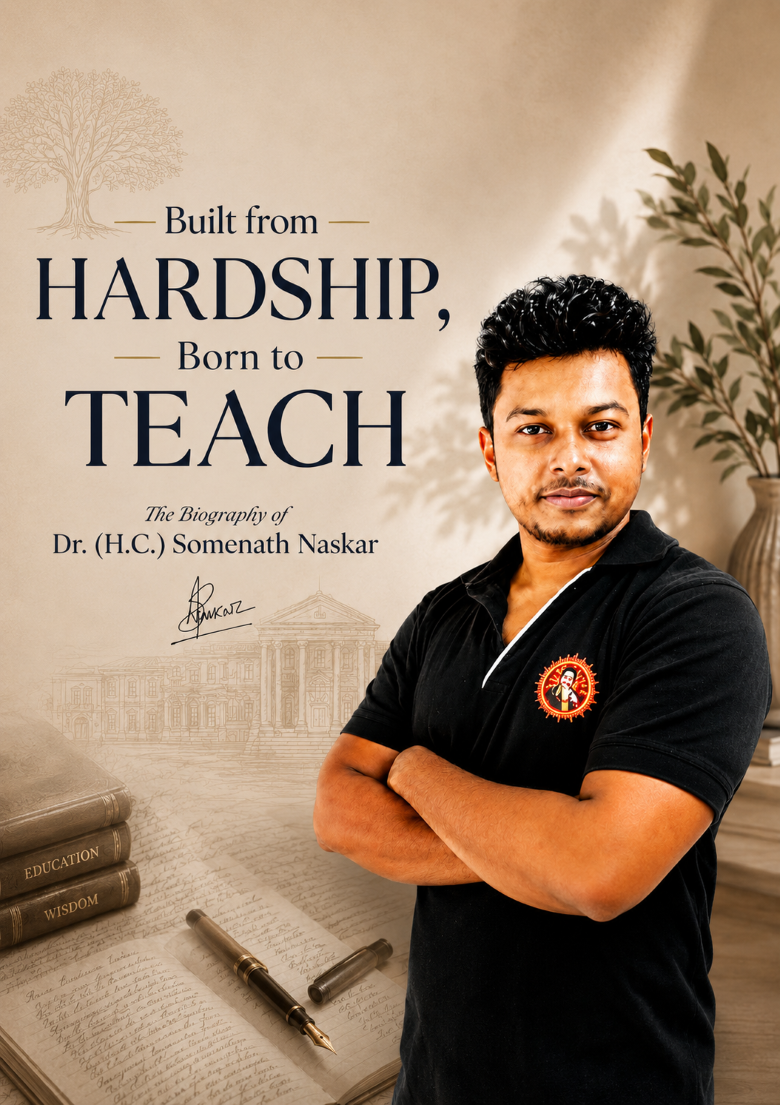
“Even the simplest start can hold a depth that only time reveals.”
Introduction
Dr. Somenath Naskar’s story begins in the quiet corners of life, where obstacles were a familiar presence long before success ever knocked on his door. Born on 5 October 1997, he grew up in a family that lived with limited means yet carried the quiet strength to keep going. His childhood was marked by rented living, a small home, difficult monsoon days, and parents who worked with honesty and sacrifice so that their son could study and move forward.
His early education began in a Bengali-medium school. It was not a privileged beginning, yet it gave him the first ground on which he started building himself. He was proficient in studies during his primary years, but as he moved ahead, his academic journey became difficult. The absence of proper guidance affected him deeply, especially in mathematics. There was a time when his confidence fell and his results suffered. Then a teacher whose belief and personal attention helped him rise again. That experience later became one of the reasons he understood how powerful the right teacher can be in a student’s life.
During every difficult period of his career, teaching was not only a source of income but also a reason to stand strong. When Covid affected offline tuition, he turned toward online teaching with whatever little he had. A phone, a small whiteboard, a tripod, scholarship money, and his mother’s support became the beginning of a larger dream.
From those modest beginnings grew Som’s Classroom, which later expanded into Som’s Classroom Educational Network. As its Founder and Academic Director, Dr. Somenath built a platform that reached students through YouTube, the Som’s Classroom App, live classes, recorded lessons, mock tests, study materials, books, and mentoring. His work has touched lakhs of learners and supported many students in achieving strong academic results.
Today, Dr. Somenath Naskar is known as an educator, author, digital creator, academic mentor, and edupreneur. Yet the heart of his journey remains simple. He knows what it means to study without enough resources, and he knows what guidance can do for a life.
This biography traces the making of a teacher who turned his own struggles into a mission for students who needed direction, confidence, and opportunity.
“There are childhoods that do not begin with comfort; they begin with struggle, and that struggle quietly becomes strength over time.”
Phase 1: A Childhood Shaped by Scarcity and Strength
Every life begins with a place, but some places leave a far deeper imprint than others. For Dr. Somenath Naskar, that place was Nimta, a locality in North 24 Parganas, West Bengal, where his story quietly began on 5 October 1997. When he looks back on those early years, it is not grand moments that return to him first. Instead, it is the ordinary scenes of daily life that remain etched in his memory. Those memories carry the simplicity of childhood, but they also reveal the realities that shaped his understanding of resilience from a very young age.
At the time of his birth, his family did not have a home of their own. They lived in a rented house, like many families striving to build a better future one day at a time. There was no certainty about what lay ahead, only the hope that life would gradually become more stable. His father worked in a factory where almirahs were manufactured. It was demanding work that required long hours, yet the income was modest and often insufficient to meet every need of the family. His mother contributed in her own way by working in other people’s homes, washing utensils and doing household chores. There was dignity in their labor, even though life rarely offered comfort.
After years of effort, his father was finally able to purchase a small house. It was far from luxurious, yet for the family, it represented something much greater than bricks and walls. It was the first place they could truly call their own. The house was modest in every sense, but it carried the dreams of two parents who had worked tirelessly to create a sense of permanence for their child.
Even then, life remained challenging. During the monsoon season, the house would fill with water. The flooding was not occasional. It became a familiar part of those rainy months. Dr. Somenath still remembers waking up to see water spreading across the floor until it reached beneath the bed. The family adapted as best they could. He, along with his parents, would sleep together on the bed while floodwater surrounded them below. For many children, such memories might have been frightening. For him, they became part of what he accepted as everyday life. He did not grow up measuring happiness through comfort. Instead, he learned that togetherness often mattered more than circumstances.
Looking back, those moments reveal something remarkable about his childhood. There was no sense of bitterness when he spoke about them. He recalled them honestly, almost as if they had become quiet reminders of where his journey truly began. The difficulties never erased the warmth of family life. Even in a house surrounded by floodwater, there was still the reassuring presence of his parents beside him.
The financial condition of the family influenced almost every aspect of life. Every expense had to be considered carefully. Every decision was shaped by necessity rather than convenience. Yet within those constraints, his parents never stopped valuing education. They understood that while they could not immediately change their circumstances, learning could open doors that had remained closed to them.
“A child learns to believe in himself first, in places where even basic learning feels like a small victory every single day.”
Phase 2 : The First Classroom and the Weight of Possibility
When Dr. Somenath Naskar was around five years old, his formal education began at Shyamaprasad Nagar Primary School. It was a Bengali medium school, and in many ways, it reflected the circumstances of his family at that time. His parents could not afford to admit him to an English-medium institution, so his earliest lessons unfolded in a modest local classroom where resources were limited, but his interest in learning began to take shape.
For a young child, school is often the first world beyond home. For Dr. Somenath, it became the place where he started discovering that studies could give him confidence. Although the school was not considered a strong or highly privileged institution, he did not allow that to define the quality of his own effort. He studied with sincerity and gradually became known as a good student. In those early years, he remained quick in learning and performed well among his classmates.
There was something natural in the way he connected with studies during his primary years. He was not pushed by comfort, private facilities, or expensive academic support. His growth came from attentiveness, discipline and a quiet desire to do well. The financial situation at home had already taught him that nothing came easily, and perhaps because of that, he treated learning with seriousness even as a child.
After completing his primary schooling up to Class 4, Dr. Somenath moved toward the next stage of education. Admission to high school was not automatic in the way he experienced it. He appeared for an admission test to enter the best Bengali medium school in the area where he lived. For a child coming from a modest primary school, this was an important step. It required confidence, preparation and the ability to prove himself beyond the limits of his previous environment.
He performed well in the admission test and secured admission. That moment held a quiet promise. It suggested that even though his beginnings had been limited, his ability was not. Entering a better school meant entering a wider academic space, one that carried more expectations and competition. For his family, it must have brought hope. For him, it opened a new phase where he would soon learn that talent alone is not always enough unless it is supported by the right guidance.
From Class 5 onward, the academic journey became more difficult. The shift from primary school to high school brought new subjects, greater pressure and a more demanding environment. The child who had once been fast in school now began to experience a decline in performance. He later described this period as a kind of degradation in his studies. It was not because he lacked ability. The difficulty came from not having access to proper teachers.
“Sometimes life sends the right person at the right moment, and that one presence changes the way everything is seen and understood.”
Phase 3 : When Struggle Met Guidance and Confidence Returned
As Dr. Somenath Naskar moved deeper into his school years, the transition from early promise to academic difficulty became more visible in his journey. The period from Class 5 onward did not unfold with the same ease he had once experienced in his primary education. Instead, it became a time where effort alone was not enough, and the absence of proper academic support began to weigh heavily on his performance.
During this phase, mathematics emerged as one of his greatest challenges. Without access to a strong mathematics teacher, the subject slowly turned into a barrier rather than a field of understanding. His father’s financial limitations made it difficult to arrange additional academic help, and as a result, he struggled to keep pace with the expectations of his class. This struggle eventually led to failure in mathematics, a moment that deeply affected his academic standing and confidence.
The decline in his performance was not sudden but gradual. Over time, his position in school reflected this shift, and he found himself placed in Section C among four sections. For a student who had once shown strong academic ability in his early years, this change carried emotional weight. It was not only about academic ranking but also about how quickly a student’s confidence can be shaped by results and environment.
Yet within this difficult phase, there was a turning point that would later define much of his outlook on education. In Class 8 or 9, he came into contact with Monoranjan Maiti Sir, a teacher who would play a crucial role in changing the direction of his academic journey. The influence of this teacher did not come through shortcuts or instant transformation. It came through consistent attention, belief and guidance at a time when Dr. Somenath needed it the most.
Under this guidance, something began to shift within him. The same student who had struggled to keep pace started to regain his connection with learning. The improvement was not limited to one subject. It reflected in his overall academic confidence. Slowly, he began to move out of the academic setback that had defined his middle school years.
One of the most significant signs of this change was his movement from Section C to Section A. This shift was not just a change in grouping. It represented a return of confidence, effort, and belief in his own abilities. The experience of being guided personally by a teacher, especially after a phase of struggle, left a lasting impression on him. It showed him how targeted support and individual attention could completely alter a student’s academic direction.
Note of Thanks
This biography of Dr. Somenath Naskar stands as a humble acknowledgement of the many hands, hearts, and silent sacrifices that shaped his journey. No success in his life belongs to him alone, for every step forward was supported by people who believed in him even when circumstances were difficult.
With deepest gratitude, he remembers his mother, Pranati Naskar, whose strength, sacrifice, and unconditional support became the foundation of his life. Her presence remained a guiding force through every struggle and achievement. He also holds the memory of his late father with profound respect, whose hard work and dedication created the early foundation of his education and future.
He expresses sincere appreciation for Ruma Bera, whose support during important phases of his life brought comfort and stability when it was most needed. He also acknowledges Monoranjan Maiti Sir, whose guidance and belief helped him regain confidence during his academic struggles and shaped his path as a learner.
With heartfelt respect, he also thanks his wife, whose encouragement and support strengthened him during later years of his journey. Above all, Dr. Somenath Naskar extends gratitude to every student who trusted him, learned from him, and became part of his educational mission, as well as to his team who stood beside him in building his vision into reality.
thanks,
– Dr. Somenath Naskar